
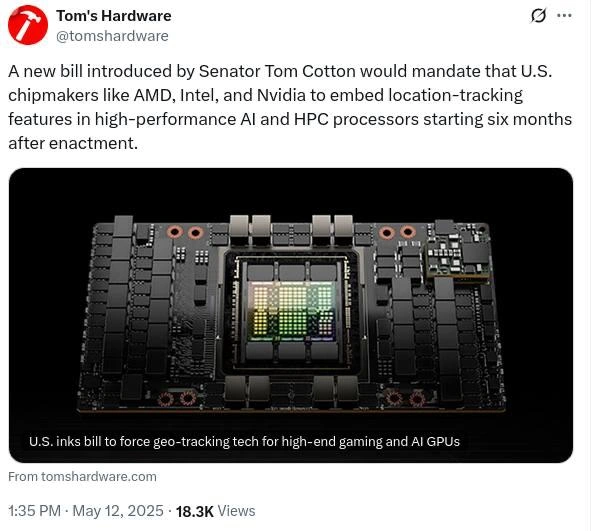
Bill wants AI GPUs to include geo-tracking - hardware offload for compliance nightmares
Description
Screenshot of a Tom’s Hardware tweet. The tweet text reads: “A new bill introduced by Senator Tom Cotton would mandate that U.S. chipmakers like AMD, Intel, and Nvidia to embed location-tracking features in high-performance AI and HPC processors starting six months after enactment.” Below the tweet is a website card showing a close-up render of a massive black PCB with a central GPU package filled with rainbow-colored cores; caption: “U.S. inks bill to force geo-tracking tech for high-end gaming and AI GPUs.” Tweet metadata at the bottom: “1:35 PM · May 12, 2025 · 18.3K Views.” Visually, it’s a standard Twitter post with Tom’s Hardware red logo avatar on a white background. Technically, the image alludes to government-mandated hardware telemetry baked into next-gen accelerators - raising concerns about supply-chain security, export-control enforcement, and yet another layer of opaque microcode senior engineers will have to audit (or ignore)

Comments
118Comment deleted
Great, now instead of just worrying about kernel panics we get to worry about kernel subpoenas - try sudo gpsctl --disable on THAT
Finally, a feature that lets your GPU phone home about its location while it's already phoning home about telemetry, crash reports, and driver updates. Now your H100 can tell the government exactly which data center rack it's mining crypto from instead of training your LLM
Nothing says 'land of the free' quite like your GPU phoning home to report its coordinates. I'm sure the performance overhead of mandatory geolocation will be negligible - just like how TSA security theater has zero impact on travel times. Can't wait for my next kernel panic to include GPS coordinates in the stack trace, really helps with debugging those shader compilation errors
Geo-tagged GPUs: when the RCA reads “cluster failed because device thinks it’s in the wrong country,” and the fix is adding continent to your Terraform modules plus a geo‑aware admission controller
Mandated telemetry etched in silicon: the ultimate supply-chain backdoor no zero-trust architecture can firewall
Can’t wait for the postmortem where half the training run dies because the new on‑die compliance attestor lost GPS in the colo, decided our H100s were in a sanctioned region, and tripped the export‑control kill switch
And how long until rendered meaningless? Comment deleted
Please, connect to the internet to activate your GPU 🤡🤡🤡 Comment deleted
"i'm sorry you got the gpu lite version you will be shown ads in your games made with ai on your own device" Comment deleted
South Park Season 1, Episode 1 "Cartman Gets an Anal Probe" (by extraterrestrials) Season 27, Episode 1 "Everyone Gets an Anal Probe" (by Nvidia and Starlink) Comment deleted
If they will block it in places like Russia and China - it is good imo Comment deleted
Good luck in tracking my location at home: the whole area is covered by GNSS jammer. Comment deleted
whatever, just make life harder for as much as possible, or maybe do white zones. Even if they will have to cover every user via GNSS jammer is already good. Makes spending resources and life harder. Comment deleted
It's called "jammer", but it's actually a spoofing device. • For example, in my location it fakes satellite almanachs, so that it apperars as there are plenty satellites in view, but you can't get even a 2D-fix, because advertised satellite positions are all fake. • In other locations, it emulates false location — cosistently across all emulated satellites of all existing systems (GPS, GLONASS, Beidu, Galileo). Good luck with white-listing, too! • It may also emulate a moving lication, not just stationary. As for the price of hardware, one doesn't need a military-grade jamming device that covers entire districts, if the target area is just a datacenter room (where those AI accelerators are usually placed) with virtually no external radio signal passing through the walls. I will not be surprised if a smaller spoofing device costs times less than a single AI accelerator card. And even if it costs like an entire AI server, then it's also worth it; just some extra money investment (that will retain its value many GPU generations after). Comment deleted
meh, good enough, still worth it Comment deleted
It's like with sanctions, minimum objective is to reduce capabilities as much as possible and increase costs overhead. Same logic Comment deleted
also, specifically in this case - they will not block you, but they will block a hundred people like you, but younger, who would like to dig into technology but can't cause of these complications, thus reducing country human potential, which is great (in this case) Comment deleted
How many young people, exactly, can afford even a single acceleration card like Nvidia H200 (worth $30k to $40k)? I would like to be among them! 🤑 Comment deleted
And if they can, they should be stopped from making bad financial decisions Comment deleted
young people? you mean google, openAI, mistrel… Comment deleted
I bought 64 core CPU for a project once, by the time I had the money for those things I had no energy or time to actually do something with it. Comment deleted
I feel it I’m feeling lucky to still have that energy AND drive to come up with new, even if sometimes silly things Comment deleted
Just don't look too deep into CPUs, Banking, networking and global powers/politicians. Comment deleted
Like, what the fuck is this. Since when is "reducing country human potential" a good thing? You're talking about limiting kids and aspiring engineers who have no political power. You aren't going to stop a state-sponsored mining farm, just gamers and AI researchers. Comment deleted
It is a pretty controversial opinion, explain yourself Comment deleted
Controversial for Russia, lol? I don't think that limiting technology access for Russia is controversial, given the war and annexations Comment deleted
What's so good about making private sector angry? Just makes their propaganda work better. Comment deleted
Tell me you're xenophobic without telling me you're xenophobic Comment deleted
Xenophobic is when you don't like foreigners. I like foreigners. I don't like countries that annex territory by waging aggressive wars in Europe. Such hate is normal, btw. I don't mind that a Russian will access technology if a the Russians live in the US. So I am hardly xenophobic. Comment deleted
Any other parts of the world are OK to wage wars in, I guess Comment deleted
Obviously I care about my home more and I will hate people who target me more. Nice whataboutism try, didn't worked. Comment deleted
You would be surprised, but I can agree on "you should not start a war without a proper jusus ad bellum" (the rest of my position should become obvious at this point) But I don't see how the hatred towards the general population will fix any of it Comment deleted
The population is responsible for their country. That's why Germany paid money for 3 generations. Comment deleted
I do understand that it is natural for Russian to try to avoid this responsibility, of course Comment deleted
The funniest thing is that the EU and US didn't annex anything after all the WW2 treaties. So even by this whataboutism Russia is still the only bad guy. But in general you are right, China did annex some stuff, so they deserve the same sentiment. Comment deleted
Which didn't stop them from killing innocent people in Belgrade, I guess Comment deleted
They didn't annex anything. So now it's calm there. It will not be calm if you annex shit. That's the difference Comment deleted
So the problem for you is the land, not the people's lives Comment deleted
No, the problem is what I wrote in my last message. Annexations are too problematic. Comment deleted
You are not hating on countries. You're promoting restrictions on people who live in those countries and don't have any political power. There's plenty of people in Russia who don't support the regime, but can't leave the country; I'm talking about minorities here, but also regular people who don't have economical resources (this is Russia, after all). You wouldn't tell a jew to "just leave Germany" in the Nazi times, and you wouldn't tell a gay person in Iran you're fine with limiting their access to information or resources. Comment deleted
You're overgeneralizing. If statistics says black people are more violent than white people, and you infer that black races are worse than white races, that's ridiculous and xenophobic. The right thing to do is to consider an individual's perspective and find the reasons for such a discrepancy, which will let you realize you're dealing with marginalization, not a body color-specific problem. Racism is easy, but only worsens the problem; an honest analysis uncovers an uncomfortable truth, but a truth nonetheless. Propaganda muddles the waters a bit. Many countries are taking a right-wind turn now because of that, and that sucks, but you wouldn't want to limit supplies to Americans and, idk, Germans because they're xenophobic. A specific person can be horrible, sure, but you'd also be harming tons of leftists, cutting off critical supplies to minorities, etc. If you dislike a country that wages a war, that's fine. Saying Russians caused this and attacking Russians in general is fine is xenophobic. An honest analysis would show that people are, on average, so poor that they can't make a tangible difference in economical power, yet along political power, and could not have been the root cause of the "war is good" sentiment. The core of the problem is the regime and its propaganda, and another core problem is people like you, who are making it unreasonably hard to leave the country. Comment deleted
I didn't annex shit mate Comment deleted
Well I am doing exactly what you suggested. What you said is not contradictory to what I said Comment deleted
No it's not. It's like hating on Nazis and waging sanctions and bombs on Germany in WW2. It's a good and moral thing Comment deleted
I don't agree with your opinion. Opposition to evil, like Russia in 2025, is fueled by hate and emotions. And practice over the history shows that it is not futile. Comment deleted
Lol, they are killing like million of people, annexing territory and ruining lives of 10s of millions. And yet in your head it is normal, but hating them for that is not normal? That some serious intellectual gymnastics, lol. Comment deleted
There is nothing wrong with hate towards the country for waging wars and annexations. It is normal. It is a tool of punishment through calls to action. Comment deleted
Typical Russian whataboutism. Literally a meme Comment deleted
If you annex shit it's not genocide resolution, it's a landgrab and you are evil Comment deleted
Vietnam war was after WW2 treaties , not before😂 Comment deleted
I don't agree here. Landgrab is more evil. It fuels conflicts for generations Comment deleted
Yes, that is enough, annexations breaking the safety net everybody created after WW2, fueling conflict for generations and all for personal gain. It is not remotely morally justified, like for example help to Kosovo and such by bombing Belgrade Comment deleted
so what about Yugoslavi ? Comment deleted
Anyone who annexed lands in Yugoslavia is as bad as Russia, I agree to apply the same logic there, no hypocrisy Comment deleted
Occupation and annexations lead to hate and conflict and death over generations of people. Comment deleted
Yes, exactly my point. Russia did care tho Comment deleted
let's just look at the actions of Europe/USA immediately after the war began: >closed the borders for ordinary citizens and small businesses of the Russian Federation, who were trying to get out of the country, but were forced to stay and thus work for the Russian economy, thereby helping Putin. >stopped selling goods to the Russian Federation, thereby upsetting the currency balance of supply and demand, which strengthened the ruble and helped Putin. >continued to buy oil, gas and other natural resources sold by Putin's friends, literally financing the war. >created crisis in the oil markets, causing a price jump and allowing Putin to earn even more. >supplied Ukraine with exactly as much weapons as it needed to hold its position, no more. >made a bunch of anti-Russian statements, which even in the no-comment mode could be shown to any resident of the Russian Federation to justify the war, thereby giving Putin's propaganda another source of fuel. For me, they did literally everything possible to support this war, lol Comment deleted
Well first of all many of those issues are already fixed. The amount of gas and oil is miniscule now compared to that time. About ordinary Russians, they are responsible for their country's actions, and there are a lot of countries except EU where they can go. They can't go to EU cause Russia tend to weaponise it's citizens, which is bad during wartime. About weapons I agree. Ukraine did hold tho, which is good. I am all for increasing military support and have a subscription to fund Ukraine military funds myself. Nobody is saying that reaction to Russians war is ideal, it is what it is. I do agree that Ukraine needs more weapons ofc. At least US and EU didn't bail like in 2014😁 Comment deleted
Don’t worry bud - it will be over soon and you’ll get new country to hate on Comment deleted
>Well first of all many of those issues are already fixed on paper >ordinary Russians, they are responsible for their country's actions work only if country is democratic, Russia is autocracy >there are a lot of countries except EU where they can go no, they cant. a lot of peoples try, but failed because of economical reasons >Russia tend to weaponise it's citizens, which is bad during wartime yea, thats exactly why we should apply all forces to strenghten Putin positions >Nobody is saying that reaction to Russians war is ideal, it is what it is. I do agree that Ukraine needs more weapons ofc. Yes, let's fuel up this war, it's a direct path to peace. >At least US and EU didn't bail like in 2014😁 Better if they did, lol. 2014 was peaceful year compared to what is happening now lol Comment deleted
> Not on paper. It's open data. You can't send gas when the pipeline is blown up, lol. Most Russian income is from oil to China and India. > People responsible because they pay taxes, not because it's autocracy. They had 30 years to do something about it. Like many other nations did. > So they can. They don't want because economical reasons. They are more comfortable with sponsoring wars than going to Kazachstan or Mongolia. That's no can't, that's don't want to. >It is Russians responsibility to do something about Putin. If they want they can leave Russia, there is a lot of countries outside the EU. EU needs to take care of Ukraine and their own countries, and that is easier to do without Russia applying force through their citizens. This makes sense during wartime and it is common practice to handle enemy country citizens this way > Fuel victim ability to protect themselves against invasion, yes. It's moral thing to do. Without weapons to Ukraine Russia will annex and kill more Ukrainians. It only makes sense to help them defend. It is Russia who is causing war, not EU. >2014 led to 2022. Russians will not stop until they are stopped with force. You can't appease them as you could not appease Germany during WW2. That's by the way also why your "stop weapons to Ukraine" argument doesn't work. Comment deleted
Here's my timeline that will provide context: 2014 happens, i'm slightly surprised by it but there's no clear data and I wasn't into politics so I have no idea what to think about it; my Crimea relatives like Russia so I just forget about it for a while. Starting in 2016 I become more interested in politics, because before that it was generally considered rotten in basis, and therefore not worth talking about because "it is how it is" and nothing can be done about it (later I learned that politics helplessness a specifically fabricated populace opinion by media in order to let corruption thrive and democracy to disappear). For example, people got accustomed to teachers being corrupt as a rule of life, and then got a big reality check when those same corrupt teachers were faking election votes in school-based election centers. Opposition reaches its peak in 2018, where the goverment's autocracy becomes apparent to more people, which takes many by surprise, because they didn't see what was happening at the top behind their own regular day-to-day fairly good quality of life. There starts a disconnect; people who watch TV hold propaganda opinions entrenched over the last 10 years, while the youth who were not watching any TV in the first place learn about corruption from the internet, but are helpless to do anything because of having essentially no weight. Protests ensue when the main opposition leader is unable to run due to purposeful legislative trickery. Protests happen and people wake up to the fact that the government has an incredible punitive potential, jailing and detaining tens of thousands using armed special forces in protests. Many people realize they physically cannot affect Putin in any way, as they see the image of them standing against 30 armed soldiers in their way, so they leave the country in perceived helplessness or start preparing to. Putin reelects himself for 4 years yet again. The election process is officially dead. All of this grows and wanes, the opposition core is still fighting for rights, highlighting corruption and trying to inform people through modern channels as best as they could to at least counter the propaganda. When 2022 happens, the propaganda'd part of Russia supports the invasion, because it turns out the effort to accustom people to Ukrainians being evil and bad goes all the way back to around 2012. I myself encounter a huge mental disconnect with the general populace (I had no idea they wanted to attack Ukraine because my social circle doesn't consume propaganda either), so I simply get up and leave, and so do my friends. Not all of them, though, because some are stuck in the country due to family reasons, economic reasons, health reasons and some are simply incapable of doing a huge paradigm shift like moving into another country. 2 more friends try and have to return because of mental health issues abroad. Later Putin kills the opposition leader, effectively murdering the opposition because no good leaders, while being fearless enough, emerge. Maybe they are good, but are too powerless to do anything with the war in full force and the punitive system in full effect. So, my point is, the situation is not simplistic. If you yourself cannot see a plan for you, yourself, alone, get rid of Putin, then so don't most people in Russia. Leaving is a good option, but not many are able to, same as Europe not having the ability to simply cut off gas in an instant. Comment deleted
I agree Comment deleted
I agree that Ukraine should defend itself, and it's annoying how spotty the support was, with too many strings attached to it, which just turned the whole thing into a slow meat grinder. It was clear Putin is only to be steamrolled by either an outside force, or an internal conflict (which only can be triggered with an outside force at this point), and they wouldn't let Ukraine be that force due to economic reasons, which Russia still has a large leverage in. Even the oil that they used to get directly from Russia they now simply buy through China, India and Latin America to bypass sanctions, which has little effect on the overall oil export of Russia, which started trending back up after 2023. Essentially, the government was let to be unchecked for so long, and while people were enjoying the post-USSR freedoms and economy boom and focusing on their personal lives, the government elites grew its personal defenses so well nobody can do anything at this point. Comment deleted
>You can't send gas when the pipeline is blown up Yea, pipeline, that does not work was blown up, make sence, lol >They had 30 years to do something about it. Like many other nations did And many other counties dont. Because conditions in each counry is different and in some countries there is no way to quicly change gowernment, even with mass protests. >They don't want because economical reasons Yea, living in Russia or dead without money is other country is dont want, of course. >This makes sense during wartime and it is common practice to handle enemy country citizens this way common practice does not equal to working practice. In 2014 when choosing between expanded conditions for a couple of regions or civil war, Ukraine chose war . When choosing in 2022 between expanded conditions for a couple of regions or full-scale war, Ukraine chose war. And war path is chosen, because of weapons supply from EU/USA. Comment deleted
I do think it's fine for Russians to not be let into EU, or be subjected to high scrutiny in order to go, simply for the reason of it being dangerous for average Ukrainians and average Russians to be able to interact within EU borders with unclear outcomes, due to Ukrainians being outraged at any Russian they see due to trauma, and Russians then feeling excused to respond in kind. That said, it's way more likely to get a visa now than it was in 2022. Comment deleted
I think it's normal to want to resist invasions on your territory, be it with a war effort or a puppeteered government effort. If you don't, you will eventually lose your entire country and will be assimilated, and your identity murdered. I assume if Finland tries to grab Saint Petersburg, or China tries to grab Vladivostok, Russia will immediately go to war without even thinking about conceding. Comment deleted
Actually I'm having second thoughts. With the current government and their inability to fight another front, I think it would be extremely funny to see how the media will contort itself into trying to say that China having sea access from Heilongjiang is a good thing, actually, and we should be happy to give the city to China. Also, all schools will now start teaching Chinese. Comment deleted
you clearly don't know what are you talking about. NS1 and NS2 were blown up. NS1 was working, and it supplied crazy amount of gas Comment deleted
in 2014 Russia attacked Ukraine, not other way around. Russia chose war, Ukraine was attacked. Comment deleted
re: oil Comment deleted
Are you stupid? Did you make a vow to use the word "responsibility" in 2nd grade and never dared to break it since? "Responsibility" is a concept entirely relative to one's sense of ethics, and ethics need to be grounded in reality, not abstract Comment deleted
Read the rest of the discussion before replying further until you arrive at the message that says "stop discussing this" Comment deleted
yeah sorry Comment deleted
I just hate this shit so much Comment deleted
Do you not see the contradiction in your words? "Russians who disagree with the war should leave, but they can't because of the government, so I'm comfortable with hating all Russians, including those who disagree with the war"? How does that work? Comment deleted
wtf? Comment deleted
It's much more complicated than just an invasion. In 2014, Ukraine experienced a serious political crisis, which led to many unhealthy incidents in which pro-European and pro-Russian people clashed. This created certain conditions in which Putin's security forces were able to penetrate Crimea and hold a referendum on joining the Russian Federation. This is a bloodless operation that cannot be called a direct seizure of territory, there was a vote and people were in favor. I agree that the annexation of Crimea is a controversial story, but the issue of the status of Crimea is a much more complex issue, it cannot be interpreted simply as an invasion and occupation. Donetsk and Lugansk are a completely different story, there were clashes with the use of weapons. And both the EU / USA and Russia threw weapons to the parties. This conflict could have been resolved by issuing expanded conditions to Donetsk and Lugansk, which would remain those regions as part of Ukraine and would allow the issue of the status of Crimea to be resolved in a peaceful environment. But this did not happen. Comment deleted
😂 Dude chill. Nobody believes this bs Comment deleted
thats not a constructive argument, lol you cant deny things that you dont like by simple saying i dont believe it Comment deleted
That's not argument, that's a position to not accept those ridiculous collection of words as a valid argument. Comment deleted
People can disregard your opinion and not have time or need to explain why, because they don't really care about you that much It may be up to you to research what in your argument was taken as weak or false points and to gain another perspective to examine your biases Comment deleted
Also I'm having dejavu now, this is like the third time this is brought up here with lengthy replies Comment deleted
true, but i cant learn this if my opponent refuse to provide any information, that would be contrary to my point of view Comment deleted
just did Comment deleted
And after that, Russia did referendum in Zaporizhia region, where they don't even control Zaporizhia city, and yet they claim to add whole region into constitution. Same shit again, these referendums are just not valid, landgrab is landgrab Comment deleted
Russia literally occupied foreign territory, did referendum under guns with them choosing who will vote and how to count, and it was against constitution of the country this territory located. This is ridiculous, really Comment deleted
and after that there was absolutely no resistance in Crimea. no rallies, nothing. this doesn't happen if people were really against. Comment deleted
Ukraine did not have capabilities at time to oppose Russia. If it would repeat in 2022 Russia would annex all of Ukraine this way. So good thing that Ukraine got military and weapons in 2022. Comment deleted
Well to be fair Ukraine didn't get military in 2022 It realized shit's fucked and was gearing it up all the way since 2014 Comment deleted
Well they were fighting with Russians since 2014, just on smaller scale Comment deleted
i dont say anything about Ukraine, i say it about Crimea citizens. i dont see signs that they disagree with that vote. Comment deleted
It does not matter how you justify it, invasion and annexation is invasion and annexation. You can't invade village with overwhelming force, do referendum under guns and landgrab. And argument about referendum is not valid after all this bs referendums after fullscale invasion. It is obvious to everyone that referendums are bs now Comment deleted
The opposing argument is that Crimea did have a large Russian-speaking population, so it was a really easy grab. The way they did the military presence was to absolutely ensure the right outcome, but I'm not even sure they had to do it to get the result they wanted, with the 1944 actions ensuring that outcome. They only had to have the military presence to prevent Ukraine from enforcing its laws, under which the referendum was illegal. Comment deleted
well it does not matter really, cause they did it the way they did, and now we see that referendums are bs Comment deleted
Essentially all voting under Putin cannot be recognized as legitimate under any circumstances Comment deleted
it's not about what Crimea people want, is that you don't fucking annex things in europe after ww2 Comment deleted
yep. hence it being illegal, hence the need to have armed presence to annex Comment deleted
you are now constantly jumping between different events, trying to mix everything into one heap. Once again, I am not saying that Crimea was 100% right to go over to the Russian Federation. I am saying that this is a difficult issue that needed to be resolved. In 2014, Ukraine could have not started a civil war, but simply given those regions extended conditions and then in a peaceful environment decide the issue of Crimea's status, but they chose war. Comment deleted
It's not difficult issue. You don't annex things in Europe after WW2 treaties, otherwise shit will stir. And even after that EU and US tried to appease Russia. And 2022 show that weak reaction to Crimea was a mistake and you can't appease Russia, they will want more. And it is literally how everything went before ww2, with Germany landgrabs weak reactions and appeasement. History literally repeat Comment deleted
If China sends a lot of Chinese citizens to permanently live in Vladivostok, buys millions of Chinese propaganda there, then holds a referendum and people are 80% for it, should Russia just give up Vladivostok without any resistance? Comment deleted
So you are ignore path of civil war in Ukraine and focus only on Crimea, right ? Comment deleted
Sure, China can also cause a civil war too to make it easier Comment deleted
Civil War in Ukraine (caused by Russia), is not justification for annexation Comment deleted
Given that Russia directly sponsored and participated in military actions you can hardly even call it a civil war, just revolution, after what Russia attacked by creating proxy structures in Donbass region Comment deleted
but why wage this war at all when it would be possible to simply give the regions extended conditions ? it would be impossible for Putin's propaganda to justify the invasion of the LPR and DPR if this were done. Comment deleted
Why even touch Ukraine at all? Stay within your fucking borders. You don't need to expand. Chill. anyway, we've been told to stop Comment deleted
BTW funny thing, that Russia literally did it with Crimea Tatars genocide Comment deleted
that's why i mentioned 1944 earlier Comment deleted
And besides, you don't really need to argue about the details. You always look at the intentions behind actions. The intentions are extremely clear, and they are Russian Imperialism. I don't support it, so that's the end of my take. All actions that stem from it are also to be frowned upon in my view. I see lots of cities in Russia struggling to even have gas brought to them properly, and they want more land still. This is politics I do not support. Comment deleted
exactly, intentions behind actions when the Ukrainian government did everything to justify Putin's actions, they obviously wanted war and the money that can be obtained from European/American aid. Seriously, the introduction of Russian as a second language for territories where ALREADY more than 50% peoples speak it, a couple of laws on the protection of culture and so on, these are basically free actions for the government, but they did everything exactly the opposite. when Europe tries to help Ukraine, but all the results lead to heating up and prolonging the conflict, it is obvious that a group of military men lobbying for their interests is doing a good job. America also just wants money from Ukrainian land, and at least now they are openly talking about it, thank them for their honesty. My point is: nobody here wants peace. I dont support Putin. If you dont support Putin, but simple follow western propaganda, you make things even worse, by fueling Putins propaganda. If we really want to stop this conflict, every side should change behavior. I stop now. Comment deleted
"West" could start and end wars in hours if they really wanted to. Comment deleted
And last time Russia occupied Ukraine they did whole Holodomor, Crimea Tatars deportation and the whole USSR thing. Comment deleted
Ayyyo @qwnick @Algoinde @mrYakov It’s dev meme channel, let’s wrap it up please @qwnick not the first time you you raising the bar into too much political and hatred perspective, please, don’t Comment deleted
first time this year tho, is there a reset time? Comment deleted
oh my god, most of this political discussion is actually completely braindead, wow Comment deleted
> this political discussion welcome to the internet Comment deleted
yep, you got me here, not gonna lie Comment deleted