The Keyboard Interrupt Says E
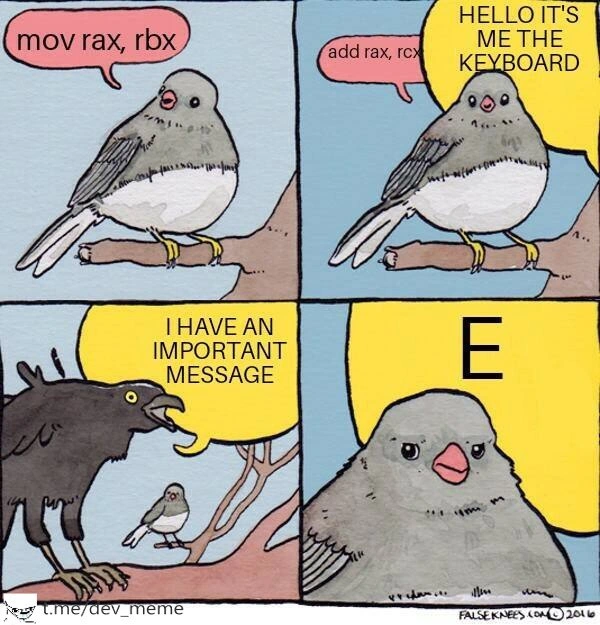
Why is this LowLevelProgramming meme funny?
Level 1: Someone Rang the Bell
This is like someone quietly doing math homework when another person bursts into the room yelling, "I have very important news!" The news is just the letter E. It is funny because the computer has a serious way to stop what it is doing for keyboard input, even when the input is only one tiny key press.
Level 2: The Keyboard Interrupts
Assembly language is a low-level way to write instructions close to what a CPU executes. In the image, mov rax, rbx means "copy the value from rbx into rax." add rax, rcx means "add rcx to rax." The exact program does not matter; the bird is just doing normal CPU work.
A register is a tiny, very fast storage location inside the CPU. Registers like rax, rbx, and rcx hold values while instructions run. They are not files or variables in the high-level sense; they are the CPU's immediate workbench.
A keyboard interrupt is a way for keyboard-related hardware and software to tell the system that input happened. Instead of the CPU constantly checking the keyboard, the input system can signal that there is something to handle. The operating system then turns that low-level input into an event that applications understand.
The punchline is the huge buildup to E. Pressing a single key feels simple to a user, but the computer still has to receive the signal, handle it safely, and deliver it to the right program. The comic makes that invisible process visible by turning the keyboard into a dramatic messenger.
Level 3: Urgent Letter Delivery
The humor comes from the mismatch between ceremony and content. The CPU bird is speaking in assembly, which feels austere and technical. The keyboard bird bursts in with maximum urgency, as though carrying a security patch, a machine-check exception, or at least a dramatic kernel panic. Instead, the message is just E. That anticlimax is the whole systems-programming joke: low-level machinery can be elaborate even when the user-facing event is laughably small.
Experienced developers recognize this pattern far beyond keyboards. Timers tick, packets arrive, disks complete I/O, mouse devices move, GPUs signal completion, and processes get scheduled. The machine is constantly negotiating between the current instruction stream and external events that demand attention. Clean abstractions make this feel simple at the application level, but underneath, there is choreography: interrupts, queues, buffers, drivers, scheduling, and event loops quietly turning "someone pressed a key" into data a program can consume.
The chosen instructions matter because rax, rbx, and rcx are general-purpose x86-64 registers, the kind of names people associate with assembly language and CPU internals. They make the bird look like the processor is doing serious register bookkeeping. Then the keyboard arrives not with another instruction but with an out-of-band demand. The joke is not that E is useless; it is that user input has priority over whatever elegant arithmetic the CPU thought it was doing.
The comic also nods at the old polling versus interrupting distinction. Polling means repeatedly checking whether something happened. Interrupting means letting the device announce that something happened. Polling is simpler to imagine but can be wasteful. Interrupts are efficient but introduce concurrency, ordering, latency, and handler-design problems. Naturally, the meme chooses the funniest possible explanation: the keyboard personally walks onto the branch and yells.
Level 4: Interrupt Vector Theater
mov rax, rbx
add rax, rcx
HELLO IT'S ME THE KEYBOARD
I HAVE AN IMPORTANT MESSAGE
E
The comic is a tiny play about asynchronous hardware events. The gray bird starts with ordinary x86-64-looking instructions: mov rax, rbx copies a value from one register to another, and add rax, rcx adds the value in rcx into rax. That is the CPU doing exactly what CPUs do: fetching, decoding, executing, retiring, and moving through the instruction stream with no emotional investment whatsoever. Then the black bird arrives as the keyboard, loudly announcing an "important message," and the entire dramatic payload is the single character E.
At the hardware/OS boundary, that is basically the shape of an interrupt. A CPU cannot spend all of its time asking every device, "Anything yet? Anything yet? Anything yet?" without wasting cycles. Instead, devices or their controllers can signal that attention is needed. In a traditional simplified keyboard story, a key press produces a scan code; an interrupt controller signals the CPU; the CPU pauses the current flow at a well-defined boundary; control jumps through an interrupt descriptor or vector to a handler; the handler reads device state, acknowledges the interrupt, queues the event, and returns so the interrupted code can continue. Modern USB keyboards travel through host controllers and HID stacks rather than the old direct PS/2 path, but the conceptual comedy remains: normal computation gets preempted because the outside world tapped the machine on the shoulder.
The final E is also funnier than it looks because a physical key press is not immediately "the letter E" at the lowest layer. Hardware often reports a key position or scan code. The operating system then applies keyboard layout, modifier state, focus, input method rules, and event dispatch before an application sees a character. The meme collapses that whole pipeline into a bird shouting E, which is technically rude but emotionally accurate.
This is why interrupt handlers are treated carefully in real systems programming. Interrupt context should be short, predictable, and boring. You acknowledge the device, capture the necessary state, defer heavier work, and get out. If handlers do too much, or if devices interrupt too frequently, the system can lose responsiveness to the work it was already doing. The comic exaggerates the priority inversion for comedy: all of register arithmetic must stop because a keyboard has arrived with one majestic glyph. Somewhere, an interrupt controller is nodding like this is a normal Tuesday.
Description
A four-panel hand-drawn bird comic shows a gray bird on a branch speaking in assembly-like instructions. The first panel says "mov rax, rbx," the second says "add rax, rcx," a yellow bubble in the second panel says "HELLO IT'S ME THE KEYBOARD," a black bird in the third panel says "I HAVE AN IMPORTANT MESSAGE," and the final close-up panel contains only the large letter "E." A small "t.me/dev_meme" watermark appears near the bottom-left, and the comic is signed at the bottom-right. The technical humor comes from mixing x86-64 register operations with the absurdly simple payload of keyboard input, reducing hardware interaction to a dramatic delivery of one character.
Comments
30Comment deleted
After all that register choreography, the interrupt handler still just wants to hand you an `E`.
But USB is a polled bus, isn't it? Comment deleted
It is Comment deleted
So the meme is true only for PS/2 keyboards? Comment deleted
And mice, yeah. I don’t remember any other older/less popular ports with hardware interruptions, but they probably exist Comment deleted
I2C, but that's an internal one mostly used in laptops Comment deleted
yes, and only if you cpu is like 2 decades old. Comment deleted
and integrated keyboards, since they don't have to adhere to any connector standard (though they often do just use the usb keyboard standard, so there's that) Comment deleted
Yes Comment deleted
y Comment deleted
/ Comment deleted
z Comment deleted
(wrong keyboard layout) Comment deleted
??? Comment deleted
the joke is that the English and German keyboard layouts have y and z swapped for some reason Comment deleted
qwerty vs qwertz Comment deleted
should I use ctrl+y to undo then? Comment deleted
no, Strg+Z Comment deleted
Steal register + Z? Comment deleted
steuerung + Z Comment deleted
управление + я Comment deleted
damn this guy can type R backwards Comment deleted
I can do small 3 з Comment deleted
holy shit Comment deleted
Yes Comment deleted
usb vs ps/2 Comment deleted
also pulling with usb is still faster than interrupt based ps/2 because the transmission of data in ps/2 is way slower than the usual polling rate used for usb devices. Comment deleted
I love how long the explanation is lol Comment deleted
And then comes the x86 System Management Mode which just grabs the CPU at any time without the OS knowing about it. 😈 Comment deleted
hardware meme at its finest Comment deleted