Skip to content
DevMeme
4839 of 7435
When kubectl outputs pods to PDF, revealing Kubernetes' surprising PDF library dependency
Containerization Post #5299, on Jul 14, 2023 in TG

When kubectl outputs pods to PDF, revealing Kubernetes' surprising PDF library dependency

Why is this Containerization meme funny?

Level 1: Unexpected Ingredient

Imagine you’re reading a cookbook about baking bread, and suddenly you find a page with instructions on how to fix a car’s engine. You’d probably do a double-take and laugh, right? You’d joke, “Hm, I guess this cookbook can fix my car, too!” The meme is playing on exactly that kind of silly surprise, but in a computer context. Kubernetes is a big program that’s supposed to help run apps (kind of like a cookbook for keeping software running). One day, developers discovered it had a random tool inside for reading PDF documents – that’s as out-of-place as car repair instructions in a bread cookbook. So they made a joke: “What if I ask Kubernetes to give me its output as a PDF file?” It’s funny because normally you’d never expect that. It’s an unexpected ingredient in the software recipe. The feeling it gives is a mix of surprise (“Why is that there?”) and amusement (“Maybe it can do this crazy thing now!”). Just like finding a toy in a cereal box, this odd detail made people smile and riff on what else Kubernetes might secretly do. In plain terms: the tool meant for managing containers had a bizarre library for PDFs hidden inside it, so devs joked that maybe the tool could print out your data on nice PDF documents. It’s the contrast between what something is meant to do and what weird thing it could do that makes it lighthearted and funny, even if you’re not a technical person.

Level 2: Pods on Paper

For a less experienced developer, let’s break down why the idea of kubectl get po -o pdf is funny. Kubernetes is a system that helps run software in containers across lots of machines – basically, it’s a big organizer for apps (that’s why it’s in the Containerization category). To interact with Kubernetes, developers use a command-line tool called kubectl (pronounced cube-cuddle or cube-control, depending on who you ask). With kubectl, you type commands into a terminal (that’s the CLI – Command Line Interface). For example, kubectl get pods is a common command that asks Kubernetes to list all the “pods” running. A pod (shorthand po) is the basic unit in Kubernetes that holds one or more containers – think of it like a little ship carrying your containerized app. So normally, when you run kubectl get pods, you get a list of pods in a default plaintext table. You can add the flag -o (which stands for output) to format that list in different ways. Common formats are -o json for JSON output or -o yaml for YAML output. These formats are structured text that developers and other programs can easily read. For instance:

kubectl get pods -o yaml   # outputs the pod list in YAML format
kubectl get pods -o json   # outputs the pod list in JSON format
kubectl get pods -o wide   # a predefined format with extra info (wide table)
kubectl get pods -o pdf    # (joke) attempt to output the pod list as a PDF file

The last line with -o pdf is not actually a real thing you can do – it’s the joke! Usually, nobody expects a command-line tool to directly generate a PDF document of the output. PDF files are for documents, reports, maybe diagrams – not the usual way you’d inspect your running containers. So why would someone even think of -o pdf? This meme was sparked by a discovery: the Kubernetes project’s code included a dependency on a package called rsc.io/pdf, which is a Go library for reading PDF files. In simpler terms, somewhere inside the huge body of Kubernetes code, there was code meant to handle PDF documents. This was surprising and funny to developers. Kubernetes managing containers is like a ship captain managing a fleet – PDF handling is more like a librarian’s job. The two don’t obviously mix! So one developer (Cless) tweeted the command jokingly, as if saying: “Oh, since Kubernetes secretly has a PDF reader in its code, maybe kubectl can output things as PDF!” It’s a classic unexpected_dependency gag – a very out-of-place piece in the software.

To unpack why that PDF library is there: big projects often rely on many dependencies (external libraries or packages that provide certain features). This is normal – instead of writing every functionality from scratch, developers import libraries. However, managing these dependencies (DependencyManagement) can get tricky; sometimes you end up including things you never directly use. It could be an indirect or transitive dependency (Library A you included also includes Library B). It could also be a leftover from an older feature or a tool that was used for testing or building Kubernetes. In fact, when David Crawshaw saw rsc.io/pdf in Kubernetes’ dependency list, he reacted with “I fear the answer” – meaning he suspected it might be something weird or unwieldy causing it. Perhaps a Kubernetes component was reading a PDF for some odd reason (maybe parsing a PDF manual or certificate?), or maybe it was just dragged in accidentally. For a junior dev, it’s important to realize that this kind of thing happens in real projects. Have you ever done an npm install or added a package and suddenly your project has tens or hundreds of sub-packages? Kubernetes, being a huge Go project, vendors a lot of packages, and some can be surprising. This scenario is a bit like DependencyHell, where you have so many dependencies that strange conflicts or irrelevant packages appear. Here it’s more humor than hellish: no one’s production cluster actually depends on PDF parsing (as far as we know!), but just seeing that in the ingredient list of Kubernetes was enough to spark jokes.

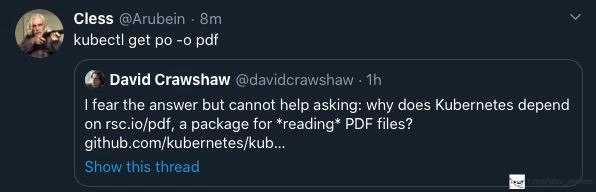
So, our meme has two parts: the quoted tweet (by David Crawshaw) expressing astonishment about the PDF library, and the top tweet (by Cless) making a tongue-in-cheek command example out of it. The blue “Show this thread” indicates there was more discussion, but the snapshot captures the essence. The humor resonates with developers who use Kubernetes because they know kubectl well. They know -o yaml, -o json, etc., and the idea of -o pdf is immediately ridiculous and intriguing. It pokes fun at Kubernetes’ ever-growing feature set. DevOpsHumor often highlights these absurd surprises in our tools – reminding us that even serious infrastructure has its odd quirks. In summary, to a newcomer: this meme is funny because it’s as if a plumber opened their toolbox and found a recipe for cake inside. Kubernetes (the toolbox for launching containers) inexplicably has a PDF tool inside it, and developers are joking, “Hey, maybe we can actually use that and print our pod info as a PDF document!”

Level 3: Kubernetes Kitchen Sink

At first glance this meme mashes up a CLI command with an absurd output format, and seasoned engineers can’t help but smirk. In Kubernetes (the de facto containerization platform), kubectl is the command-line interface used to manage cluster resources. It’s common to run commands like kubectl get pods -o yaml or -o json to output results in structured formats (YAML or JSON). So when someone jokes with kubectl get po -o pdf, it sounds like they’re asking Kubernetes to print the list of Pods as a nicely formatted PDF document. That isn’t a real feature of course – there’s no PDF export in kubectl – but the humor lands because the Kubernetes codebase bizarrely includes a library for handling PDF files. This senior-level joke hints at dependency sprawl in large projects: Kubernetes depending on rsc.io/pdf (a Go library for reading PDF files) is as unexpected as it gets. As David Crawshaw tweeted, “I fear the answer but cannot help asking: why does Kubernetes depend on rsc.io/pdf?” – a question loaded with the dread of someone who’s seen one too many strange dependencies. Experienced devs laugh in solidarity because we’ve all dug through massive projects thinking “surely they didn’t include THAT… oh no, they did.”

Behind the scenes, this joke reflects a real-world quirk: Kubernetes’ dependency management pulled in a PDF-parsing package without obvious reason. In sprawling systems, an innocuous module can drag in something wild – maybe a third-party component or a transitive dependency included it for an edge-case feature. It’s a classic DependencyHell scenario: you go to build your container orchestrator and discover it’s inadvertently lugging around a PDF reader in its baggage. Senior engineers recognize the pattern from painful experience. For example, one tiny logging library might import a utility that (surprise!) imports a PDF library to generate report documents, or a test suite might use PDF files as input data and accidentally cement that into the dependency tree. Over years, Kubernetes has grown into a “kitchen-sink” orchestrator; its codebase is huge, with many contributors adding features. It’s not a single-purpose tool anymore but a whole ecosystem, so odd things sneak in. The tweet humorously suggests Kubernetes is so feature-rich that kubectl could just output your Pods status as a PDF brochure if it wanted to. It’s funny because it feels just plausible enough in a world where even nimble CLI tools can become bloated by unforeseen requirements. Seasoned DevOps folks recall times when a seemingly unrelated library caused headaches – “why is that even in our build?” – leading to war stories at meetups about outrageous, unexpected dependencies.

The industry subtext here is a gentle roast of how modern software, even the ultra-modern cloud stuff, tends to accumulate cruft in the form of libraries and tools unrelated to the core mission. Kubernetes, meant to manage containers, theoretically should have nothing to do with PDFs (which are about documents). The absurdity highlights how tech projects can evolve in chaotic ways. It’s a nod to the realities of big open-source projects: dependency graphs so tangled you find unexpected stuff lurking. Senior engineers grin at this because it validates our inner cynic – if even Kubernetes, poster child of cloud-native design, can unknowingly carry a PDF parser, what other crazy extras live in our production binaries? The meme’s punchline also hints at documentation or debugging woes. Imagine being on-call, chasing an error at 3 AM, and discovering a stack trace coming from a PDF library deep inside Kubernetes. It’s the kind of plot twist only those who maintain complex systems truly appreciate (in a horrified, laughing-through-the-pain way). In short, DevOpsHumor at its finest: pointing out that even our sleek container orchestration tool has some “batteries included” that nobody asked for, and riffing on it by proposing a farcical new feature (-o pdf). We laugh because it’s both ridiculous and a little too relatable – every senior dev has encountered a “why the heck is this here?!” library and learned that in big systems, nothing really shocks us anymore.

Description

Dark-theme Twitter screenshot. The top tweet by “Cless @Arubein · 8m” reads: “kubectl get po -o pdf”. Below it is a quoted tweet from “David Crawshaw @davidcrawshaw · 1h” saying: “I fear the answer but cannot help asking: why does Kubernetes depend on rsc.io/pdf, a package for *reading* PDF files? github.com/kubernetes/kub…”. A blue link underneath says “Show this thread”. The humor comes from treating the kubectl CLI like it natively supports an “-o pdf” output format because the Kubernetes codebase unexpectedly includes a Go library for parsing PDFs, highlighting dependency sprawl and the odd places packages end up in large container orchestration projects

Comments

11
Anonymous ★ Top Pick Kubernetes vendors a PDF parser so kube-apiserver can skim the 800-page SBOM explaining why it vendors a PDF parser
  1. Anonymous ★ Top Pick

    Kubernetes vendors a PDF parser so kube-apiserver can skim the 800-page SBOM explaining why it vendors a PDF parser

  2. Anonymous

    The real reason Kubernetes is so resource-intensive isn't the container orchestration - it's rendering your pod status as a beautifully formatted PDF complete with embedded fonts and vector graphics, because apparently YAML wasn't enterprise enough

  3. Anonymous

    When you're debugging why your Kubernetes cluster is pulling in a PDF parsing library and realize someone probably needed to generate a single compliance report five years ago, but now it's in the dependency tree forever. At least we can dream of 'kubectl get po -o pdf' generating beautifully formatted pod listings with proper kerning and embedded fonts - because clearly that's what production infrastructure needs at 3 AM

  4. Anonymous

    Proof that transitive deps grow faster than clusters: add one library and suddenly “kubectl get po -o pdf” is an enterprise reporting feature - now who owns the printer-driver SIG?

  5. Anonymous

    Kubernetes deps: because container orchestration needed a side hustle parsing the fine print on those vendor lock-in PDFs

  6. Anonymous

    kubectl get po -o pdf - because when your SBOM includes a PDF parser, observability is for auditors, not grep

  7. @bezuhten 2y

    so why?

  8. dev_meme 2y

    It doesn't, and it should've been removed by now https://github.com/kubernetes/kubernetes/pull/97337 https://github.com/kubernetes/kubernetes/pull/102833

  9. @SamsonovAnton 2y

    Why on Earth does Midnight Commander depend on X11 libraries?

    1. @chupasaurus 2y

      Because

  10. @endisn16h 2y

    oh i kinda wish kcl get po -o pdf was real

Use J and K for navigation