The TypeScript Type System: A Journey to the Bottom of the Iceberg
Why is this Languages meme funny?
Level 1: Tip of the Iceberg
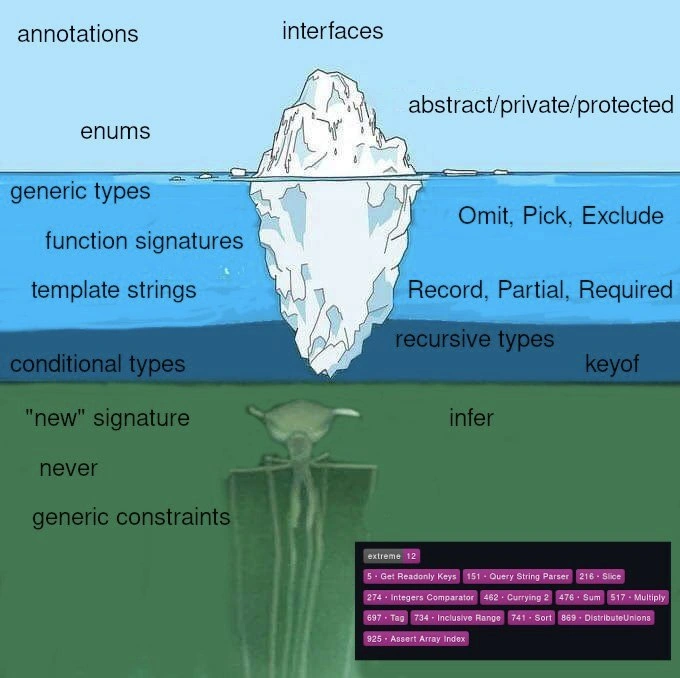
Imagine an iceberg in the ocean: you see a little snowy peak sticking out of the water, but you know there’s a gigantic chunk of ice hidden underneath the surface. This meme is saying TypeScript is just like that! The easy stuff that most people notice – like labeling things with basic types so you don’t make simple mistakes – is the small tip of the iceberg. It’s the part above the water that everyone can see. But below the water, hidden from a casual glance, there’s a huge mass of complicated, advanced features that only experienced divers (in this case, senior programmers) ever see or use. It’s funny in the same way it might be funny to realize a simple toy can unfold into a super-complex robot – you’d be surprised that something that looks simple actually has so much going on inside. For a beginner, TypeScript just means “I say this variable is a number and the tool helps me avoid mixing it up with a string.” That’s the visible part. The meme jokes that, unbeknownst to most, there’s an entire world of powerful tricks underneath – so complex it could be its own little secret programming world. In simple terms: most people only see the small easy part of TypeScript, not realizing there’s a whole mountain of complexity hidden underwater. That contrast – between what looks small and what actually is huge – is what makes the image amusing and true. It’s like thinking you’ve learned a magic trick, only to find out the magician’s book has thousands of pages of deeper spells!
Level 2: Hidden Depths of TypeScript
On the surface, TypeScript feels like a straightforward improvement over JavaScript: you add type annotations (like saying a variable is a number or a function returns a string) to help catch errors early. For example, you might write let count: number = 5; and that : number part is a basic annotation. You learn about interfaces (which let you define the shape of an object, like describing that a Car has a make and model property) and enums (which create a fixed set of named constants, like an enum Direction { North, South, East, West }). These are the little iceberg tip that every TypeScript beginner sees. You might also encounter abstract classes or private/protected modifiers – keywords that come from object-oriented programming to enforce certain class behaviors – but those still feel familiar if you’ve used languages like Java or C#. Everything up here is pretty intuitive: it’s about marking variables and structures with types so the computer can yell at you if you mess up (for instance, calling a function with the wrong type of argument).
Then you wade a bit into deeper water and find generic types. Generics are like templates that allow types to be reusable for any kind of input. For instance, an array type can be generic (Array<T> means “an array of some type T”) so you can have Array<number> or Array<string>. You learn to write functions like function identity<T>(value: T): T { return value; } which works for any type T because of that <T> generic parameter. Along with generics, you start using function signatures in types – for example defining a type for a function itself: type BinaryOp = (x: number, y: number) => number; describes any function that takes two numbers and returns a number. This is where you start explicitly thinking about the types of functions, not just variables. You also discover template literal types around this stage. Template literal types (introduced in later TS versions around 4.x) let you create or match types based on string patterns (similar to how template strings work at runtime). For example, you can have a type like type prefixedID = `id-${number}` which means “a string that starts with id- followed by a number”. This opens the door to doing neat string manipulations in types.
Around here, you also bump into TypeScript’s utility types – built-in helpers that live just below the surface to make your life easier. These include Pick (to select a set of keys from a type), Omit (to exclude a set of keys), Partial (to make all properties optional), Required (to make all properties required if some were optional), Exclude (to remove certain types from a union), Record (to create an object type with a set of keys all having the same value type), and more. For example:
interface Person { name: string; age: number; location: string; }
type JustName = Pick<Person, "name">;
// JustName becomes { name: string } – we picked only the 'name' property.
type NoLocation = Omit<Person, "location">;
// NoLocation becomes { name: string; age: number } – we omitted 'location'.
type MaybePerson = Partial<Person>;
// MaybePerson is { name?: string; age?: number; location?: string; } – all props optional.
These utilities are extremely handy and show that types can be transformed and composed. A junior developer at this point realizes types are not static declarations – they can be computed and modified. It’s a hint of the larger iceberg just below, and it feels empowering yet still manageable.
As you keep going, you start encountering the more advanced features that were lurking underwater. One big concept is conditional types. A conditional type lets you say “if type X fits some condition, then result in type A, otherwise type B”. It looks like T extends U ? X : Y. For example, we can write a simple conditional type that checks if a type is string or not:
type IsString<T> = T extends string ? "yes" : "no";
type Test1 = IsString<number>; // "no" (number is not string)
type Test2 = IsString<string>; // "yes" (string extends string)
Here IsString<number> evaluates to "no" and IsString<string> to "yes" – at the type level! This shows that a type can actually choose a different type based on a condition, essentially like an if for types. Now, combine this with union types (TypeScript’s way of saying a variable could be one of several types, like string | number) and you get a phenomenon where these conditionals automatically distribute over unions (meaning they apply to each part of the union separately). That can be really powerful but also confusing at first.
Then there are recursive types – a type that refers to itself. Imagine you want to describe a tree-like structure: you might have an interface Node that has a value and an array of children which are themselves Node type. That’s a recursive type definition. At the type system level, recursion allows defining infinitely nesting structures or performing repetitive computations in a type (with the compiler having a recursion limit for safety, usually).
Now, on to the mysterious keywords near the bottom of the iceberg: keyof, infer, never, and generic constraints. The keyof operator is actually not too scary: if you have a type Person, keyof Person would produce the union of its keys (e.g., "name" | "age" | "location" for our Person). It’s like asking the type system, “what keys does this object type have?” and using that as a type itself. This is useful for all sorts of meta-programming with types – like creating a validator that only allows object keys that actually exist on a given type, etc.
The infer keyword is more magical. You use infer inside a conditional type to extract a piece of a type. It’s like saying “within this pattern, let me pull out a subtype and give it a name to use in the outcome”. For instance, consider extracting the element type of an array:
type ElementType<T> = T extends (infer U)[] ? U : never;
// If T is an array (like U[]), infer U as the element type, otherwise give never.
type A = ElementType<string[]>; // A is string
type B = ElementType<number[]>; // B is number
type C = ElementType<string>; // C is never (string is not an array)
In ElementType<T>, we used T extends (infer U)[] ? U : never. This means: if T matches the pattern “some array of U”, then the type should resolve to U (the thing inside the array), otherwise it becomes never. The result is that ElementType<string[]> can figure out it’s string, and ElementType<string> becomes never (meaning it’s not applicable). The infer keyword basically lets the compiler intelligently fill in a type for U based on the pattern we provided. It’s similar to how we mentally think “if T is an array of something, give me that something” but doing it in a type-safe way. This opens the door to a lot of powerful meta-programming with types because you can deconstruct types and transform them.
Speaking of never: this is a special type in TypeScript that represents an impossible value. It’s the result of things that can’t happen. For example, a function that never returns (because it always throws or loops forever) has return type never. In conditional types, if something doesn’t apply, we often use never as the “nothing” type. It basically signals “no type at all” or “this branch is not applicable”. It’s a bit like the bottom of the type world – an empty set, if you will.
And generic constraints are a way to put limits on generics. You write something like <T extends Animal> to mean “T can be any type as long as it’s an Animal (or a subclass of Animal)”. It’s like setting a rule so you can safely use T knowing it has at least the shape or capabilities of Animal. If someone tries to use your generic with a type that doesn’t extend Animal, the code won’t compile. This is important for making generics both flexible and safe. It’s a straightforward concept: it’s ensuring type safety by saying “I don’t care what T is, as long as I know it has these properties or behaviors, then I can work with it”.
Finally, the meme references a “Type-Challenges” repository (with labels like “extreme 12” and tasks named Get Readonly Keys, Query String Parser, Sum, Sort, etc.). This is a community-driven set of puzzle problems meant to be solved using only TypeScript types. Yes, that means writing type aliases and interfaces – no actual runtime code – to accomplish tasks. For example, “Query String Parser” would involve taking a type representing something like "foo=1&bar=2" and producing an object type { foo: 1; bar: 2 }. Solving that means leveraging template literal types and recursion to break the string apart by & and = at the type level. Challenges like Sum, Multiply, or Sort are essentially implementing arithmetic or sorting algorithms using types (often by representing numbers as strings or tuples of digits, then recursively operating on them!). These puzzles are considered extremely difficult (hence the “extreme” tag) and they string together all the deep features: you’d use infer to break apart strings or tuples, recursive conditional types to iterate, and clever constraint tricks to carry values. The fact that these are even possible should tell you how far beyond “just annotate some variables” the TypeScript type system has grown.
In summary, as you go from top to bottom: you start with simple, everyday static typing (just putting types on things), move into more dynamic and flexible type constructions (generics and utility types), and finally plunge into a realm where the type system itself can enforce complex logic and even perform computations. Many TypeScript devs might never use the bottom-of-the-iceberg features in a real project – and that’s okay! They exist for those edge cases and for the satisfaction of type-system enthusiasts. The meme’s layers reveal that TypeScript has hidden depths: what appears to be a small enhancement to JavaScript actually conceals a powerful, elaborate type system under the hood. That hidden complexity is both what gives TypeScript its strength (you can make your code extremely safe and expressive) and what makes it intimidating. It’s like discovering your humble toolkit has a secret compartment full of advanced gadgets – exciting for those who find it, but invisible to those who don’t go looking.
Level 3: Deep End of Typing
For seasoned TypeScript developers, this meme elicits a knowing chuckle of “so true!”. On the surface, new adopters see only the small, shiny tip of TypeScript – things like simple type annotations, interfaces, and enums – basically the stuff above the water in the iceberg. These are the features you learn in an afternoon and feel confident about. But as you gain experience (or dare to peek into the source of a complex library or DefinitelyTyped definitions), you start noticing there’s much more under the waterline. The meme labels the waterline with features like generic types, function signatures, template literal types, and the handy utility types (Omit, Pick, Exclude, Record, Partial, Required). This represents the point where a developer moves from basic usage into intermediate usage – for example, using generics to write reusable functions, or using utility types to transform one shape into another. A mid-level dev starts feeling pretty smart at this stage, thinking “I got this TypeScript thing down.”
Then comes the eye-opening plunge: deeper down are advanced generic tricks that senior TypeScript wizards wrestle with. We’re talking about conditional types (typing logic that picks a branch based on whether a type extends another) and recursive types (types defined in terms of themselves, often to model recursive data or to unroll computations step by step). The keyof operator (yielding the keys of an object type as a union of strings) starts appearing, enabling dynamic property-based typing patterns. Seasoned devs have war stories of crafting or debugging these complex types to model tough problems or achieve zero-runtime type safety. Perhaps you tried to ensure a function’s return type automatically changes based on its input type – you likely dabbled in conditional types or even infer to extract types from generics. These are the signposts that you’re descending into the type system’s deep end.
The humor arises from the stark contrast: the casual TypeScript user thinks it’s just about catching undefined bugs and adding a few type declarations, while the power user is effectively doing static-world sorcery. For example, a junior might use interface Person { name: string; age: number; } and call it a day. Meanwhile, a senior might devise a type that, say, takes any object and produces a new type of all its readonly keys versus mutable keys – something requiring a conditional type and infer. Take utility types: a newbie happily uses Pick or Partial without much thought, but an advanced user realizes “hey, I can write my own conditional mapped types to enforce complex invariants”. Many experienced devs eventually encounter a library or codebase where the types are so fancy that the error messages become a wall of < and > and extends clauses. It’s funny because it’s relatable – if you’ve been there, you recognize each stage of the iceberg from personal experience. There’s a shared camaraderie (and a bit of PTSD!) in reading those bottom keywords like infer and never and recalling the late-night Stack Overflow sessions trying to figure out why your deeply nested conditional type wasn’t working.
The iceberg meme format perfectly captures this gradient: most people stay near the surface, and that’s fine – you can be productive in TypeScript with just the basics. But the meme playfully warns (or boasts) that if you swim further down, you’d better be prepared to confront mind-twisting type constructs. The inclusion of the Type-Challenges “extreme” problems at the abyss is a nod to the ultra-nerds who pushed TypeScript to its limits. Challenges like “Query String Parser” or “Sort” at compile time are real, and only very confident (or crazy) devs attempt them – it’s like the Olympics of static typing. The meme is saying: TypeScript isn’t just toy types – it hides a leviathan of complexity underneath. Seasoned devs laugh because they know how true this is; they’ve either fought these beasts or deliberately steered clear after hearing the tales. It’s both a point of pride (“I solved that crazy conditional type problem!”) and a satirical warning (“Abandon all hope, ye who venture below generics!”). And importantly, it speaks to Developer Experience (DX): work with TypeScript can go from smooth sailing with autocomplete and safety at the shallow end, to wrestling a giant squid of the type checker in the depths. The shared relief and humor come from acknowledging just how far down the rabbit hole goes – and that most of us are okay not venturing too far underwater unless we absolutely must.
Level 4: Turing Tar Pit
At the deepest depths of TypeScript’s type system lurks something theoretically mind-bending: it’s effectively Turing-complete. This means the type system isn’t just a simple checker—it’s powerful enough to perform arbitrary computations (given enough cleverness and compiler patience). In computer science terms, TypeScript’s advanced types form a kind of lambda calculus playground, where you can encode algorithms using only types. Features like recursive conditional types and the infer keyword allow the type system to simulate loops, pattern matching, and recursion. In fact, TypeScript’s type system has been proven to be a Turing-complete language of its own – akin to an esoteric functional language running during compile time. This is why the iceberg’s abyss shows things like computing sums, multiplies, sorting, and even parsing a query string purely in type definitions. It’s the “Turing tar-pit” Perlis warned about: everything is possible, but nothing of interest is easy down here. You could, for instance, implement a Fibonacci sequence or a quicksort algorithm using only TypeScript types – and people do attempt such feats in the Type-Challenges (the meme’s purple legend lists examples). That list of “extreme 12” challenges is essentially a hall of fame for type-system puzzles that require writing what amounts to programs in the type language. At this level, the TypeScript compiler becomes a mildly begrudged co-processor crunching through recursive type expansions. The humor here has a dark glint of awe: the same static typing tool meant to catch simple bugs can be stretched into a full-on abstract programming environment. It’s as if a casual sailboat (basic types) unexpectedly conceals a nuclear submarine (Turing-complete type wizardry) deep below – surprising, a bit terrifying, but also fascinating for those brave enough to dive this far. And of course, with great power comes great headaches: a type definition that acts like code can hit compiler recursion limits (to prevent infinite loops, since the halting problem applies to the compiler now!), or produce error messages the size of novels. Yet, for the adventurous, these depths demonstrate the true power and bizarre beauty of TypeScript’s type system, where types cease to be just annotations and become a full computational universe beneath the surface.
Description
This image uses the popular iceberg meme format to illustrate the escalating complexity of TypeScript's type system. The top of the iceberg, visible above the water, lists fundamental and widely understood concepts like 'annotations', 'interfaces', 'enums', and 'abstract/private/protected'. Just below the surface are intermediate features that proficient developers use regularly, such as 'generic types', utility types like 'Omit, Pick, Exclude', and 'recursive types'. Deeper down, in the dark water, lie the advanced and more esoteric features like 'conditional types', the 'infer' keyword, and the 'never' type. At the absolute bottom, in the abyss, is a small screenshot of 'extreme' TypeScript type challenges, including tasks like 'Query String Parser' and 'DistributeUnions', representing the pinnacle of type-level programming. The meme humorously and accurately portrays the developer's journey into TypeScript, starting with simple type annotations and descending into a powerful, Turing-complete system that few ever fully master. It's relatable to any senior developer who has realized the surprising depth hidden beneath the language's initial simplicity
Comments
18Comment deleted
The top of the TypeScript iceberg is what you show the project manager. The bottom is what you use to write a type-safe CSS-in-JS library that makes the compiler cry
“Product: ‘Just add an enum.’ One sprint later the “enum” is a 150-line recursive conditional that quick-sorts distributive unions, tsc takes longer than our CI build, and yes - management still calls it “just JavaScript with types.”
The skeleton at the bottom isn't dead from waiting for the build to finish - it's from trying to explain to the PM why implementing a simple form now requires a PhD in category theory and three weeks of type gymnastics
TypeScript's type system is Turing-complete, which means somewhere down there the compiler is solving your business logic and your runtime is just a formality
This iceberg perfectly captures the TypeScript journey: you start with 'let x: string' feeling accomplished, then six months later you're debugging 'type DeepReadonly<T> = T extends object ? { readonly [K in keyof T]: DeepReadonly<T[K]> } : T' at 2 AM, questioning every life choice that led you here. The real horror isn't the complexity - it's realizing that the 'extreme +2' challenges at the bottom are exactly what your coworker used in production to 'ensure type safety' for a simple form validator
Every TS migration starts with 'interfaces and enums' and ends with a PR where a distributed conditional type with infer parses query strings and sorts arrays at compile time, because doing it at runtime would be less type-safe
We promised to “just add types” - now we ship a compile-time query‑string parser stitched with infer chains, tsc is our second interpreter, and the build farm files an SLO against distributive unions
TypeScript iceberg: interfaces for the resume, infer/never for when you need to prove job security
what language? Comment deleted
any Comment deleted
How many languages have Partial or keyof? Comment deleted
isn't keyof just a function to get the key of a value from a dict? So… pretty much every lang with dicts, no? Comment deleted
Keyof is type operator https://www.typescriptlang.org/docs/handbook/2/keyof-types.html I know not many languages, but only typescript gives me make such things with types Comment deleted
that's a weird-ass keyword Comment deleted
Too hard to just give an answer? Comment deleted
unknown Comment deleted
ts? Comment deleted
Yes looks like it. The never make me think of ts Comment deleted