Clickbait Pull Requests Get Approved
Why is this CodeReviews meme funny?
Level 1: Clickbait Homework
It is like turning in homework with the title "You won't believe what this student did with fractions!" instead of just saying "fraction worksheet." The joke is funny because the developer treats code review like a dramatic internet article, and somehow all the dramatic titles got approved.
Level 2: Review Needs Context
A pull request is a proposed code change that teammates can review before it is merged. Reviewers look for bugs, unclear logic, missing tests, security problems, and whether the change matches the goal.
The meme shows PR titles written like internet headlines. They are funny because they use dramatic phrasing for ordinary engineering work. A redirect bug becomes "the incredible solution this developer found." A copy change becomes a cliffhanger.
For newer developers, the useful lesson is that PR communication matters, but not like this. A good title should explain the change directly. A good description should say why the change exists, how it was tested, and what reviewers should pay attention to. That helps people approve faster because they understand the work, not because they were tricked into clicking.
Level 3: Approval-Rate Optimization
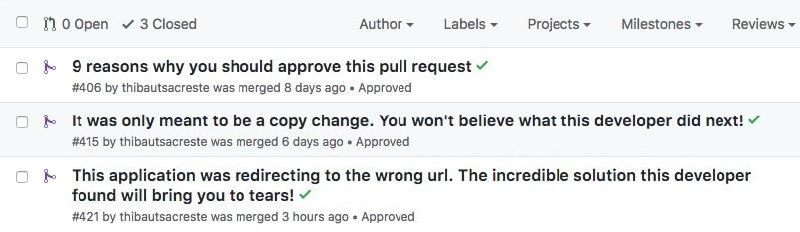
The pull request list shows 0 Open and 3 Closed, and all three visible PRs are merged and marked Approved. Their titles are pure attention-economy bait:
9 reasons why you should approve this pull request
It was only meant to be a copy change. You won't believe what this developer did next!
This application was redirecting to the wrong url. The incredible solution this developer found will bring you to tears!
The joke works because a pull request is supposed to be a sober unit of engineering review: here is the change, here is why it exists, here is the risk, here is what was tested. The meme replaces that with the rhetorical machinery of clickbait articles. Suddenly code review is not about diff quality, regression risk, or maintainability; it is about whether the title creates enough curiosity to farm approvals.
Experienced developers recognize the uncomfortable truth underneath the exaggeration. Review attention is scarce. A clear PR title and description really can affect review speed because reviewers triage work constantly. A title like Fix redirect target for checkout callback is genuinely useful. But the meme pushes that sensible communication advice into absurd marketing logic: optimize the headline, get the merge. Somewhere, a growth team just asked whether approvals need A/B testing.
The deeper satire is that code review has a social layer. Reviewers are humans with context switches, deadlines, notification fatigue, and their own backlog. The best PRs respect that by being small, well-scoped, and easy to reason about. The worst PRs hide a risky architectural migration behind "minor copy change." The second visible title jokes about exactly that: it was "only meant to be a copy change," then the diff probably touched auth, routing, CSS, and one mysterious YAML file nobody admits owning.
The post message, Use this one simple trick to get your PRs accepted immediately!, completes the format. It parodies the fantasy that there is a hack around trust, ownership, and careful review. In reality, fast approvals come from boring virtues: small diffs, good tests, explicit trade-offs, readable commit history, and not surprising your reviewer like a pop-up ad with database permissions.
Description
A GitHub-style pull request list shows "0 Open" and "3 Closed" with filters for "Author", "Labels", "Projects", "Milestones", and "Reviews" across the top. Three merged, approved PRs are listed with sensational titles: "9 reasons why you should approve this pull request", "It was only meant to be a copy change. You won't believe what this developer did next!", and "This application was redirecting to the wrong url. The incredible solution this developer found will bring you to tears!" Each row shows a PR number, the author "thibautsacreste", a merge time, and "Approved" with a checkmark. The joke reframes code review as attention-economy marketing, where the fastest path through peer review is not a clean diff but a headline optimized for clicks.
Comments
1Comment deleted
The diff was mediocre, but the PR title had a 38% higher approval-through rate.