The Illustrated Burdens of a Backend Developer
Why is this Backend meme funny?
Level 1: Always On Duty
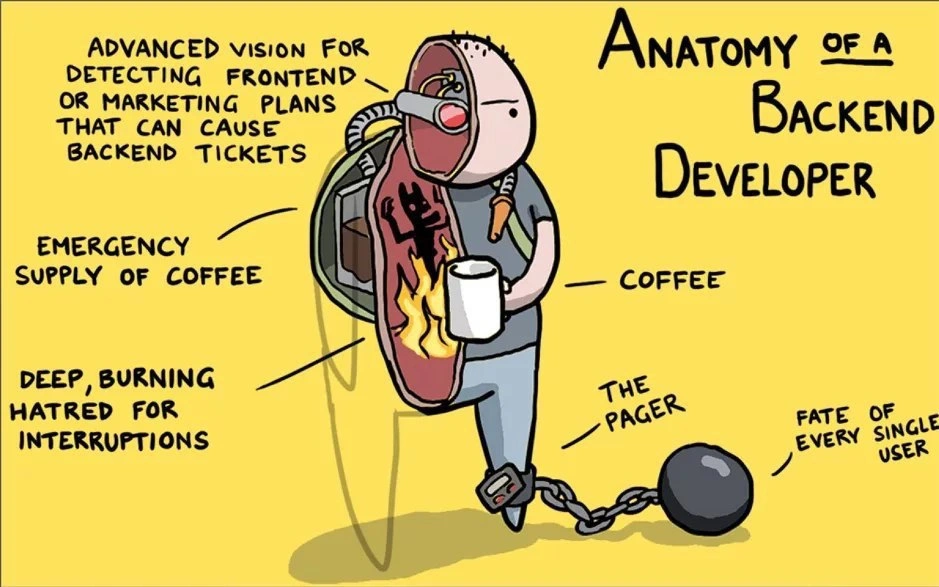
Imagine there’s a big machine that lots of people need every day – like a giant water fountain in a town that everyone drinks from. Now, you are the only person who knows how this machine works and how to fix it if it breaks. That means you have to watch over it all the time. You even carry a special alarm with you that will ring loudly if the machine has any trouble, even if it’s the middle of the night. So you can never really relax or go too far, because if that alarm goes off, you’ve got to rush and save the day. You’re basically always on duty, like a firefighter waiting for a fire. To stay awake and ready, you drink a lot of coffee (kind of like your energy juice). You’re tired, you have dark circles under your eyes, but that coffee keeps you going when you’d rather be sleeping. Now, because you’re so focused on watching the machine, you get a bit grumpy when people interrupt you for silly things. It’s like if you were trying to concentrate on keeping the fire from restarting, and someone comes up and asks you about something totally unrelated – you might snap, “Not now, I’m busy!” The cartoon is funny because it shows this situation in a silly way: the developer is drawn with a coffee pot inside him as if he runs on coffee, and a big iron ball chained to him saying “fate of every user,” as if he’s literally chained to his duty. Of course, in real life they’re not actually chained or filled with coffee, but that’s what it feels like to them. It’s a joke that says: a backend developer’s job can be super demanding – they’re always alert, fueled by caffeine, and they can’t stand being distracted – and that’s both kind of crazy and humorous at the same time.
Level 2: On-Call Survival Kit
Let’s break down the meme’s elements in simpler terms. The title “Anatomy of a Backend Developer” means it’s humorously labeling the parts of a backend engineer’s life as if we’re looking at an X-ray or diagram of their body and gear. A backend developer is a programmer who works on the server-side of things – all the behind-the-scenes functionality that users don’t directly see. If you imagine a web application, the frontend is like the tip of the iceberg that users interact with (buttons, forms, website design), while the backend is the huge chunk underwater: servers, databases, and logic that make the features actually work. So this cartoon is joking that if you peek inside a backend dev (figuratively!), you’ll see what really keeps them going and what they deal with daily. Think of it as a comedic inventory of a backend developer’s survival kit: coffee, a pager, special “vision,” and some intense emotions.
One key item shown is coffee – both a mug in the hand and an “emergency supply” burning inside their torso. This highlights how stereotypically, developers (and especially those working late on tough problems) drink a lot of coffee. Coffee for developers is like spinach for Popeye or fuel for a car. It keeps them awake and functioning, especially if they’ve been up late or got called in the middle of the night to handle an issue. The phrase “emergency supply of coffee” suggests that when things go wrong (an emergency with the system), the first aid is caffeine. It’s depicted as flames to be funny – of course people don’t literally have fire in them, but it implies high energy or an engine running hot on coffee. If you’ve ever pulled an all-nighter to finish a project or study, you might relate to guzzling coffee or energy drinks to stay alert. That’s what’s going on here: the backend dev runs on coffee as much as on skill.
Another item is “The Pager” strapped to the belt. This is a reference to on-call duty. In many tech teams, being “on call” means one team member is the designated responder for any problems that happen off-hours. If something breaks at 2 AM, the on-call person’s job is to respond quickly – much like a doctor on call for emergencies or a firefighter waiting for the alarm. Back in the day, companies literally gave employees a pager (a small device that beeps or vibrates and shows a number to call) to alert them of issues. The meme plays on that classic imagery. These days, it might just be a smartphone alert or a loud notification, but developers still often say “the pager” meaning the on-call alert system. In the cartoon, the pager is beeping away, indicating the poor developer is constantly at its mercy. If that pager goes off, it usually means something is wrong in production (the live system users are on) – maybe the website is down or a critical error occurred – and the developer must drop everything to fix it. So having the pager is like having an ever-present leash. It symbolizes responsibility: you can’t ignore it. It’s even drawn like one of those old-school beepers to underscore the feeling of being bound to work. It’s a bit like how a delivery person is always listening for their dispatch radio, or a doctor carries a pager for emergencies. When you’re on call, you organize your life around the possibility that “I might have to rush to my computer at any moment.” Not very relaxing, right? The cartoon makes it humorous by literally chaining the character to a weight labeled “fate of every single user” – showing that the pager is effectively chaining them to the users’ needs all the time.
Yes, that iron ball labeled “Fate of every single user” is dramatic, but it symbolizes the weight of responsibility. Why every user? Because if the backend system fails, it could affect all users of the application, not just one or two. For instance, if you’re a backend dev for a big online game and the server crashes, everyone playing that game is affected at once. So it can feel like you hold all those people’s experiences in your hands. That ball-and-chain imagery is usually associated with prisoners or relentless obligations (people joke about being “chained to their desk” or a “ball-and-chain” dragging behind them as a burden). Here it means the developer can’t just walk away from the job – the welfare of all users is always dragging behind. It’s funny in the cartoon because it’s so literal (a real metal ball attached to their leg), but it reflects a truth: backend folks often worry about system stability and user impact even when they’re off the clock. They might constantly check their phone or monitoring dashboards to make sure everything’s okay. So the fate of every user being this huge weight is an exaggerated way to say “the job carries huge responsibility everywhere you go.”
Now, the cartoon also labels “advanced vision for detecting frontend or marketing plans that can cause backend tickets.” This phrase is a mouthful, but it’s basically an inside joke about interdepartmental headaches. Let’s unpack it: “frontend or marketing plans” refers to ideas or requests coming from the front-end team or the marketing team. Frontend developers handle the user interface (the visual part of an app or website), and they might request changes from the backend team to support some new feature on the site. The marketing team might decide on campaigns (like a big sale, or a new product launch) that suddenly drive a ton of traffic or require new backend features last-minute. Both of these scenarios can inadvertently create more work (and problems) for the backend. When those new tasks or bugs appear, they usually get logged as tickets in the project management system (like Jira, Trello, or GitHub issues – basically a to-do or bug report). So “backend tickets” means tasks or bug fixes for the backend team to do. Now, what about “advanced vision for detecting ... plans that can cause ... tickets”? It humorously suggests that this developer has a special ability to foresee which plans will become pain points for them. It’s like saying they have radar or spidey-sense for upcoming trouble. For example, if a marketing plan is “We’re going to double our user count with a viral campaign next week!”, an experienced backend dev might immediately think “Uh oh, can our servers handle double traffic? If not, we’re going to have downtime and lots of issues (tickets).” Or if a frontend dev says, “We want to add five new fields to the user profile page, can you support that?”, the backend person knows that could mean changes to the database, more load, potential for bugs – in short, likely new tickets coming their way because something might break or need optimization. This vision isn’t a real superhero power, of course; it’s a funny way to say experience has taught them to be on the lookout. They’ve seen similar situations before, so now they can predict problems before they happen. The cartoon drawing might show the character’s eyes or glasses with some high-tech aura (to signify “advanced vision”), implying they can see through the shiny plans and identify the hidden headaches. It’s a lighthearted jab at how other teams (with good intentions!) sometimes create chaos for the backend. The backend dev has almost a built-in alarm for that: they might sarcastically think, “I just know this request is going to blow up our workload.” This fosters a bit of friendly rivalry: Backend vs Frontend jokes are common, where each side teasingly blames the other for issues. Here, the backend dev is basically bracing for impact whenever frontend or marketing comes with something new.
Next, we see “deep, burning hatred for interruptions.” That sounds intense, but it’s intentionally over-the-top to be funny. Many developers value concentration. When writing code or solving a tricky bug, they need to hold a lot of details in their head. If you’ve ever been really focused on a puzzle or a homework problem and someone barges in and breaks your focus, you know how frustrating that can be. For a developer, an unexpected interruption – like someone coming by to ask a non-urgent question, or a random phone call – can cause them to lose their mental place in a complex problem. They might not literally hate the person interrupting, but in that moment, there’s definitely internal groaning. The meme dramatizes it by calling it a burning hatred. The person is drawn with maybe angry scribbles or fire inside to show how much they detest being disturbed during work. Why is this especially highlighted for backend developers? Possibly because backend work often involves deep problem-solving, debugging, or performance tuning that can take a lot of uninterrupted time. If they’re in the middle of, say, tracing why a server keeps crashing or optimizing a slow database query, an interruption can set them back quite a bit. It’s also a nod to a cultural thing in programming: you might see developers wearing headphones or putting a little sign that says “Do Not Disturb, Coding in Progress.” It’s because they’re not trying to be antisocial; they just need to concentrate. In the cartoon, labeling it as a core part of their anatomy is a joke – as if every backend dev is born with a special organ that just radiates anger whenever they get interrupted. It’s exaggerated for comedic effect. The truth behind it is simply that focus is precious in coding work, and frequent interruptions (especially unnecessary ones) are a well-known source of frustration. So the meme is saying, inside every backend dev is a tiny inferno of annoyance reserved just for those moments someone breaks their flow. It’s relatable to developers, and even non-devs who’ve tried to concentrate on tough tasks.
All these elements together create a funny caricature of a backend developer’s life. If you’re newer to tech, think of it this way: this picture is combining a bunch of in-jokes and common experiences of backend engineers into one big cartoon exaggeration. It’s both celebrating and poking fun at their lifestyle:
- On-call duty (the pager and the chain to users) – meaning they have to be ready to fix things anytime, and they carry the weight of user impact.
- Caffeine reliance (coffee everywhere) – meaning they drink coffee like water to keep going through long hours or late nights.
- Anticipating problems (advanced vision) – meaning they’ve developed keen instincts for potential pitfalls in new requests, thanks to experience.
- Needing focus (hatred of interruptions) – meaning they really dislike being needlessly disturbed because it messes up their work momentum.
It resonates as humor because each of these has a kernel of truth that many developers have felt. The cartoon just makes them literal and extreme for laughs. For example, no one literally has a flaming coffee cauldron inside them, but lots of devs joke “I’m probably 50% coffee by now,” especially after a tough week. And no one is actually chained to a ball labeled “users’ fate,” but many have canceled evening plans saying “I’m on call, I can’t be too far from my computer.” By presenting these serious responsibilities in a silly visual way, the meme makes us smile and think, “Haha, that’s so spot on!” It’s a classic piece of developer humor – taking real work scenarios and exaggerating them so we can laugh about the stressful parts. Even if you haven’t been on call yet or you’re just starting in backend development, this gives you a peek into the culture and running gags among developers. They often cope with a demanding job by joking about it exactly like this. After all, sometimes you’ve got to laugh at your problems… preferably over a cup of coffee!
Level 3: Shackled to Prod
At the highest level, this meme is a wry nod to the devops reality of modern backend engineering: you build it, you run it. The cartoon depicts a backend developer almost like a prisoner of their own production system – the heavy iron ball labeled “Fate of every single user” chained to their ankle says it all. In real life, a senior backend engineer often feels the weight of every user’s experience on their shoulders. If the authentication service goes down or the database locks up, every single user of the product is affected. That ball-and-chain is a comedic exaggeration of carrying that enormous responsibility 24/7. It’s indicating that there’s no escape from production obligations: even off the clock, you’re never truly off-duty when you’re on OnCall_Duty. Want to go out on a Friday night? Better have your laptop and VPN handy, because if an outage strikes, you’re getting yanked back by that chain. This dark humor resonates with anyone who’s sacrificed sleep (or sanity) to keep systems running. It’s the “hero culture” of backend firefighting embodied in a single image – funny because it’s uncomfortably true.
The pager on the belt (literally labeled “The Pager”) is another strong symbol of the on-call lifestyle. In the bad old days, that meant an actual beeping pager; today it’s usually an app like PagerDuty or OpsGenie on your phone, but the result is the same – beep! your presence is urgently required. The meme plays on the idea that a backend dev is effectively chained to a pager. A true veteran has a kind of Pavlovian relationship with that sound: heart rate spikes, adrenaline surges, because a page at 3 AM means something in production is on fire. There’s a running joke in the ops world that incidents have a cruel sense of timing – they only happen at odd hours or right when you’ve relaxed. As a cynical veteran would quip, “$ uptime` always drops when you lie down.” The developer in the image literally carries this alert device at all times, illustrating pager dependency in its most literal form. It’s a ball-and-chain of a different sort: you can’t go too far or disconnect too much, or you’ll miss the alarm. Many experienced developers have anecdotes of being in the shower or on a date when the pager went off – reminding them that personal time is a luxury, not a guarantee, when you’re responsible for a live system. The humor here is equal parts “Haha, so true!” and “Oof, too real.”
Now, let’s talk about that “Emergency supply of coffee” drawn as a flaming furnace inside the dev’s torso. This is a tongue-in-cheek way to say that coffee is basically the fuel keeping the backend developer alive and coding. The flame suggests an engine or boiler: our developer is effectively powered by caffeine combustion. It’s a playful jab at the well-known coffee-fueled coding sessions that are especially common during late-night problem solving. When you’re jolted awake at ungodly hours by a critical page, the first thing you reach for (after your laptop) is probably a mug of strong coffee. Caffeine is the lifeblood of on-call duty – a stimulant to counteract sleep deprivation and keep your brain sharp when debugging a production issue at 4 AM. There’s a reason tech offices stock endless free coffee and developers joke about having coffee in their veins. In fact, a popular saying is “Software runs on servers, developers run on coffee.” Here the meme takes that literally: this engineer has a burning internal reservoir of java (the bean juice, not the language… although Java developers might argue it’s both!). The emergency aspect is key: it’s an emergency supply because the times you need it most are when everything is going wrong. The flames could even hint at the burnout that looms when you live perpetually on caffeine and adrenaline – an advanced joke within the joke for those who’ve been through the burnout cycle. But primarily, it’s highlighting the almost comical dependency on coffee to function, especially in crunch times. One could say this character’s architecture has a CaffeineOps module: turn coffee into code and incident resolution, with the efficiency of a highly-tuned (if slightly overclocked) machine.
Perhaps the most insightful (and slightly vindictive) callout in the image is the “advanced vision for detecting frontend or marketing plans that can cause backend tickets.” This is a clever nod to the hard-earned intuition senior backend devs acquire for trouble brewing in other departments’ ideas. It’s portrayed almost like a superpower – a specialized sensor or a pair of infrared goggles strapped to the head, scanning for incoming nonsense. In reality, this “vision” is a mix of experience, healthy paranoia, and having been burned by last-minute requests too many times. Seasoned backend engineers can often smell a bad idea a mile away. For example, when the frontend team excitedly proposes a flashy new UI feature that calls the API 100 times more often, a little alarm bell goes off in the backender’s mind: This is going to hammer our servers and fill our error logs – hello, new support tickets! Or when marketing dreams up a big promotional event (“We’re going to have a million users live-streaming simultaneously for this campaign!”) the veteran backend dev’s eye might twitch because they know the database or message queue isn’t ready for that scale without serious work. This is the “sixth sense” of backend development – an ability to foresee how scope creep or poorly planned features will translate into all-nighter bug fixes or emergency hotfix deployments (i.e., more BackendTickets in the tracker). It’s a defensive adaptation: after you’ve spent a few years putting out fires caused by someone else’s “great idea,” you start to recognize the pattern. You develop a radar for phrases like “just a small change” or “shouldn’t be too hard to add,” because they often precede a production incident. The meme humorously personifies this as advanced vision, like the character can literally detect incoming work (“danger, this marketing plan will spike traffic and cause a cascade of errors!”). It’s poking fun at the often tense dynamic between teams: the Backend vs Frontend good-natured rivalry and the friction between engineering and marketing. In tech memes, front-end developers are sometimes caricatured as moving fast and breaking things, while backend devs are the grumpy gatekeepers saying “Are you trying to kill my server?!”. Here, that dynamic is captured perfectly. Our backend hero isn’t just coding; he’s constantly on the lookout for external plans that unwittingly dump more toil onto his plate. It’s a bit cynical – essentially implying “I just know this request is going to blow up my service” – but any senior engineer who’s dealt with surprise feature launches can relate. This frontend_ticket_detection superpower is portrayed humorously, but it underscores a real engineering skill: anticipating impact. In complex systems, everything is connected; a change in the user interface or a sudden spike in user activity can expose scaling issues or hidden bugs in the backend. The meme shows that the battle-hardened backend dev is ready - not only writing code, but mentally preparing for the fallout of others’ decisions. It’s a laugh of recognition: “Yup, I get this feeling every time Product says ‘we have a new idea...’.”
And then there’s the “deep, burning hatred for interruptions.” This one is drawn literally as a fiery anger in the developer’s gut. The wording is over-the-top on purpose – it’s funny because it’s an exaggeration of a truth. Any developer (not just backend) knows the pain of being in the middle of a complicated build or tracing a thorny bug, only to get yanked out of that mental zone by an interruption. Maybe it’s someone tapping you on the shoulder to ask a “quick question,” or an email notification popping up, or yet another meeting invite smack in the most productive part of your day. That feeling of “No, not now!” can indeed burn inside. For backend folks, interruptions can be especially costly. You might be debugging a production issue – tailing logs, testing a fix, tracing through microservice call graphs – which requires intense focus. An unexpected context switch in that moment is like pulling the emergency brake on a train: everything screeches to a halt and it takes a lot of effort to get moving again. In more technical terms, an interruption can feel like a sudden segmentation fault in your brain’s process or a cache being invalidated – you lose a lot of the loaded context and have to reconstitute it from scratch. This is why developers often have a reputation for being prickly when disturbed. It’s not that they actually hate people (well… give or take on a rough day), it’s that breaking concentration can derail progress for quite a while. There’s even industry lore about “Maker’s Schedule vs Manager’s Schedule” that highlights how creatives/engineers need large uninterrupted blocks of time, whereas managers work in slices of meetings. This meme’s developer clearly runs on a Maker’s Schedule and any random interruption is met with inner fury. The humor is cranked up by labeling it a burning hatred – we imagine this exhausted, coffee-fueled dev just screaming internally when someone says, “Hey, quick thing...”. It’s an extreme depiction, but it resonates strongly with engineers who’ve been in the zone solving a complex issue and had that flow shattered. Ironically, the on-call pager itself is the ultimate interruption, and the dev can’t hate that one – it’s literally their job to respond. So the meme is also hinting at this paradox: you despise needless interruptions, yet you’ve signed up for a role where sudden interruptions (alerts) are part of the gig. Perhaps that’s why the hatred is burning deep down – because externally the dev has to stay professional, but inside they’re like “Please, Universe, not another ping right now.” It’s a relatable frustration, caricatured to comic effect.
All together, this “Anatomy of a Backend Developer” illustration packs a lot of insider truth into a simple cartoon. Each labeled part corresponds to a real aspect of backend life: unyielding responsibility (uptime shackles), constant alertness (the pager leash), caffeine reliance, battle-worn foresight, and aversion to distraction. It’s a form of humorous solidarity among developers – we can laugh at this image because we’ve felt every one of those things. The senior engineers chuckle (or groan) in recognition: the meme is basically holding up a mirror to their caffeine-fueled, pager-powered existence. It’s not just random silliness; it’s pointing at systemic issues in tech culture. On-call burnout, the need for better DeveloperExperience_DX (like actually having a life outside work), inter-team communication fails (“surprise, launch is tomorrow!”), and the simple human need for focus – these are all serious things wrapped in a joke. The cynical undertone says: “Yes, this job can be absurdly demanding – might as well laugh so we don’t cry.” And that’s the beauty of it: the meme lets developers laugh at their shared pain. After all, when you’re stumbling on your third cup of coffee, troubleshooting why the production cluster is suddenly on fire because Marketing ran a midnight campaign, sometimes humor is the only relief. It’s a cathartic kind of funny – the kind that understands what you’re going through.
Description
A cartoon illustration titled 'Anatomy of a Backend Developer' set against a bright yellow background. The central figure is a developer shown in a partial cutaway view, revealing their inner workings. Various humorous labels point to different features: 'ADVANCED VISION FOR DETECTING FRONTEND OR MARKETING PLANS THAT CAN CAUSE BACKEND TICKETS' points to a cybernetic eye. The developer's torso is filled with a 'DEEP, BURNING HATRED FOR INTERRUPTIONS,' visualized as a devil over a fire. They carry an 'EMERGENCY SUPPLY OF COFFEE' in a backpack, while also holding a mug simply labeled 'COFFEE'. Shackled to their ankle is 'THE PAGER', connected to a large ball and chain labeled 'FATE OF EVERY SINGLE USER'. This comic satirizes the high-pressure life of a backend engineer, highlighting the constant on-call responsibilities, the mental load of anticipating system-breaking changes, the need for uninterrupted focus, and the immense weight of ensuring service reliability for all users
Comments
8Comment deleted
The 'Advanced Vision' is just a sophisticated pattern-matcher for Jira keywords like 'synergy,' 'quick-win,' and 'just a small change.'
Backend anatomy in two metrics: 99.9% caffeine throughput, 0.1% remaining error budget - every time marketing ships a “simple tweak,” the pager GC-pauses my weekend
The only organ missing is the vestigial optimism that died when marketing promised "it's just a simple API call" and you discovered they meant real-time aggregation across 47 microservices with sub-100ms latency requirements
The pager is chained to the ankle and the users' fate to the pager - a distributed system where the single point of failure drinks coffee
The anatomical accuracy is striking - particularly the 'advanced vision' evolved specifically to detect scope creep disguised as 'quick frontend changes' that inevitably cascade into database migrations, cache invalidation nightmares, and that one legacy API nobody dares touch. The pager as a literal ball and chain perfectly captures the existential dread of being the only person who understands why the system works at 3 AM when it decides not to
Backend anatomy: coffee in active-active, a pager that functions as a distributed lock on your weekend, and a sixth sense that translates “minor marketing change” into cache invalidation, unbounded fan-out, and a 3 a.m. SLO postmortem
Backend engineering is turning marketing promises into a 3am page; coffee provides eventual consistency to my attention while the pager triggers forced leader election on my REM cycle
Backend heart: flame graphs of interruption burn, optimized for zero-context async suffering