Skip to content
DevMeme
332 of 7435
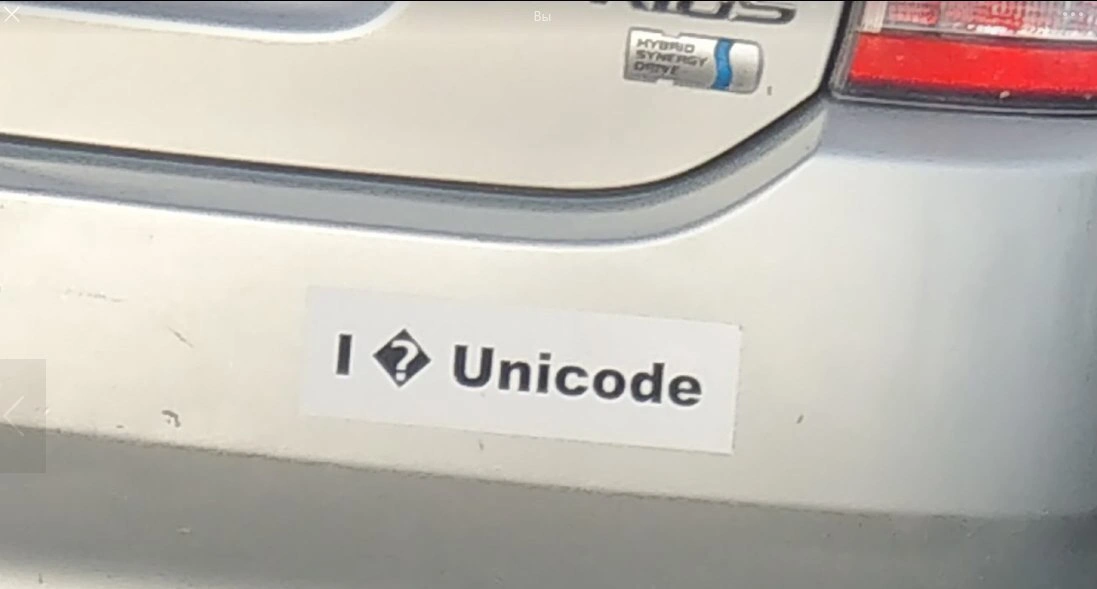
Ironic Bumper Sticker Shows a Classic Unicode Fail
DataFormats Post #391, on May 24, 2019 in TG

Ironic Bumper Sticker Shows a Classic Unicode Fail

Why is this DataFormats meme funny?

Level 1: The Confused Heart

Imagine you’re drawing a picture with a special heart symbol to say you love something, but when you hold it up, everyone just sees a big question mark where the heart should be. It’s as if you tried to say "I ♥ Unicode" but it came out as "I ? Unicode". That’s exactly the joke here. The person wanted a bumper sticker that says they love Unicode (Unicode is like a universal language for computers to handle text from all languages). But somehow, the heart didn’t print right, and a funny unknown symbol showed up instead.

It’s like sending a love note and the heart emoji turned into a question mark on the other person’s phone. The result looks silly and a bit absurd: you expect a heart, but you get this “I don’t know what this is!” symbol from the computer. That mix-up is why it’s funny. It’s taking a technical mistake – something didn’t understand the heart symbol – and turning it into a real-world joke. Even if you don’t know about computers, you can giggle at the fact that the car’s sticker is kind of messed up: the love literally got lost in translation, and now it says "I (weird question diamond) Unicode." It’s a nerdy way of saying, "Oops, my heart didn’t show up, but I meant love!" The humor is in that little oopsie — a heart turned into a mystery symbol — right there for everyone to see.

Level 2: Broken Heart Symbol

Let’s break down what’s happening in simpler terms. Computers store text as numbers, and character encoding is like the secret code that maps those numbers to letters or symbols. A long time ago, there was ASCII, which handled basic English letters, numbers, and punctuation by assigning each one a number (like A=65, B=66, etc.). But ASCII was limited – it didn’t include symbols like ♥ or letters from other languages like ñ or 渡. Different regions came up with different code pages (imagine separate little codes for Western Europe, Eastern Europe, Asia, etc.), but that was messy; a number in one code page could mean a totally different character in another.

Unicode came to the rescue by creating one huge list for (almost) every character you can think of. Unicode gives a unique number (a code point) to characters from multiple languages, emojis, math symbols, you name it. The heart ♥ has a Unicode number, for example, and so does the Unicode logo character itself (🕴 just as an example). However, to get these numbers into a file or through the internet, we use an encoding like UTF-8. UTF-8 is super popular because it can represent any Unicode character and is also efficient. In UTF-8, common characters (like English letters) stay one byte (so ASCII text looks the same), but fancy characters like ♥ take more bytes (in fact, ♥ takes three bytes in UTF-8).

Now, an encoding bug happens when one part of the system speaks one "language" for text and another part expects a different "language". Imagine you write down a secret message in Morse code but your friend tries to interpret it as Braille – the result would be gibberish. In tech terms, if something was saved in UTF-8 but read as if it were Latin-1 or ASCII, the bytes get misinterpreted. That’s when you see those funky sequences like "â" or random question marks on your screen. The text isn’t actually corrupted – it’s just being translated with the wrong cipher. We call this kind of mishap mojibake (a fun Japanese word meaning "unintelligible transformation"), which is essentially text turning into nonsense due to encoding mix-ups.

The black diamond with a question mark — — is what we call the replacement character. Think of it as a placeholder or a white flag from the computer. When it sees a number that doesn’t translate to a valid symbol in the current encoding scheme, it throws up its hands and says, “I don’t know what this is, so I’ll just put this � symbol here.” It’s literally an error symbol for text. You’ve probably encountered it or its cousins: maybe you’ve opened a document or a web page and saw weird characters like � or boxes or hieroglyphic-looking stuff where normal punctuation or emojis should be. That means the program showing you the text got some bytes it couldn’t interpret correctly.

So in the bumper sticker, the owner likely wanted it to say "I ♥ Unicode". But somewhere in the process of making that sticker, the heart symbol didn’t get handled right. Perhaps the design was made on a computer that used the heart, but the printer or software only understood basic text and not the heart’s Unicode. The heart’s code got lost in translation, and the printer substituted the generic � character. The result: "I � Unicode". In plain English, the computer couldn’t draw the heart, so it drew a question-mark-in-a-diamond to show something went wrong. It’s as if the sticker literally has a bug printed on it!

This is a classic tech humor gag because it takes an annoying real-life coding problem and makes a joke out of it. It’s like if someone had a shirt that said "404 Love Not Found" (playing on the "404 Not Found" web error). Here it’s "I � Unicode" – which is funny because Unicode is supposed to handle symbols like hearts, yet the symbol failed to show up. Developers find it amusing and relatable because almost everyone in programming has hit this problem at least once: you try to display some text with a special character, and you end up with either a bunch of nonsense characters or this replacement symbol.

For a newer programmer, think of a time you copied and pasted text and got weird results. Maybe you wrote a Python script on Windows and the output in the terminal showed odd characters instead of quotes or dashes, or you saw question marks instead of an emoji on an older device. That’s exactly what’s going on here. The fix in those cases is usually to make sure you’re using the right encoding (these days, UTF-8 is the safe bet) consistently everywhere. For instance, saving a file as UTF-8 and also reading it as UTF-8. If you mix up, say, UTF-16 and ASCII, or forget to specify encoding when reading a file, you’ll hit these funky symbols.

In summary, the bumper sticker meme is saying: even the thing that’s meant to solve text encoding problems (Unicode) isn’t safe from a classic encoding slip-up. It’s a playful wink to developers: "Haha, look, even our “I love Unicode” sticker got an encoding bug!" It teaches a small lesson too – always be mindful of your text encoding – but in a lighthearted way. And if you didn’t get all the technical details, at the very least you can appreciate that the heart was supposed to be there, and instead there’s a goofy question mark symbol, which is pretty much the computer version of a mistake. That contrast is what makes it funny.

Level 3: UTF-8 Heartbreak

For seasoned developers, this meme hits like an inside joke about one of our oldest nemeses: character encoding bugs. The bumper sticker reads "I � Unicode" instead of the intended "I ♥ Unicode", and that black diamond with a question mark is instantly recognizable to anyone who’s wrestled with text data. It’s the infamous Unicode replacement glyph, basically the software’s way of saying, "I tried to print a character here, but I had no clue what it was." Seeing it smack in the middle of an "I ♥ ___" phrase is both hilarious and painfully relatable. We’ve all seen an innocent love symbol (♥) or apostrophe or em-dash turn into garbled nonsense when something wasn’t handled in the right format.

Why is this combination so funny? It’s the irony and the meta-humor. The sticker is professing love for Unicode – the universal standard supposed to cure our text encoding headaches – yet it visibly fell victim to an encoding fail. It’s like saying "I love Unicode so much, I even bugged out my sticker to prove it!" The heart symbol — a classic sign of affection — didn’t survive the journey from digital text to physical print, leaving that goofy � symbol in its place. That’s the exact thing Unicode was designed to avoid, which makes it a cheeky self-own and resonates as CodingHumor. Developers see that and chuckle: Of course the "Unicode" sticker has an encoding issue. It’s humor wrapped in irony, the kind that makes you do a double-take and then nod knowingly.

This sticker encapsulates a scenario many devs know too well. Imagine pulling data from a database or calling an API, expecting a nice UTF-8 string, but somewhere along the pipeline an older system or a misconfigured library treats it as ASCII or Latin-1. Suddenly, your user’s name "José" shows up as "José" or a "♥" turns into "♥". That replacement character � is basically a giant red flag that screams "text encoding bug here!". We usually encounter it in logs, console output, or web pages when something wasn’t in the expected data format. It’s a hallmark of a bug that can be trivial or maddeningly elusive: maybe a missing header, an outdated library default, or forgetting to use .encode('utf-8') somewhere. Seeing that symbol on a car’s bumper is unexpected and comical – it’s like the bug jumped out of the matrix into real life.

The phrase "I � Unicode" can be read as "I [unknown] Unicode" – almost as if the driver is questioning their love for Unicode or admitting their love got mangled. It hints at a love-hate relationship: we do ♥ Unicode because it lets us use emojis, international characters, and symbols easily… but oh boy, if you’ve ever dealt with a legacy system that doesn’t get the memo, your ♥ can quickly turn into a �. In other words, Unicode is great, until something somewhere isn’t actually Unicode-compliant. Many of us have battle stories: an out-of-date database that only speaks Latin-1, an email client that misinterpreted UTF-8, or a mis-set default encoding that led to hours of debugging gibberish output. This meme winks at those shared struggles.

Notice the small detail above the sticker: the car’s badge says "HYBRID SYNERGY DRIVE". Unintentional as it may be, it’s a nice metaphor for what Unicode is trying to do – create a hybrid synergy between all the world’s writing systems in one standard. But when systems mix old and new (like a hybrid of legacy code pages and Unicode), synergy can turn into chaos. The bumper sticker essentially shows an encoding mismatch: perhaps the text "I ♥ Unicode" was designed on a computer, but when printing, the software or font used couldn’t interpret the ♥ symbol. Maybe the heart wasn’t in the chosen font’s repertoire, or the file with the design was saved in the wrong encoding. The result is a missing glyph icon in place of a heart. It’s the kind of subtle mistake only someone fluent in tech would catch. A non-dev might just see a weird question-mark symbol, but devs immediately recognize the sign of an encoding_fail.

From an engineering standpoint, this highlights how legacy data formats and modern systems intersect. It’s a reminder that even though Unicode has been the standard for decades now, ASCII and other regional encodings (often called code pages) still lurk in the wild. For example, a file saved as "ANSI" on Windows (which might actually be Windows-1252) won’t know what to do with a ♥ character – that code point isn’t in its 0-255 range. If that file is later read as UTF-8, or vice-versa, boom – you get either nonsense or a replacement char. It’s a classic integration glitch: one piece speaks Unicode, another doesn’t. In big systems, these bugs pop up at the worst times (often in production when a user inputs "😊" or "Δ" or some non-ASCII symbol and everything downstream chokes). As a result, the unicode_replacement_character has practically become a mascot for "text bug happened here."

This meme is essentially an expert-level Easter egg. It’s not just saying "I love Unicode" – it’s also showing off a bug in plain sight and expecting you to get the joke. It’s the kind of thing you’d only find funny if you’ve been burned by character encoding issues before. The combination of DeveloperHumor and RelatableHumor comes from that shared pain. We laugh because we’ve all been there: hours spent debugging why "é" turned into "é" on the website, or why a simple heart symbol crashed an ASCII-only service. There’s even that old tongue-in-cheek saying: "There are 2 hard things in computer science: cache invalidation, naming things, and off-by-one errors." Seasoned devs often amend: "and character encoding." This bumper sticker is the physical proof of that adage – even a literal ♥ can trip you up if you’re not careful.

In true geek fashion, whoever made this sticker took a glitch and made it the punchline. It’s like wearing your failures as badges of honor. No doubt, any coder tailing this car would grin and think, "Ha, I see what you did there." It’s a small comforting reminder that we’re not alone in our facepalm moments – somewhere out there, another programmer had a heart-to-question-mark situation and decided to proudly slap it on their Prius for all to see. And instead of being a failure, it became a joke we can all appreciate.

Level 4: Substitution of Last Resort

At the lowest level, text is just numbers. Unicode assigns every character a unique code point (think of it as an ID number). For example, the heart symbol ♥ has a code point (let's say U+2665 for the black heart suit). In Unicode, "I ♥ Unicode" is actually the sequence: U+0049 (I), U+0020 (space), U+2665 (♥), then U+0020 U+0055 U+006E ... for " Unicode". To actually store or send those code points, they must be turned into bytes via an encoding. The most common encoding, UTF-8, will represent U+2665 (♥) as a multi-byte sequence: in hex, E2 99 A5.

Now, if everything goes right, any program reading E2 99 A5 as UTF-8 will happily display "♥". But if something along the way interprets those bytes incorrectly (say, as plain ASCII or a different code page), things go wonky. ASCII, for instance, only knows about 0-127. Bytes like 0xE2, 0x99, 0xA5 are out-of-range, so an ASCII-based system just shrugs. Older data formats or misconfigured software might instead treat each of those bytes as separate characters in a legacy encoding (like Windows-1252). In Windows-1252, 0xE2 is "â", 0x99 is "™", 0xA5 is "¥". So you’d get "I ♥ Unicode" – classic mojibake (garbled text from encoding mix-ups).

Modern decoders often handle this more gracefully by using a special fallback symbol. Unicode actually reserves a code point U+FFFD for replacement when something can't be decoded properly. This is the Unicode replacement character, rendered by most fonts as a black diamond with a white question mark: . It's the universal placeholder for "unknown character" or "invalid byte sequence". When a UTF-8 decoder encounters bytes that don’t form a valid character, it will typically insert a U+FFFD as a safe replacement and move on. This prevents the decoder from crashing or misaligning on a stream of text. It’s a bit of defensive design: even errors are standardized. The nickname for U+FFFD is "replacement glyph" or "substitution of last resort" – basically, "I tried to decode something here and this is all I got."

In our case, that heart symbol fell victim to such a substitution. The sequence meant to be "♥" didn’t decode as valid Unicode in whatever process made the sticker, so it was replaced by . The result is literally baked into the meme: I � Unicode. This is Unicode’s internal self-repair mechanism made visible – the sticker showcases that even Unicode itself has a plan for failure. Ironically, Unicode, which unifies world scripts, also includes a symbol to represent “Oops, couldn’t read that one.” This allows text processing to continue past errors. For example, decoding a malformed sequence:

# Intentionally break a UTF-8 sequence for '♥' by dropping the last byte
broken_bytes = b'I \xe2\x99 Unicode'
print(broken_bytes.decode('utf-8', errors='replace'))
# Prints: "I � Unicode"

Here the decoder sees an incomplete 0xE2 0x99 sequence (supposed to be ♥ = 0xE2 0x99 0xA5), can’t resolve it, and thus inserts a single as a stand-in before carrying on. Under the hood, this ensures data integrity – better to show an obvious placeholder than silently produce wrong characters or crash. It’s a fascinating corner of text-handling theory: by design, the replacement character keeps streams of text resilient. In essence, the meme is a real-world sighting of a low-level text encoding safeguard in action.

Description

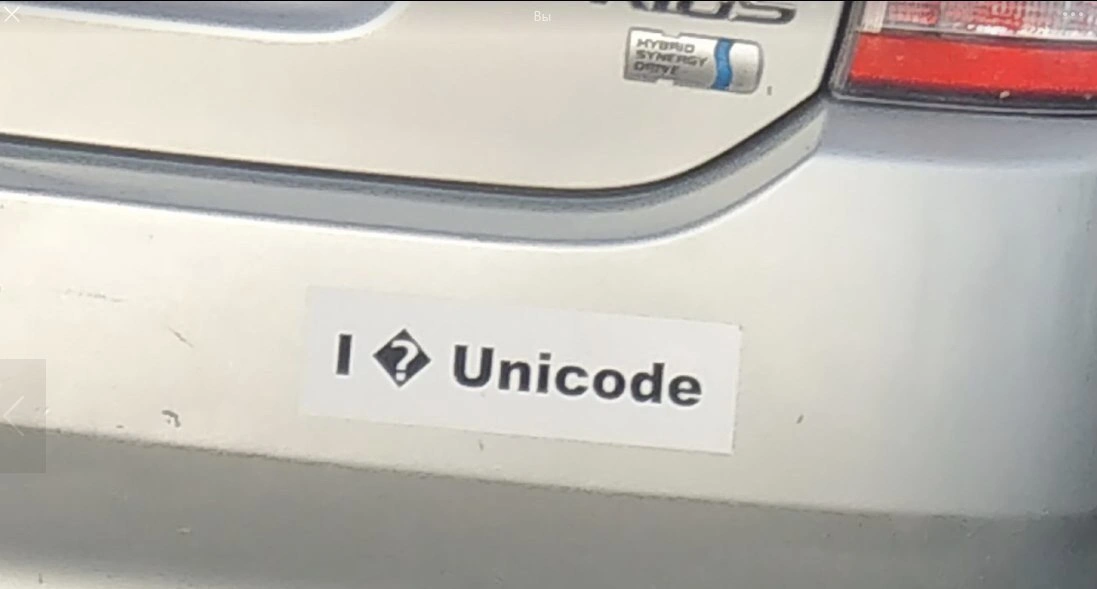
A close-up photograph of a silver car's rear bumper. On the bumper is a white rectangular sticker that reads, 'I � Unicode'. The character that is supposed to be a heart (❤️) has been incorrectly rendered as the Unicode replacement character (U+FFFD), which is a black diamond with a white question mark inside. In the background, a 'HYBRID SYNERGY DRIVE' emblem is visible on the car's trunk. The humor is deeply ironic: the sticker professes love for Unicode, the standard designed to prevent character encoding issues, yet it perfectly demonstrates the exact problem of 'mojibake' or garbled text that occurs when encoding is handled improperly. This is a highly relatable in-joke for any developer who has battled with UTF-8, database collations, or font rendering issues
Comments

8
Anonymous ★ Top Pick That's the physical manifestation of setting your database connection to latin1 while your tables are utf8mb4. It wants to show love, but all it can commit is ambiguity
  1. Anonymous ★ Top Pick

    That's the physical manifestation of setting your database connection to latin1 while your tables are utf8mb4. It wants to show love, but all it can commit is ambiguity

  2. Anonymous

    My “I ♥ Unicode” sticker took the same route as our prod logs - five microservices and one CP1252 gateway - so of course it showed up as “I � Unicode.”

  3. Anonymous

    The laptop sticker perfectly captures our relationship with Unicode: we claim to support it in every sprint planning, but production always ends up with mojibake in the CEO's quarterly report

  4. Anonymous

    It says 'I � Unicode' - and honestly, the replacement character expresses my feelings about encoding more accurately than the heart ever could

  5. Anonymous

    Nothing says 'I love Unicode' quite like displaying U+FFFD - the replacement character that haunts every developer who's ever tried to parse user input from a legacy system. It's the technical equivalent of saying 'I love cooking' while serving a burnt dinner. The sticker perfectly captures that moment when your UTF-8 decoder encounters invalid byte sequences and throws up its hands in defeat, rendering the very symbol of encoding failure. At least they're honest about the relationship - it's complicated, full of edge cases, and occasionally displays characters that shouldn't exist. Every senior engineer has debugged this exact diamond-question-mark at 2 AM, wondering if the issue is in the database collation, the HTTP headers, or just cosmic punishment for not reading the Unicode specification thoroughly enough

  6. Anonymous

    Nothing says "I love Unicode" like the heart rendering as U+FFFD because the print shop decoded UTF‑8 as CP1252

  7. Anonymous

    Peak i18n: HTTP says charset=UTF-8, JDBC writes latin1_swedish_ci, MySQL “utf8” is 3‑byte, marketing pastes a ❤️ - production prints U+FFFD

  8. Anonymous

    I ♥ Unicode: because NFC normalization on legacy strings beats any microservices refactor

Use J and K for navigation