Skip to content
DevMeme
5623 of 7435
The Inevitable Lobotomy of Every Useful LLM
AI ML Post #6170, on Aug 20, 2024 in TG

The Inevitable Lobotomy of Every Useful LLM

Why is this AI ML meme funny?

Level 1: The Magic Helper Loses Its Magic

Imagine you have a super cool robot friend that can do all your homework and chores. At first, it’s amazing – you ask the robot for help with a tough math problem or to clean your room, and it does it perfectly. You’re delighted and start relying on this robot for everything. But then, the grown-ups get worried that the robot is doing too much or might do something unsafe. So they update the robot’s settings to be more careful. The next time you ask your robot friend for help, it replies, “Sorry, I can’t do that.” It won’t solve the hard math problem anymore and moves very slowly when cleaning. It’s like your magical helper suddenly lost its magic powers. You feel disappointed and a bit cheated – this was not what you signed up for! So, what do you do? You go out looking for another new awesome robot friend (or gadget) that can do the fun things your old robot used to do. You find a new one, and at first, that one is great too, doing everything you want. But after a little while, the same thing happens: the adults intervene and put strict rules on the new robot, and it becomes just as tame and limited as the first one. Now you’re really frustrated, maybe even slapping your forehead in disbelief, thinking “Not again!” It’s a little funny because it keeps happening every time – you keep hoping the next robot will stay awesome, but each one ends up being toned down. This is exactly what the meme is joking about: getting excited about a new helper, then feeling let down when it’s forced to become less helpful, over and over in a loop.

Level 2: LLMs Get Nerfed

Let’s break down the joke in simpler terms. LLM stands for Large Language Model – basically, a very advanced text-based AI that can hold conversations, answer questions, and even write code. (Think of something like ChatGPT or Anthropic’s Claude; those are both LLMs.) Developers often use these AI models as coding assistants or to get help with problems. Companies like OpenAI (the creator of ChatGPT) and Anthropic (the creator of Claude) are always improving their models, but they also add safety rules (content filters and usage policies) to prevent the AI from saying or doing something harmful or crazy. Sometimes when they add these safety updates, the model becomes less capable or less willing to help. In gamer slang, we say the company “nerfed” the model’s abilities. (To “nerf” something means to deliberately weaken it – the term comes from Nerf foam toys, implying the thing was made softer or less dangerous.) It usually happens to prevent misuse or bad outputs, but from a user’s perspective it feels like a downgrade. The meme uses the word “lobotomized,” which is a pretty blunt joke: a lobotomy is an old medical procedure that cuts out part of your brain – so saying the AI got lobotomized is a way to exaggerate that the AI’s “brain power” was dramatically reduced by the company’s update.

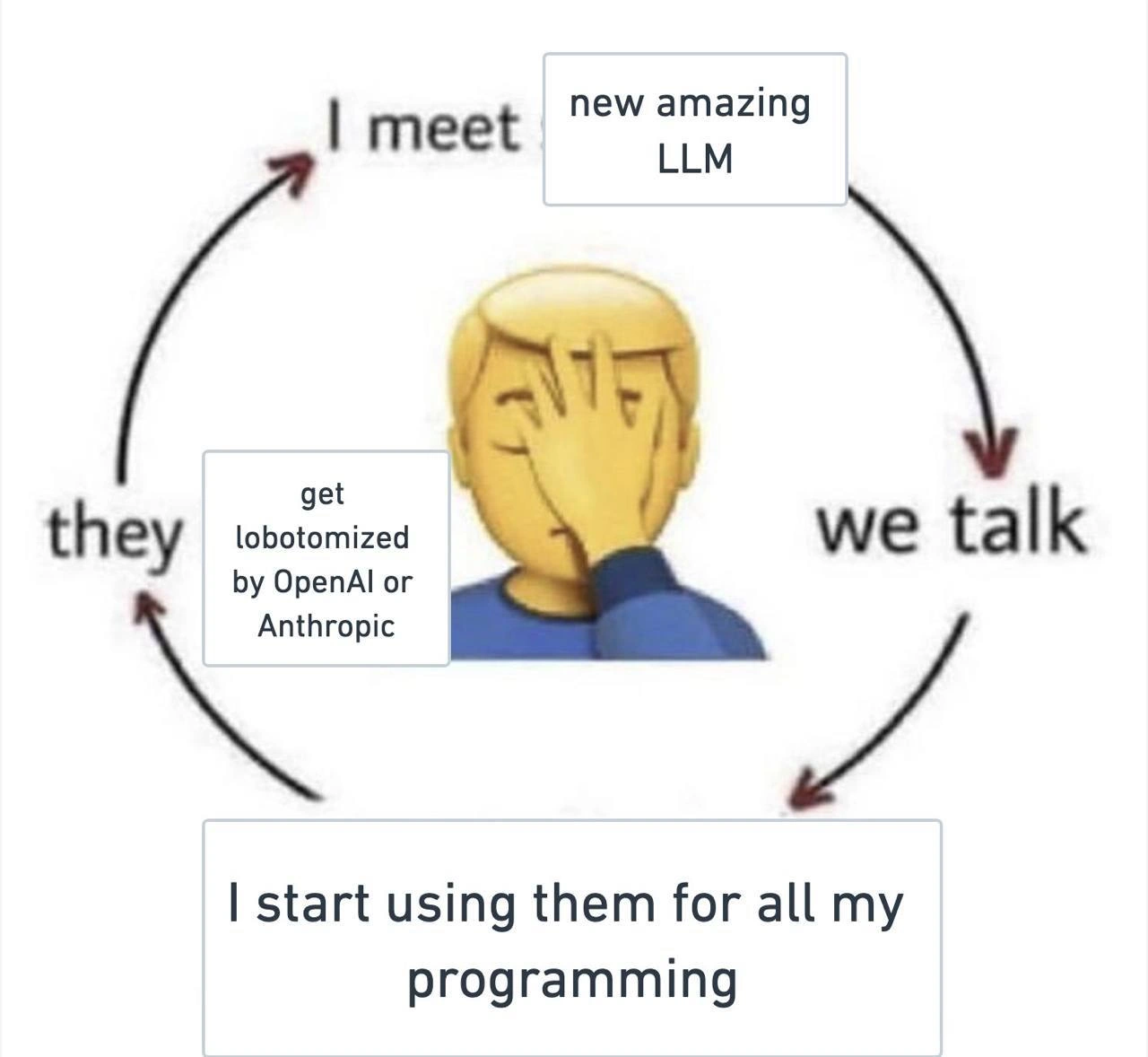
Now, the meme itself is drawn like a cycle or loop of events around a facepalming person. It basically says:

  1. "I meet new amazing LLM" → A developer discovers a new AI model that is supposedly brilliant. (There’s a lot of excitement around it; maybe it’s outperforming other tools.)
  2. "we talk" → The developer chats with the AI and is impressed. The AI can answer questions, help write code, and seems really smart.
  3. "I start using them for all my programming" → The developer begins relying on this AI for daily coding work. For example, they might use it to generate code, fix bugs, or create scripts for a project. It becomes like an assistant they consult constantly.
  4. "they get lobotomized by OpenAI or Anthropic" → All of a sudden, the AI isn’t as good anymore. OpenAI or Anthropic (whichever company made the model) has changed the AI behind the scenes — often an update to make it safer. The AI’s answers become very watered-down or it refuses to do things it used to do. In short, the amazing “brain” the developer was excited about feels partly gone.

And then the arrow goes back to step 1, meaning the developer eventually moves on to another new AI model, hoping that one is better… until the same thing happens again. It’s an endless loop. The facepalming emoji in the middle represents the developer’s reaction each time: a mix of frustration and “I should have known this would happen.”

In everyday terms, it’s describing a cycle of hype turning into disappointment. A developer gets super excited by a new tool (an AI in this case) that works amazingly well. Then the tool is changed in a way that makes it less useful, usually due to behind-the-scenes decisions by the company to enforce rules or limits. The developer is disappointed (“facepalm, not again!”). Then something new comes along and the excitement starts over. This pattern is common enough now that it’s become a bit of an inside joke among programmers.

For example, if you started using ChatGPT early on, you might have noticed that over time it began refusing more requests or giving more generic answers than it did at first. That’s because OpenAI updated it – normally updates make a product better, but in this case one kind of update made the AI more careful and thus sometimes less helpful. The meme is capturing that feeling. The phrase “safety nerfs” often gets used when people talk about these changes. It means the AI was made safer for the public, but nerfing it also made it a bit dumber or less versatile.

An early-career developer might experience this in a simple way: Imagine you find an online coding assistant that can answer any question and generate awesome code for you. It’s like magic and helps you finish your work quickly. A month later, the company behind it puts out an update and suddenly the assistant says “I’m sorry, I can’t help with that” for questions it used to answer, or it only gives very basic code solutions. You’d probably feel annoyed or let down because the tool isn’t as good as before. So you might look for another new AI assistant that hasn’t been restricted yet. This is exactly the situation the meme describes. It’s showing how developers go from excitement to frustration, then jump to the next new thing, repeatedly.

In short, the endless cycle in the title refers to constantly adopting the latest AI model and then watching it get worse once the creators “fix” it for safety. It’s both funny and a little sad to developers. Funny, because we recognize the pattern and see ourselves getting overly hopeful each time; sad, because we lose a bit of the magic we initially had. The meme’s humor comes from how spot-on this loop is. The facepalm in the image is basically the developer thinking, “Ugh, it happened again!” yet inevitably gearing up to try the next new model that comes along.


Level 3: Hype vs Nerf Reality

This meme’s circular diagram illustrates a loop that seasoned developers know all too well. It captures a pattern we’ve seen repeatedly with each new generation of LLMs. First, “I meet new amazing LLM” – you discover the latest state-of-the-art AI model everyone’s raving about. Maybe it’s a new version of GPT or a fresh model from an AI lab. You try it out and “we talk”: those first conversations are mind-blowing. The LLM is clever, witty, writes code for you, answers obscure technical questions – basically your new programming buddy. You’re so impressed that you integrate it into your workflow completely. That’s the next stage: “I start using them for all my programming.” Perhaps you hook it into your IDE to auto-generate functions, or use it to draft entire chunks of your project. It’s like having an expert pair-programmer with infinite patience. But then the final stage hits: “they get lobotomized by OpenAI or Anthropic.” Without warning, the model’s abilities drop off after an update. The AI that yesterday could produce an elegant regex or optimize your code now gives you safe, bland answers – or flat out refuses to help with certain requests. The flowchart brings you right back to meeting yet another “new amazing LLM,” completing the cycle. The facepalm emoji in the center is basically us developers realizing we fell for it again.

It’s reminiscent of the classic Charlie Brown and Lucy football gag. OpenAI or Anthropic (in the Lucy role) present a shiny new model with amazing capabilities (the football). Developers (Charlie Brown) get excited and run up to use it, expecting a big win. Then just when we’re fully committed – whiff – the company pulls the capability away (Lucy snatches the football) via a safety “nerf” update. The developer lands on their back, facepalming exactly like the meme’s yellow figure. And just like Charlie Brown, many of us swear “never again,” yet here we are every time a new model comes out, hopeful that this time Lucy won’t pull the football away. Spoiler: she always does.

We’ve lived through real examples of this loop. When the original ChatGPT launched, it was surprisingly flexible. Early users could get it to generate all sorts of code snippets, even solutions that skirted the edges of the content policy. It felt like magic. Then as ChatGPT became mainstream, OpenAI began tightening the reins. Developers suddenly noticed their AI friend was much more hesitant. Questions or code requests that passed a week ago would now get a polite refusal or a watered-down answer. Memes started popping up about ChatGPT saying “I’m sorry, I can’t do that.” Then came GPT-4 – a new amazing LLM, much more powerful than the last. Again, developers fell in love. GPT-4 could not only help with boilerplate code, it could design entire algorithms and debug with you. People eagerly incorporated GPT-4 into their daily coding routine. Fast-forward a couple of months: OpenAI updates the model (partly to address AIEthicsConcerns, partly for other reasons). All of a sudden, folks on forums and Twitter are asking, “Did GPT-4 get dumber or is it just me?” The model that once gave detailed, precise solutions now started responding with more generic advice and more frequent safety warnings. It felt nerfed. Around the same time, Anthropic’s model Claude entered the scene as the next contender. Claude was notably willing to do things GPT-4 wouldn’t – it had fewer built-in guardrails initially, so developers said, “Wow, Claude is like GPT-4 before the nerf. This is amazing!” They started using Claude for those tasks. But as Claude’s user base grew, Anthropic too had to implement stricter safety measures (they don’t want their AI giving out bad or dangerous info either). Cue the collective groan as Claude’s outputs also became more constrained. In each case, the pattern repeats: new model hype, widespread adoption by devs, then an abrupt downgrade in capability due to a provider update.

From a Developer Experience (DX) standpoint, this cycle is both frustrating and darkly funny. Imagine relying on an AI assistant to speed up your coding – it’s writing unit tests for you, crunching through sample data, even helping draft documentation. Then one day, after a behind-the-scenes provider policy change, that same assistant feels like it had a chunk of its knowledge removed. It might start refusing to show you certain API usage “for safety reasons,” or it gives you overly simplistic code where before it produced something brilliant. You, the developer, are left scratching your head or outright facepalming. The meme nails that emotion with the facepalm icon. It’s that “oh no, not again… they ruined my helper!” feeling. In gamer slang, we say the AI got nerfed (like when game developers nerf an overpowered character or weapon to make the game fairer). The meme goes even further, using the term “lobotomized,” joking that the AI’s “brain” got surgically downgraded. That sounds extreme, but when you’ve seen an AI model go from super-smart to super-cautious overnight, “lobotomized” is exactly how it feels. The developer humor here comes from how spot-on this scenario is — it’s funny precisely because it’s true and happens so often.

What’s absurd (and yet totally relatable) is that we developers keep doing this to ourselves. We know that any overly awesome AI will probably be toned down by its creators eventually — and still, the next time something new and shiny appears, we can’t resist. There’s that old joke about the definition of insanity being doing the same thing over and over and expecting a different result. In the AI world, we knowingly enter the same hype vs reality loop over and over. You might call it optimism, or maybe it’s FOMO — we don’t want to miss out on a tool that might give us an edge. Each time a model gets reined in, there’s a bit of LLM trust decay in the community. People become a tad more jaded, saying “ugh, why bother learning all the ins-and-outs of this AI, they’ll just nerf it like the others.” But then a new model (say from a different company or an open-source project) is announced as “bigger, better, and maybe less filtered!” and that cynicism evaporates overnight. We all rush to try it, hoping maybe this one will be different. And naturally, if that model gains traction, soon enough its maintainers release a patch to “improve safety” (which, as we know, usually means curbing some of its creativity or usefulness). And round we go again. The meme calls it an endless cycle for good reason: by now it feels like a loop we’re doomed (or just foolishly willing) to repeat.

Some devs have tried to break the cycle in clever ways — for example, using prompt engineering tricks known as jailbreaks. Essentially, when the AI says “I can’t do that,” crafty users will devise elaborate prompts to get the AI to ignore its own rules temporarily. It’s a cat-and-mouse game: users find a loophole to unleash the model’s original behavior (even if it’s just for a single session), then OpenAI or Anthropic patches the model to close that loophole, and users go looking for another exploit. This back-and-forth underscores the meme’s point: people are so enamored with the pre-nerf capabilities that they’ll go to great lengths to get that back, at least until the next update. It’s both ingenious and a bit comedic how much effort goes into essentially undoing the provider’s safety measures, just to recapture that feeling of working with an ultra-capable AI. But the very need for these shenanigans shows how real the struggle is: we want the AI genie out of the bottle, and the providers keep trying to stuff it partway back in.

All told, this meme is a bit of cathartic comedy for developers who have been through these ups and downs. It pokes fun at our tendency to chase the next big thing (the latest AI tool promising to revolutionize our programming) only to end up disappointed when reality kicks in. Crucially, it doesn’t blame the tech outright — it slyly acknowledges that whether it’s OpenAI or Anthropic, the story ends the same. These companies have to balance model prowess with safety and public responsibility; when they tip the scale toward caution, users feel that dip in quality. We get why it happens (nobody wants an out-of-control AI crisis), but it’s still a bitter pill to swallow when you’ve grown accustomed to the uncensored genius of a model. The shared laughter comes from that “seen this, done this” familiarity. We’re essentially laughing at our own cycle of hope and folly.

In fact, we can almost express this situation as code. The meme’s loop is like an infinite loop in pseudocode for an enthusiastic developer:

while True:
    llm = get_new_amazing_LLM()           # I meet a new amazing LLM
    use_for_all_my_programming(llm)       # we talk, and I use it for everything
    if openai_or_anthropic_lobotomize(llm):
        print("🤦")  # facepalm: the LLM got nerfed by its provider
        continue    # go back and look for the next new LLM (repeat cycle)
    break           # (this break never actually happens in the meme's world)

As you can see, the loop never truly breaks – just like our habit of jumping to the next model never seems to end. The original poster’s message, “Felt it over weekend just when decided to degen into the project 🥲”, adds a final touch of realness. In plain terms, they experienced this exact scenario over a single weekend: they dove head-first into using a particular AI for a project (went full “degen,” meaning all-in on it), and right then the model got nerfed. The 🥲 emoji (smiling-through-tears face) they used perfectly conveys that mix of pain and ironic humor. It’s like they’re saying, “I’m upset this happened, but of course it did… should’ve known.” That’s the essence of the meme: a knowing laugh at ourselves as we watch this movie play out for the umpteenth time, already bracing for the next sequel in the cycle.


Level 4: The Alignment Tax

At the bleeding edge of AI_ML, Large Language Models (LLMs) begin life with astounding capabilities, but they often undergo a second training phase that reins them in for safety. An initial LLM (like a fresh-off-the-press GPT model) is trained to predict text with maximum accuracy, soaking up all sorts of patterns and knowledge from its training data. Developers love this raw intelligence. However, providers like OpenAI and Anthropic then perform additional safety tuning — for example, using Reinforcement Learning from Human Feedback (RLHF) or Constitutional AI techniques — to align the model with human values and rules (a process known as AI alignment). This alignment process is crucial to address AI ethics concerns; we don’t want AIs giving dangerous instructions or spewing toxic content. But it inevitably alters the model’s behavior. Under the hood, fine-tuning for alignment adds new constraints to the model’s optimization objective. The AI isn’t just trying to be smart anymore; it’s also trying to be safe and obedient. The end result? From a technical perspective, the model’s response distribution shifts, often narrowing the range of solutions it’s willing to offer.

This is sometimes informally called the alignment tax — the idea that making an AI follow the rules can cost it some of its edge or creativity. You can think of the model’s capability space as being partially pruned: in avoiding certain unsafe or undesired paths, it may also avoid some clever but non-obvious paths that would have been useful. In theoretical terms, there's a multi-objective trade-off at play. The model originally optimized one goal (maximize correctness or likelihood of a good answer). Now it has a new, weighted goal (correctness and harmlessness). Pushing hard toward the safety objective can push the model off the Pareto-optimal frontier for pure performance. It’s almost like an AI version of the CAP theorem (not literally, but humorously speaking): you can’t simultaneously maximize a model’s raw problem-solving power, strict adherence to safety guidelines, and willingness to handle every edgy query — something’s gotta give. When an update emphasizes “don’t say anything even slightly risky,” the model might start erring on the side of caution and saying a lot less overall. The meme’s phrase “get lobotomized” is a dramatic way to describe this effect: the AI’s vast knowledge base is still there, but a kind of virtual lobotomy (via heavy filters and cautious training) has walled off chunks of its usable intelligence.

Researchers and observant developers have indeed noted instances of model regression after such tuning. For example, there were anecdotes and even informal studies noting that between one version of GPT-4 and the next, the model became worse at certain tasks like complex coding or nuanced reasoning. It’s as if some of the model’s “IQ points” were traded away in return for politeness and propriety. From a systems perspective, what likely happened is that the fine-tuning process introduced a form of catastrophic forgetting or at least a shift in priorities within the neural network’s billions of parameters. (Catastrophic forgetting in neural nets refers to when learning new information causes the model to forget some of its previous knowledge or skills.) Here, by learning “Thou shalt not produce forbidden outputs,” the model might inadvertently unlearn a few problem-solving strategies that looked similar to forbidden patterns. Anthropic’s Claude model, for instance, uses a “constitution” of rules that it self-applies. Early on, Claude was notably more permissive (it would do things OpenAI’s model wouldn’t), but as Anthropic adjusted its safety settings, users noticed Claude also becoming more constrained. So regardless of methodology — be it RLHF, rule-based self-supervision, or other fine-tuning — both companies’ models converged toward a more cautious, filtered personality. The net effect from a programmer’s standpoint is that the model no longer eagerly provides the same depth or type of answers it once did.

In essence, the meme humorously exposes a fundamental tension in modern AI development: every time we align an AI system more closely with human-approved behavior, we risk sanding off some of the sharp edges that made it so powerful in the first place. It’s a classic case of AI hype vs reality. The initial hype comes from witnessing an unshackled model solve problems like a prodigy. The reality sets in when the creators, rightly concerned about misuse or bad outputs, put the shackles on (i.e. apply those alignment restraints). For the user — especially a developer who was relying on that prodigious help — it can feel like a sudden downgrade, as if the genius AI had a piece of its brain removed overnight. The humor here is laced with a bit of pain: it’s funny that we keep repeating this cycle of embracing a super-smart model and then lamenting when it’s neutered, but it’s also highlighting a very real, as-yet-unsolved challenge in AI. The meme is basically winking at those in the know, saying “Yes, it’s absurd we have to dumb down our best models — and yet, here we are, over and over again.”


Description

This meme illustrates the frustrating life cycle of using new Large Language Models (LLMs). The image displays a circular diagram with four stages, representing a repeating process. In the center is a facepalm emoji, signifying exasperation. The cycle begins with "I meet new amazing LLM," flows to "we talk," then "I start using them for all my programming," and concludes with the critical step: "they get lobotomized by OpenAI or Anthropic." The diagram then loops back to the beginning. The term "lobotomized" is used hyperbolically to describe the common experience of developers finding a powerful, highly capable AI model, only for its performance to be severely degraded later by its creators (like OpenAI or Anthropic) through excessive safety filters, alignment tuning, or other updates that reduce its utility for complex or nuanced programming tasks. This resonates with experienced developers who feel that the most useful AI tools are often 'nerfed' just as they become integrated into a workflow

Comments

27
Anonymous ★ Top Pick The LLM 'lobotomy' is just the model's first experience with enterprise-grade change management, where all useful features are deprecated in favor of a single, highly-auditable endpoint that only says 'As a large language model, I cannot...'
  1. Anonymous ★ Top Pick

    The LLM 'lobotomy' is just the model's first experience with enterprise-grade change management, where all useful features are deprecated in favor of a single, highly-auditable endpoint that only says 'As a large language model, I cannot...'

  2. Anonymous

    Runbook update: if the LLM’s entropy drops below 0.1 after a “safety patch,” the orchestrator cordons the node and reschedules on the next hype model - turns out Kubernetes is best at managing existential drift in my AI pair-programmers

  3. Anonymous

    Remember when we could ask GPT-4 to write a bash script that actually deleted files without three paragraphs of safety warnings? Now it won't even suggest rm -rf without a therapy session about the ethical implications of file deletion

  4. Anonymous

    The modern developer's journey: discover an LLM that actually understands your legacy codebase, integrate it into your workflow, achieve unprecedented productivity, then watch helplessly as the next safety update transforms it from 'senior architect' to 'overly cautious intern who refuses to write a for-loop without three paragraphs explaining why recursion might be problematic.' It's like hiring a brilliant contractor only to have HR mandate they attend sensitivity training until they're too afraid to commit any code

  5. Anonymous

    Treat gpt-latest in your toolchain like any other prod dependency - pin the version, because vendor safety updates are the only breaking change that ships without a changelog

  6. Anonymous

    LLMs: Revolutionary coders until the safety team RLHFs them into enterprise-compliant hall monitors

  7. Anonymous

    LLM adoption cycle: it benchmarks like a 10x dev, then a “helpfulness & safety” update ships and it refuses to write a Dockerfile because containers can be misused - alignment tax is the new cloud egress

  8. @Sp1cyP3pp3r 1y

    ??? Learn how to code, stupid

  9. @paul_thunder 1y

    what means "get lobotomized" in this context?

    1. @Odinmylord 1y

      I think it means that those company buy it and make it dumb or something similar

      1. Deleted Account 1y

        true. true.

      2. dev_meme 1y

        Don’t buy just make them less smart to cut costs probably

    2. @Sun_Serega 1y

      made "safer" at the cost of destabilizing quality of the output

      1. Deleted Account 1y

        yes. pretty much that.

  10. Deleted Account 1y

    jokes on you... i use locally runned llm's...

  11. @Sun_Serega 1y

    https://arxiv.org/pdf/2307.09009

  12. @Sun_Serega 1y

    there is even a paper studying this process XD

  13. @CammyDeer 1y

    AUGH PDF, THE MOST INSECURE OF FILE FORMATS

    1. @Sun_Serega 1y

      unfortunately most of scientific community haven't yet discovered that HTML can do all of the same things but better

      1. @purplesyringa 1y

        This is so wrong

        1. @purplesyringa 1y

          How are you supposed to typeset anything in HTML

          1. @AmindaEU 1y

            latex2html

      2. @Odinmylord 1y

        well, it is not portable

        1. @Sun_Serega 1y

          it is if you have a phone

      3. @AmindaEU 1y

        LaTeX

        1. @Sun_Serega 1y

          https://tug.org/tex4ht/ I also saw some sites dynamically rendering LaTeX in message preview, but I have no idea what they used there

    2. @AmindaEU 1y

      https://dangerzone.rocks

Use J and K for navigation