A Purely Functional Reason to Endure a Headache
Why is this FunctionalProgramming meme funny?
Level 1: Brawling Over a Bad Pun
Imagine a friend who is very picky about how things are done – so much that they follow their special rules even when it’s totally funny and unnecessary. In this joke, the friend is a programmer who always writes code with “no surprises.” They believe nothing should happen aside from the one thing that’s supposed to happen. Now, picture that friend has a headache. You offer them medicine to help. But they say, “No, I won’t take it, because it has side effects!” In normal life, we know medicine can sometimes have small unwanted things happen – like a cough syrup might make you a little sleepy as a side effect. That’s usually fine, it’s a tiny price for feeling better. But your friend is pretending to be so strict (and a bit silly) that they refuse the medicine just because of those extra effects. It’s as if they’re following their coding rule in real life: “I only accept things with no side issues at all!” That idea by itself is pretty funny – it’s a goofy mix-up of real life and nerdy rules.
Now, to make it even funnier, the meme shows a scene where after the friend delivers this punchline (the jokey answer about side effects), everyone starts fighting like in a comedy movie. Arms are swinging, people are tumbling over – it’s total chaos, like a big cartoon brawl. Of course, in real life your friends wouldn’t actually start punching each other over a cheesy joke; this is just the meme being exaggerated for laughs. The overreaction is the point: it was a really corny joke and the meme pretends that it was so terrible or so controversial that it caused a riot. It’s kind of like when someone tells a pun in a group and half the people groan “Oh no, that was awful!” while the others laugh – here the groaning and laughing is blown up into a silly fake fight. The emotion we get is both surprise and humor: first you giggle at the wordplay (side effects in medicine vs in programming), then you see everyone ridiculously losing their minds over it, which makes the whole thing even more hilarious. In simple terms, it’s funny because a very strict rule got applied at the wrong time (which is super silly), and then everyone acts out a wild reaction to a very nerdy joke. It’s an over-the-top, playful way to show how one little pun can set off a comedic chain reaction. Even if you don’t know anything about coding, you can laugh at the idea of someone saying no to headache medicine for such a nutty reason – and all their friends literally jumping into a goofy fight about it!
Level 2: Pure Functions, Pure Chaos
Let’s break down the basics of this joke. Haskell is a programming language, and it’s the poster child for what we call functional programming. In functional programming, we try to use pure functions as much as possible. A pure function is kind of like a magical blender: you put something in (input), you get something out (output), and nothing else in the world is changed or affected during the process. The key is that a pure function has no side effects.
Now, what exactly are side effects in programming? A side effect is anything a piece of code does other than returning a result. Think of a function as a little machine: if it’s pure, it just calculates and returns a value. If it has side effects, it might be doing extra sneaky stuff like changing a global variable, writing to a file, showing a message on screen, or modifying a database. For example, imagine we have a function that adds two numbers. A pure version of that function only gives you the sum. But an impure version might also print out “I added two numbers!” to the console or alter some counter variable somewhere – those extra actions are side effects. Side effects aren’t always bad – in fact, a lot of useful things in programs are side effects (reading user input, saving a file, sending an email – these are all interactions with the outside world). However, side effects can make programs harder to understand and debug, because there’s more going on than just input -> output. One part of the code might quietly change something that affects another part, and that can lead to unexpected bugs (the dreaded “spooky action at a distance” in code).
Haskell’s big quirk (and strength) is that it really doesn’t like side effects. In Haskell, you can’t just fire off a print statement or modify a variable whenever you want. Those actions have to be handled in a special way (via things like the IO monad, though you can think of it simply as Haskell’s way of saying “okay, this part might do something in the real world”). If you write a regular Haskell function, you can be pretty sure it’s as pure as math – it won’t suddenly change some internal state or print out unicorn emojis or anything. This is what we mean by FunctionalProgrammingConcepts like functional purity. It’s actually really cool for developers because it means if a Haskell function gave you a result once, it’ll give you the same result every time you call it with the same input, guaranteed, without any sneaky side business. That reliability is one reason functional programming fans love purity: fewer surprises, fewer bugs.
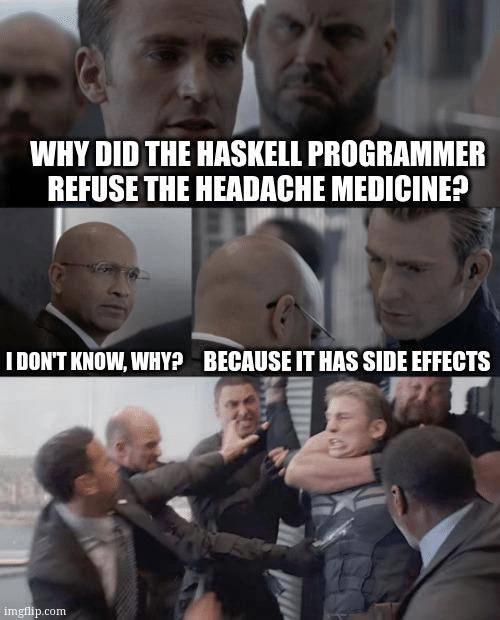
Now to the meme: it’s doing a play on words with “side effects.” In everyday English, side effects usually refer to the unintended secondary effects of a drug or medicine (like a drowsy feeling or an upset stomach you might get besides the main effect of curing your headache). In programming, as we just discussed, side effects are those extra actions a function might do (besides its main job of computing a result). The meme shows a conversation in text form over a three-panel scene:
WHY DID THE HASKELL PROGRAMMER REFUSE THE HEADACHE MEDICINE?
I DON'T KNOW, WHY?
BECAUSE IT HAS SIDE EFFECTS.
In the first panel, someone poses a riddle-like question: “Why did the Haskell programmer refuse the headache medicine?” The second panel shows another person answering, “I don’t know, why?”. This is a classic joke setup—one person is setting up the pun, the other is taking the bait. The third panel delivers the punchline: “Because it has side effects.” Here’s why that’s funny to programmers: a Haskell programmer is portrayed as being so strict about avoiding side effects in their code that they extend this strict rule to real life and won’t take a painkiller because the medicine might have “side effects”! It’s a goofy literal twist—of course, a normal person hearing “this medicine has side effects” would understand it means possible minor drawbacks. But our stereotypical Haskell enthusiast treats “side effects” like a big no-no, exactly how they treat side effects in code. It’s humor rooted in a LanguageQuirk: Haskell people obsess over purity and the meme imagines that obsession spilling out of the coding world.
And then we have the images of the suited men bursting into a brawl in the final panel. This is a meme template taken from an action or thriller movie scene (the specifics aren’t too important, it’s just recognized as “office fight breaking out”). The sudden fight erupting is an exaggeration to make the joke even sillier. Basically, the meme is saying: the pun was so bad or so controversial that it caused a riot. This adds an extra layer of DeveloperHumor: in tech circles, we often jokingly dramatize how a trivial debate or a nerdy pun can lead to “violence” (usually just playful banter, of course). It’s like how a group of developers on a team might jokingly start a loud, mock-serious argument when someone mentions tabs vs spaces, or Vim vs Emacs – nobody is actually angry enough to throw punches, but we pretend it’s an epic battle. Here, the Haskell purity joke escalates into an all-out (comically over-the-top) fight among presumably colleagues or other programmers. The blurred faces and business suits give it a tongue-in-cheek “even the higher-ups are throwing down over this nerdy joke” vibe. It’s absurd and that’s why it’s funny. The core concepts – Haskell, functional purity, side effects – are real programming topics, but the scenario is exaggerated to cartoonish levels, which lets developers laugh at our own intense discussions. After all, whether you’re team “pure functional” or not, everyone can appreciate the image of a boardroom brawl triggered by something as geeky as a pun about side effects!
Level 3: Side Effect Showdown
For the seasoned developer, this meme hits on a well-known source of both pride and playful mockery in the programming world: Haskell’s fanatical avoidance of side effects. The setup is a classic Q&A joke that any programmer steeped in language wars can appreciate. “Why did the Haskell programmer refuse the headache medicine?” It’s immediately clear to the initiated that we’re dealing with a pun on SideEffectsInProgramming. In day-to-day coding, side effects (like a function altering a global variable, writing to a file, or launching a missile 😜) are often the cause of elusive bugs and “headaches” in maintenance. Many of us have slogged through debugging sessions muttering “somewhere, something changed and I didn’t know about it”. So when the answer comes — “Because it has side effects” — it’s a groaner of a pun that makes programmers laugh and cringe in equal measure. It’s funny because it’s true in a bizarro sense: a hardcore Haskell developer so loyal to pure functions might jokingly shun even medicine due to its side effects, the same way they shun impurity in code. The humor taps into that communal experience of DeveloperHumor: we’ve all met (or been!) the engineer who takes a principle too seriously. It’s the archetype of the purity-obsessed functional programming guru who treats mutable state like a deadly contagion. Haskell’s LanguageQuirks include this very obsession — it’s a language where even printing "Hello, World" involves an elaborate dance to keep the action conceptually pure. Seasoned devs recognize this and chuckle at how the meme exaggerates it to ridiculous proportions.
The final panel showing a full-on brawl among suit-clad men is an absurdist flourish. This image is a popular fight scene template used in memes to amplify a punchline: one moment we’re sharing a corny joke, the next moment chaos erupts. Why a fight? It represents how a simple nerdy pun can ignite passionate (and in this case, physically exaggerated) reactions among tech folks. Anyone who’s witnessed a “{Haskell vs. Everyone Else}” flame war on an online forum will smirk at this depiction — minor language debates can escalate swiftly, if only verbally. The suited executives throwing punches could symbolize corporate developers or different language camps losing it over the side effect joke: perhaps the OOP folks vs functional folks in an over-the-top battle royale. It’s a tongue-in-cheek nod to the FunctionalProgramming holy wars: one corny purity joke was all it took to start a melee. In reality, developers don’t literally fistfight over monads, but we do get into spirited arguments at conferences or on Slack about immutability, side effects, and the “right” way to code. The meme perfectly captures that too real feeling — the moment a pun about a programming concept drops, and half the room groans while the other half whoops, and a mock battle of wits ensues. In fact, the phrase “side effects” is notorious enough to spark debate. A senior dev knows the subtext: side effects cause bugs, but avoiding them (like Haskell does) often means steep learning curves and sometimes impractical code. There’s an ironic twist hidden here that a long-time coder might appreciate: Haskell is often touted as a cure for the headaches caused by messy, state-riddled code… yet adopting Haskell can have its own side effects (like a smaller ecosystem, tricky abstractions, or difficulty hiring developers who grok monads). So the “medicine” for code headaches (pure FP) has trade-offs too — but don’t tell the Haskell fanatics that, or another brawl might break out! This blend of genuine software engineering insight and silly exaggeration is what makes the meme so satisfying for experienced devs. It’s an inside joke among colleagues – a “pure” kind of comedic showdown that leaves everyone nodding and laughing (and maybe clutching their aspirin… or not).
Level 4: Monads Over Medicine
At the deepest technical level, this meme riffs on Haskell’s core principle of purity in functional programming. In theoretical computer science, a side effect is any additional effect of a function beyond returning a value – it’s like hidden output that isn’t part of the function’s result (for example, modifying a global state or printing to a console). Haskell is designed to completely eliminate these surprises, adhering to referential transparency: given the same input, a pure function always produces the same output and nothing else. This ideal comes straight from the lambda calculus, the mathematical model of computation that treats functions like equations – no state, no mutation, just input -> output. In a pure functional world, a function (or a medicine!) would have exactly one effect: its intended result, with no side gibberish. The humor here springs from that principle taken to an absurd extreme: if Haskell’s philosophy says “no side effects at all,” then a true Haskell devotee might jokingly reject even headache pills because they come with “side effects” (unintended consequences), violating the sacred rule of purity.
To manage real-world tasks like I/O (which by nature cause effects in the world outside the program), Haskell employs the abstract power of monads. A monad (a concept from category theory) is a kind of computational wrapper that can sequence operations (like reading a file or printing text) while still isolating effects from the pure portion of the code. For instance, Haskell’s IO monad encapsulates actions that interact with the external world. From a theoretical standpoint, this is ingenious: you get to perform needed actions (because any useful program must ultimately interact with the world) without breaking the mathematical model of purity. However, monads are infamous for being a bit mind-bending – a running joke is that explaining monads can itself cause headaches! Here the meme playfully hints at that world: a Haskell programmer, so steeped in the theory that side effects must be handled with care, hears the phrase “headache medicine has side effects” and reflexively recoils. It’s a perfect storm of FunctionalProgramming theory colliding with everyday life. The punchline lands because, at a scholarly level, Haskell folks indeed treat side effects as toxic unless quarantined in monadic purity – extending that attitude to medicine is a nerdy logical leap that echoes the language’s mathematical strictness. In essence, this joke is a nod to the elegant (and sometimes extreme) academic FunctionalProgrammingConcepts underpinning Haskell: in a category-theoretic utopia, even your aspirin would be pure and side-effect-free!
Description
A three-panel meme using the "Captain America Elevator Fight" format from the movie 'Captain America: The Winter Soldier'. The first panel shows Captain America asking with a serious expression, "WHY DID THE HASKELL PROGRAMMER REFUSE THE HEADACHE MEDICINE?". The second panel shows another character, Jasper Sitwell, looking back and setting up the punchline with the text, "I DON'T KNOW, WHY? BECAUSE IT HAS SIDE EFFECTS". The third panel depicts the violent outbreak of the elevator fight, implying the pun was so bad it incited a physical altercation. The humor is a niche technical pun playing on the double meaning of "side effects." In medicine, side effects are unintended and often adverse reactions to medication. In the context of purely functional programming languages like Haskell, a "side effect" is any interaction a function has with the outside world beyond returning a value (e.g., modifying state, writing to a file). Haskell's core philosophy is to minimize or isolate side effects to create predictable, pure functions, making the concept anathema to its practitioners
Comments
8Comment deleted
A Haskell programmer doesn't refuse medicine because of side effects; they just wrap the headache in an IO monad and promise to deal with it... eventually
Pharmacist: “These painkillers are safe.” Senior Haskell dev: “They mutate global liver state without an IO monad - sounds like `unsafePerformIO` in tablet form.”
The real side effect is explaining to your PM why the simple CRUD feature took three weeks because you needed to implement a monad transformer stack to handle database connections 'the right way'
The real headache comes when you try to explain to stakeholders why your Haskell microservice needs a 47-step monad transformer stack just to log a message to stdout. Sure, it's mathematically pure and provably correct, but the side effect is that your team now communicates exclusively through category theory diagrams and nobody can onboard a new developer without a PhD in type theory
Accept one pill with side effects and your whole day’s type becomes IO - now even stand‑up requires do‑notation
Haskell devs treat side effects like production outages: isolate, contain, or abort mission
FP lead at urgent care: No thanks - we don’t allow side effects in prod; last time we did, we had to run a saga to roll back the liver writes
mood, sumatriptan makes everywhere else ache Comment deleted