The Foundational Off-By-One Error in Database Theory
Why is this Databases meme funny?
Level 1: The Extra Rule
Imagine your teacher says, “I have 12 rules for the classroom,” but then you look at the poster and there are actually 13 rules listed. You’d probably giggle and say, “Hey, that’s one extra!” This meme is funny for the same reason. A famous computer scientist made a list of rules and called them “12 rules,” but he sneaked in an extra rule at the beginning, making it 13 in total. It’s like saying you have a dozen donuts for sale, but then there’s actually a bonus donut in the box. Most people would be happy to get an extra donut, but they might still laugh and think, “Did the baker forget how to count?” In the computer world, we sometimes start counting at 0 instead of 1, so our numbers can look a bit off to everyone else. The joke here is basically, “Haha, the computer experts said 12 but meant 13 – no wonder people tease that they can’t count!” It’s a light-hearted laugh at a small mistake (or really, an odd way of counting). Even though it’s just a tiny detail, seeing “12 rules” turn out to be 13 feels silly in a fun way. The humor doesn’t mean computer science isn’t real or important – it just shows that even serious experts can present things in a quirky way that makes the rest of us smile.
Level 2: Twelve Plus One
Let’s break down the joke in simpler terms. E.F. Codd was a famous computer scientist who invented the idea of the relational database – that’s the kind of database where you store information in tables (rows and columns) and use relations between them. Back in the day, Codd came up with a list of twelve rules to define what a relational database system should do. These were basically DatabaseDesignPrinciples or guidelines. For example, one rule said that “all information in the database must be represented as data values in tables” (meaning everything is stored in a table format). Another rule required a comprehensive data language (basically, a way to query and manipulate data – think SQL). These rules were (and still are) taught in CSFundamentals classes to help students understand what makes relational databases special.
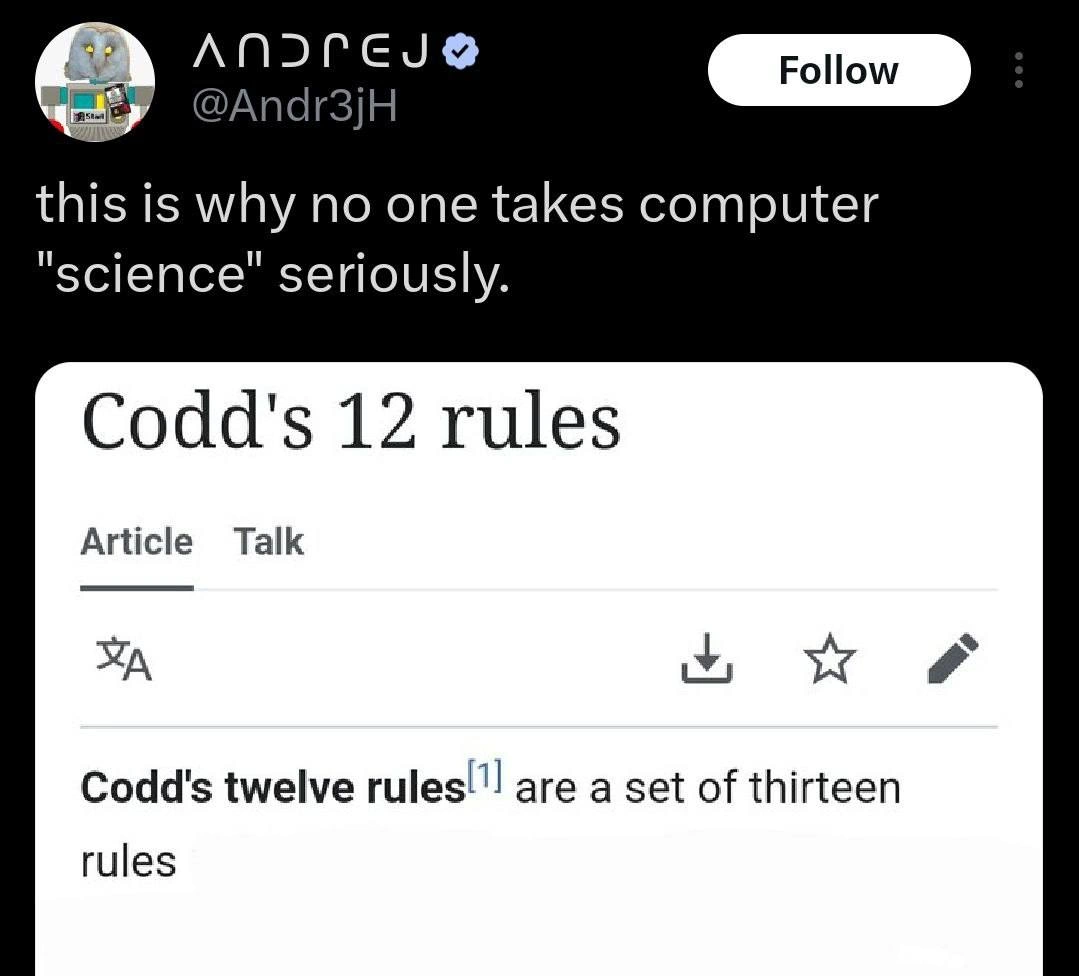
Now, here’s the funny part: Codd numbered his rules starting with 0. So he had Rule 0, Rule 1, Rule 2, ... up to Rule 12. Yes, that is 13 rules total (because you count 0 as the first). But he still referred to them collectively as “the twelve rules.” It sounds like a silly contradiction, right? This is exactly what the meme highlights with the Wikipedia screenshot: “Codd’s twelve rules are a set of thirteen rules.” You might wonder, was this a mistake? Not really! Rule 0 was kind of an introductory rule – a fundamental assumption that “for a system to be relational, it has to be able to manage databases using these rules.” It was added on top of the other twelve, but people never bothered to change the catchy title “12 rules.” It’s a bit like a textbook saying “Chapter 0” for the introduction and then chapter 1, 2, ..., 12 for the main content. It makes sense to the author, but on a quick glance it might look like they miscounted. This little mix-up is precisely the joke.
In programming and computer science, counting from zero is actually common. Many programming languages use 0 as the first index of an array or list. For instance, the first element of an array is index 0, the second is index 1, and so on. So if you have 13 elements, their indices go 0 through 12. That’s likely why Codd’s list of “12” rules goes 0–12. It’s normal for us tech folks, but it can confuse everyone else! In fact, an off-by-one error is a classic mistake where a loop or count goes one too far or one short because of these indexing issues. It’s one of those RelatableHumor moments for developers – we’ve all accidentally written a loop that iterates 13 times when we meant 12. Here’s a tiny example in code that shows how counting can include an extra number if you start at 0:
for i in range(13):
print(f"Rule {i}")
# This will print:
# Rule 0
# Rule 1
# ...
# Rule 12
# (That’s 13 lines: from 0 through 12)
In the code above, range(13) produces numbers 0 to 12. Even though “13” is the count, the last number printed is 12 because we began at 0. This illustrates how a computer person might say “from 0 to 12” and think of it as 12 intervals, even though it’s 13 numbers.
So, the meme is joking that computer science can be a bit too clever or pedantic for its own good. The tweet, with a tone of sarcasm, says: “this is why no one takes computer ‘science’ seriously.” Of course, people do take it seriously (we literally run the world on databases and code!), but the joke is that little things like calling 13 things “12 rules” sound absurd. It’s a playful jab at the ComputerScienceHumor niche: we have great DatabaseSystems theory and precise specs, yet we present them in a way that looks like we can’t do basic arithmetic. For a newcomer or junior developer, the takeaway is that this is just a funny historical quirk. Codd’s rules themselves are important in RelationalDatabaseDesign, but the naming is something of an inside joke. And if you ever see a Wikipedia line like that, now you know it isn’t a typo – it’s our quirky computer science culture showing through.
Level 3: Hard Things: Naming & Counting
Why do seasoned developers smirk at this? Because it combines two of the classic “hard problems” in computer science – naming things and off-by-one errors – into one beautiful little DatabaseHumor package. Codd’s 12 rules are famous in DatabaseSystems lore for defining what makes a true relational database. But here we see the Wikipedia entry flatly state: “Codd’s twelve rules are a set of thirteen rules.” That’s an off_by_one_in_spec if there ever was one! It’s as if the academic world said “twelve” but counted like a programmer and got thirteen. This inside joke plays on the fact that computer folks often start counting at 0 (so counting 0 through 12 gives you 13 items). What’s hilarious is that this isn’t a typo – it’s an intentional numbering scheme by Codd. Yet to any pedantic reader, it looks like a blatant counting mistake. RelatableHumor? Absolutely – every developer has encountered an off-by-one error, like a loop that runs one time too many or an array index out of bounds by one. Seeing such a slip in an official context (a published set of rules) hits close to home.
This meme also pokes fun at academic pedantry: “this is why no one takes computer ‘science’ seriously,” the tweet jabs. There’s a grain of truth in the jest – computer science terminology can be quirky. We have grand-sounding principles and RelationalDatabaseDesign theories, yet we trip over something as basic as numbering. Seasoned engineers recall countless times specs and docs had inconsistencies or poorly named concepts (Java’s java.util.Date API, anyone?). Here, the very title of a fundamental spec is an academic_counting_fail on the surface. It’s the kind of irony senior devs adore: like how there are 8 bits in a byte but 1024 bytes in a “kilobyte”, our field isn’t always as neat as the word “science” implies.
In real-world terms, think of a veteran database architect chuckling to themselves: “They literally had to add a Rule 0 – of course they did.” Many in the industry know that Codd’s rules were a serious attempt to keep database vendors honest. (Back in the 1980s, some products called themselves “relational” without actually adhering to Codd’s principles, so he laid down the law – twelve laws, numbered 0 to 12!). The result today is a minor historic irony that every CS grad learns: one of our core CSFundamentals lists doesn’t even count the way non-tech people expect. It’s a gentle reminder that even in high-level ComputerScienceHumor, an off-by-one gag can sneak in. For the senior crowd, it’s a knowing laugh at our own expense – we can build complex DatabaseSystems on solid theory, yet we might label a baker’s dozen of rules as just twelve. In short, the humor here stems from an industry that’s brilliant but sometimes can’t even count its own rules correctly (or rather, counts differently). And as every experienced coder knows, sometimes those little counting differences are exactly where the bugs – or the laughs – come from.
Level 4: The Zeroth Rule Paradox
At the deepest level, this meme touches on relational model theory and a sly mathematical quirk of computer science. In E.F. Codd’s foundational work on relational databases, he enumerated what we call Codd’s 12 rules—a set of criteria defining what a true relational database management system (RDBMS) must support. The twist is that he started counting from Rule 0, a zeroth axiom stating the system must be relational (a prerequisite for all other rules). This is reminiscent of the Zeroth Law concept in science (like the Zeroth Law of Thermodynamics added after the fact): a fundamental rule so basic it got tacked on before the “first” rule. By numbering from 0 through 12, Codd ended up with thirteen total rules while still calling them a dozen. It’s an almost axiomatic in-joke: a formal spec with an off-by-one numbering.
From a theoretical perspective, Codd’s rules were like axioms in mathematics. They codified DatabaseDesignPrinciples in a rigorous way, ensuring properties like data independence, comprehensive language support, and systematic treatment of nulls. These rules align with the abstract algebra of the relational model (tuples, relations, projections, joins, etc.) and with first-order logic constraints. The relational_model_history angle is that Codd published these rules in 1985 to differentiate true relational systems from marketing pretenders of the era. It’s a bit ironic and ComputerScienceHumor-worthy that such a precise academic definition hid a counting oddity. The paradox is purely nominal: the content is sound, but the presentation tickles the logical mind. In a way, it demonstrates how computer scientists often index from zero as second nature, even in formal writing. (Legendary computer scientist Edsger Dijkstra once championed 0-based indexing for its mathematical elegance.) So here we have a serious CS_Fundamentals artifact – a RelationalDatabaseDesign rule set – unintentionally doubling as a tongue-in-cheek example of the classic counting quirk in computing. The meme gleefully exposes this layered irony: even our revered database specs aren’t immune to a zero-based counting joke.
Description
The image is a composite of two screenshots. The top part is a tweet from the user ANDREJ (@Andr3jH) which reads, "this is why no one takes computer \"science\" seriously." The word "science" is in quotation marks to express skepticism. Below the tweet is a screenshot of a Wikipedia article titled "Codd's 12 rules". The first sentence of the article's body text humorously states, "Codd's twelve rules[1] are a set of thirteen rules". This contradiction is the core of the joke. It highlights a famous piece of computer science trivia: Edgar F. Codd's foundational rules for relational databases are numbered 0 through 12, resulting in thirteen rules in total. This is a perfect, real-world example of an "off-by-one error," one of the most common types of bugs in programming, making the tweet's jab at the rigor of computer "science" particularly amusing to developers
Comments
24Comment deleted
Codd's 12 rules are the original off-by-one error, the Genesis bug from which all our fence-posting sins descend. We're not bad at counting; we're just honoring a legacy system
Codd’s “twelve” rules? Just the inevitable off-by-one when the theorists index from 0, the DBAs index from 1, and marketing rounds any backlog ≥12 down to a PowerPoint-friendly dozen
After 20 years in the industry, I've learned that Codd's Rule #0 is actually the most important one: 'For a system to qualify as a relational database management system, it must first confuse everyone about whether arrays start at 0 or 1.'
Ah yes, Codd's 12 rules - the database theory equivalent of 'there are 10 types of people in the world.' Nothing says 'rigorous academic discipline' quite like a foundational specification that can't count its own axioms. At least when we ship off-by-one errors to production, we have the decency to call them bugs rather than naming the entire framework after them. Though to be fair, Codd was just preparing us for the reality that every 'simple' database migration will inevitably require N+1 steps
Codd’s “12 rules” are thirteen - the bonus rule is the only one every RDBMS implements: ignore any subset of the other twelve and still market yourself as “relational.”
Codd's rules: Proving RDBMS foundations ship with schema drift right out of the gate
Classic RDBMS marketing: call them “12 rules,” ship 12/12 compliance, quietly ignore Rule 0 - the one that says you must actually be relational
Well, the countdown includes zero in programming smh Comment deleted
Thats not correct Comment deleted
1 story-point task might turn out to take 1 week 😄 Comment deleted
Array overflow Comment deleted
Count will be 12 no mayter if you index from 0 or 1 Comment deleted
Basic math but ok Comment deleted
Well, yea Comment deleted
28 Comment deleted
Okay idk who but either me or you failed school Comment deleted
Oh ye, I forgot to multiply And it's still school holidays rn, so well Comment deleted
💀 Comment deleted
Quick maths Comment deleted
Pentium P5 800 Math Comment deleted
Lore: it was recalled die to floating point inaccuracies Comment deleted
Ikr Comment deleted
I think 28, but math isn't my cup of tea. Comment deleted
0 based, ez Comment deleted