Developer flow shattered by constant coffee break interruptions, Tom cat meme depiction
Why is this Communication meme funny?
Level 1: Cartoon Cat Concentration
Imagine you’re reading your favorite storybook and you’re really into it, but every few minutes someone taps you on the shoulder to come look at something else. You’d probably lose your place in the book each time and feel annoyed, right? That’s exactly what’s happening to the cat in this cartoon (Tom) and to the developer he represents. The programmer is like you trying to enjoy your story, and the coworkers interrupting are like those constant shoulder taps. Every time the developer starts getting into a good coding groove, a colleague says “Hey, let’s take a coffee break!” It’s funny in the picture because we see a grumpy cartoon cat being pulled towards a coffee sign, but it’s also easy to understand: anyone would be frustrated if they were trying to focus and kept getting interrupted. The meme is showing that in a silly way we can all relate to.
Level 2: Flow State 101
Let’s break down what’s happening in this meme in simpler terms. The caption says, “When you try to code but you’re constantly interrupted by your colleagues.” This describes a very common situation in software teams. You sit at your computer trying to write code, but other people keep pulling you away for conversations or breaks.
Several concepts are at play here:
Flow state: This is when a developer is fully concentrated on coding. You might hear it described as being "in the zone." In a flow state, a programmer has all the details of the task in mind and is making good progress. Time tends to fly because they’re so absorbed in the work. It’s a highly productive state of mind where coding feels almost effortless. However, it takes a while to get into a flow state, and it’s fragile – an interruption can break it quickly.
Context switching: In computing, context switching is when a CPU switches from one task to another. In human terms, it means changing your focus from one thing to a different thing. Developers often juggle multiple tasks or issues, but doing so comes with a cost. When you switch context (for example, stop coding to talk to a colleague), your brain needs time to adjust. You have to remember what you were doing later when you come back to coding. Frequent context switching (lots of interruptions) makes it hard to finish anything because you keep resetting your mental progress.
Developer productivity: This refers to how much useful work (like writing code, fixing bugs, building features) a developer can get done. Productivity can drop if the developer is interrupted often, because they spend a lot of time restarting their thought process. Imagine trying to solve a complex math problem but someone asks you a question every couple of minutes – you’d keep losing your train of thought. That’s why uninterrupted time is very valuable for coding.
Communication vs. focus: Working with colleagues means there will be chats, questions, and meetings – that’s normal and often necessary. Good communication can help a team, but there’s a balance to strike. If team members come by too often for non-urgent chats (like coffee breaks or small talk), it can become a problem for someone who is concentrating. Many companies recognize this and encourage things like designated "quiet hours" for focus, or set times for team coffee breaks so that everyone pauses work together rather than causing random interruptions throughout the day.
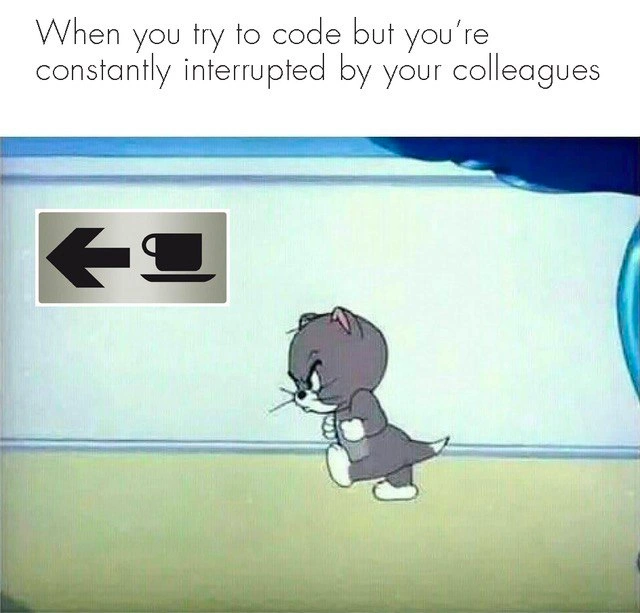
Now, in the image, we have Tom the cat from the classic Tom and Jerry cartoon. Tom is depicted walking determinedly forward with clenched fists and an annoyed expression. On the wall beside him is a sign with a left arrow and a coffee cup symbol, indicating that the break room (or coffee machine) is to the left. The joke is that Tom (the developer in this scenario) is trying to move forward (focus on coding), but the environment (the sign and presumably colleagues following that sign) is encouraging him to go left to the break area. Tom’s body language – the clenched fists and angry face – shows he’s frustrated about being pulled away from his goal.
So, the whole meme is essentially saying: “I’m trying to work on code, but my coworkers keep interrupting me for coffee breaks or chit-chat, and it’s breaking my focus.” This is a lighthearted way to acknowledge a real challenge in teamwork: everyone has experienced trying to concentrate and being disturbed by someone, and how irritating that can feel when you just want to keep going on what you’re doing.
Level 3: Interrupt-Driven Development
This meme is painfully funny to anyone who’s tried to get work done in a busy office. It highlights a classic developer frustration: losing the flow state due to constant interruptions. The text “When you try to code but you’re constantly interrupted by your colleagues” sets the stage. The image of Tom (the cartoon cat) marching irritably in the opposite direction of a coffee cup sign says it all: he’s determined to code, and all the hallway signs (and by extension, colleagues) are pointing him toward yet another coffee break.
The humor works because it’s true. In many workplaces, especially with open office layouts or chatty team cultures, a programmer’s day can feel like interrupt-driven development. You’re deep in code, tracking a complex logic bug or implementing a new feature, and then a coworker pops by: “Hey, quick coffee?” or “Got a minute to help me with this issue?” That “quick” interruption can derail your concentration completely. Developers often joke about this as a form of workplace context switching. Unlike a computer, you can’t just context-switch and instantly pick up where you left off — there’s a spin-up time to recall all the details. By the time you regain your focus, another interruption might strike.
Developer productivity suffers greatly under these conditions. It’s often said (only half-jokingly) that a five-minute interruption can cost you thirty minutes of progress. This is because when a coder is in the zone (another word for flow), they have a mental model of the entire problem loaded up. A colleague waving you over to the coffee machine forces a drop of that mental stack. It’s like having to close all your code files and clear your thought cache, only to reopen and reload them again after the chat. No wonder Tom the cat looks so annoyed! That face is every developer internally screaming when the third “brief chat” of the afternoon pulls them away from an editor full of half-written code.
The sign with the coffee cup in the meme is a nice touch. It symbolizes the collaboration culture in many offices – always nudging people to interact, take breaks together, have spontaneous discussions. Sure, communication and team bonding are important – and who doesn’t enjoy a coffee break (granted, by the third one before lunch its charm fades) – but there’s an unintended side effect: flow state disruption. It’s a bit of a running joke in tech circles that the open-plan offices and constant Slack messages meant to foster collaboration often become the biggest threats to actually getting things done. This meme riffs on that irony. It’s blending developer humor with a slice of truth: too much socializing or too many meeting-like interruptions, and the code simply won’t write itself.
Seasoned developers know this struggle all too well. Many cope by wearing headphones as a “do not disturb” sign or by scheduling specific “focus time” where they mute notifications. There’s even a term “Maker’s Schedule vs Manager’s Schedule” popularized in tech – developers (makers) need large uninterrupted blocks of time, whereas managers operate in hour-by-hour meeting slots. When these worlds collide, the maker (coder) often gets pulled into the manager’s rhythm of frequent context switches, and productivity nosedives. The meme captures that collision in a simple visual: the poor developer (Tom) just wants to march forward and build something, but the office environment (signs pointing to coffee breaks) keeps yanking him sideways.
In short, this image resonates with engineers because it pokes fun at a collaboration challenge: balancing the need to communicate with the need to concentrate. It’s meeting humor in a nutshell — replace the coffee icon with a meeting invite and Tom’s expression would be the same. We laugh at this scenario because we’ve all lived it. It’s a shared pain. The next time you see a programmer frowning after a harmless “got a minute?” from a colleague, remember Tom’s clenched fists in the meme. They’re not angry at the person; they’re frustrated at the situation. Getting back into a complex coding problem isn’t trivial, and repeating that cycle all day is exhausting. This meme turns that silent frustration into a cartoon we can chuckle at, even as we nod in sympathy.
Level 4: Context Switching Overhead
Even computers hate being interrupted too often. In operating system design, a context switch occurs when the CPU stops working on one process and switches to another, saving and loading all the necessary state. This isn't free – it incurs overhead. Caches get invalidated, the CPU pipeline may need flushing, and time is spent saving/restoring registers instead of doing actual work. If the scheduler interrupts tasks too frequently, the system starts thrashing: it wastes more time switching contexts than executing useful instructions.
A developer’s brain faces a similar fate with constant interruptions. Think of a programmer in a deep flow state as analogous to a CPU executing a thread with all the right data loaded in cache. When a colleague suddenly says, "Hey, let's grab coffee," it's like receiving a hardware interrupt. The brain must perform a costly context save: mentally bookmark the code’s state, remember variable names, the next steps, and then attend to the chat. By the time the developer returns, the mental "cache" is cold. They must reload all that information – where was I in the function? What was the next logic fix? This re-loading is analogous to a cache miss in computing. It can take many minutes to rebuild the context (just as a CPU might spend numerous cycles to refill its pipeline after a flush).
With repeated interrupts, a developer experiences cognitive thrashing. Each coffee break or "quick question" call is like the scheduler cutting the time slice too short. The job of coding never runs long enough to produce output before the next context switch hits. The result? Developer productivity plummets. This is essentially an interrupt storm affecting the human processor: too many context switches causing near-zero forward progress.
From a theoretical perspective, it’s a reminder that human cognition has a context-switch cost much like computers do. In fact, research in human-computer interaction and psychology backs this up. Continuous partial attention and multitasking degrade performance. Our mental model of a complex codebase is like an in-memory data structure; if we don’t get enough continuous time to work on it, we end up constantly swapping it out to disk (long-term memory) and back in, which is terribly inefficient. The humor here is that a fundamental computer science problem – context switching overhead – is mapping perfectly to a workplace frustration. The meme takes a mundane office scenario and hints at these deep technical parallels: a flow state disruption can be as crippling to a programmer as high interrupt latency is to a real-time system.
Description
The image is a single-panel meme. Across the top, black text on a white background reads: “When you try to code but you’re constantly interrupted by your colleagues”. Below, a frame from the classic Tom and Jerry cartoon shows a determined, slightly angry Tom walking to the right in a hallway with clenched fists. On the wall to Tom’s left is a grey sign that features a large black left-pointing arrow and a coffee-cup icon, implying a break room in the opposite direction. The juxtaposition illustrates a developer’s attempt to keep coding while coworkers repeatedly lure them away for coffee chats, highlighting the real-world productivity cost of context switching and lost flow state in engineering environments
Comments
6Comment deleted
That coffee-room arrow is basically an unmaskable interrupt - every trigger flushes my brain’s L1 cache and swaps the entire sprint backlog out to disk
After 20 years, I've learned that "quick questions" have a context-switching cost of exactly one fully loaded mental stack frame, plus the 45 minutes it takes to remember what the hell I was debugging in the first place
Every senior engineer knows the paradox: you're hired for your ability to solve complex distributed systems problems requiring hours of uninterrupted deep thought, but your calendar is a Tetris game of 'quick syncs' and 'just 5 minutes' that fragment your day into useless 23-minute chunks. The real architecture challenge isn't microservices - it's architecting enough contiguous focus time to actually think about the microservices
Every “got a sec?” raises an IRQ; my handler returns 302 to /coffee and spends 20 minutes warming the L1 mental cache
Every “got a minute?” is a non‑maskable interrupt - by the time the mental cache warms back up, the only system still hitting five nines is the espresso machine
Colleagues interrupting flow: the cheapest way to turn your brain's L1 cache into a thrashing swap file