Skip to content
DevMeme
626 of 7435
Developers praise incremental releases then roast the MVP for missing features
Agile Post #714, on Sep 28, 2019 in TG

Developers praise incremental releases then roast the MVP for missing features

Why is this Agile meme funny?

Level 1: One Piece at a Time

Imagine you’re building a big LEGO castle set, but you decide to build it one piece at a time instead of putting everything together all at once. You tell your friend, “Let’s start small and build gradually so we do it right.” Now, after you’ve placed just a few LEGO bricks, you look at what you’ve got and complain, “Ugh, this doesn’t even look like a castle yet. It’s so terrible!” Sounds silly, right? You’re upset that the castle isn’t complete, even though you were the one who wanted to build it step by step. That’s exactly the joke here. Developers often say “it’s better to start small and improve later” (like building the castle piece by piece), but then they get mad when the first version of something isn’t fully finished (like whining that the tiny start of the castle isn’t the whole castle). The meme is funny because it’s showing someone doing the very thing they complained about – it’s a big goofy “you asked for this, and now you’re upset about it” moment.

Level 2: MVP: Missing Vital Parts

Let’s break down what’s going on for those newer to these concepts. The meme is talking about incremental_releases versus expecting a full product immediately. In software development, an MVP (Minimum Viable Product) means the simplest version of an app that’s just functional enough to be usable and demonstrate the core idea. Think of it as version 1.0 with only the must-have features. Teams release an MVP to start getting real user feedback early, then they plan to add the nice-to-have features in later updates. This is a key part of Agile methodology – an approach to building software in small, quick steps rather than one giant step. Agile folks often say “release early and iterate,” meaning get something out there, learn from it, improve it continuously.

Releasing features gradually (instead of all at once) is a common practice now. Many apps and services do rolling updates. For example, a social media app might not roll out a new feature to everyone on day one. Instead, they use feature flags – a technical switch in the code – to turn the feature on only for a small percentage of users or a specific group (like beta testers or a random 5% of the user base). This way, if something breaks or isn’t quite right, it only affects a few people and can be fixed before a wider launch. It’s like a dimmer switch for new features: slowly lighting up more users as confidence grows. Developers often recommend this approach because it makes deployments safer and lets the team gather feedback incrementally. In dev lingo, it’s called progressive rollout or continuous delivery, part of modern DevOps culture.

Now, the funny (or sad) part: developers as users can be impatient. The meme shows a tweet where the first line is developers saying “do gradual releases!” and the second line is also developers complaining “ugh, this new app doesn’t do everything.” It’s poking fun at us – the developer community – for sometimes talking out of both sides of our mouth. On programming forums or Twitter (which is the format of the meme image), you’ll often see devs championing good practices like MVPs and release cadence improvements. But then a new app or tool comes out (maybe an early version from a startup or an open-source project) and some of those same devs will immediately criticize it for lacking certain features or polish. Essentially, they roast the MVP for being, well, an MVP. 😅

If you’re a junior developer, you might have witnessed this on a small scale. Perhaps you built a simple web app or a game with just basic functionality and shared it. You might’ve heard responses like, “It’s cool, but does it do X as well? Can it also do Y?” You’re thinking, “Not yet, I plan to add that later!” The person’s reaction can feel harsh, as if they expected a fully featured product from the get-go. That’s exactly what’s happening in this meme: developers praising the idea of starting simple, but then acting like regular picky users when they encounter someone else’s 1.0 version. It’s relatable because many of us have felt both sides – the pride of releasing something small and the frustration of using something small.

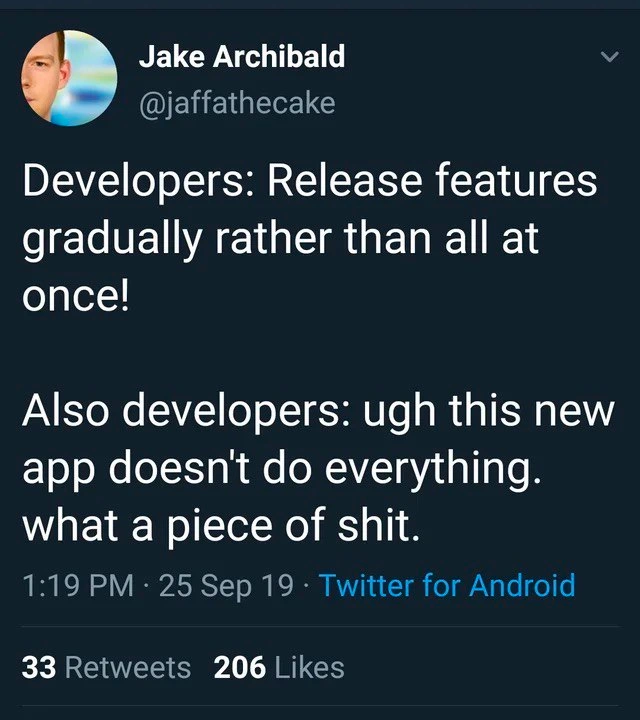
The Twitter screenshot format here is common for DeveloperHumor memes. The top part shows the author (Jake Archibald, a well-known developer advocate) and his tweet. The text in dark-mode (white on navy blue) reads those two contradictory statements. The bottom shows the tweet details like time, date (25 Sep 2019), and engagement (retweets and likes), which tells us this joke struck a chord with a lot of people (i.e., many devs found it true enough to like/retweet). In context, it’s both an AgileHumor jab and a commentary on DevCommunities behavior. Developers love to toss around terms like “MVP”, “feature flags”, “continuous deployment” as best practices — that’s the first part of the tweet. The second part is basically saying: when an app actually follows that advice and comes out with minimal features, developers (switching hats to users or critics) can be brutally unsympathetic, calling it “a piece of 💩” for not having everything at once. The meme calls out this discrepancy in a funny way.

To sum up: the meme is highlighting a gap between what developers say (in professional discussions about process) and what developers do (when reacting on forums or social media to new software). It’s a light-hearted reminder not to be too hypocritical. If we truly believe in giving feedback to improve an MVP, we shouldn’t slam it for being an MVP. For newer devs, it’s also a peek into a common dev community in-joke: we have strong opinions about how software should be made, yet we sometimes forget those principles when we’re the consumers of software.

Level 3: Release Early, Complain Often

At the heart of this meme is a biting look at Agile philosophy versus actual developer behavior. It highlights a classic paradox in developer culture: we preach incremental releases and MVP discipline, yet we often trash-talk any early version that doesn’t feel “complete.” In theory, rolling out features gradually (using techniques like feature flags and continuous delivery) is beloved in dev communities. It’s considered a hallmark of modern release cycles – ship small changes frequently, get user feedback, and avoid the risk of a huge waterfall all-at-once launch. This is the feature_flag_mindset many senior engineers advocate for: deploy a Minimum Viable Product (MVP), then improve it iteratively.

But the humor (and pain) here comes from developer hypocrisy. The tweet by Jake Archibald contrasts two voices of the same crowd:

Developers in theory: “Release features gradually rather than all at once!”
Developers in practice: “Ugh, this new app doesn't do everything yet. What a piece of 💩.”

It’s a dev expectations vs reality moment. On the left, we hear the rallying cry of agile release_cadence: “Release early, release often!” On the right, we witness the knee-jerk reaction of those very same developers when they act as users or critics: “This MVP is missing so many vital features; it’s basically unusable.” The irony is thick. In other words, we love MVPs until we’re the ones using them.

Why is this so familiar? Experienced devs have seen this pattern countless times. A team decides to launch an MVP or beta version of a product – say a new app or a dev tool – to gather early_adopter_feedback. This first release covers the core use-case but lacks many bells and whistles. Immediately, on Twitter, Hacker News, Reddit, you name it, other developers pounce: “It doesn’t support X? No dark mode? Can’t integrate with Y? What a joke.” The same folks who champion “don’t ship all at once” can become the loudest critics when a incremental_releases approach yields an initially minimal product. It’s a running gag in DeveloperHumor circles because it’s so true. Jake Archibald’s tweet resonated (33 retweets, 206 likes) because every engineer recognizes this Agile irony. We’ve all been that two-faced developer at some point – advocating lean development at work, then ranting online that someone’s 1.0 version is “missing vital parts.”

From a senior perspective, this meme hints at deeper issues in our field. We know that huge, monolithic releases are risky – big bangs often lead to massive bugs or failed projects (remember the AgilePainPoints that led us away from waterfall?). Gradual rollouts with feature flags let us monitor performance, do A/B testing, and toggle off something if it misbehaves in production. It’s a strategy to manage complexity and ensure stability. DevCommunities praise this because it leads to more robust software and continuous improvement. Yet, culturally, there’s an impatience and perfectionism among developers as end-users. Perhaps it’s pride or high standards – we spend our days building software, so when we try someone else’s app, we have zero chill for missing features or half-baked UIs. It’s a “we could have done this better” reflex. We forget that what we’re looking at is an MVP by design – meant to be improved with our feedback. Instead, we roast it like it should have been a fully mature product on day one.

This contradictory stance can have real consequences. Product teams face a dilemma: stick to incremental delivery and risk public backlash for “lacking features,” or delay releases until more is complete (which contradicts agile principles). Many a time, fear of harsh early feedback leads teams to hold back, basically creeping back toward slower, larger releases – exactly what Agile was trying to avoid. It’s a release early vs. polish fully conundrum. The meme shines light on this tension: everyone says they want quick iterations, but few have the patience for a true MVP in the wild. In the end, the tweet is a form of collective self-deprecation in the developer community – calling ourselves out for having our cake and wanting to eat it fully frosted too. DeveloperIrony at its finest. We laugh (perhaps a bit nervously) because it’s a relatable mirror: Agile in the streets, Waterfall in the sheets. We know the right thing to do, but our inner user still greets a newly released “Version 0.9” with a groan: “Why doesn’t it do everything already?”

Description

This meme is a dark-mode screenshot of a tweet by Jake Archibald (@jaffathecake). The tweet text reads: “Developers: Release features gradually rather than all at once! Also developers: ugh this new app doesn't do everything. what a piece of shit.” Underneath, standard Twitter metadata shows “1:19 PM · 25 Sep 19 · Twitter for Android”, plus counters “33 Retweets” and “206 Likes”. The visual is typical Twitter UI - white text on a navy background - conveying a sarcastic comparison of two contradictory developer statements. Technically, it pokes fun at agile MVP philosophy, feature-flag rollouts, and the tension between shipping early and satisfying developer expectations, a common pain point in release and product discussions

Comments

6
Anonymous ★ Top Pick We champion progressive delivery all sprint, then the moment the canary hits prod without dark mode, offline sync, and a GraphQL endpoint, half the senior devs file a SEV-1 and the other half start sharpening their pitchfork-as-code scripts
  1. Anonymous ★ Top Pick

    We champion progressive delivery all sprint, then the moment the canary hits prod without dark mode, offline sync, and a GraphQL endpoint, half the senior devs file a SEV-1 and the other half start sharpening their pitchfork-as-code scripts

  2. Anonymous

    We spend years perfecting our MVP methodology, then rage-quit an app because it doesn't have dark mode on day one

  3. Anonymous

    Ah yes, the eternal paradox: we preach 'ship early, iterate often' and 'perfect is the enemy of good' in our sprint retrospectives, then immediately rage-tweet when a new app launches without feature parity with a decade-old incumbent. It's the engineering equivalent of a chef who advocates mise en place but orders takeout because the restaurant 'doesn't have everything on the menu.' We've all been there - championing phased rollouts and canary deployments by day, writing one-star reviews about missing dark mode by night. The cognitive dissonance is strong, but at least we're self-aware enough to meme about it

  4. Anonymous

    We ship MVPs behind feature flags, but uninstall others' alphas screaming for monolith parity

  5. Anonymous

    We preach feature flags and small, reversible changes - then 1-star an MVP for missing offline mode, SSO, and export-to-CSV in version 0.1

  6. Anonymous

    Progressive delivery is our religion - until we’re the customer and open a Sev‑1 because the v0.1 canary lacks SSO and CSV export

Use J and K for navigation