The CAPTCHA Every Developer Fails
Why is this Bugs meme funny?
Level 1: Find the Typo in the Shredded Letter
Imagine a security guard who won't let you into a building until you find the spelling mistake in a letter — but first he runs the letter through a paper shredder, glues the strips back in random order, and hands it over with a smile: "If there are none, click skip." Everyone clicks skip. The joke is that finding mistakes in deliberately scrambled computer code is just as hopeless, and the polite little skip button is the machine quietly admitting that nobody — human or robot — could ever pass this test.
Level 2: CAPTCHAs, Minification, and Why That Code Looks Like That
The pieces, decoded:
- A CAPTCHA ("Completely Automated Public Turing test to tell Computers and Humans Apart") is the are-you-a-robot gate. Google's reCAPTCHA popularized the image grid — "select all squares with traffic lights" — which this meme clones precisely.
- A bug is a flaw in code; the beetle icon in the corner is the literal mascot (the term predates computing, but the famous anecdote involves an actual moth taped into a logbook).
- Obfuscated code is code transformed to be hard to read — variable names replaced with things like
_0x2391x4, strings moved into lookup arrays so_0x6675[13]might secretly mean"innerHTML". It's done to hide logic from prying eyes. Minified code is similar but for size: shipping JavaScript with whitespace and long names stripped so pages load faster. Both produce the wall of noise in the grid. setInterval(fn, 10000)runs a function every 10 seconds;clearInterval()stops it. So the snippet is a polling loop — something checking a page every 10 seconds — which you can only tell because those two names survived obfuscation, a nice illustration of how much heavy lifting names do.- The early-career rite of passage referenced here: your first production error that points into minified code. The fix isn't squinting harder — it's source maps, files that map the mangled output back to your original source, so the debugger can show you real code again.
The honest lesson under the laugh: readability is not cosmetic. The grid is the same program it was before obfuscation; it lost nothing but human meaning — and with it, all debuggability.
Level 3: An Undecidable CAPTCHA
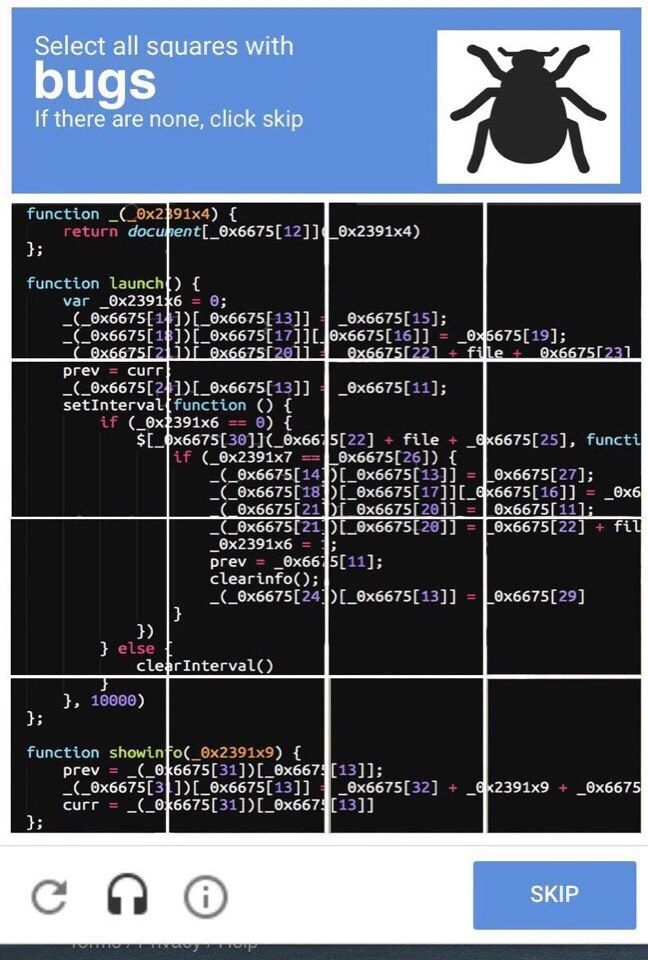
The parody is pixel-faithful: the blue reCAPTCHA header ("Select all squares with bugs. If there are none, click skip"), the beetle silhouette where the sample image goes, the refresh/audio/info icons, the blue SKIP button. But the 3×4 grid doesn't slice a street scene — it slices a dark-theme editor full of obfuscated JavaScript: functions named launch() and showinfo() whose bodies are nothing but hex-soup like _(_0x6675[14])[_0x6675[13]] = _0x6675[15];, wrapped around a setInterval(...)/clearInterval() pair on a 10000 ms timer.
The joke operates on three stacked levels, and the deepest one is genuinely cruel. CAPTCHAs work by finding a task cheap for humans and expensive for machines — reading warped text, spotting crosswalks. This meme proposes a task that is expensive for everyone and, in the general case, formally impossible: deciding whether arbitrary code contains a bug runs straight into Rice's theorem territory — non-trivial semantic properties of programs are undecidable. You cannot, even in principle, build the answer key. A CAPTCHA whose ground truth doesn't exist is the perfect dev-humor artifact: it looks like a UI, it's actually a paradox.
The second level is what the specific code is. This isn't sloppy human code — it's the unmistakable output of an obfuscator (the _0x6675[...] string-array indirection is the signature of tools that hoist every string literal into one array and replace identifiers with hex names). Which means the meme is asking you to do code review on minified production output, a thing every web developer has actually attempted at 2 AM, staring at a stack trace pointing into bundle.min.js line 1, column 48,213. The shared trauma is real: the bug is in there, the answer exists, and the artifact you're given has been deliberately stripped of every affordance — names, whitespace, intent — that would let a human find it. Source maps were invented precisely because this grid is unplayable.
The third level inverts the CAPTCHA's social contract. "Prove you're human" usually means proving you have human perception. Here, the only honest human move is the one the UI graciously offers: SKIP — which is also, not coincidentally, the industry-standard response to a code review containing 4,000 changed lines of unreadable code. "LGTM." There's even a plausible reading where clicking skip is the correct answer in a darker sense: in obfuscated spaghetti with shared mutable state (prev = curr across an interval callback) the squares with bugs are statistically all of them, and selecting all twelve tiles is indistinguishable from selecting none.
Description
This meme presents a CAPTCHA-style challenge, a common web security feature used to distinguish humans from bots. The blue header instructs the user, 'Select all squares with bugs,' accompanied by a black silhouette of an insect. Below, a 3x3 grid is superimposed on a block of code. The code itself is dark-themed, syntax-highlighted JavaScript, but it's heavily obfuscated. Variable and function names are replaced with hexadecimal representations (e.g., `_0x2391x4`, `_0x6675`), and logic is hidden behind array lookups, making it practically unreadable and unmaintainable for a human. The humor is a clever pun on the word 'bug.' While the CAPTCHA literally asks for insects, any experienced developer would immediately recognize that the unreadable, convoluted code is itself a massive 'bug' from a code quality and maintainability standpoint. The joke implies that the correct answer is to select every single square, a task that ironically proves one's humanity through their understanding of software development pain points
Comments
8Comment deleted
This isn't a CAPTCHA to prove you're human. It's the final round of a senior developer interview to see if you're smart enough to refuse to work with that codebase
Vendor drops 50 KB of minified JS and asks for a “quick security review,” so we follow policy: squint at the obfuscation grid, hit SKIP, and stamp it SOC 2 compliant
This is just production code after the junior dev assured me their webpack config "only removes unnecessary whitespace"
Finally, a CAPTCHA that's also a Turing test for humans: nobody, carbon or silicon, can find bugs in code where every identifier is _0x6675[13]
When the CAPTCHA asks you to identify bugs but you're staring at obfuscated JavaScript with more _0x prefixes than a hexdump - turns out both the beetles AND the code qualify. At least the insect won't try to mine cryptocurrency in your browser or exfiltrate your localStorage. Though honestly, with variable names like '_0x2391x6', I'd argue the real bug is whoever thought this obfuscation would fool a security researcher for more than 30 seconds
The senior dev CAPTCHA: skip because every square's got a latent race condition masquerading as a feature
Senior solution: click SKIP, add CSP script-src 'self', and rip out the third-party obfuscated JS - the bug is the dependency
Dev CAPTCHA: “Select all squares with bugs.” In obfuscated JS indexing a magic string table and mutating globals on setInterval(10000), the only wrong answer is believing any square isn’t one