Google Confirms: The Computer is Large
Why is this Google meme funny?
Level 1: The Loudest Boring Announcement
Imagine a TV reporter standing breathlessly outside a giant bakery, cameras flashing, saying: "BREAKING NEWS — the bakery has officially confirmed that its oven is LARGE." That's the whole story. No new bread, no secret recipe — the oven is big, and we knew that. It's funny because the announcer's voice is set to "moon landing" while the actual news is set to "nothing," and that mismatch is exactly how a lot of real news about big tech companies sounds once you listen closely to what's actually being said.
Level 2: Clickbait Anatomy for the Newly Online Engineer
Decoding the parts:
- ClickHole (the
clckhl.colink) is a satire site from The Onion's publisher, built to mimic viral-content sites. Recognizing parody domains matters more than it should — these screenshots circulate stripped of context, and plenty of people have shared ClickHole headlines as real news. - Clickbait is headline-writing optimized for clicks rather than information: curiosity gaps, urgency phrases ("The Future Is Now"), and authority verbs ("Confirmed"). The structure is engineered the way an A/B-tested signup button is — and that's literally how it's produced, by testing variants against engagement metrics.
- The kernel of truth being spoofed: Google really does operate some of the largest computing infrastructure in existence — global data centers, custom AI accelerator pods, and research-grade quantum hardware. Articles about these frequently bury the engineering substance under exactly this kind of framing. The meme doesn't deny the computers are impressive; it mocks reporting that conveys nothing else.
- A practical habit this meme teaches early-career developers: when you read a tech headline, try mentally compressing it to its claim. "Company X unveils revolutionary Y" often compresses to "company X sells Y now." If a headline survives compression with content intact, it's worth your time. If it compresses to "computer is big" — you've been clickbaited, and your senior colleagues' weary reaction to the latest Hacker News frenzy will suddenly make sense.
Level 3: The Hype Cycle's Null Hypothesis
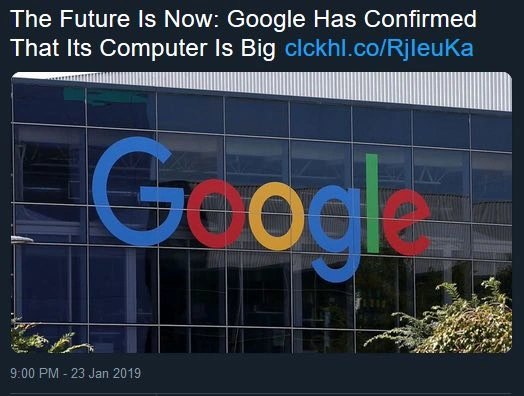
The tweet, timestamped 9:00 PM · 23 Jan 2019, reads:
The Future Is Now: Google Has Confirmed That Its Computer Is Big —
clckhl.co/RjIeuKa
Beneath it, the obligatory stock photo of the Googleplex facade — glass, steel, the multicolored logo across the windows, aspirational blue sky. The clckhl.co shortlink marks this as ClickHole, The Onion's clickbait-parody site, whose entire art form is reproducing the grammar of viral tech journalism while setting its information content to exactly zero.
The genius is in how precisely the headline is assembled from real components. "The Future Is Now" is the stock breathless opener of a thousand genuine quantum/AI/moonshot writeups. "Has Confirmed" performs the journalism ritual where a company saying something about itself gets framed as an investigative scoop. And the payload — "Its Computer Is Big" — is the magic trick: it's what an enormous fraction of actual big-tech coverage reduces to once you strip the adjectives. Quantum supremacy announcement? Computer is big. New TPU pod, exaFLOPS cluster, record-breaking training run, hyperscale data center campus? Computer is big. The parody works because it's a lossy compression of real headlines that loses almost nothing — the journalistic equivalent of discovering your 40 GB of microservices logs gzip down to "everything is fine."
For people inside the industry, the satire lands on two targets at once. The first is access-driven tech media, which structurally depends on companies for embargoes and keynote seats, and thus reliably transcribes press releases with "Confirmed" stapled on. The second target is us — the engineering audience that upvotes this stuff. Every hype cycle (big data, then ML, then quantum, then LLMs) has run on headlines whose technical substance, to a practitioner, is roughly "the computer is big," yet which successfully reset roadmaps, reorgs, and résumé keywords industry-wide. Scale-as-news is seductive precisely because scale is the one metric that needs no understanding to be impressed by; nobody writes "Google Has Confirmed Its Paxos Implementation Is Subtly Correct," though that would be the harder achievement.
The stock photo completes the package. The headquarters facade is the visual idiom of "we have nothing to show you" — data centers are unphotogenic warehouses and the actual artifact (software) is invisible, so coverage of the most consequential systems on Earth is illustrated, forever, with the sign on the building. Form fully intact, content fully absent: the parody barely had to exaggerate.
Description
This is a screenshot of a tweet featuring a satirical headline. The tweet text reads, 'The Future Is Now: Google Has Confirmed That Its Computer Is Big,' followed by a shortened link, 'clckhl.co/RjleuKa'. The image accompanying the tweet is a straightforward photograph of a modern glass-paneled Google office building, prominently displaying the company's large, colorful logo. The humor is derived from the absurdly literal interpretation of 'big computer,' juxtaposing a headline that sounds like a major technological breakthrough with the mundane reality of a large physical building. It's a deadpan, satirical jab at the grandiose language often used in tech journalism. For senior developers, it's a dry, low-effort pun that mildly amusingly plays on the immense, distributed, and abstract nature of Google's actual computational infrastructure versus its physical corporate presence

Comments
8Comment deleted
In a leaked internal doc, they confirmed their main computer also has a very large cache. It's called a 'parking garage'
“Google says its computer is big.” Senior translation: roughly two million fault domains under one global Paxos roof - a single “computer” so large even the CAP theorem files a support ticket
Finally, a Google announcement that doesn't require a 47-page whitepaper to understand why it's revolutionary
Big computer confirmed - expect the keynote, the whitepaper, and a managed service that bills you per rack-unit of bigness
Breaking: Google confirms their infrastructure spans multiple machines. In related news, water is wet, TCP has three-way handshakes, and that O(n²) algorithm you wrote in 2015 is still running. Next week's headline: 'Amazon Reveals S3 Stores More Than One File' followed by 'Facebook Admits Database Contains Multiple Rows.' The real question isn't whether Google's computer is big - it's whether their SREs have finally achieved the mythical five-nines uptime while simultaneously running A/B tests on the entire planet's search results
Google's monolith architecture: unrefactorable, eternally available, and billed per square foot
“Google confirms its computer is big.” Engineers call it Borg, Spanner pretends it’s one machine, and the SRE calls it rolling a kernel upgrade across a zip code
Cool, is_big=true - now can we see regions×nodes, QPS, p95s, and PUE, or is this just another marketing feature flag?