Skip to content
DevMeme
Frontend Elegance vs. Backend Reality
Frontend Post #24, on Jan 25, 2019 in TG

Frontend Elegance vs. Backend Reality

Why is this Frontend meme funny?

Level 1: The Back of the Drawing

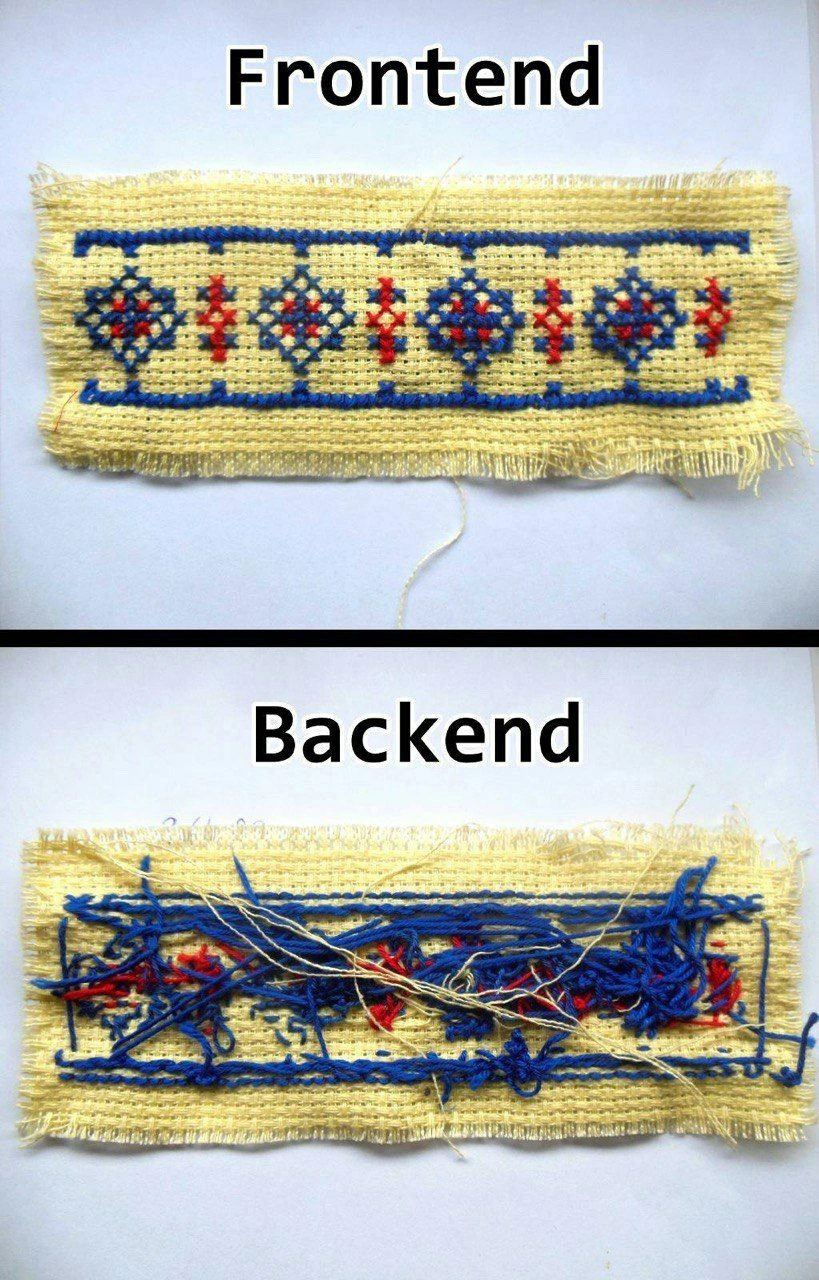
It's like a kid's art project: from the front, the stitched picture is neat and pretty, the kind of thing you'd hang on the fridge. Flip it over and it's a bird's nest of knots and dangling string. The joke is that apps and websites are exactly the same — the screen you see is the pretty front, and somewhere behind it is a glorious tangle that the builders quietly hope you never ask to see. And here's the secret that makes it funny instead of sad: the tangle is what's holding the pretty side together.

Level 2: Interfaces and Implementations

Mapping the picture to vocabulary you'll meet at work:

  • Frontend is the part of software users see and touch — web pages, buttons, layouts. Its job is to look like the top photo: clean, consistent, aligned.
  • Backend is everything behind it — servers, databases, APIs, the logic that computes what the frontend displays. Users never see it, just like nobody frames the back of an embroidery.
  • An interface (or API boundary) is the agreed surface between the two: the frontend asks "give me the user's orders," the backend produces them, and how it produces them is hidden. The fabric in the photo is that boundary.
  • Spaghetti code is code whose control flow tangles like the bottom photo — everything connected to everything, no clear path. Technical debt is the accumulated shortcuts that got you there: each "I'll tidy this later" is one more loose thread.
  • Encapsulation is the design principle the meme illustrates by accident: hide the messy internals, expose a clean surface. Done well, the mess at least stays inside the module instead of dangling off the edges.

The early-career revelation this image delivers is that the bottom photo is normal. Your first look inside a production codebase usually feels like flipping the embroidery: the product looked so polished from outside that the internal chaos seems like a scandal. It isn't. It's what real, shipped, evolving systems look like — and learning to read the tangle, rather than demanding it never exist, is most of the job.

Level 3: The Abstraction Boundary, in Aida Cloth

Two photographs of the same physical object. Top, labeled "Frontend": the face of a cross-stitch on yellow aida fabric — a disciplined ornamental band of blue and red diamonds between two clean blue border lines, symmetric, evenly spaced, frankly publishable. Bottom, labeled "Backend": the reverse of that exact piece — a snarl of knotted blue thread, red peeking through at random, loose strands dangling off the edges, stitches crossing wherever they needed to go to make the front come out right.

The reason this metaphor detonates among developers is that it isn't really a frontend-vs-backend joke — it's a joke about abstraction boundaries, and the embroidery makes the boundary literal: it's the fabric. Everything above the cloth is interface; everything below is implementation. And the craft truth embedded in real embroidery holds for software with eerie fidelity: the back is messy because the front is clean. Every neat diamond on the face required the thread to travel somewhere on the reverse — jumping between motifs, anchoring ends, doubling back. Order on one side is purchased with entropy on the other. That's not negligence; that's conservation of complexity. You can move the mess, hide the mess, encapsulate the mess — you cannot delete it.

This is why senior engineers nod rather than laugh. They've seen the gorgeous marketing site backed by a cron job named final_fix_v2_REAL.sh. They know the polished checkout flow that, one layer down, reconciles inventory via CSV emails parsed with regex. The visible tangle here is spaghetti code in its most literal rendering — actual strands, actually tangled — and it accumulates exactly the way technical debt does: each individual stitch decision was locally reasonable ("just carry the thread over, no one sees the back"), and the global result is something no one would ever design on purpose. There's also a tribal-warfare reading the meme slyly enables: backend engineers see it as slander ("our side has structure, you just can't see it"), frontend engineers see it as vindication, and both are wrong in the same way — flip any sufficiently examined frontend codebase over and you'll find its own knots, in useEffect form.

The most honest detail is that the back works. Nothing is broken in the bottom photo. The tangle holds the pattern together; pulling out the "ugly" threads would destroy the beautiful face. This is the part refactoring zealots learn painfully: the mess and the function are often load-bearing for each other, and the cost of a pristine reverse side — counted-thread perfection, every end woven invisibly — is real, and someone has to decide if the back of a piece nobody flips over is worth it. Most product roadmaps decide it isn't. The fabric ships.

Description

A two-panel meme comparing software development to embroidery. The top panel, labeled "Frontend," displays a beautiful, orderly cross-stitch pattern on a piece of yellow fabric. The design is symmetrical and uses red, white, and blue thread. The bottom panel, labeled "Backend," shows the reverse side of the same piece of fabric. It's a chaotic mess of tangled threads, knots, and loose ends, revealing the hidden complexity required to produce the clean result on the front. The meme humorously illustrates the common reality where a polished user interface (frontend) is supported by a complex, often messy, server-side infrastructure (backend). For senior developers, this is a relatable analogy for how systems are architected - what the user sees is a carefully managed abstraction, while the underlying implementation can be a tangled web of services, legacy code, and quick fixes that somehow work together
Comments

8
Anonymous ★ Top Pick The frontend is the meticulously curated REST API response. The backend is the series of shell scripts, cron jobs, and a Perl script from 1998 that generates it
  1. Anonymous ★ Top Pick

    The frontend is the meticulously curated REST API response. The backend is the series of shell scripts, cron jobs, and a Perl script from 1998 that generates it

  2. Anonymous

    The React UI is a hand-stitched masterpiece - just don’t flip it over or you’ll spot the knotted goroutines, Kafka retries, and that one cron job called “temp_patch.sh” we’re all pretending isn’t the only thing keeping prod alive

  3. Anonymous

    The frontend is just the backend with a really good PR team and a restraining order against anyone who tries to look under the hood

  4. Anonymous

    Every system is beautiful at the API boundary; flip it over and you find the threads marked 'TODO: untangle before launch' - dated three launches ago

  5. Anonymous

    This embroidery perfectly captures the essence of full-stack development: the frontend is what you show in demos and put on your portfolio, while the backend is what you frantically refactor at 2 AM before the code review, hoping no one asks about that nested callback hell holding together your 'microservices architecture.' The real artistry isn't in the pattern users see - it's in making that tangled mess of threads somehow produce a coherent, beautiful interface without unraveling completely when someone changes a single dependency version

  6. Anonymous

    Frontend: pixel-perfect stitches. Backend: thread dump masterpiece holding prod together

  7. Anonymous

    That “Frontend” is the Figma screenshot; the “Backend” is the anti‑corruption layer, three cronjobs, two compensating transactions, and five TODOs marked “temp until after launch” - now in year six

  8. Anonymous

    Frontend is pixel-perfect; backend is a decade of compensating transactions stitched with cron jobs, DB triggers, and a queue named “retry-forever.”

Use J and K for navigation