The Perils of Code Review Scope Creep
Why is this CodeReviews meme funny?
Level 1: Not My Mess
Imagine you and your sibling share a room. You tidy up your side of the room nicely, putting away your toys and making your bed. But your sibling’s side is still a total mess – toys on the floor, bed unmade. Now a parent walks in, inspects the room, and says, “Nope, not clean enough. Fix this room before you can go out and play.” They’re looking at the whole room. You point to the messy side and protest, “But that’s not even my mess!” You feel it’s unfair because you’re being told to clean up something you didn’t spill or scatter.
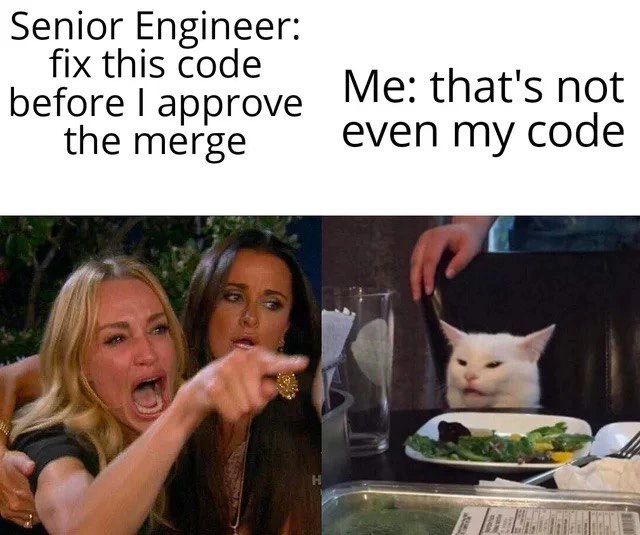
This meme is joking about that exact feeling, but in a programming team. The “senior engineer” is like the parent demanding the whole room be clean, and “me” (the developer) is like the kid saying it’s not my mess to clean. It’s funny because we’ve all been in that unfair spot: being blamed for or asked to fix something we didn’t do. In simple terms, it’s a laugh at the frustration of being made responsible for someone else’s mistake — whether it’s a messy room or messy code.
Level 2: Not My Code Problem
In simpler terms, this meme highlights a common pull request hassle: being asked to change something in the code that you weren’t responsible for. A pull request is like saying, “Hey team, I finished a code change. Can we add it to the main project?” Before merging your changes, other developers review them — that’s the code review process using version control platforms like GitHub or GitLab. They look at the diff, which shows exactly what lines of code you added, removed, or modified.
Usually, reviewers focus on your changes, but they can also see a few unchanged lines around your edits for context. Sometimes a reviewer notices an old mistake or ugly code in those nearby lines and can’t ignore it. The senior engineer in the meme does exactly that: they see some code in the file that isn’t up to standards (even though you didn’t touch it) and demand you fix it. When they say, “fix this code before I approve the merge,” they’re essentially refusing to let your work go through until that unrelated issue is resolved. The “merge” here means integrating your code into the main branch; an approval is often required from a senior team member to do so.
The “Me” in the meme — the developer — responds with “that’s not even my code.” This means “I didn’t write that part of the code, and it wasn’t part of the changes I proposed.” It’s a genuine protest. Imagine you’re a junior developer who made a small change, and suddenly you’re asked to overhaul a chunk of code written by someone else long ago. You’d be confused: Why am I being held responsible for this other code? But in team programming, code is a shared responsibility. If you happen to be working in a file and something is clearly wrong nearby, a conscientious reviewer might ask you to fix it while you’re at it. It’s like a code review pain point many of us learn early on — your job isn’t always just your new code; sometimes it involves tidying up the surrounding legacy code too.
The meme’s images drive the point home in a comedic way. It uses the famous “Woman Yelling at a Cat” format. On the left, the woman (representing the senior engineer) is angrily pointing and yelling — just like a reviewer nitpicking or scolding during a PR. On the right, the cat (representing “me,” the developer) sits looking bewildered and defensive in front of a salad. That cat’s confused, annoyed face perfectly matches how a developer feels being blamed for something they didn’t do. The contrast is hilarious: one side is furious and adamant, the other side is stunned and saying, “Wait, what? How is this my problem?” Developers share this meme because it’s developer humor rooted in truth. We’ve all seen code reviews where the comments start veering into “fix that other thing you didn’t even touch,” and it’s both frustrating and absurd — a little drama in the merge process that we can laugh about afterward.
Level 3: The Blame Game
This meme perfectly captures a frustrating code review scenario many developers recognize: a reviewer (the Senior Engineer) blocking a merge by demanding changes to code that the pull request author didn’t even modify. In a typical Git workflow, you open a pull request for your changes and a senior dev reviews the diff (the lines added/removed). Here the senior spots an issue in the surrounding code — something you didn’t write — and insists it be fixed “before I approve the merge.” It’s basically an unsolicited side quest: your simple feature update suddenly turns into cleaning up old code.
For experienced engineers, this is a classic code_review_gatekeeping moment. The reviewer is treating the codebase like a fortress where nothing gets merged unless all nearby problems are resolved. It’s well-intentioned (who doesn’t want cleaner code?), but it creates merge approval drama. The text “fix this code before I approve” is essentially the senior dev saying, “I won’t let any code through until you tidy up this leftover mess.” And the developer’s reply “that’s not even my code” is a polite way of saying, “Why am I being blamed for this? I didn’t write that!” This dynamic is humorously dubbed not_my_code_blame – holding someone accountable for issues in legacy code they inherited. In version control, one could even run git blame on the offending file and see it was authored by someone else, yet here the onus lands on the hapless current developer.
This pattern is all too real in large codebases. Perhaps an outdated function or technical debt lurks in the file you touched. The senior engineer, being thorough (or picky), seizes the chance to fix it now: “Since you’re in that file anyway…” 😒. Suddenly your 5-line change turns into a 50-line refactor. This kind of scope creep during reviews can introduce risk — you might accidentally break something else or run into merge conflicts with others’ work. But from the senior’s perspective, if that sloppy code isn’t cleaned up now, it might live on forever. It’s a bit of a blame game meets quality crusade: the reviewer thinks, “We must improve this codebase,” while you’re thinking, “Great, now I’m fixing stuff from 3 years ago just to get my feature in.”
The humor (tinged with pain) comes from how relatable this is. Every seasoned dev has had a straightforward PR turn into a mini bug-fixing marathon because a reviewer spotted some tangential issue. It’s a common CodeReviewPainPoints story: you feel both annoyed and obligated as you mutter, “Fine, I’ll fix it… even though it’s not my fault.” The meme’s blurred, yelling woman is the overzealous reviewer, and the unamused cat is the developer stuck with the extra work. In real life, the exchange happens via pull request comments rather than shouting, but the emotion is the same. It’s funny because it’s true — we laugh to keep from crying when a pull request approval turns into an unexpected housecleaning of the code.
Description
This image uses the popular 'Woman Yelling at a Cat' meme format to illustrate a common frustration in software development. The meme is a two-panel image. On the left, a distraught woman (Taylor Armstrong) is yelling and pointing, with the caption 'Senior Engineer: fix this code before I approve the merge'. On the right, a confused-looking white cat (Smudge the Cat) sits at a dinner table with a plate of salad, captioned 'Me: that's not even my code'. The meme humorously captures a frequent code review scenario where a developer submits a pull request for a specific change, but the reviewing senior engineer identifies unrelated, pre-existing issues in the same file or module. The senior then blocks the merge, demanding the developer fix this 'technical debt' they didn't create. This situation, often referred to as scope creep, places the developer in the awkward position of having to either take on extra work or argue about the scope of their task, perfectly reflected by the cat's bewildered and defensive expression
Comments
7Comment deleted
The 'You Touched It Last' rule of code ownership is the enterprise version of musical chairs, but the last one standing has to refactor a 2000-line function with no tests
At my shop, git has a new blame mode: “last-person-to-open-the-PR,” so tweaking one import makes you legal guardian of every 2009 XML/SOAP hairball that file ever touched
The senior engineer who can't read git blame is the same one who insists on squashing commits because "clean history" while simultaneously destroying all evidence of who actually wrote what
The real tragedy here isn't being asked to fix someone else's code - it's that 'git blame' will forever show YOUR name on those lines after the refactor, making you the historical scapegoat for future archaeologists digging through the codebase. Welcome to collective ownership, where the code is everyone's responsibility but somehow always your fault
- Summary: Two-panel “yelling at cat” meme. Text: “Senior Engineer: fix this code before I approve the merge / Me: that’s not even my code.” It riffs on code reviewers blocking a PR by demanding fixes to unrelated legacy code. - Why it’s funny (senior dev lens): Captures review gatekeeping, unclear ownership in monorepos, and the tension between “Boy Scout Rule” vs PR scope. Highlights coupling and process friction more than code quality. - Primary category: Code Review / Pull Requests - Secondary themes: Git/Merge, Legacy Debt, Ownership Boundaries, Scope Creep, Quality Gates, Monorepo Coupling - Suggested tags: code-review, pull-request, git, merge-approval, reviewer-gatekeeping, scope-creep, legacy-code, ownership, monorepo, process-friction - Relevance to software engineering: High
Pre-merge fixes: where 'not my code' rebase-s into 'my hotfix' faster than you can git blame
Monorepo life: Prettier rewraps a header, CODEOWNERS drags six teams into your PR, and now you're responsible for a service you learned existed from the diff