Skip to content
DevMeme
6663 of 7435
Illusion of Free Choice Between Human-Written and AI-Written Terrible Code
CodeQuality Post #7300, on Oct 20, 2025 in TG

Illusion of Free Choice Between Human-Written and AI-Written Terrible Code

Why is this CodeQuality meme funny?

Level 1: Either Way, It’s Messy

Imagine you have a big coloring book picture to fill in. You’re given two crayons to choose from: one is your regular crayon and the other is a brand-new fancy crayon that promises to make coloring super easy. You might think, “Wow, if I use the fancy crayon, my picture will turn out perfect!” Meanwhile, using your regular crayon is just the normal way you’ve always colored. But here’s the catch: if you scribble carelessly, it doesn’t matter which crayon you picked — the picture will come out messy with colors all over the lines. The fancy crayon might make the scribble a bit brighter, but it’s still a scribble. 😅

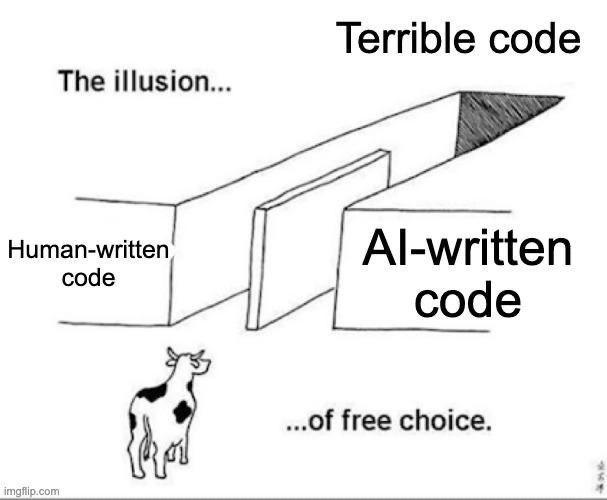
This is what the meme is joking about. Whether a person writes the code (uses the regular crayon) or an AI writes the code (uses the fancy new crayon), if we’re not careful and coloring inside the lines (following good steps), the result can be a big old mess. It’s like your parents asking, “Do you want to do your homework now or after dinner?” You feel like you have a choice, but in the end you’re doing homework either way. Likewise, the meme shows a cow choosing between two paths, but both paths lead it to the same spot. The poor cow thinks it has freedom to choose, but surprise! both choices end up with it hitting the “terrible code” wall (which is the bad outcome).

So in super simple terms: no matter which option you pick, if you don’t do things properly, you’ll get a bad result. Just like no matter which chore you pick at home, you’re still stuck doing a chore, no matter who writes the code (human or AI), you can still end up with bad code. The meme is funny to developers because it says “hey, we might think using AI to code will save us, but nope, we can mess up that way too!” It reminds us of a basic idea: you can’t escape doing the necessary work. Whether you or a tool writes something, you still have to pay attention and clean it up, or else it’s going to be messy in the end.

Level 2: Different Author, Same Bugs

Now, let’s break this down in simpler terms. This meme is comparing two ways of writing code – by a human developer or by an AI coding assistant – and jokes that both can end up creating terrible code if we’re not careful. The comic uses the “illusion of free choice” theme: a cow sees two pathways (one labeled “Human-written code,” the other “AI-written code”), but both pathways merge and lead to the same bad place (a wall of “Terrible code” with spikes). In other words, it doesn’t matter if a person wrote the code or a machine did – the outcome can be equally bad.

Let’s clarify some key terms in this context:

  • AI-written code: This refers to code produced with the help of AI tools. Think of things like ChatGPT or GitHub Copilot – these are AI/ML models that can generate programming code based on prompts. They’ve been trained on lots of existing code from the internet. When you use such a coding_assistant, you might type a comment or a function name, and the AI suggests code to complete it. It feels a bit like having an autocomplete on steroids. However, the AI doesn’t actually understand the project’s full needs; it’s guessing what code might solve your prompt based on patterns it has seen before. So it might give you a chunk of code that looks right but isn’t exactly what you need, or has a mistake you don’t notice immediately. This is part of the meme’s joke: people may assume code from an AI is correct, but it can still be very flawed or unmaintainable (hard to read and modify).

  • Human-written code: This is just the usual way of coding – a developer writes the code by hand, thinking through the logic (hopefully). Humans have the advantage of understanding the context and the purpose of the program better than any current AI. But humans are, well, human – we make mistakes, especially when rushed or tired. We might forget a condition, mishandle a special case, or write something in a confusing way. The meme isn’t claiming humans and AIs write code in exactly the same way; rather, it humorously claims both can lead to the same kind of problems in the end. If best practices aren’t followed, either method results in buggy code (code with errors) and TechnicalDebt.

  • Terrible code: This phrase is slapped on the final wall in the comic for a reason. Terrible code means code that is low-quality. It’s the kind of code that gives developers headaches. It might run, but it’s full of bugs (errors or things that make the program behave incorrectly), or it’s written in such a confusing way that nobody wants to touch it. It’s also often not well-tested or documented. Imagine a function 500 lines long named doStuff() – that’s a hint of terrible code. 😂 The meme basically says: you thought you had a choice in avoiding terrible code by picking one path or the other, but surprise! Without proper care, you end up there regardless.

  • CodeQuality and TechnicalDebt: Code quality refers to how good and clean the code is. High-quality code is easy to read, works correctly, and is easy to maintain or extend. Low-quality (terrible) code is the opposite: it’s confusing, likely to break, and hard to fix. Technical debt is a term for what happens when we choose an easy or quick solution now that we’ll “pay for” later in extra work. For example, if I copy-paste some code from the internet to meet a deadline (quick fix) but don’t fully understand or clean it up, it might cause big problems down the road – that’s like taking on “debt.” You got a feature fast, but later you’ll pay interest in the form of debugging pain or refactoring work. The meme suggests that both AI and human code can incur technical debt if used carelessly. Using an AI to write code quickly might save time now, but if that code is poor, you have to spend more time later fixing it – the debt comes due. Similarly, a human can write bad code under pressure and leave a mess for future us.

  • Code review and refactoring: These concepts are hinted at in the meme’s description (encouraging design reviews and refactoring discipline). A code review is when other developers check someone’s code before it’s merged in, to catch bugs or suggest improvements. Refactoring means cleaning up and improving the code after it works, to make it clearer or more efficient without changing what it does (sort of like tidying your room — everything functions already, but you organize it so it’s nicer and easier to find things). The point is that whether code is from an AI or a human, it needs these processes. If you skip reviews and never refactor messy parts, the codebase will deteriorate.

So what’s the meme’s message in plain speak? It’s saying: Don’t be fooled into thinking that just choosing AI will automatically give you better code. It’s an illusion of choice. The quality of the software depends more on solid engineering practices than on who/what wrote the initial draft. A sloppy human coder and an unchecked AI suggestion can both introduce the same bug or design flaw. For example, consider a simple scenario:

# AI-generated attempt (with a subtle bug if all numbers are negative)
def find_max(arr):
    max_val = 0  # Assume 0 as a default maximum
    for x in arr:
        if x > max_val:
            max_val = x
    return max_val

# Human-written quick hack (potentially the same bug for negative numbers)
def find_max_human(arr):
    max_val = 0  # Developer also starts max at 0 by habit
    for x in arr:
        if x > max_val:
            max_val = x
    return max_val

print(find_max([-5, -1, -3]), find_max_human([-5, -1, -3]))
# Both versions mistakenly return 0 for this list of all negative numbers.

In this snippet, we ask for the maximum number in a list. Both the AI-generated code and the human-written code made the same mistake: they started max_val at 0. If all numbers in the list are negative, the function will wrongly return 0 (because 0 never gets replaced since it’s greater than any negative). The correct approach would be to initialize max_val with the first element of the list (or handle an empty list separately). This example shows that an AI can mirror a human mistake if that mistake was common in its training data, and a human can independently come up with the same flawed logic. End result? The same bug in both cases.

For a junior developer or someone new: imagine you have two teammates helping you with a school coding project. One is a human friend, the other is an AI tool. Your human friend might write a quick solution that “works” but forgets something (like not considering negative numbers). The AI might give you a solution that looks neat, but maybe it also didn’t consider that case. If you don’t double-check either solution, you’ll end up handing in a project that fails for certain inputs. The meme is basically saying the responsibility is on you and your team to ensure quality, no matter where the code comes from.

So, the cow cartoon simplifies this idea: the cow is the project or developer, choosing between two routes (human do it or AI do it). The cow might expect one route to be safer or better, but both routes combine and lead to the same spikes (the terrible_code outcome). It humorously warns: don’t rely on an “illusion” that AI-written code will automatically be better. You still have to use good practices: test the code, review it, and clean it up. Conversely, just because code is human-written doesn’t mean it’s good either — humans need to follow those practices too! In short, good software isn’t guaranteed by who writes the code; it’s guaranteed by what happens afterwards (testing, reviews, maintenance).

Level 3: Illusion of Quality

Stepping down to a senior engineer’s perspective, this cartoon nails a contemporary software development joke: AIHypeVsReality in the realm of CodeQuality. We see a cow approaching two corridors — one marked “Human-written code” and the other “AI-written code.” Both channels merge into the same chute heading straight for a spiky wall labeled “Terrible code.” The caption declares “The illusion... of free choice.” For veterans in the field, this hits close to home. The meme satirizes the current debate over AI coding tools: Will having an AI generate code save us from bugs and TechnicalDebt, or are we just choosing a different flavor of headache? The answer, it laughs, is the latter.

Why is this funny? Because we’ve all been promised that some new tool or methodology will banish bad code forever – and it never quite works out. It’s reminiscent of the old joke in programming: “It works on my machine!” doesn’t guarantee it works in production. Here, the equivalent is: “It was written by an advanced AI!” doesn’t guarantee it’s good code in production either. The cow’s so-called choice between AI or human coding is a fake dilemma, a classic illusion_of_choice_meme. In reality, without proper discipline, coding_assistants can lead a team down the same path of bugs, crashes, and late-night debugging as any hurried human coder would.

Let’s unpack the scenario. Imagine a development team under pressure: they can either (A) have developers crank out features manually or (B) rely on an AI autocomplete to generate some functions. Option B sounds futuristic and foolproof – after all, the AI has ingested all StackOverflow and GitHub, so presumably it knows what it’s doing, right? Meanwhile, Option A is the status quo: humans writing code, with all our known failings (typos, copy-paste errors, forgotten edge cases). The meme cheekily suggests that either way, if you just toss the code into the product without strong code review and refactoring, you’ll end up with a bug-ridden, unmaintainable mess. That spike-tipped wall labeled “Terrible code” is the fate of every slipshod project. It’s a one-way trip to the land of spaghetti logic and escalating code_review_pain.

Seasoned engineers recognize the pattern being poked at here. We’ve seen juniors writing gnarly nested if-statements at 4:59 PM Friday that break on Monday, and we’ve also seen AI-generated code that looks clean but hides a minefield of edge-case bugs. In both scenarios, what’s missing is not raw speed or even initial correctness – it’s the ongoing attention to design and quality. The meme reminds us that tools don’t absolve responsibility. You can’t say, “Oh, the AI wrote this, so it must be fine,” any more than you can trust a random snippet copied from the internet without understanding it. Architecture reviews, unit tests, and thoughtful refactoring are the boring, critical chores of software engineering that actually determine if code stays good or rots. As the caption implies, many teams today fall for the “illusion” that using AI will automatically enforce quality, when in truth it just generates more code that still needs heavy scrutiny.

From an AIHumor angle, it’s chuckle-worthy because it cuts through the current hype. We have all these fancy GPT-based assistants and AI_written_code generators, but developers joke that now we just get to discover new kinds of bugs — sometimes absurd ones that no human would think of, courtesy of an AI’s alien logic. Meanwhile, human_written_code is no saint either; humans excel at inventing creative bugs all on their own, from off-by-one errors to forgetting to handle null pointers. In the end, the AILimitations become apparent: the model might produce code that compiles and even runs, but it can be as opaque and convoluted as a legacy 15-year-old Java class with god-object antipatterns. Senior devs often quip that maintaining AI-written code can feel like maintaining someone else’s code written at 3 AM – because effectively, it is someone else’s code (the “someone else” just happens to be a neural network). The on-call pager doesn’t care whether the bug was introduced by a person or an AI; at 3 AM, you’re debugging it just the same.

Crucially, the comic highlights TechnicalDebt: the gradual build-up of “terribleness” in code over time. It doesn’t matter if initial code was pumped out by an excited junior developer or by an over-confident AI – if that code is merged without review, if quick fixes pile up without refactoring, the system will accrue debt. Soon, new features become harder to add and every bug fix risks breaking something else. The illusion_of_choice here is thinking that who (or what) writes the code is the deciding factor in quality. In reality, it’s how the code is written and maintained. Without good practices, both forks in the road lead to the same maintenance nightmare. It’s a gentle poke at managers and architects: you can invest in all the AI tools you want, but you still need to enforce design reviews, code standards, and refactoring. No GPT-4 or Copilot is coming to magically refactor your 10,000-line monolith or rename confusing variable names for you (at least not reliably).

To put it simply, the meme draws laughs (and a few groans) from experienced devs because it’s too real. We’ve seen teams argue “Let’s use AI, it’ll prevent mistakes,” only to discover different mistakes cropping up. We’ve also seen teams stick to human-only coding and churn out equally awful legacy code because they skipped best practices. The cow’s fate — splatting into the “Terrible code” wall — is a cautionary punchline. It reminds everyone that quality is a deliberate effort, not a default state you get by picking the “right” path. Whether your code is birthed by silicon or scribbled by caffeinated humans, if you don’t tame complexity and pay back debt, you end up in the same place: living in a codebase horror show.

In case all that went over someone’s head, here’s a quick summary of the tongue-in-cheek comparison this meme is making:

Route Taken Hope/Expectation Actual Outcome
Human-written code Developers will craft careful, clean solutions by hand. Quick hacks and shortcuts creep in under pressure, yielding bugs and tangled logic.
AI-written code The AI will produce flawless code using its vast knowledge. Plausible-looking code often with hidden errors or mismatched context, still requiring intense debugging.
End result (no interventions) We’ll get high-quality, maintainable software. Terrible code – a bug-ridden, unmaintainable mess without strong reviews and refactoring.

No matter which wall the cow (our project) tries to jump over, it lands in the same muddy pit of “Ugh, this code is awful.” The humor may be a bit dark, but it serves as a shared knowing laugh among developers: We’ve all been that cow. 🐄💻🔧

Level 4: No Silver Bullet

At the highest level, this meme hints at a fundamental truth in software engineering: there is no silver bullet for writing perfect code. Whether a human types the code or an AI/ML model generates it, the underlying complexity of software doesn’t magically disappear. In theoretical terms, software quality is constrained by problems that are computationally hard (and sometimes undecidable). For instance, automatically ensuring code has zero bugs in all cases is akin to solving the halting problem – essentially impossible with a general algorithm.

In the context of AI-generated code, consider how Large Language Models (LLMs) work. These models (like the ones behind modern coding assistants) don’t truly understand code in a human sense; they predict likely sequences of tokens based on training data. They’ve ingested millions of lines of existing code – which inevitably includes both good practices and bad habits. So an AI might produce syntactically correct solutions that still harbor subtle errors or inefficient design patterns. It’s a classic case of Garbage In, Garbage Out (GIGO): if the training data has flawed or average-quality code, the AI will happily regurgitate those flaws in new forms. The AI can’t inherently guarantee CodeQuality because it’s optimizing for plausibility, not correctness.

Moreover, any non-trivial software system has a complexity that grows over time. There’s a concept sometimes jokingly called software entropy: just like physical systems tend toward disorder, codebases tend toward chaos without regular maintenance. No generative model can bypass the second law of thermodynamics of code – without continual refactoring and careful design, the TechnicalDebt in a project will increase. The meme’s dark humor captures this inevitability: no matter how advanced your tools (even state-of-the-art AI coding assistants), you can’t escape the fate of messy code if you neglect software engineering fundamentals. As legendary computer scientist Fred Brooks noted decades ago with “No Silver Bullet,” there’s no single tool or technology that eliminates the inherent difficulty of software development. AI might speed up typing or offer suggestions, but it doesn’t solve the core challenges of clarity, correctness, and maintainability.

So from a high-altitude perspective, the cow in the comic is every developer facing a false dichotomy: one path labeled “Human-written” and another “AI-written,” both ultimately converging on the spike wall of “Terrible code.” This convergence isn’t accidental – it’s enforced by the very nature of coding complexity. Unless we fundamentally change how we ensure correctness (think formal verification or exhaustive testing, which are hard), any code path can lead to bugs. In summary, the meme wryly illustrates a theoretical inevitability: tools and authors may differ, but the inherent complexity and risk of bugs in software remain. The laws of computation and the tendency toward disorder guarantee that simply choosing a different path (human or AI) doesn’t avert the eventual reckoning with bad code.

Description

A meme using the classic 'The illusion... ...of free choice' template showing a cow approaching what appears to be two different paths but both lead to the same destination. The left path is labeled 'Human-written code', the right path is labeled 'AI-written code', and the single destination they both funnel into is labeled 'Terrible code'. The image has an imgflip.com watermark. The joke is that regardless of whether code is written by humans or AI, the end result is equally terrible -- there is no escape from bad code

Comments

12
Anonymous ★ Top Pick Turns out the real AI disruption was democratizing the ability to write code that makes senior engineers cry -- humans had a 50-year head start, but AI achieved parity in 2 years
  1. Anonymous ★ Top Pick

    Turns out the real AI disruption was democratizing the ability to write code that makes senior engineers cry -- humans had a 50-year head start, but AI achieved parity in 2 years

  2. Anonymous

    The primary difference between the two paths is that 'human-written' terrible code has a `git blame` that points to a person, while 'AI-written' terrible code just points to a version number and a vague apology in the release notes

  3. Anonymous

    Great - now the on-call roulette is deciding whether the 3 a.m. stack trace starts with my initials or with “gpt-3.5-turbo,” but the pager still rings either way

  4. Anonymous

    After 20 years of writing code, the real revelation isn't that AI writes terrible code - it's that it writes terrible code with the same confident incorrectness we've been deploying to production all along, just 10x faster and with better documentation of why it's wrong

  5. Anonymous

    Turns out the real 'garbage collection' we needed wasn't in our runtime - it was for both our codebases and our AI prompts

  6. Anonymous

    Choose human or AI - after merge, git bisect still lands on utils/helpers.js, a 1200-line function that pages SRE at 02:00

  7. Anonymous

    Human code accrues tech debt linearly; AI parallelizes it across hallucinations

  8. @ZmEYkA_3310 8mo

    Yeah at least the human understands what hes doing tho

    1. @mold_in 8mo

      oh really?

      1. @ZmEYkA_3310 8mo

        Yeah, im pretty sure my code is fucking dogshit and shouldnt be used at all.

  9. @mrYakov 8mo

    Absolutely normal to look at code that you wrote earlier and think that it is shit. Thats mean your skills raised.

    1. @ZmEYkA_3310 8mo

      Improving overnight 🥀🥀🥀

Use J and K for navigation