IQ Bell Curve Meme AI Hype vs AI Slop Reactions
Why is this AI ML meme funny?
Level 1: Caught in the Middle
Imagine there’s a magical cooking machine that can make a soup. Now, a little child tastes the soup and immediately says, “Yuck, this tastes like slop!” On the other end of the spectrum, a master chef tastes the same soup and also says, “Meh, it’s slop.” But then there’s a cook with just okay skills watching this machine. He sees the machine’s soup win a big cooking contest, and he starts panicking: “This is unbelievable! The machine just beat all the human chefs – I’m so scared it’s going to replace us!”
See what happened? The kid (who doesn’t know much) and the master chef (who knows a ton) both weren’t impressed – they both called the machine’s soup “slop” (which means garbage). It’s only the in-between cook – who knows a bit about cooking but isn’t a top chef – who is freaking out and feeling threatened by the machine’s success. He’s in the middle, and he’s the only one making a big fuss.
This is exactly the joke of the meme: the people at the two extremes (very simple and very wise) just dismiss the AI’s work as junk, while the person in the middle is losing his mind over it. It’s funny because you’d think the super smart person might be the most concerned or the one to sound the alarm. But nope – in the joke, the super smart person and the not-so-smart person oddly agree with each other and stay calm, and it’s the average guy who’s panicking.
The humor comes from this unexpected situation. It’s like seeing a beginner and an expert both go “Pfft, nothing to worry about,” and only the guy with some knowledge is running around worried. We laugh because the middle guy’s overreaction seems out of place when even the genius isn’t worried. It’s a playful way of saying sometimes the ones in the middle overthink things, while the ones with either no clue or a lot of clue just go, “Relax, it’s not a big deal.” The extremes agree, and the poor guy in the middle ends up looking a bit silly – and that role reversal is what makes the meme entertaining and relatable.
Level 2: Bell Curve Basics
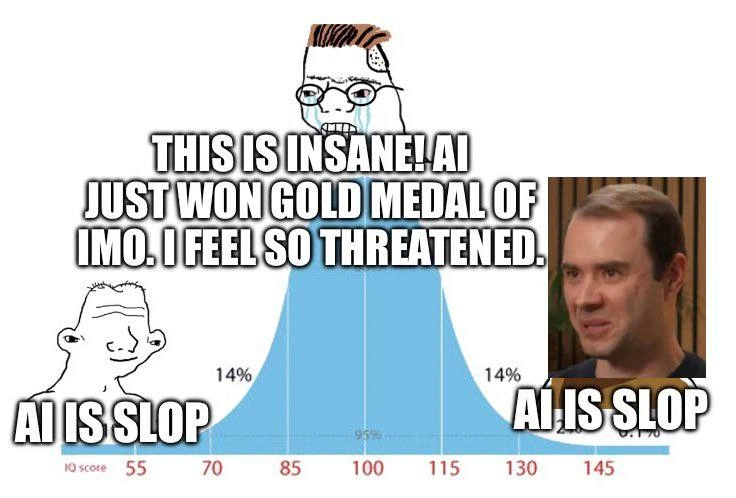
Let’s break down the meme’s pieces in simple terms. The image shows a bell curve – that smooth blue hill shape – which is a common way to depict the spread of IQ scores in a population. IQ is supposed to measure intelligence, and it’s designed so that most people score around the middle (100 is the average). The further out you go to the left or right, the fewer people have those scores (the image even has small percentages like 14% near the edges to indicate the proportion of people in those ranges). So, left end = low IQ, middle top of the curve = average IQ, right end = high IQ.
Now, the meme populates this curve with three characters:
- On the far left, at the low IQ tail, there’s a simple cartoon face. This is a version of the Wojak meme character drawn in a very minimalist, goofy style (often used to represent someone a bit dumb or very simple-minded). He’s smiling and seems totally content. Next to him, in big letters, is the phrase “AI IS SLOP.” That’s his statement. Slop means something like trash, muck, or very low-quality food (imagine pig slop). In internet slang, calling something “slop” is a insultsaying it’s junk. So this left-side guy is basically saying, “AI is garbage.” He represents a person who isn’t smart (low IQ) and who just dismisses AI outright without much thought.
- In the middle of the curve (average IQ), we have a different Wojak variant known as a Soyjak. This character has a distinctive look: glasses, an undercut hairstyle, and in this image, tears streaming down his face. Soyjak is often used in memes to depict a person (usually a nerdy or overly enthusiastic guy) who is either very excited or very upset about something. The text over his head (at the peak of the curve) is “THIS IS INSANE! AI JUST WON GOLD MEDAL OF IMO. I FEEL SO THREATENED.” That’s a mouthful, and it captures him basically screaming in shock. Let’s unpack that:
- “AI just won gold medal of IMO” – Here AI means Artificial Intelligence, essentially a computer program or machine intelligence. IMO stands for the International Mathematical Olympiad, which is a famous worldwide math competition for high school students. Winning a gold medal in the IMO is a huge deal for a human – it means you solved some extremely difficult math problems and ranked among the top participants globally. The meme claims an AI achieved this feat (won a gold medal), which suggests the AI managed to solve those super hard problems.
- “This is insane!” – he’s saying that’s crazy/unbelievable.
- “I feel so threatened.” – means he is feeling personally threatened by this AI achievement. In other words, he’s scared that AI might be becoming “smarter” than humans or than him. This touches on a common fear: people worry that if AI can do intellectual tasks (like solving Olympiad problems) better than humans, then what role will humans have? Will AI replace experts, take jobs, or make some human skills obsolete? The soyjak in the meme is having exactly that fear, hence the tears and panic.
- So the middle character is an average-IQ person who is overreacting to AI’s big accomplishment with a mix of awe and fear. He’s the only one with a long, detailed reaction (notice the extremes just have a short phrase). That emphasizes how he’s really worked up about it.
- On the far right, at the high IQ tail, there’s a different kind of image: it’s not a cartoon now, but an actual photograph of a man’s face (though the face is pixelated/blurred for anonymity or comedic effect). Often in these bell curve memes, the rightmost character is portrayed as a wise or highly intelligent person. Sometimes it’s shown with a fancy character or a well-known “smart” figure; here they used a real person’s photo to give a sense of realism. This right-end character is also saying “AI IS SLOP.” Yes, the exact same line as the left-end character. This implies that the very smart person is also dismissing the AI’s work as slop (garbage).
So, putting it together:
- Left end (low IQ): “AI is slop.” (Translation: I don’t trust or care about this AI stuff; it’s junk.) – Said by someone who doesn’t understand much about AI, just instinctively calls it trash.
- Middle (mid IQ): “This is insane, AI just achieved something huge (won IMO gold)! I’m so threatened.” – Said by someone of average intelligence who understands enough to be impressed and even scared by what AI did.
- Right end (high IQ): “AI is slop.” (Translation: I know a lot about this field, and I’m not impressed; it’s still junk in my opinion.) – Said by someone very intelligent or knowledgeable, downplaying the AI achievement as not a big deal or low quality.
The meme cleverly uses this setup to highlight the contrast. The two people on the opposite ends (one presumably not smart at all, and one extremely smart) have the same short opinion: they both dismiss the AI. Only the person in the middle is freaking out with a long emotional response.
Now, why is this funny or what idea is it conveying? Essentially, it’s poking fun at the person in the middle – sometimes called the “midwit” on the internet. Midwit is a slang term (a combination of “mid” for middle and “wit” as in intellect) used to describe someone of average intelligence who often overthinks or overestimates things. The meme suggests that the midwit is overreacting (“This is insane! I feel so threatened!”) whereas both the simpleton and the genius aren’t worried and just say “it’s slop.”
It’s also a commentary on opinions about AI in the real world:
- Some people dismiss AI as overhyped or useless without much thought (that’s like the left side). You might hear someone say “ChatGPT just makes stuff up, it’s garbage,” who maybe hasn’t seen its full capabilities.
- Some people (often those with only a moderate understanding) get really hyped or really scared by news of AI achievements (that’s the middle guy). For instance, when they hear “an AI solved a bunch of very hard math problems,” they might think the robot apocalypse or a revolution is at hand. They take it as a sign that AI is now smarter than humans and it rattles them.
- Others, often experts or very logical folks, acknowledge the AI did something notable but still critique it heavily (that’s the right side). They might say, “Sure, it won a math contest, but it probably had access to lots of similar problems or it’s just brute forcing solutions; it’s not truly intelligent.” These people tend to be more skeptical of the hype because they know the nuances – like they might know that an AI can score well on a test but still fail at commonsense reasoning or truly creative tasks. So in their view, the AI’s flashy win is not that impressive in the grand scheme, hence calling it “slop.”
The International Mathematical Olympiad (IMO) reference is specifically chosen to represent a pinnacle of human intellectual achievement in math. If an AI wins a gold medal there, it’s a big symbolic moment (since only very gifted human students do that). The meme exaggerates this scenario to make the mid-level person’s freak-out more understandable – like “wow, AI reached a new height.” But then it humorously undercuts it by having both a dummy and a genius go “Meh, slop.”
This bell-curve meme format (with the three characters) is a known meme template used online, often captioned with different opinions on various topics. It’s basically a visual joke that the extremes (low and high) sometimes agree, and it’s the middle that’s different. In this case, the topic is generative AI and its perceived quality/impact. The phrase “AI is slop” has actually become a bit of a catchphrase in some online communities where people criticize AI-generated content (like saying AI art lacks soul, or AI essays are nonsense). So seeing that phrase on both ends reinforces the idea that both the least informed and the most informed camps are saying the same thing about AI: that it’s not that great.
So, to recap in simpler terms:
- Bell Curve – represents distribution of intelligence (low on left, high on right, average in middle).
- Wojak/Soyjak characters – meme figures representing people (dumb, average, smart) and their attitudes.
- “AI is slop” – slang for “AI output is garbage/low quality.” Both a clueless person and a genius are saying this.
- Mid character’s rant – shows someone moderately intelligent who’s very impressed and scared by AI’s latest feat (AI winning a math competition).
- The meme humorously suggests that sometimes very smart people and not-so-smart people agree, while the folks in between are the ones getting agitated.
It’s making fun of the current AI debate where you have a lot of hype and panic (often from people who are kinda in the middle of understanding it), versus a lot of dismissal (from people who either don’t get it at all, or get it so much that they know its shortcomings). The end result is a comedic snapshot of how different people react to AI news: two opposite guys saying “it’s rubbish” and one middle guy screaming “this is huge (and I’m scared)!” The contrast is what makes it funny and pointed.
Level 3: Midwit Meltdown
For those experienced in the tech world, this meme hits on a very familiar pattern in the ongoing AI/ML hype cycle. We have a bell curve where the left and right ends – representing the least and most knowledgeable folks – oddly enough share the same reaction, and the poor soul in the middle is having a crisis. The centerpiece is the bespectacled “soyjak” character at the top of the IQ curve, frantically exclaiming: “This is insane! AI just won gold medal of IMO. I feel so threatened.” This mid-level intellect (often nicknamed a midwit in meme-speak) is basically melting down. He’s just learned about an AI achieving a superhuman feat – winning a gold medal in the International Mathematical Olympiad – and he’s reacting with pure existential dread. You can almost hear the panic: “If AI can beat the world’s smartest math whizzes, what does that mean for me?!”
This melodramatic reaction is something we’ve seen in real tech discussions. When a cutting-edge AI achieves something notable (be it solving tricky math problems, writing solid code, or passing professional exams), a lot of folks in the tech community have strong feelings. The meme is pointing out that those with a moderate amount of knowledge are often the ones freaking out the most. They know enough to realize the achievement is extraordinary, but maybe not enough to realize, for example, that an AI excelling at a competition doesn’t instantly equal SkyNet or human obsolescence. So the mid-tier tech person goes into full doom spiral: “This AI is so powerful – it’s insane – I’m threatened!” This captures the AI hype dilemma for many professionals: excitement mixed with fear that we’re witnessing something that could upend the industry (and our careers).
Now, the punchline is that both ends of the bell curve are just shrugging it off with the phrase “AI is slop.” In internet slang, calling something “slop” means it’s trash, low-quality mush. It’s a pretty dismissive (almost crude) assessment of, say, AI-generated content or results. So here we have:
- Left end (low knowledge): a simple smiling Wojak cartoon, happily saying “AI is slop.” This could be that person who tried ChatGPT once to do their homework, got a nonsense answer, and now believes all AI output is garbage. Or they read a headline about an AI mistake and concluded it’s all overhyped junk. Essentially, it’s an oblivious kind of confidence: “Meh, this stuff is useless.”
- Right end (high knowledge): a presumably brilliant person (represented by a real-life looking face) also saying “AI is slop.” This is the seasoned expert – maybe a veteran developer or a PhD researcher – who’s not easily impressed. They’ve been through the cycle of new tech hype before. They might acknowledge the AI’s accomplishment but still label it slop because they see its flaws. For example, they might say, “Sure, it solved those Olympiad problems, but it probably saw thousands of similar problems in training or uses brute-force logic. It’s not truly thinking.” This perspective comes from a place of deep understanding: the expert knows what current AI can and cannot do. They might view the AI’s IMO gold as a neat trick but not a sign of actual genius. In the back of their mind, they’re recalling all the limitations – how the AI might falter on a simple variation of the problem or how it doesn’t know why the solution works. So, somewhat cynically, the expert calls it “slop” too, essentially equating the AI’s work to an inferior imitation of human work.
The humor is that the noob and the guru completely agree in their dismissal, even though normally you’d expect the smart person to argue with the ignorant person. It’s the middle guy who’s isolated, flailing in panic. If you’ve worked in tech teams, this scenario might feel too real. Think about a new framework or tool: sometimes junior folks or outsiders scoff at it (“Ugh, why do we even need this?”), senior architects critique it (“It doesn’t solve anything new, just adds complexity”), and it’s the intermediate devs who are either hyping it or worrying it’s the next big thing they must catch up on. This meme nails that vibe when it comes to AI breakthroughs.
To make it even clearer, here’s a pseudo-code representation of the meme’s logic:
# Pseudo-code logic of the bell curve meme reactions
for person in ["low_IQ_person", "mid_IQ_person", "high_IQ_person"]:
if person != "mid_IQ_person":
print("AI is slop")
else:
print("This is insane! I feel so threatened!")
In real-world terms:
- The “low_IQ_person” might be someone who barely understands AI (or anything complex) and just defaults to "it's all stupid". They’re not losing sleep over an AI win — they might even be unaware of it, and if they are, they dismiss it offhand.
- The “high_IQ_person” is that domain expert or uber-genius developer who’s seen this all before. They might respond to news of an AI winning IMO with a skeptical critique on Twitter or HackerNews, basically downplaying it (not out of ignorance, but out of having very high standards for what counts as real intelligence or game-changing innovation). This is the person who calls GPT-4 a “glorified autocomplete” or says “Solving contest problems isn’t the same as doing original math research.” In other words, they have context.
- The “mid_IQ_person” is our poor soyjak in the middle, the one subscribed to all the AI newsletters and YouTube channels, who understands the headlines but perhaps not the fine print. This person sees the news and is genuinely alarmed. It’s like the developer who panicked when GitHub Copilot was announced, thinking, “OMG, it’s going to take my job!” or conversely, the one who hypes it to colleagues saying, “If you’re not using AI, you’ll fall behind, this thing is unreal!” There’s a bit of imposter syndrome and fear of the unknown fueling that reaction.
This structure is a commentary on tech culture as much as it is on AI. The meme format (bell curve with characters on each end and in the middle) has been used in many contexts to show how “both ends against the middle” can happen. Here the context is the generative AI debate – how people respond to the rapid advances in AI capabilities. The midwit freak-out is something many of us have witnessed (or experienced personally!) in the last couple of years as AI models started doing surprising things. It’s that friend or colleague who is furiously tweeting that “AI is going to either save or destroy the world, I can’t believe it” while some other folks quietly roll their eyes.
The meme’s comedic effect comes from exaggeration and role reversal:
- We usually expect really smart people to be the ones waving the alarm bell, and uninformed folks to maybe not care. Here, the smartest guy in the room is as unbothered as the dumbest guy in the room. Both just casually dismiss this groundbreaking achievement with a one-liner: “AI is slop.”
- It leaves the middle guy looking overdramatic and somewhat ridiculous – he’s literally crying while these two bookends are calm and contemptuous of the AI.
For developers and tech insiders, there’s a layer of relatable humor here. We constantly see sweeping AI hype articles (“AI just mastered X!”) followed by polarized commentary: - Some saying “pfft, it’s nothing special” - Others saying “this will change everything, we’re doomed or blessed!” If you’ve been around long enough (and especially if you’ve lived through a few hype cycles and IndustryTrends), you develop a bit of cynicism like the right tail character. At the same time, those new or half-informed might oscillate between amazement and panic – like our midwit soyjak. And of course, some people never buy the hype from day one, like our left tail friend who needed maybe two words to deliver his verdict.
So, why is it funny? Because it rings true and yet is absurd. It’s poking fun at the mid-level analyst who’s basically tearing his hair out, by showing that both someone who “doesn’t get it at all” and someone who “gets it better than anyone” are sitting back saying “Relax, it’s crap.” This is meme shorthand for the idea that sometimes the middle folks overthink it. It’s a cheeky way to remind us that not every astonishing tech breakthrough is as world-ending (or world-saving) as it might seem in the moment, and that both naive dismissal and expert skepticism can sound identical even though they come from opposite ends. In community jargon, it’s a roast of the midwit mindset. And if you’ve ever been on tech Twitter or Reddit when a big AI story breaks, you’ll recognize these three archetypes instantly — which is exactly why the meme elicits knowing chuckles from the developer crowd.
Level 4: The Wisdom of Extremes
At the far ends of the bell curve (the tails of a normal distribution), we find an ironic convergence of opinion about generative AI. This meme portrays both the low-IQ extreme and the high-IQ extreme sharing the exact same blunt verdict: "AI IS SLOP." On a deep analysis level, this highlights a phenomenon where novices and experts can unexpectedly agree, albeit for completely different reasons grounded in cognition and technology.
The right tail (high IQ) in the meme corresponds to someone exceptionally intelligent or knowledgeable – think of an AI researcher or genius-level engineer. Their dismissal of AI as "slop" comes from a place of technical insight. They understand how today’s Generative AI systems (like large transformer-based networks) actually work. These models are essentially gigantic statistical engines – Large Language Models (LLMs) that predict text based on training data, sometimes described as stochastic parrots. A true expert knows that even when an AI produces an impressive result (say, solving a difficult math problem), it’s often by brute-force pattern matching over vast data, not because the machine understands the problem in a human sense. In other words, from the expert’s perspective, the AI’s solution might be technically correct yet lack any real insight or creativity – akin to an encyclopedic regurgitation. This is why the genius on the right tail coolly labels the output "slop": they’re holding AI to a very high standard (the same standard they’d apply to a brilliant human mind), and they see current AI falling short. There’s an allusion here to the ongoing AI hype vs. reality debate in research circles: top experts often temper the hype by pointing out that today’s AI, for all its cleverness (even winning an IMO gold medal), is still fundamentally limited by its architecture and data. It’s not matching human intuition; it’s mimicking it. The right-tail’s stance is rooted in concepts like the distinction between narrow AI and general intelligence, and the knowledge that extraordinary benchmark performance (even at an Olympiad level) doesn’t equal general reasoning ability. In short, the genius sees the impressive achievement and says, “Meh, it’s just a fancy curve-fitting algorithm doing its thing” – hence slop in their eyes.
Now consider the left tail (low IQ) character. This simply drawn smiling Wojak represents a person who likely doesn’t grasp the technology at all. Their "AI IS SLOP" verdict comes from ignorance or lack of exposure. They might have seen some AI outputs that were garbled or incorrect and concluded the whole thing is junk. Or they could be parroting contrarian takes without understanding (ironically, a bit like an actual parrot!). In cognitive terms, this reflects the Dunning–Kruger effect: those with the least knowledge can be the most overconfident in their opinions. Since they don’t understand how remarkable an AI-solving IMO problems is, they dismiss it out of hand. To them, AI is just some fancy toy that spits out weird answers – essentially slop. What’s fascinating is that the left tail’s simple skepticism coincides with the right tail’s highly informed skepticism. It’s a classic case of horseshoe theory in tech discourse: the ideas at the extreme ends curve towards each other, yielding a similar outcome (in this case, derision of AI output) even though one end lacks understanding and the other end has an abundance of it.
This meeting of minds at the extremes is why the meme is structured on a bell curve in the first place. The bell curve (a normal distribution) is not just a random choice – it’s directly implying an IQ distribution (with the average in the middle and fewer people as you go to very low or very high IQ). Fun fact: IQ scores are usually standardized so that $100$ is the mean and about $15$ points is the standard deviation. That means an IQ of ~70 is around the 2nd percentile (far left tail) and ~145 is about the 99.7th percentile (far right tail). By using this curve, the meme creator taps into the trope that ideas can align at the lowest and highest intellects. Both a 70 IQ person and a 145 IQ person are shown giving the same reaction here. It’s a tongue-in-cheek visualization of a perplexing real-life pattern: sometimes those who know almost nothing and those who know almost everything somehow come to echo each other.
Now, lingering at the center of the curve, we have the mid-range IQ character (the so-called midwit). This meme’s midwit is losing his mind over the news that an AI won a gold medal at the International Mathematical Olympiad. To an expert, that achievement might prompt a measured nod or even doubt (“Did it really solve novel problems or just ones similar to what it was trained on?”). To the uninformed person, that achievement might not even register (“What’s IMO? Who cares?”). But to the midwit – someone with enough education to recognize the IMO as a big deal, but not enough to contextualize it – this development is earth-shattering. The meme text captures it: “THIS IS INSANE! AI JUST WON GOLD MEDAL OF IMO. I FEEL SO THREATENED.” The mid-level mind here is overwhelmed, seeing the AI’s success as an existential threat. This reaction embodies a very human response to rapid technological progress: techno-anxiety among those who feel their understanding (and perhaps value) might suddenly become obsolete.
From a theoretical standpoint, this aligns with how partial knowledge can lead to greatest anxiety. With incomplete information, the mid-tier individual can imagine all sorts of worst-case scenarios (AI surpassing human intelligence completely, taking all the prestigious achievements, etc.) without the calming perspective of either ignorance (blissfully unaware) or deep knowledge (aware of the limits). It’s reminiscent of the classic idea that “a little learning is a dangerous thing.” In the meme, that danger manifests as a freak-out.
This bell curve meme format has actually become a popular way to illustrate situations where the extremes agree and the middle disagrees. It’s essentially a graph of the “midwit” concept: the suggestion that people of average-ish intelligence often overcomplicate or panic, whereas simple intuition or advanced wisdom might reach a similar, more straightforward conclusion. In our case, the straightforward conclusion is “AI is slop” – shared by the extremely naïve and the extremely wise, while the mid-level intellect is tangled in emotional and intellectual knots. It’s both a commentary on the spectrum of attitudes towards AI and a meta-joke about how intelligence itself can shape one’s perception of technological hype.
In summary, at this deep dive level we see how the meme uses a statistical concept (IQ distribution) and a cultural concept (Wojak characters) to lampoon the AI discourse. It calls out the almost paradoxical unity between first-glance dismissals and highly informed critiques of AI (both labeling it “slop”), contrasted with the frazzled middle trying to make sense of an AI’s astounding accomplishment. It’s a clever nod to the reality that in tech debates, the loudest panic often comes from those in the middle of the understanding curve. The extremes, each in their own way, remain unfazed.
Description
A meme using the IQ bell curve (midwit) template. At the top center (the midwit peak, around IQ 100), a crying wojak character with glasses and styled hair says 'THIS IS INSANE! AI JUST WON GOLD MEDAL OF IMO. I FEEL SO THREATENED.' On the left tail (low IQ ~55), a calm simple wojak says 'AI IS SLOP'. On the right tail (high IQ ~145), a calm real person also says 'AI IS SLOP'. The bell curve shows the IQ distribution with 95% within the center, 14% on each shoulder. The joke is that both the lowest and highest IQ people share the same dismissive view of AI, while the average-intelligence people are the ones panicking about it
Comments
19Comment deleted
The real intelligence test isn't the IMO -- it's knowing that winning a math competition doesn't mean AI can center a div. Low IQ and high IQ agree: it's all slop. The midwit is updating his LinkedIn to 'AI-displaced.'
The midwit panics because an AI solved an IMO problem. The senior dev knows the AI was trained on the last 50 years of IMO problems and still probably produced a proof that was syntactically correct but logically unsound, much like half the PRs they review
Relax - the day AI can debug a left-pad outage at 3 AM is the day it actually earns that IMO gold medal
The real bell curve is watching junior devs panic about AI replacing them while senior architects and the guy who still uses vim without plugins both know it'll just create more YAML files to debug
When AI solves IMO problems, the juniors panic about job security, the midlevels write think pieces about AGI timelines, and the seniors just shrug - they've seen enough 'revolutionary' benchmarks to know that acing standardized tests doesn't mean the model can debug a prod incident at 3am
AI nails IMO gold - impressive. Now watch it hallucinate CAP theorem trade-offs in a sharded DB cluster
Cool that a model ‘won IMO’; wake me when it can bisect a 3am distributed incident without hallucinating the runbook and still keep the error budget green
just because you don't know how to use it doesn't mean it's a slop. Comment deleted
LLM == slop Comment deleted
sure buddy Comment deleted
Clankerfucker spotted Comment deleted
sit and shit your pants, soon there will be more free space here without you Comment deleted
lmao Comment deleted
hey foxy 🦊 Comment deleted
Cogsucker spotted Comment deleted
Gold medal of in my opinion?? Comment deleted
international mathematics olimpiad Comment deleted
gj aws Comment deleted
But they will not learn Comment deleted