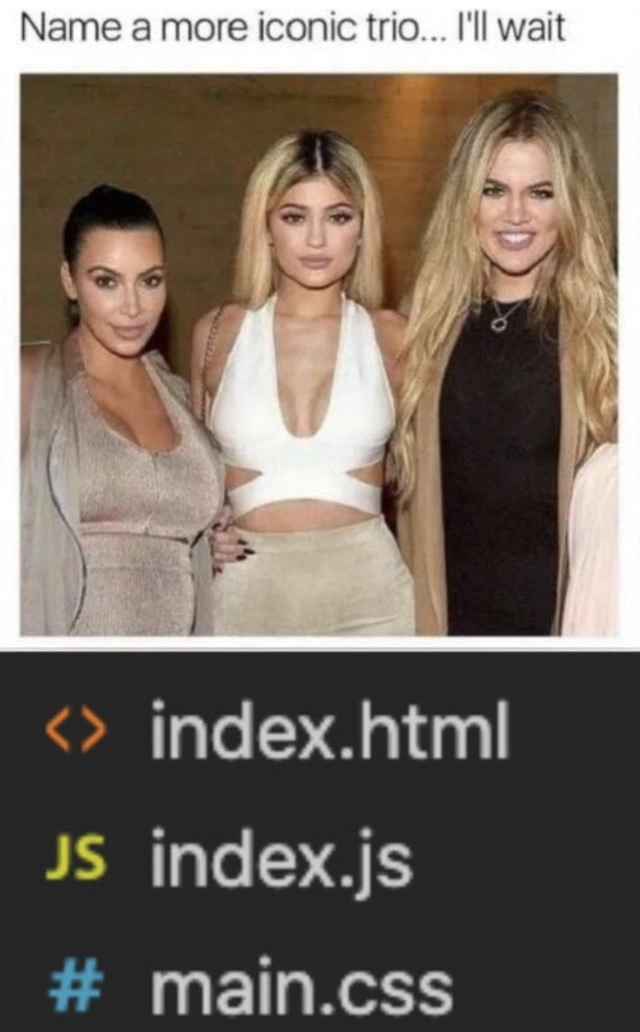
The Holy Trinity of Web Development
Why is this WebDev meme funny?
Level 1: PB&J Sandwich
Making a website is a bit like making a peanut butter and jelly sandwich. You need three basic parts to make it tasty and complete. First, you have the bread – this is like the HTML, giving the sandwich its shape and structure. Then you spread the peanut butter and jelly – that's like the CSS adding color and flavor, making the whole thing look and taste appealing. Finally, imagine adding a little extra fun, like cutting the sandwich into a cool shape or the gooey jelly oozing out when you take a bite – that's the JavaScript, bringing some excitement and interactivity. Each part by itself isn't as exciting: just bread is plain, and just peanut butter or jelly alone would be missing something. But when you put them all together, you get a classic, delicious sandwich. In the same way, HTML, CSS, and JavaScript work together to make a webpage that has structure, style, and a bit of interactive fun. The meme makes us smile because it compares something we programmers find iconic (those three coding files) to a trio everyone knows and loves. It's saying that these three parts are always better together – and that's what makes them legendary to web developers.
Level 2: Website Starter Pack
The bottom half of the meme looks just like a dark-themed code editor (imagine VS Code or your favorite IDE) showing three files:
<> index.html
JS index.js
# main.css
Each file has a special icon: an orange <> symbol for an HTML file, a yellow JS badge for JavaScript, and a blue # for a CSS file. This is essentially the starter pack for a simple webpage. If you're a junior developer or just starting in WebDevelopment, you'll encounter these three early on because together they make a basic website work:
HTML (HyperText Markup Language) – This is the structure and bones of the webpage. The
index.htmlfile is usually the main page. It contains the actual content and organizes it with elements like<header>,<p>(paragraph),<img>(image), etc. Think of HTML as the blueprint or skeleton: it tells the browser what to show (text, buttons, images) and how these pieces are arranged (headings, lists, links in a navigation bar, and so on). By convention, index.html is often the default filename that a web server will serve as the homepage if you don't specify a file.CSS (Cascading Style Sheets) – This is the design layer, the skin and makeup of the site. The
main.cssfile holds all the style rules that make the HTML look nice. CSS can set colors, fonts, sizes, spacing, and even complex layouts. When you change a CSS file, you change the appearance of the website (for example, making the background blue or the text centered). It's called "cascading" because style rules cascade down and can override each other based on specificity (if two rules conflict, the more specific one wins). In practice, you link the CSS file from the HTML, and the browser applies those styles to the elements. In our trio, CSS is what turns a plain structure into a visually appealing page.JavaScript – This is the interactive brain of the webpage. The
index.jsfile is a script that the browser runs to add functionality. JavaScript can respond to user actions (like clicks or key presses), update the content dynamically, validate forms, fetch data from servers without reloading the page (using AJAX/fetch calls), and much more. If HTML is the nouns on the page and CSS is the adjectives, JavaScript is the verbs – it makes things happen. By naming it index.js, we imply it's the main script of our site (similar to how index.html is the main page). Often, you'll see this file included by a<script src="index.js">tag inside the HTML, which means the browser will load and execute that JS code.
For a newcomer to Frontend development, seeing these three files listed together is a rite of passage. In your first web project, you typically create an index.html file, then add a <link> tag to include your CSS file and a <script> tag to include your JS file. For example, in the head of your HTML you might write:
<link rel="stylesheet" href="main.css">
<script src="index.js" defer></script>
This connects the trio: the HTML file pulls in the CSS and JS. When you open the HTML file in a browser, you'll see your page's content and structure (thanks to HTML), the content will be nicely styled (thanks to CSS), and it will have some interactive behavior if you wrote any in JS.
The meme's joke is comparing this very technical trio to a famous pop culture trio. If you're new to coding, it helps to know the phrase "Name a more iconic trio... I'll wait." is an internet meme way of saying that the trio shown is unbeatable or the most classic in its category. Here, the trio is our basic web files. It's funny because it suggests that for web developers, HTML, CSS, and JavaScript are as legendary as any famous celebrity siblings or characters. And honestly, for anyone who's tried building a webpage, it's kind of true! You quickly learn that you need all three: leaving one out is like missing an ingredient in a recipe. Without HTML, there's no content or page at all. Without CSS, everything looks bland and unformatted. Without JS, the page just sits there and can't do much interacting. Together, though, they make magic. This meme is a nod to that fundamental fact in a lighthearted, FrontendHumor way. It resonates with both newbies and seasoned devs because we've all seen these file names a million times—they're the MVPs of client-side web development.
Level 3: Holy Trinity of Frontend
"Name a more iconic trio... I'll wait."
This meme playfully crowns HTML, CSS, and JavaScript as the ultimate dream team of the web. The top image shows a trio of glamorous celebrity sisters (think Kardashian-level iconic) making a grand entrance, and the caption dares us to find a more legendary trio. The punchline? In the coding world, no trio is more iconic than index.html, main.css, and index.js. This is the foundation of virtually every website: structure, style, and interactivity all working together.
Experienced developers immediately recognize this front-end triumvirate. It's practically the holy trinity of web development. Just as those famous siblings are inseparable in tabloids, you always see HTML, CSS, and JS together in any web project. They each have a distinct role:
index.htmlis the backbone, the content and DOM structure of the page (the HTML tags like<div>and<p>create the skeleton).main.cssis the stylist, the Cascading Style Sheets that dress up that content with fonts, colors, and layout (making things look fabulous on screen).index.jsis the dynamism, the JavaScript code that brings the page to life with logic and interactivity (handling clicks, animations, data fetching, and more).
The humor here comes from mixing a pop culture reference with developer reality. In pop culture, an "iconic trio" might be glamorous stars; in development, our stars are files and code. When these files "make an entrance" in a project (as the meme text hints), it's like the VIPs have arrived on the red carpet of your code editor. Seasoned devs chuckle because there's truth in it: no matter how many modern frameworks or build tools we use, at the end of the day everything compiles down to HTML, CSS, and JS. You can almost hear a senior dev say, "Yes, our fancy React app ultimately spits out an index.html with a bundle of JS and some CSS. These three always run the show in the browser."
There's also a nod to the principle of separation of concerns. Frontend folks know we separate content (HTML), presentation (CSS), and behavior (JS) for clarity and maintainability. It's a classic pattern that has stood the test of time (much like those famous sisters staying in the headlines). In the early days of the web, HTML did everything (content and style — remember <font> tags and other deprecated tricks?). Then CSS was introduced to handle all the styling, and JavaScript emerged to manage interaction. This trio became a best practice because each part can shine at what it does best. The meme exaggerates that reverence: to developers, these files are as celebrated as pop stars.
For veteran web developers, there's also a tongue-in-cheek acknowledgement that every project begins with these usual suspects. It's a shared experience: you start a new website, and the first thing you do is create an index.html with a basic structure, link a main.css for styles, and wire up an index.js for functionality. Seeing those three filenames is comforting and iconic, like meeting old friends in a new city. The meme taps into that inside joke — FrontendHumor that newcomers quickly learn and seniors never forget. No matter how advanced our build pipelines get, we still ultimately cheer for this classic trio. Name a more iconic trio in web development... we’ll wait.
Description
A two-panel meme using the 'Name a more iconic trio...' format. The top panel features a photograph of reality TV personalities Kim Kardashian, Kylie Jenner, and Khloé Kardashian, with the caption above them reading, 'Name a more iconic trio... I'll wait'. The bottom panel, against a dark gray background reminiscent of a code editor, displays three lines of text representing the foundational files of a webpage. The first line shows an orange HTML tag icon '<>' next to 'index.html'. The second line has a yellow 'JS' icon for 'index.js'. The third line uses a blue hashtag '#' icon, commonly associated with CSS IDs, next to 'main.css'. The meme humorously proposes that the combination of HTML, JavaScript, and CSS is a more iconic and fundamental trio to web developers than the famous sisters are to pop culture. It's a universally understood joke within the web development community, representing the core separation of concerns: structure (HTML), behavior (JavaScript), and presentation (CSS)
Comments
7Comment deleted
The original frontend starter pack. Before bundlers, frameworks, and a thousand dependencies in package.json, this was the only 'stack' you needed to worry about
index.html, index.js, main.css - the only trio that’s survived every “let’s rewrite it in {Angular|React|Svelte|Next}” exec memo since 2006; git blame still lists them as founding engineers
After 20 years in tech, I've seen frameworks rise and fall, but index.html, index.js, and main.css remain the eternal trinity - though nowadays they're probably bundled, minified, and served through 17 layers of abstraction with a side of webpack config that nobody truly understands
Every senior engineer knows that while frameworks come and go with the hype cycle, this trio has remained inseparable for decades - though we've collectively spent more time arguing about whether the CSS file should be named 'main.css', 'style.css', or 'styles.css' than the Kardashians have spent on social media. The real controversy? Whether index.js should actually be index.ts in 2024
The unkillable root trio - even Next.js can't dethrone index.html without a proxy
Microfrontends, SSR, and islands aside, every rewrite ends the same: index.html bootstraps index.js while main.css keeps prod alive with one strategic !important
The most resilient frontend architecture: index.html, main.css, index.js - every framework is just ceremony to ship those three files to an S3 bucket behind CloudFront