The Brutal Reality of Switching Programming Languages
Why is this Languages meme funny?
Level 1: Easy Mode vs Hard Mode
Imagine you’ve been training with heavy weights on your legs every day, and then one day you take them off and just walk normally – you’d feel super light and free, right? That’s like the C++/Java programmer who has been carrying heavy “syntax weight” suddenly trying Python, which is lightweight. Now flip it: imagine you usually walk around with no extra weight (that’s the Python dev enjoying an easy stroll), but one day someone hands you a huge backpack and heavy boots to wear (that’s all the C++/Java stuff) – walking now feels like a tough uphill hike. You’d probably feel exhausted and overwhelmed. In this meme, learning Python is the easy stroll for the heavy-booted guy, and learning C++/Java is the uphill hike for the sneaker-wearing guy. One situation feels like relaxing on a couch and the other feels like going to war. It’s funny because we’re talking about the same activity (learning a new programming language) but the difficulty flips depending on where you started. Anyone who’s ever found one task easy and a different but related task super hard can relate. It’s like a kid used to doing 100-piece puzzles suddenly faced with a 1000-piece puzzle – of course they’ll feel like it’s a battle! Or someone who can solve big 1000-piece puzzles trying a 100-piece one and going “Oh, this is nothing, done in a jiffy.” The meme simplifies that feeling into two pictures: an “Ah, this is easy!” picture and an “Oh no, this is hard!” picture. Even without knowing coding, you get the idea that one person is having a much easier time learning something new than the other. That’s the whole joke – sometimes what’s easy for me can feel like a epic struggle for you, and vice versa, all because of what we’re each used to.
Level 2: Curly Braces vs Whitespace
Let’s break down the joke in more straightforward terms. This meme compares how developers feel when learning new programming languages, specifically contrasting Python with Java and C++. Why those languages? Python is known for its simplicity and clean syntax, whereas Java and C++ are known for being more verbose and complex. The images exaggerate feelings: in the first panel, the C++/Java developer learning Python is super relaxed (almost like “Ah, this is easy!”). In the second panel, the Python developer learning C++/Java looks battle-worn and tense (as if saying “This is so hard, I’m in a fight for survival!”). The humor comes from flipping expectations: the direction of the learning curve really changes how difficult it feels.
Some key differences will help explain why the experiences are so different:
Syntax and Formatting: Python’s syntax is very minimalistic. It uses indentation (whitespace) to structure code instead of
{ curly braces }. You don’t need;semicolons at the end of each line. For example, to define a simple function in Python, you just write it with proper indentation:def greet(name): print(f"Hello, {name}!")In Java or C++, you’d have to use braces and semicolons:
#include <iostream> using namespace std; void greet(string name) { cout << "Hello, " << name << "!" << endl; } // <-- curly brace to end function int main() { greet("World"); return 0; // semicolon at end of statement }Notice all the extra symbols (
{},;,#include, etc.) in C++? A Python developer isn’t used to writing all that boilerplate. It can feel like a lot of ceremony for little tasks. Conversely, a C++/Java dev who is used to writing a lot just to get simple things done might find Python’s whitespace and lack of braces refreshingly simple.Typing (Static vs Dynamic): Python is a dynamically-typed language. This means you don’t declare the type of a variable; you can do
x = 5andxcan later even become a stringx = "five"without any fuss. The language figures out types on the fly as the program runs. Java and C++ are statically-typed. In those languages, you must declare the type of each variable, and it cannot change:int x = 5; x = "five"; // This would cause a compile-time error in Java, type mismatch.The advantage of static typing is that the compiler (a program that translates your code into machine code) will catch type errors before you even run the program. The disadvantage is you, as the programmer, must think about and specify types everywhere, which is extra work and learning. For a Python dev who never had to worry about whether something is an
intor aString(they just use it), having the compiler yell about type mismatches is a new, possibly frustrating experience. It’s as if the language is less “forgiving”. On the other hand, a C++/Java dev moving to Python might feel weird that everything just works without type declarations — it might even feel too easy, or they might feel a bit uneasy not having those guarantees. However, mostly they’ll enjoy the break from writing types everywhere.Compilation vs Interpretation: Java and C++ code are compiled. This means you have a separate step where you run a compiler program (
javacfor Java,g++for C++) that checks your code and turns it into an efficient form the machine can run. If there are any errors (syntax errors, type errors, etc.), the compiler will stop and list them out, and you can’t run the program until you fix them all. Python, by contrast, is interpreted (though technically Python internally compiles to bytecode, it’s abstracted away). You generally run a Python script directly and if the Python interpreter encounters an error in a line, it will throw an exception at runtime. This difference is huge for learning: the Python dev is used to a flow where you write code and test it immediately, often finding out about errors when you hit that part of the code. When they move to C++/Java, they’re confronted with a wall of compile errors before the program even starts. It can feel like an examiner that won’t even let you into the exam if your paperwork isn’t 100% in order. For example, a Python dev might write a quick script in Python and run it and see a mistake only when that line executes. If they try the same approach in C++:// Imagine this is part of a C++ program int a = 5 std::cout << a << std::endl;They forgot a semicolon after
5. The C++ compiler will immediately throw an error likeerror: expected ';' after expression. The Python dev might think, “oops, minor typo,” but the C++ compiler treats it as a show-stopper. This strictness is new to them and can be intimidating. On the flip side, the C++/Java dev going to Python might feel liberated: “You mean I can just run my code and see what happens? No lengthy compile step? Awesome!” They do have to adjust to the idea that errors might pop up at runtime, but for many, that immediate feedback loop is fun and interactive (like using the Python REPL to test things quickly).Memory Management and Low-Level Detail: This is more about C++ versus Python (Java has automatic memory management like Python, via a garbage collector). In Python, if you create an object or a list, you never have to worry about freeing the memory it uses. The Python runtime will automatically clean up objects that are no longer needed (garbage collection). In C++, however, especially in older styles of C++ or low-level programming, if you allocate memory, you often must release it. Forgetting to do so leads to a memory leak (your program uses more and more memory). Or if you release something too early or incorrectly, you might try to use memory that’s no longer valid, which can crash the program (that’s the infamous segmentation fault, often just called segfault). A Python developer has likely never seen a segfault from their pure Python code—they might not even know the term. Suddenly in C++, if they mess up pointers, the program just blows up with a cryptic message like “Segmentation fault (core dumped)”. That’s scary! It feels like the program went to war with them. Conversely, a C++ dev learning Python might find it refreshing that they can create complex structures without meticulously managing memory. They might even feel a bit uneasy at first, wondering “Are you sure this is okay? Who’s deleting these objects?” until they learn to trust the system. But overall, not having to constantly check for memory issues is a big relief — it’s one major reason Python is considered easier for beginners.
Verbose vs Concise: Java (and to some extent C++) is considered verbose. Verbose means you have to write a lot of code to express something. Python is often described as concise or having a lot of syntactic sugar (nice shortcuts) to do things with fewer lines. For example, compare printing “Hello” in both:
System.out.println("Hello");vs
print("Hello")Python’s version is clearly shorter. Or adding elements to a list vs an ArrayList in Java. Or iterating over a list:
for item in my_list: print(item)versus
for (String item : myList) { System.out.println(item); }They’re not hugely different here, but Python avoids the parentheses, colon vs braces, the type declaration (
Stringitem) etc. The difference in larger programs becomes more pronounced: Java often requires defining classes and methods for everything, even if you just want a simple script. Python lets you write top-level code (just run a sequence of commands). So a Python dev having to wrap their head around “Everything must be in a class, and we need a main method, etc.” is a bit of a paradigm shift. It feels verbose and unnecessary to them initially. Meanwhile, a Java dev might find Python’s free-form scripting a bit chaotic but mostly they’ll be like “Wow, I did that in 3 lines in Python, it took me 10 in Java. Neat!” They might comment on how Python uses spacing and indentation as part of syntax (something they’re not used to—improper indentation in Python causes an IndentationError, whereas in C++/Java whitespace usually doesn’t matter). Once they get used to it, they usually appreciate how clean it looks without all the braces.
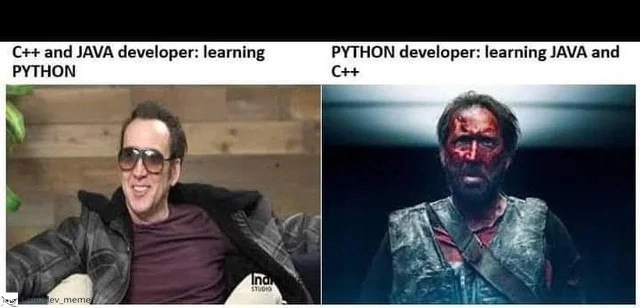
In the meme’s two-panel format, the top caption “C++ and JAVA developer: learning PYTHON” with the relaxed man shows this scenario of an experienced programmer finding an easier language and just chilling. The bottom caption “PYTHON developer: learning JAVA and C++” with the armored warrior conveys the opposite: an experienced Python coder finding the harder languages and feeling like they’re in a struggle. This is a form of learning_curve_humor, joking about how the learning curve (the difficulty of learning over time) can be very steep in one direction. If you imagine a graph: for Python to C++, the curve spikes upward steeply (harder), for C++ to Python, the curve might even feel like a downward slope (easier).
It’s also touching on c_plus_plus_complexity and java_verbosity versus python_syntax_simplicity. These tags basically summarize the idea: C++ is complex (lots of low-level detail), Java is verbose (lots of words/code), Python has simple syntax (fewer symbols, more like pseudocode). So for someone fluent in complexity and verbosity, simplicity is welcome. But for someone fluent in simplicity, being thrown into a world of complexity and verbosity is quite a shock. This contrast is very relatable in developer circles — hence it’s a common source of CodingHumor. Many developers have shared their personal stories on forums about how weird it was going from one language to another. This meme just captures that feeling in one image, which is why people find it funny and tag it as DeveloperHumor and RelatableDevExperience.
To put it simply: if you’re a newcomer reading this, think of it like languages you know. If you only ever spoke a very straightforward language and then tried to learn one with a lot of formal grammar rules and nuances, you’d feel the struggle. Meanwhile, someone who mastered the complicated one might find the straightforward one a breeze. That’s exactly what’s happening between Python (straightforward, less rules) and C++/Java (lots of rules and structure). The meme exaggerates it by showing a relaxed dude for the easy scenario and a battle-scarred warrior for the hard scenario, which is classic meme humor – using dramatic images to emphasize the difference in feeling.
Level 3: Brace for Impact
For seasoned developers, this meme hits on a hilariously true dynamic: moving down the complexity ladder versus moving up it. The left panel’s chilled-out C++/Java developer represents someone who’s spent years wrestling with verbose syntax, strict type systems, and the occasional compiler tantrum. To them, picking up Python feels like kicking back in a recliner after years of sitting on a hard wooden bench. They’ve been living in a world of public static void main(String[] args) ceremony, juggling curly braces {} and semicolons ; everywhere, and carefully typing every variable (lest the compiler wag a finger at them). When such a dev opens a Python file for the first time, there’s an almost magical “Is that it?!” moment of shock and delight. No class definitions required for a simple script, no compile-step separate from run-step, no wrestling with the type of every single object. It’s practically spa day for the brain. The meme’s humor here plays on that relief: the C++/Java veteran is so relaxed it’s as if they can’t believe coding can be this straightforward. They might even feel a bit guilty — “Surely it can’t be this easy to get a program running… what’s the catch?” But as any polyglot dev will tell you, this scenario is very real. A colleague of mine, after years of C++ template metaprogramming, tried Python and literally laughed out loud when his Hello World ran on the first try without any boilerplate. Developer Experience (DX) can be night-and-day between these ecosystems. Python is famously concise; it’s often said that Java is to verbose rituals what Python is to succinct zen. In industry terms, Python’s philosophy emphasizes readability and simplicity (“There should be one—and preferably only one—obvious way to do it,” says the Zen of Python), whereas Java and C++ come from a tradition of enterprise-level robustness, where being explicit and verbose is a virtue that keeps large codebases maintainable. A senior engineer recognizes the top panel and likely reminisces about the first time they wrote something in Python: it felt like trading in a heavy, tool-packed Swiss army knife for a sleek, specialized scalpel for a quick task.
Now compare that to the right panel’s poor Python developer stepping into the ring with Java and C++. That image of a battle-armored, bloodied warrior? It’s only slightly an exaggeration of the emotional state. This is where the meme pulls a classic role-reversal gag: the context flip. The Python dev is used to a gentle learning curve – Python is often the first language taught because of its clean syntax and forgiving nature. When they try to learn Java or C++, it’s like being dropped into a boot camp live-fire exercise with zero prep. Suddenly, everything is strict. The compiler isn’t a friendly interpreter that tries to run your code while pointing out issues; it’s a strict gatekeeper that barks errors at every slight misstep. Forgot a semicolon? Error: expected ‘;’ before ‘}’ in line 12. Used the wrong type? Type mismatch: cannot convert from String to int. Didn’t anticipate that an array index might go out of bounds? C++ might not even warn you – it’ll just let you shoot yourself in the foot and segfault. It’s a harsh learning curve indeed, and the Python dev in this scenario feels like they’ve gone from floating in a calm pool to swimming upstream in a raging river with armor on.
The learning curve swap depicted here is painfully relatable. Senior devs have seen (or experienced) both sides: maybe you learned Java in college and later picked up Python for scripting, or you started with Python for quick automation and then had to dive into C++ for a performance-critical project. The reason it’s “comfortable couch vs. battle mode” comes down to those languages’ design differences. Java’s verbosity means a Python dev is overwhelmed by boilerplate. They have to set up a class, a main method, understand what public static void means, and deal with a lot of ceremony just to get output on the screen. It feels like bureaucracy: imagine if you had to file three forms and acquire a permit just to boil a kettle of water—that’s what writing a simple program in Java can feel like to a newbie coming from Python. C++ is even more daunting in places: memory management is manual, so our Python dev now must learn about pointers (int* ptr what is this sorcery?), references, and the concept that you can actually cause a program to crash by mismanaging memory (an experience virtually unheard of in managed languages like Python which would simply throw an exception). They run into concepts like header files (.h vs .cpp files) which have no equivalent in Python. And error messages? A simple mistake in C++ might spew a cascade of template errors or undefined reference errors that look like another language entirely. No wonder the meme shows the Python dev as if they’ve been through war—it’s exhausting dealing with the new rules and details.
Crucially, experienced developers see the truth in this humor: it’s all about what you’re used to. The meme exploits the fact that “easy” and “hard” are relative states in a coder’s journey. A C++ guru has already fought dragons (memory leaks, race conditions, segmentation faults, oh my!), so using Python feels like a friendly pet lizard by comparison. Meanwhile, a Python guru stepping into C++ encounters those dragons for the first time and probably wishes for a flame-proof shield. Everyone in the field knows a colleague or friend (or themselves) who said something like, “I tried to learn C++ after doing Python, and wow, it felt like punishment!” The war-painted figure resonates because picking up C++ for the first time often does leave you with metaphorical scars: endless debugging sessions for a missing *& in a function signature, or days spent figuring out why your program crashes only to realize you mis-freed memory. The meme’s two-panel comparison layout brilliantly captures this asymmetry: one side calm and cool, the other side intense and intimidating. It plays on the inside joke that not all programming languages are created equal in terms of difficulty.
To a senior dev, there’s also an implied commentary on language paradigms and developer culture. C++ and Java communities often stress rigorous engineering, design patterns, and performance considerations. Python’s community often values quick results, readability, and simplicity. Neither approach is inherently better—it’s about the right tool for the job—but the culture shock of moving between them can be very real. A battle-hardened C++ dev might jokingly complain that Python feels like “coding with kid gloves on,” and a Python dev might feel like Java is “trying to write a novel just to say Hello.” The meme condenses those sentiments into a single image pair that any polyglot programmer can understand at a glance. In essence, it’s a humorous nod to shared developer experience (DX): we all have war stories with one language or another, and seeing that contrast drawn so bluntly is both funny and a tiny bit cathartic. It reminds the old-timers of how far they’ve come and perhaps gently warns the newcomers of what challenges lie ahead if they venture into the land of C++ and Java. As the saying goes in dev circles — “Java is to JavaScript what car is to Carpet.” They’re totally different beasts, and here Python and C++/Java are worlds apart in complexity. This meme simply illustrates that if you’ve tamed the wild beast (C++/Java), walking the dog (Python) is easy; but if you’ve only walked a dog, facing a wild beast for the first time is a shocker. It’s relatable, it’s tongue-in-cheek, and it carries a nugget of truth about the learning curve in software development. Seasoned programmers are likely grinning (or smirking) because they’ve lived this swap in one direction or the other.
Level 4: Type System Shock
At the deepest technical level, this meme highlights a clash of programming language paradigms—static typing and dynamic typing, and the underlying complexity each paradigm carries. A developer moving from C++ or Java to Python is essentially descending the ladder of abstraction complexity: they’re going from lower-level, systems-oriented languages with explicit type enforcement and manual memory considerations, to a high-level interpreted language that abstracts away most of those concerns. Conversely, a Python developer climbing up to C++/Java is confronting the full brunt of that complexity head-on, experiencing what amounts to type system shock.
Under the hood, C++ and Java perform strict compile-time type checking, leveraging formal type systems to catch errors before the program ever runs. This means a C++/Java coder has internalized concepts like data type sizes, conversion rules, and the eerie joy of seeing a template error that spans multiple pages of compiler output. They live in a world of compilation pipelines: source code is parsed into an AST (Abstract Syntax Tree), checked against the language’s grammar and type rules (any mismatch yields a compile error), and then turned into optimized machine code (or bytecode in Java’s case). These languages demand a precise mental model of how the computer manages memory—stack vs heap allocation, pointers or references, object lifetimes, and the illustrious garbage collector (in Java) or lack thereof (in C++). A seasoned C++ dev knows the nuances of O(1) stack allocation versus dynamic heap allocation, can reason about cache locality, and respects the golden rule of memory management: every new should pair with a delete (or at least a smart pointer). In short, they operate close to the metal, where off-by-one errors can corrupt memory and dangling pointers can summon the dreaded segmentation fault. This is the intense reality they’re accustomed to.
Now drop that expert into Python’s world: an interpreted execution model with dynamic typing and automatic memory management. From a theoretical perspective, Python’s interpreter performs just-in-time symbol binding and type checking at runtime (often referred to as duck typing: “if it quacks like a duck, it’s a duck”). There’s no compile-time type theorem to satisfy; instead, objects carry type info with them and operations are resolved on the fly. Fundamental computer science theory tells us that this dynamic approach trades away some static verification for developer convenience and flexibility. But that trade-off means far less cognitive overhead upfront. The C++/Java developer, steeped in formality, finds Python almost too easy: no need to declare int x = 5; – just x = 5 and Python figures it out. The interpreter handles memory with a heap and garbage collector, so no need to manually free anything. Complex data structures like lists and dictionaries are built-in with arbitrary resizing and hashing; comparing that to manually managing std::vector capacity or writing your own hash map in C++ feels like skipping a hard proof by citing a known theorem. The deep humor here emerges from an understanding of computational complexity hidden by abstraction – the C++/Java dev knows exactly how much machinery is running invisibly in Python, and is relieved to let the interpreter handle it for once. It’s like a physicist using a calculator for basic arithmetic: they can do it the hard way, but why not relax when an abstraction does it for you?
On the flip side, the Python developer thrust into C++/Java’s domain is forcibly learning the theory they never had to confront. Every missed semicolon or mismatched type is a lesson in formal languages and compiler design. They’re learning, perhaps painfully, that a program’s grammar in C++/Java is strict—much like a context-free grammar that won’t tolerate an out-of-place token. The Python dev who never worried about memory now comes face-to-silicon with the concept of manual memory management and pointers referencing absolute addresses in memory. It’s a crash course in operating system and architecture fundamentals: “This is how a high-level snippet ultimately maps to CPU instructions and memory registers.” The meme exaggerates this as a battle-hardened warrior because diving into C++ can feel like preparing for combat with the hardware itself. In academic terms, the Python dev is experiencing a paradigm shift akin to moving from a high-level managed runtime model (Python’s VM) to an unmanaged, deterministic world where undefined behavior lurks if you stray from the rules. They’re learning about things like compile-time polymorphism (C++ templates) versus Python’s runtime polymorphism, and discovering that what was once a one-liner in Python might require intricate boilerplate or design patterns in Java/C++. The cognitive load skyrockets: it’s not just writing code, it’s reasoning about the program’s correctness in multiple dimensions (syntax, types, memory, performance) before it ever runs. This deep level highlights why the meme’s scenario is so relatable to experienced developers: it’s rooted in fundamental trade-offs in language design and theory. High-level languages like Python minimize accidental complexity at the cost of some performance and early error detection, whereas low-level languages expose that complexity to maximize control and efficiency. Switching from one to the other is a profound shift in mental models, almost like switching between different branches of mathematics. No wonder one direction feels like a breeze and the other like gearing up for war – it’s all about how much of the computer’s inner workings the developer must juggle in their head. The humor lands because, from a theoretical lens, we know both approaches are valid solutions to the eternal problem of software development: managing complexity. But experiencing the inverse of what you’re used to can be both enlightening and comically painful. This meme encodes that truth in a visual punchline, and those who understand the weight of these paradigm differences can’t help but chuckle (or wince).
Description
A two-panel comparison meme featuring actor Nicolas Cage to illustrate the differing experiences of developers learning new languages. The left panel is captioned, 'C++ and JAVA developer: learning PYTHON,' and shows a cool, confident Nicolas Cage smiling while wearing sunglasses and a leather jacket. The right panel, captioned 'PYTHON developer: learning JAVA and C++', depicts a starkly different scene: a bloodied, disheveled, and tormented Nicolas Cage staring intensely, looking as though he has endured a traumatic battle. The meme humorously captures a widely held sentiment in the programming community: for developers accustomed to the strict typing, manual memory management, and verbosity of C++ and Java, learning the dynamically-typed and cleanly-syntactical Python feels like a breeze. Conversely, for a developer used to Python's high level of abstraction, delving into the complexities of compilers, pointers, and boilerplate in C++ or Java is often a painful and arduous experience

Comments
7Comment deleted
The transition from Python to C++ is the leading cause of developers suddenly appreciating the verbosity of Java
C++/Java dev adopting Python: “Cool, the interpreter is my garbage collector.” Python dev adopting C++: “Cool, the garbage collector is… me, gdb, and 1,800 pages of ISO prose about what happens if I blink.”
The Python developer discovering they need to implement a custom comparator in Java: "Wait, you mean I can't just sort with key=lambda x: x.whatever?"
The meme perfectly captures why Python developers experience existential dread when they encounter their first segfault, realize they need to understand move semantics, or discover that 'just add another library' isn't a valid solution when the compiler throws 47 template instantiation errors. Meanwhile, C++ devs learning Python feel like they've been granted parole from memory management prison - no more wondering if that pointer is dangling, just `import antigravity` and call it a day
C++/Java devs treat Python like a weekend script; Python devs hit Java's boilerplate like refactoring a mainframe COBOL monolith
Going C++/Java → Python feels like taking off a weighted vest; going Python → C++/Java feels like meeting RAII, templates/generics, and a linker that unlocks UB as a difficulty setting
C++/Java → Python: fewer braces and no linker; Python → Java/C++: welcome to types, headers, CMake, and the ancient ritual of appeasing the linker