Skip to content
DevMeme
1173 of 7435
The Three Great Myths of Software Development
Documentation Post #1308, on Apr 14, 2020 in TG

The Three Great Myths of Software Development

Why is this Documentation meme funny?

Level 1: Lost Without a Map

Imagine you got a new LEGO set, but when you open the box, there are no instructions. You have all these pieces but no idea how to build the cool castle you saw on the box. You’d feel confused and a bit frustrated, right? You might start guessing how pieces fit or look for a picture on the box to guide you. Maybe you’d even ask a friend for help.

This meme is joking that using a new tool or service in programming often feels just like that. A well-documented API is like having a clear instruction booklet for a LEGO set – except in real life, programmers almost never get a booklet that good. It’s saying that believing you’ll get perfect instructions for using a new code library is kind of like believing in the Easter Bunny or Tooth Fairy – a nice idea, but not real.

So the funny part is a mix of surprise and relief: surprise that someone said it out loud, and relief that you’re not the only one who has felt this way. It’s like finding out all your classmates also thought the math test was hard – you’re not alone in your struggle. Developers share this meme to laugh about the fact that, many times, they have to figure things out on their own because the “instruction booklets” for these coding tools are missing or incomplete. It’s a way to say, “Yep, I’ve been there too, and it’s okay – we’ll build the castle without the map if we have to.”

Level 2: Missing Manual

For a newer developer, let’s unpack what’s going on. First, API stands for Application Programming Interface. It’s like a menu for a web service: it lists what you can ask the service for and how to ask for it. For example, an API might have an endpoint (URL) like /weather/today?city=London that returns the weather for London. But to use an API correctly, you need documentation – the instructions or guide explaining these endpoints, parameters, and responses.

Documentation can include:

  • API Reference: a list of endpoints or functions and their parameters. Think of this as a dictionary of what the API can do.
  • Guides/Tutorials: step-by-step articles on common tasks (e.g., “How to get started with our User API”).
  • Examples: sample requests and responses, so you know what to send and what you’ll get back.
  • Error codes and messages: explanations for when things go wrong (like what a “404” vs. “500” error means in this context).

Now, the meme jokes that a “well documented API” is as mythical as the Easter Bunny or Tooth Fairy. Why? Because developers constantly encounter APIs that are poorly documented. A junior dev might expect that every API has a nice manual or website explaining how to use it. But often, you get very minimal docs, or none at all.

Imagine you’re given a library or a web service to integrate into your app. The ideal situation: there’s a clear README or website with all the info. Real situation: you find a sparse README that says “Here’s our API. Endpoints: /doThing, /doOtherThing. Good luck!” – not very helpful. It’s like getting a board game with the rulebook missing.

Let’s clarify some terms and technologies referenced in the meme and tags:

  • Developer Experience (DX): This refers to what it’s like for developers to use a tool or API. Good DX means it’s easy to understand and integrate. Documentation is a huge factor in DX. An API might be powerful, but if the docs are bad, the DX is poor because developers struggle to use it.
  • Swagger/OpenAPI: These are tools/standards to auto-generate API docs. You might see something called a Swagger UI – a web page that lists all the API endpoints and lets you test them. It’s generated from the API’s code. While helpful, if the code comments are brief, the Swagger UI might still be cryptic. For example, it might list an endpoint and say “Returns user object” without explaining what’s inside that object.
  • Subtitle meme template: The image uses subtitles from a movie scene. In this case, it’s from an animated movie (DreamWorks’ Megamind, with the red-haired character named Titan). The original scene had him saying: “There is no Easter Bunny, there is no Tooth Fairy, and there is no Queen of England!” as a dramatic way to say “those things are fake.” The meme replaces the last part with “well documented API” to make a tech joke. So the format is a familiar movie quote turned into programmer humor.

Now, why do developers find this relatable? Some typical early-career encounters:

  • Your first API project: You’re told to use service X’s API. You search for docs. Maybe you find a website or a PDF. As you read, you notice important details missing, or the docs use an old version of the API. You try the examples exactly as written, but they don’t work because the API changed since the docs were written. Frustrating, right?
  • Trial and error: With poor documentation, you resort to guessing. “Maybe the endpoint needs a different parameter? Or returns a different field?” You essentially experiment: call the API, see what error comes back, tweak something, call again. This is time-consuming.
  • Asking for help: You might go on forums like Stack Overflow or the project’s GitHub issues page to ask, “How do I do X with this API? The docs don’t say.” Often, you’re not the first one – someone else already asked and maybe got an answer from another dev or even the API’s maintainer. In effect, the community is filling in the documentation gap after the fact.

For instance, say you use a User API and you want to get a list of users who joined after a certain date. The docs don’t mention any filtering. But you guess maybe there is a query parameter like ?joined_after=2020-01-01. You try it; if it works, great (you discovered a hidden feature!). If not, maybe you get an error or just all users. With good documentation, you wouldn’t have to play this guessing game.

The developer humor here comes from shared pain. New devs might initially be surprised – “Really, no documentation? How do they expect us to use this?!” More experienced devs nod and say, “Yup, welcome to the club. We’ve been dealing with this forever.” The meme basically tells junior devs in a tongue-in-cheek way: don’t be too surprised when you face crappy docs; it’s practically a rite of passage.

But there’s also a hopeful side: recognizing this problem is the first step to improving it. Many modern teams are starting to prioritize docs (because a popular, well-loved API does tend to have great documentation, like Stripe or Twilio APIs which newcomers often laud for being clear). Developer tools companies now hire technical writers and DevRel (Developer Relations) folks specifically to make the onboarding experience smoother. Yet, the meme wouldn’t be so relatable if the opposite weren’t still common.

So in summary for a junior: an API is like a service you talk to, documentation is supposed to be your guidebook for talking to it, and the joke is that finding a really thorough guidebook is strangely as hard as finding an imaginary fairy-tale creature. It’s a bit of an exaggeration, but it feels true when you hit that one Friday night bug and the docs are nowhere to be found!

Level 3: Documentation Desert

In the windswept API landscape, a senior developer trudges through a vast documentation desert. The meme’s punchline lands because it’s painfully true: truly well-documented APIs are as rare as unicorns (or Easter Bunnies 🐇). Seasoned devs have spent endless hours integrating web services with sparse docs. They recognize the format instantly: a two-panel subtitle meme using a scene from Megamind where Titan shatters childhood myths. Here, he’s shattering a programmer’s innocent belief that an API will have comprehensive docs.

Why is this so funny (and sad) to experienced engineers? Because we’ve all been there: the project manager promises “Don’t worry, the third-party service is easy; it has great docs.” Then reality hits – the docs are outdated, incomplete, or auto-generated gibberish. The humor bites with dark truth: “There is no Easter Bunny, no Tooth Fairy, and no well documented API.” The developer experience (DX) that product brochures boast about often turns to developer frustration. We laugh, but it’s a knowing laugh from battle scars.

Consider the typical integration scenario:

  • High hopes: You excitedly open the API guide expecting clear examples and thorough explanations.
  • Gut punch: The “documentation” is a one-page README with a single curl example. Critical details are missing – what are valid parameters? What errors to expect? It’s like reading a treasure map with half the landmarks erased.
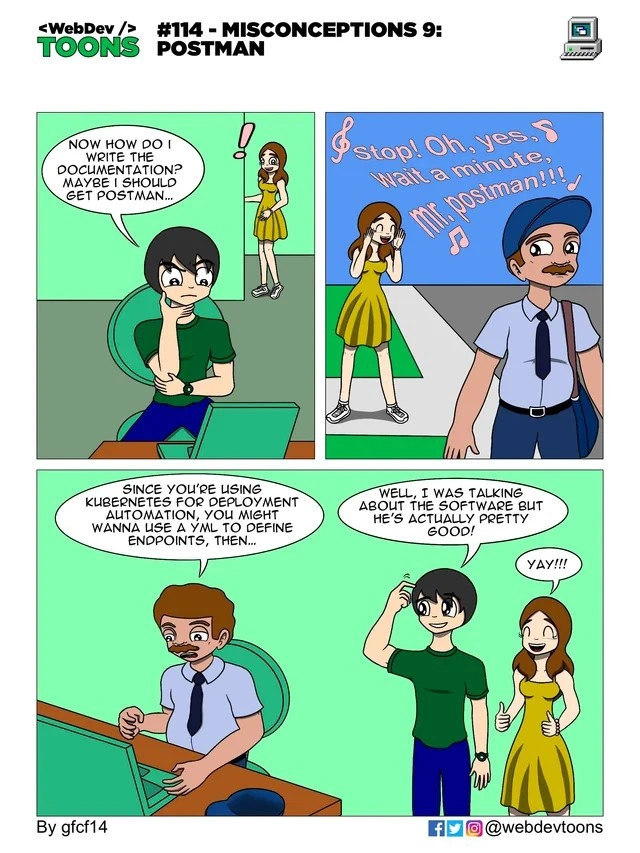
  • The real work: You end up spelunking source code or reverse-engineering API responses with Postman. When something breaks, the 500 Internal Server Error tells you nothing and the docs are silent about error codes.

This meme perfectly satirizes that industry pattern: Documentation is promised, but seldom delivered. Documentation often gets treated as an afterthought in many teams. Under tight deadlines, writing docs falls by the wayside. Product managers prioritize new features over updating the developer guide. And once the API is released, the docs frequently drift out-of-sync with the code.

Real-world pain: Ever integrated a cloud provider’s API and found half the JSON fields undocumented? Senior devs have, many times. They’ve learned that “well-documented” often means “we generated an API reference for you, good luck!” The meme’s deadpan revelation is essentially a senior dev speaking to a junior: “Kid, those nice stories about thorough API docs? Yeah… welcome to reality.”

We also see a bit of gallows humor about Developer Experience (DX). Companies love to brag that their APIs are easy to use. But DX isn’t just fancy SDKs; it’s documentation, examples, tutorials – things that actually help you succeed. A mythical well-documented API would have:

## User Endpoint  
**GET /users/{id}** – *Retrieve user info.*  
**Parameters:**  
- `id` (string, required): The user’s ID.  

**Responses:**  
- 200 OK: A JSON object with user details (see example).  
- 404 Not Found: No user with that ID.  
- 401 Unauthorized: Missing or invalid API key.  

**Example:**  
```http
GET /users/12345 HTTP/1.1  
Host: api.example.com  
Authorization: Bearer <token>  

Response:  
200 OK  
{  
  "id": "12345",  
  "name": "Alice",  
  "email": "[email protected]"  
}

Most of us would be *delighted* to find docs this clear. But more often, we get something like:  

```markdown
**GET /users/{id}** – Returns user data.  
*(No further info.)* 😑

The meme’s comedic despair comes from this exact gap between best practice and reality. It highlights a cultural issue: many engineering orgs undervalue documentation. Writing docs doesn’t get you a promotion; shipping code does. So the “myth of good API docs” persists. Senior devs share this meme alongside other jaded jokes (“It’s always DNS”, “Works on my machine”). It’s both a coping mechanism and a rallying cry for better practices.

And let’s not forget the historical irony: Decades ago, thick printed manuals and RFCs were commonplace. Old-school enterprise APIs (CORBA, anyone?) came with phone-book-sized documentation sets. They were dense, but at least they existed. Today, with agile processes, continuous delivery, and rapid iteration, documentation often lags behind. The result? Newcomers to an API end up searching Stack Overflow for scraps of guidance some kind soul posted.

In summary, this top level breaks down the meme’s core for the veterans: it’s funny because it’s true. The mythical well-documented API sits on the same shelf as tooth fairies – a comforting idea from storybooks that real life refuses to validate. The experienced dev chuckles, equal parts amused and exasperated, because they’ve lived this myth-busting moment again and again.

Description

A two-panel meme featuring the character Tighten from the animated movie Megamind, used to express a cynical truth about software development. In the top panel, Tighten looks distressed as he says, "There is no Easter Bunny, there is no Tooth Fairy,". In the bottom panel, his expression shifts to a menacing, conspiratorial grin as he delivers the punchline: "and there is no well documented api". This meme humorously equates the existence of good API documentation with childhood myths, highlighting a common and frustrating experience for developers who often have to work with poorly explained, outdated, or non-existent API docs. It's a relatable joke for any engineer who has spent hours reverse-engineering an API's behavior

Comments

7
Anonymous ★ Top Pick Some say that if you read a perfect, up-to-date Swagger doc under a full moon, the API gateway will grant you three nines of availability
  1. Anonymous ★ Top Pick

    Some say that if you read a perfect, up-to-date Swagger doc under a full moon, the API gateway will grant you three nines of availability

  2. Anonymous

    “We’ll publish the Swagger spec right after MVP” is the grown-up version of “Santa’s coming” - by Q3 the only gifts we unwrap are Wireshark captures

  3. Anonymous

    The API documentation was actually written by the same contractor who promised the endpoints would be self-documenting - right before they left for a startup that's now your biggest competitor

  4. Anonymous

    Every senior engineer knows the real Easter egg hunt isn't finding hidden features - it's reverse-engineering an undocumented API by reading network traces at 2 AM because the vendor's 'comprehensive documentation' is three years out of date and consists entirely of a single cURL example that returns 401

  5. Anonymous

    Our API documentation is eventually consistent - the spec converges to production behavior after three quarters

  6. Anonymous

    Well-documented APIs: mythical as the Easter Bunny, but without the chocolate eggs to soften the blow

  7. Anonymous

    At enterprise scale, “well-documented API” means Swagger UI renders, auth lives in a Jira thread, and every sample cURL targets an endpoint retired in last quarter’s OKRs

Use J and K for navigation