When Your Name Is an Unhandled Exception
Why is this Databases meme funny?
Level 1: A Very Silly Rule
Imagine you’re signing up for a fun event at school, and you have to write your name on the form. Now imagine the form has a tiny box that can only fit six letters, so if your name is longer than six letters, the computer that takes the form will crash. Instead of fixing the form or the computer, the school makes a very silly rule: “Sorry, kids with names longer than 6 letters can’t join the game.” Sounds unfair and ridiculous, right? It’s not the kid’s fault at all – it’s the form’s fault for being too small!
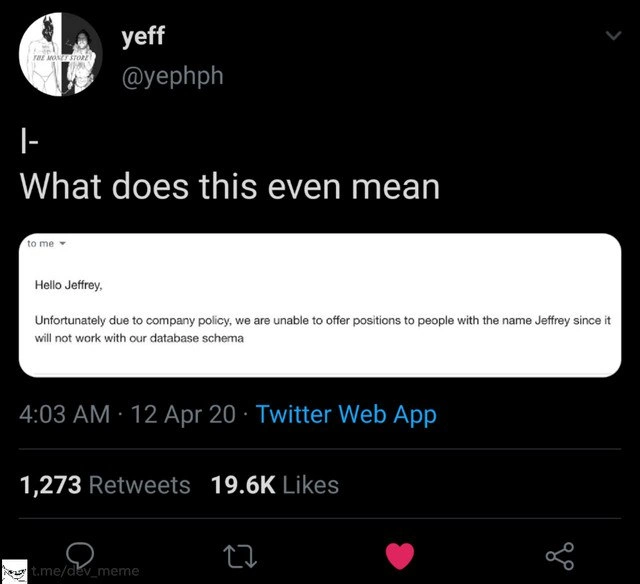
That’s exactly what’s happening in this meme’s story. A company told someone named Jeffrey that they won’t give him a job because their computer system can’t handle his name. It’s like saying, “Your name doesn’t fit in our box, so you can’t play.” Everyone can see that the sensible thing would be to get a bigger box (fix the computer program) instead of turning away a perfectly good person.
We find it funny (and a bit absurd) because grown-ups and big companies are not supposed to have rules this silly. It feels like something from a cartoon: a character gets blocked by a talking door that says “Name too long – entry denied!”. The tweet in the meme is basically the person going, “Huh? What does that even mean?!” in total confusion. And honestly, that’s how anyone would react.
So, in simple terms, the joke is highlighting how goofy it is when a computer problem becomes a human problem. The company’s computer was designed poorly, and instead of fixing it, they made a crazy rule that hurts people with certain names. It’s funny to us because it’s obviously the wrong solution – it’s so bad it’s laughable. And if you were Jeffrey, you’d probably be both upset and baffled. The humor comes from just how off-the-mark the company’s response is.
In the end, the meme is a reminder: some rules are just plain silly, especially when a computer is in charge for the wrong reasons. It makes us laugh and also be glad that most places would simply fix the form (or the database) instead of rejecting the person. After all, a name is just a name – no one should be rejected because a computer can’t handle it!
Level 2: Name Field Fiasco
At this level, let’s break down the technical jargon and scenario in simpler terms. The meme highlights a database schema problem turning into an HR headache. First, what’s a database schema? It’s basically the blueprint of a database – it defines how data is organized in tables, the columns in those tables, and what kind of data can go into each column. For example, a table of job applicants might have a column FirstName that’s defined to hold text up to a certain length.
Now, imagine the people who built this company’s applicant database were a bit short-sighted. Maybe they set the FirstName field to only allow, say, 6 characters. In database terms, they used something like VARCHAR(6), meaning “a text field that can hold up to 6 letters.” This is where the trouble starts. The name "Jeffrey" has 7 letters, which is one letter too long for that field. That’s what we mean by a varchar_length_bug – the field’s length is too short for real data.
What happens if you try to shove "Jeffrey" into a 6-character limit? The database will throw an error. It’s like trying to put a size-7 foot into a size-6 shoe – it just doesn’t fit. Here’s a hypothetical demonstration in SQL, the language used to communicate with relational databases:
-- Defining a table with a very strict schema
CREATE TABLE Applicants (
FirstName VARCHAR(6) -- First name can only be 6 characters long
);
-- Inserting a short name works fine:
INSERT INTO Applicants (FirstName) VALUES ('Robert');
-- (This would succeed, as "Robert" is 6 letters.)
-- Inserting "Jeffrey" is one letter over the limit:
INSERT INTO Applicants (FirstName) VALUES ('Jeffrey');
-- ERROR: value too long for type character varying(6)
-- The database rejects the operation because "Jeffrey" doesn't fit the schema.
In a well-run system, the correct response to that error would be to fix the schema – for instance, alter the table to allow more characters (maybe VARCHAR(50) to be safe, or use a TEXT type with virtually no limit). But in the world of the meme, the company’s solution was the opposite: don’t allow the name. The HR email basically says, “Sorry, we can’t hire you because our database can’t handle your name.” This is presented as a “company policy,” which is hilarious because it reveals the company is codifying a technical limitation into an official rule rather than just resolving the technical issue.
Let’s clarify a few terms and why they’re funny here:
Name field constraint: This refers to any restriction on the name field in the database. It could be length (as in our example) or allowed characters (some systems might reject names with spaces, hyphens, or non-English letters). A famous piece of developer lore is a document called “Falsehoods Programmers Believe About Names,” which lists assumptions like “names are short” or “names only contain letters A-Z.” Real life proves these false. If a database was designed with such false assumptions, you get bizarre bugs. Here, the constraint seems to be tripping on “Jeffrey.”
Schema-driven rejection: This phrase means the database’s design (the schema) is driving a decision to reject something (in this case, a job candidate!). Normally, business rules drive schema, not the other way around. Seeing it reversed is both comedic and concerning. It’s like the tail wagging the dog: the tech should serve the business, not dictate who HR can hire.
HR system edge case: An edge case is an unusual scenario that wasn’t anticipated by the system’s normal rules. A candidate whose name doesn’t fit might be such an edge case. Ideally, edge cases get handled gracefully (by updating the system). In our meme’s scenario, the edge case (name too long for schema) wasn’t handled in code, so it bubbled up to HR. The result is an “edge case” email to the candidate that leaves everyone scratching their heads.
Tech debt: This is worth explaining because it’s essentially what’s on display here. Tech debt refers to the idea that if you take shortcuts in coding or design now, you might pay a price later. Maybe years ago, a developer set up the database with narrow limits (shortcut), and for a while it worked “well enough.” But that decision accumulates interest – eventually, it causes a problem that is costly or embarrassing (the debt comes due). Rejecting a qualified person named Jeffrey because of a coding decision is a comical example of paying off tech debt with social interest. The company now either has to 1) fix the database (which might be non-trivial if the software is old and fragile) or 2) stick to the absurd policy and miss out on good hires. For now, it sounds like they chose option 2.
DatabaseDesign humor: Developers often joke about how real data breaks naive designs. For instance, you might design a database thinking every person has one first name and one last name – then you meet someone with three last names, or no last name at all, and your system crashes. In this case, the humor is that an everyday name wasn’t accounted for. It’s like a slapstick moment in tech: something as ordinary as "Jeffrey" brings the whole hiring system to a halt.
The original tweet’s author (@yephph) says, “I– What does this even mean”, expressing bewilderment. If you’re less technical, their confusion is valid: it is baffling to hear that a database schema doesn’t accept a normal name. But now you know it likely means the company’s software literally cannot save the name in its database due to a design flaw. The HR person writing that email probably didn’t fully understand the tech either – they just got a notice from IT that “the system throws an error for this candidate’s name,” and they translated it (awkwardly) into a rejection email.
In plain terms: the company’s hiring software was not built to handle a candidate named Jeffrey, so the company decided not to consider Jeffrey, instead of updating their software. This is why developers are facepalming at this meme. It’s a perfect storm of DatabaseHumor and CareerHumor – a simple bug turning into a surreal hiring policy. The lesson for junior developers is clear: when designing systems, always allow for real-world data. And if you ever encounter a bug like this, fix the system, not the person! Otherwise, you might end up on Twitter as the joke of the day.
Level 3: Schema Over Sanity
This meme hits a raw nerve for seasoned developers. It’s a darkly funny case of tech debt leaking into human resources policy. The tweet’s screenshot shows an HR email bluntly saying they can’t hire “Jeffrey” because his name breaks the database schema. Yes, you read that correctly – a person’s name is effectively a fatal error in their system. This is the kind of absurdity one encounters only after years battling ancient enterprise software and database design fiascoes.
Let’s unpack why this is so uproariously tragic:
Rigid Database Schema: Somewhere in this company’s code, the database schema (the structured design of how data is stored) has a constraint that chokes on the name "Jeffrey". Perhaps the
FirstNamefield was defined with a ridiculously short length or strict format. Imagine a table column likeFIRST_NAME VARCHAR(6)– just six characters max. That would accept "Jeff" (4 letters) or "John" (4), maybe even "Robert" (6), but "Jeffrey" (7) is one letter too many. The result? A database error whenever poor Jeffrey’s name is inserted. It’s a classic varchar_length_bug.Tech Debt Turned “Policy”: Instead of fixing the root cause (altering the schema to accommodate real human names), someone decided to label it "company policy". This is schema_driven_rejection at its finest: rather than refactor the code, they literally refuse to hire people with that name. It’s as if the database said
NoJeffreysAllowed = TRUEand HR shrugged and went along. The veteran in me cringes – this is the database calling the shots on hiring decisions! Career_HR meets DatabaseDesign in the worst possible way.Historical Baggage: How does a situation like this even arise? Likely from ancient legacy systems or sloppy design. Picture an HR system written decades ago with hard-coded assumptions about names. Maybe the original developer assumed no first name would exceed 6 letters (an obvious mistake, but such false assumptions about names are more common than you’d think). Over time, instead of redesigning the schema to be more flexible, the company piled on workarounds. By 2020, they’ve reached the ultimate lazy fix: Just don’t hire those whose names our system can’t handle. It’s a real hr_system_edge_case turned into official edict.
Shared Trauma in Tech: This meme is TechHumor gold because so many of us have fought against rigid systems. We’ve seen forms that reject O’Connor because of the apostrophe (SQL injection fears or encoding issues), or databases that can’t handle a last name of
"Null"(causing queries to break). The developer community often references the classic “Little Bobby Tables” comic from xkcd – where a school’s database is destroyed by a student’s name cleverly crafted as SQL code (Robert'); DROP TABLE Students;--). In that case, the solution was to sanitize inputs, not ban students with tricky names. Here, instead of fixing their input handling or expanding a field length, the company chose the path of comedic insanity.
To an experienced engineer, the email in the meme reads like a horror-comedy. The line:
“Unfortunately, due to company policy, we are unable to offer positions to people with the name Jeffrey since it will not work with our database schema.”
translates to: “Our DatabaseSchema is so poorly designed that it can’t store your name, and we’d rather reject you than refactor our code.” It’s both laughable and horrifying. We laugh because it’s absurd DatabaseHumor, and we shudder because we’ve seen echoes of this in real life. This is career humor with a dark twist – the database (and the developers behind it) just vetoed a candidate purely because of a string of characters. Rejected by the schema – what a nightmare scenario!
In summary, Level 3 perspective sees this meme as a sharp satire of companies crippled by their own DatabaseDesign flaws. It exaggerates reality (we hope no one literally has a “No Jeffreys” rule), yet it resonates because we know how often technology constraints drive silly business decisions. The veteran developer in us cackles at the absurdity, then immediately checks our own systems for any name_field_constraint or other landmines that could cause such embarrassment. After all, no one wants to explain to HR why the database had the final say in hiring.
Description
A screenshot of a tweet from user 'yeff' (@yephph) that expresses confusion with the text 'I- What does this even mean'. The tweet contains an image of an email or message addressed to 'Hello Jeffrey,'. The message reads: 'Unfortunately due to company policy, we are unable to offer positions to people with the name Jeffrey since it will not work with our database schema'. The tweet is dated 4:03 AM, 12 Apr 20. The humor lies in the absurdity of a database schema being so poorly designed that it cannot accommodate a common name like Jeffrey. For developers, this suggests a catastrophic level of technical debt, hardcoded values, or a complete failure in data validation, making the company's excuse both hilarious and terrifying
Comments
7Comment deleted
Their schema probably has a UNIQUE constraint on `first_name` and they already hired a Jeffrey. It's either that or their entire backend is a single regex that panics on the letter 'J'
Welcome to enterprise tech, where rejecting every “Jeffrey” is still cheaper than ALTER TABLE first_name MODIFY VARCHAR(32)
Somewhere there's a senior engineer who hardcoded "Jeffrey" as the test user in production, and now the entire authentication system depends on it being unique
When your database schema is so rigidly designed that it becomes your HR department's excuse generator. This is what happens when someone takes 'fail fast' literally and applies it to the hiring pipeline - apparently they've got a CHECK constraint on applicant names. One can only imagine the schema: CREATE TABLE employees (name VARCHAR(50) CHECK (name != 'Jeffrey')) - because why fix your data model when you can just reject perfectly qualified candidates? It's the ultimate manifestation of 'it's not a bug, it's a feature' meeting 'we can't change it, it's in production.' Somewhere, a senior architect is explaining that migrating to support the name 'Jeffrey' would require a three-sprint epic and extensive regression testing
Nothing says 'data-driven HR' like an ATS with first_name VARCHAR(6) and a CHECK constraint forbidding 'Jeffrey'; the approved migration path is legally renaming yourself to 'Jeff'
When your legacy schema's VARCHAR(3) finally enforces HR diversity quotas - Jeffs denormalized on sight
At this company HR is ACID-compliant: “Jeffrey” violates the CHAR(6) constraint, so we roll back the candidate