Skip to content
DevMeme
1542 of 7435
The Unflinching C++/Qt GUI Developer
Languages Post #1723, on Jun 18, 2020 in TG

The Unflinching C++/Qt GUI Developer

Why is this Languages meme funny?

Level 1: Cooking from Scratch

Imagine two friends making a snack. One friend pops a frozen pizza into the microwave and laughs at the other friend, saying “Haha, you’re making a pizza from scratch? That’s cute.” The second friend is calmly kneading dough and chopping fresh ingredients in the kitchen. He just smiles and says, “Yes.” In this story, the one with the microwave thinks the other is silly for working harder using the oven and fresh dough. But the calm friend knows something important: his homemade pizza will turn out delicious, much better than the quick microwave snack. He doesn’t get upset at the teasing – he’s confident because he trusts the quality of what he’s doing. The joke is funny because the microwave friend expected an angry or defensive response, but all he got was a proud “Yes”. Sometimes, doing things the tried-and-true way might take more effort, but the results speak for themselves. The quiet confidence of the friend cooking from scratch makes the teasing look trivial – and that’s exactly why the scene makes us smile.

Level 2: Web vs Native GUI

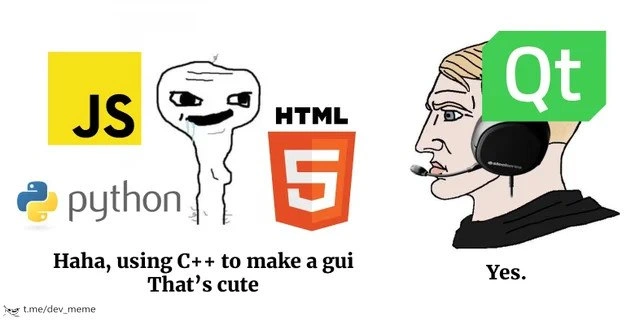
Let’s break down what’s happening in this meme. On the left side, we have a cartoon character (the soyjak) next to three familiar tech logos:

  • JS (JavaScript) – the yellow square with “JS” stands for JavaScript, a very popular programming language usually used in web pages to make them interactive.
  • Python – the blue-and-yellow snake icon represents Python, another popular programming language known for being easy to learn and use.
  • HTML5 – the red shield logo with “HTML” represents HTML5, which is the standard language for creating the structure of web pages.

These three items together (JavaScript, Python, HTML) suggest a “web dev stack,” meaning a collection of technologies often used together to build apps or user interfaces. For example, a developer might use HTML (and CSS) for the layout and style, JavaScript for interactive behavior in a web page, and perhaps Python to run a server or as a back-end that feeds data to that interface. In some desktop app setups, Python might even launch a local web interface or use frameworks that embed a browser to create a GUI. The soyjak character is shown mocking the other side by saying: “Haha, using C++ to make a GUI? That’s cute.” In plain terms, he’s laughing at someone for using C++ to create a graphical user interface.

Now, the right side has a very different vibe. There we see the Qt logo (a green square with “Qt”) overlaid on a confident looking cartoon man often called the “Chad”. Qt is a framework for building applications, most notably for making GUIs, and it’s typically used with the C++ programming language. C++ itself is a powerful, low-level programming language (lower-level than Python or JavaScript) often used for high-performance applications. When we say “GUI” (Graphical User Interface), we mean the buttons, windows, text fields – basically the visual app interface you can click and interact with, as opposed to text-based console programs. Qt is one of the major frameworks that lets developers create those interfaces in C++ with relative ease, and importantly, it allows the same C++ GUI application to run on different operating systems (Windows, macOS, Linux, etc.) with minimal changes – that’s what we call cross-platform capability.

In the meme, the Chad character with the Qt logo simply responds with “Yes.” That’s it – just one word, calmly saying yes. This format is actually part of an internet meme style known as “soyjak vs Chad”. The soyjak (left) usually whines or mocks something, and the Chad (right) typically responds in a short, confident way, often just agreeing as if unbothered. It’s a way to show that the Chad character is so confident in his position that he doesn’t even find the insult worth arguing about. Here, Chad is basically saying, “Yes, I do use C++ to make a GUI,” with the implication that he’s quite content doing so.

So why is the web dev side saying “That’s cute” about using C++ for a GUI? In slang, calling something “cute” in that tone is a way to belittle it or say “aw, how quaint.” The web tech folks might think using C++ for making interfaces is old-fashioned or unnecessarily hard, especially since these days many developers use high-level languages and web technologies to create user interfaces. After all, with things like Electron (which isn’t explicitly named in the meme but is widely associated with using JS/HTML for desktop apps), you can make a cross-platform desktop application with just web technologies. Python also has frameworks (like PyQt, ironically, or Tkinter) to make GUIs more easily than writing raw C++ code. So from the soyjak’s perspective, the Qt developer is stuck in the past or doing extra work – thus he’s laughing.

However, the twist and humor of the meme comes from the Qt developer’s reaction. He isn’t upset or trying to defend himself with a long argument. He just says “Yes.” This implies a high level of confidence. It’s like he’s thinking, “Call it cute if you want, but it works great for me.” The meme is essentially laughing at the situation of a smug group and a silently confident individual. The Qt guy is portrayed as a Chad – internet slang for someone who is effortlessly cool and confident – meaning the meme sides with him as the admirable one.

From a technology standpoint, what’s being hinted at is the difference between native GUI development vs. web-based GUI development:

  • Native C++ GUI (Qt): This means writing the application in a compiled language (C++) and using a specialized toolkit (Qt) to create windows, buttons, etc. “Native” means it runs directly on the operating system’s GUI system. This often yields fast performance and a look-and-feel that matches other apps on the system. But it requires knowledge of C++ which is more complex (you manage memory and deal with pointers, for example). Qt helps by providing a lot of ready-made UI components, and it uses a concept called signals and slots (kind of like events and handlers) to wire up interactions. C++ programs are compiled to machine code, which generally runs faster and uses resources more efficiently than interpreted code.
  • Web Stack GUI (JS/HTML/Python): This approach treats the app more like a web page. You design the interface with HTML (and CSS for style) and make it interactive with JavaScript. If Python is involved, it could be running a local server or some back-end logic. Sometimes technologies like Electron are used so that the web code can run as a desktop app (Electron basically bundles a Chromium browser and Node.js to run JavaScript on the desktop). This approach is popular because many developers know web languages, and you can reuse code across web and desktop. However, these apps can be heavy – since you’re running a whole browser behind the scenes – and not as snappy as a well-written native app. Python, while easy to write, is also interpreted and can be slower than C++.

The meme’s joke leans on the stereotype that web developers may scoff at older languages like C++ as “too low-level” or “not necessary anymore,” while system/desktop developers roll their eyes at how inefficient some web-based apps can be. The Chad Qt saying “Yes” is effectively owning the fact that, yes, he uses a 20+ year-old framework (Qt) with C++, and he’s fine with it because it’s still a relevant and powerful combo for many applications. Qt is widely used in industries (like automotive interfaces, engineering tools, even some UI parts of software like Autodesk Maya or Zoom) – it’s proven and maintained. Meanwhile, the flashy new solutions (JS, etc.) are great for some things but not automatically superior for everything.

In simple terms, the left side is using multiple easier tools glued together and finds it funny that the right side is using a single harder tool. The right side confidently acknowledges it. It’s like a group of people saying, “Haha, you’re still doing it the hard way,” and the person goes, “Yep, I am,” with a smile because he knows the hard way yields strong results. This resonates as developer humor because it reflects real exchanges in tech communities. The tags like Cpp, JavaScript, Python, LanguageComparison, LanguageWars all point to this being a friendly jab at the ongoing debates over programming languages and frameworks. And indeed, this meme is a lighthearted take on those debates – showing that sometimes the subject of ridicule doesn’t even care, because he’s confident in his choice.

Level 3: Compiled Confidence

The meme lampoons a classic language wars scenario in GUI development. On the left, a trembling Soyjak character (an internet cartoon archetype of an overly emotional, mocking nerd) is backed by the logos of JavaScript, Python, and HTML5 – the staple tools of modern web development. He sneers, “Haha, using C++ to make a GUI? That’s cute.” On the right stands the Chad Qt developer (the confident meme character with a defined jawline and headset) emblazoned with the green Qt logo. Unfazed by the jibe, Chad’s single reply is a calm, “Yes.” This one-word retort is a mic-drop moment for seasoned developers: it embodies quiet confidence in a robust tech stack and flips the script on the heckler.

Technically, this meme contrasts desktop GUI programming in C++ (using the Qt framework) against a more web-centric GUI toolchain (mixing JavaScript, HTML, and often Python for glue). The humor arises from the absurdity of a three-language pile mocking a single, compiled language solution. Web developers often champion their stack’s flexibility and approachability – using HTML for structure, CSS for style, JavaScript or Python for logic – and might tease C++ as archaic or overkill for making a window with buttons. But the Qt Chad’s chill “Yes” implies “Yes, and it works amazingly well.” It’s developer humor rooted in irony: the supposedly “outdated” choice stands strong without needing validation. In fact, experienced devs know that Qt (born in the 90s and still thriving) powers many professional applications and offers something the web stack can’t easily match: native performance with a single cohesive framework.

This framework versus language face-off hides deeper truths that senior developers smirk at. Modern Electron apps (built with the same JS/HTML combo Soyjak represents) infamously bundle a whole Chromium browser just to show a desktop GUI. This can bloat memory usage and file size – essentially shipping an entire web browser for each app. Qt, by contrast, is a C++ library compiling down to native code. A Qt application is typically a lean, self-contained executable that boots up fast and runs with lower memory overhead. The meme’s subtext is a wry performance comparison: the Chad C++ app likely launches in milliseconds and sips RAM, while the soyjak’s Electron-based app takes seconds to start and chomps gigabytes. No wonder the Qt dev is confidently saying “Yes” – he knows his choice, though less trendy, is technically solid.

Another layer to the laugh is the dependency irony. The web stack crew mocks C++ for GUIs, yet their own tools ultimately rely on C/C++ under the hood. The Python interpreter (CPython) is written in C. The JavaScript engine (like Chrome’s V8) that runs all those fancy web apps? It’s written in C++. Even the HTML5 rendering in a desktop context happens inside a browser engine compiled from C++. In other words, the “soyjak” devs are standing on a tower built by C/C++ but acting smug about not using it directly. The Qt Chad knows this and doesn’t even bother to point it out – he just effortlessly uses the power of C++ directly for his GUI. This reversal – mocking someone for using the very foundational tech that makes your solution possible – is rich comedic iron to a veteran programmer.

From an industry perspective, the meme pokes at the fad-driven development vs. time-tested tools. Today’s tech culture often glorifies frameworks that let you write one codebase for web, mobile, and desktop. JavaScript with a UI library, packaged by something like Electron or a Python wrapper, is seen as “modern”. Meanwhile, C++ with Qt is viewed by some as an old man’s toolkit – powerful but “uncool” or requiring too much boilerplate. The meme exaggerates this divide: a chorus of “Haha, that’s cute” from the hip crowd, versus a single Chad “Yes” from the C++ guru who’s heard it all before. It’s a scene many senior devs recognize: a meeting room where enthusiastic new hires push the latest web-first solution, while a quiet veteran knows that the “boring” proven technology will actually work better for this use case. The veteran doesn’t waste breath on debates; they just deliver results. Qt Chad’s calm yes = results speak louder than hype.

Importantly, the humor also comes from the Soyjak vs Chad meme format itself. This format casts one side as whiny or insecure (soyjak) and the other as confident and unfazed (Chad). By using it, the meme creator makes an implicit value judgment: the Qt approach is the Chad – i.e., the objectively confident, superior one (in this context) – and the web stack approach is the soyjak, superficially derisive but ultimately insecure. The sheer brevity of “Yes.” is comic gold because it’s the ultimate power move: no lengthy rebuttal, no defensive rant, just agreement. It’s as if the Qt developer is saying, “Call it cute all you want, I know what I have.” In internet culture, this is known as the “Yes Chad” response – owning the insult proudly, which usually flips the script on the insulter. Developers in on the joke will chuckle because they’ve seen countless flame wars where one side just can’t resist writing a wall of text to justify their tech stack. Here, the Qt dev needed only a single word. That one word carries a big subtext: C++ Qt for GUI? Yes – it’s tried-and-true, performant, and I’m perfectly happy with it.

This meme resonates in forums and communities because many devs have lived this debate:

  • A front-end web developer might genuinely find C++ GUI development intimidating or antiquated, having spent their time in React or Angular, so they joke about it.
  • The C++ veteran has likely endured years of hearing “Why not use X language, it’s easier!” but also cleaning up when those “easier” tools hit performance or stability limits. He’s past the point of arguing – he just builds the darn thing in Qt and lets it do the talking.

In essence, this is developer humor about confidence in one’s tools. It satirizes the knee-jerk dismissiveness some have toward older or lower-level technologies, while winking at the fact that sometimes the older tool outlasts the hype. The categories of Languages and Frameworks collide: we see a framework (Qt) personified as Chad, calmly facing down a gaggle of languages (JS, Python, HTML) personified as a smug mob. It’s an absurd visual metaphor, but it brilliantly captures the feeling of being outnumbered by hype and not minding at all. Any programmer who’s ever stuck with a “less cool” stack because it simply works will find this meme both hilarious and vindicating. Qt Chad doesn’t argue; he doesn’t have to – the success of his C++ GUI (and the meme’s punchline) is just “Yes.”

Description

A 'Yes Chad' (or Nordic Gamer) meme format contrasting different technologies for graphical user interface development. On the left, a crying/mocking Wojak character is surrounded by the logos for JavaScript (JS), Python, and HTML5. The text below it reads, 'Haha, using C++ to make a gui That's cute'. A small watermark for 't.me/dev_meme' is visible in the bottom left corner. On the right stands the stoic, blonde-haired 'Chad' character wearing a gaming headset, with the green Qt framework logo superimposed over his head. His only response is the word 'Yes.'. The meme humorously illustrates the cultural divide between developers using web technologies or high-level languages for UIs and those who use the more traditional, high-performance C++/Qt stack. It portrays the C++ developer as confident and unbothered by the mockery, proud of their choice of tool, which is often used for demanding native and cross-platform applications where performance is critical
Comments

7
Anonymous ★ Top Pick The JavaScript ecosystem invents a new GUI framework every week. The C++/Qt ecosystem just keeps shipping performant desktop apps that work for 20 years
  1. Anonymous ★ Top Pick

    The JavaScript ecosystem invents a new GUI framework every week. The C++/Qt ecosystem just keeps shipping performant desktop apps that work for 20 years

  2. Anonymous

    “JavaScript + Python + 1,200 npm packages to render a button.” Qt dev: “Cute - my statically-linked 12 MB binary shipped the whole product while your dependencies were still auditing left-pad.”

  3. Anonymous

    The real joke is that the JavaScript developer's Electron app is probably using 2GB of RAM to render a todo list, while the Qt developer's entire IDE fits in the memory footprint of a single Chrome tab

  4. Anonymous

    When your 'Hello World' GUI compiles to 2MB with Qt while the JavaScript equivalent ships 200MB of Chromium, but they're the ones laughing at your choice of C++. Meanwhile, you're over here with sub-millisecond render times and native OS integration, wondering if they've discovered the profiler yet

  5. Anonymous

    Web GUIs: Infinite flexbox tweaks for 'native' feel. Qt: Ships with actual pixels and zero Chromium bloat

  6. Anonymous

    A Qt/C++ GUI that cold-starts in ~80ms and sips 40MB still beats shipping a full Chromium just to render a button

  7. Anonymous

    Yes - C++/Qt for GUI: where “npm audit” becomes “ldd,” first paint beats Electron’s dependency load, and the changelog doesn’t list a Chromium version

Use J and K for navigation