When Engineers See Automation Everywhere
Why is this Automation meme funny?
Level 1: When Laziness Gets Creative
Imagine you really, really don’t want to do a simple chore, like picking up your toys or petting your cat. Instead of just doing it (which would take maybe a few seconds), you come up with a wild plan: you’re going to teach your dog to do it for you! 😃 You spend all week showing the dog how to gently use its paw to stroke the cat. Eventually, the dog learns to do it, and you proudly sit back and say, “See, I don’t have to pet the cat anymore, it happens automatically!” Sounds funny, right? You put in a ton of effort to avoid a tiny bit of effort each day.
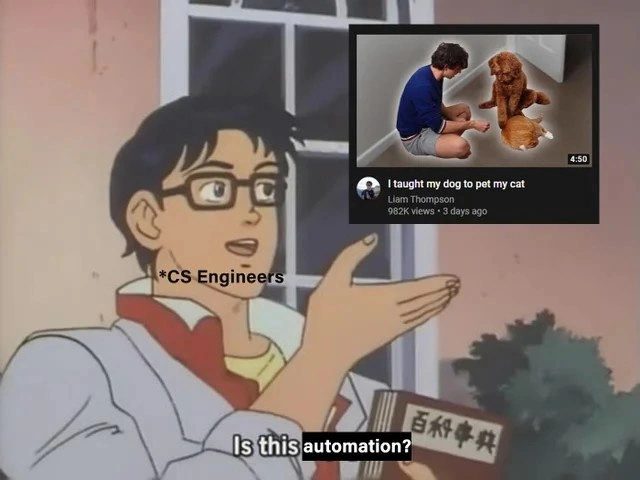
This meme is laughing about that exact situation. It’s like building a super complicated LEGO machine to drop a ball into a cup that you could have just dropped in yourself. We find it funny because the person is so determined not to do the small task that they ended up doing an even bigger task first! It’s a very creative kind of laziness. Instead of being practical, they treated the problem like an experiment or a game. The picture shows an anime guy pointing at something (in the original, he’s confused about a butterfly). In our version, he’s pointing at a YouTube video where someone taught a dog to pet a cat, and he’s asking, “Is this automation?” – which is a big word for making things happen by themselves. He’s basically saying, “I made it so I don’t have to do it, does that count as a machine doing it for me?” It’s silly because a dog isn’t a machine, and training it was way harder than the original chore.
Why do we laugh? Because we’ve all done funny things to avoid work at some point. Maybe you tried to rig a broom to automatically sweep your room, or you stacked things precariously so they’d fall and close the door behind you (instead of just getting up to do it). It usually ends up being more work to set up than just doing the simple thing – and that’s the joke. It’s poking fun at the idea that sometimes we go overboard just to save ourselves a little effort. In the end, the dog petting the cat is cute and cool, but it makes us giggle to call it “automation.” It’s like saying, “Look, I found a way to not have to do this myself!” – even though the “way” was pretty over-the-top.
So, this meme feels funny and warm because it’s about human nature: we love to invent clever solutions (especially if we’re techie or playful) even when we’re kind of just being lazy. And seeing a dog and cat involved makes it extra wholesome and amusing. It reminds us that sometimes doing things the simple way is fine, but where’s the fun in that? 😄
Level 2: Automating the Pet Project
Let’s step back and clarify some of the technical humor here. Automation, in a developer context, means using technology (usually software or hardware) to perform tasks with minimal human effort. Common examples are writing scripts to automatically deploy code, using a cron job (a scheduled task in Unix-like systems) to run nightly backups, or setting up a robot vacuum to clean your room. The goal is to save time and avoid repetitive manual work. In the meme, however, the idea of automation is applied in a very non-traditional way: instead of writing code or using a machine, someone literally taught a dog to do a task (petting a cat) for them. It’s basically saying, “I don’t want to do this myself every time, so I found a way for it to happen automatically.” Training a pet isn’t what we usually mean by automation scripts, but the end result is similar – you’re not doing the task yourself anymore!
Now, what makes this funny to developers is the clear case of over-engineering. Over-engineering means designing a solution that is far more complicated than necessary for the problem at hand. Here, the “problem” is straightforward: petting a cat. A simple solution is to just, well, pet the cat whenever it wants attention. But our imaginative engineer in the meme chose a more elaborate path: teach the dog to do it. This likely took way more effort than the manual solution, which is the classic hallmark of over-engineering – like writing a 100-line script to automate something you could do manually in 30 seconds. Developers often joke about this because it happens in real life: for example, a programmer might spend an entire day automating the setup of a development environment (so next time it’s one click), even if manually setting it up takes only 10 minutes. We do it for the promise of future convenience, but sometimes we invest a lot more time than we ever save.
The meme uses the well-known “Is this a pigeon?” template. In that original meme, an anime character confusingly points at a butterfly and says “Is this a pigeon?” – it’s about mislabeling something. In our case, the CS Engineer (Computer Science engineer) character is pointing at a YouTube thumbnail of a dog-and-cat training video and asking, “Is this automation?” It’s a playful mislabeling. Normally, you wouldn’t call dog training “automation,” but the engineer is so eager to declare that they’ve automated a task that they’re willing to stretch the definition. The YouTube thumbnail itself is a real-looking example (with title “I taught my dog to pet my cat” and lots of views) – using it in the meme adds a touch of reality and absurdity. It implies someone actually did this on YouTube, making the scenario tangible. Developers often share such quirky tech or pet project videos and geek out about them. Seeing it framed as “the butterfly” in this meme emphasizes how ridiculous yet relatable it is to call that automation.
Let’s also talk context: Developer Productivity and Automation go hand in hand. In tech teams, increasing productivity often means automating repetitive tasks (testing, building, deploying, reporting – anything that frees humans to focus on creative work). There’s a famous saying that good programmers are lazy – meaning they’ll find ways to do less work by letting computers or scripts do the heavy lifting. This meme takes that to a comedic extreme. Instead of a computer program, a dog is doing the work, and instead of writing code, the dev writes (or follows) a dog training plan. It’s basically treating the dog like a very unconventional “automation script.”
The tags like OverEngineering and Overcomplicated Solution highlight the core joke: using a complex method to solve a simple problem. The tag pet_automation isn’t a standard term in tech; it’s a playful tag combining pets with automation, exactly what’s happening in the picture. If you’ve ever heard of a “pet project,” that’s usually a developer’s fun side project – here it literally involves pets! And we have dog_training_workflow – again not a typical engineering term, but here we’re imagining the steps to train a dog as if it were a workflow in a project. It’s blending the language of software (workflow, automation, project) with everyday life tasks. That blend is where a lot of the humor comes from: treating a YouTube dog trick with the same serious lingo we’d use for deploying a new app version.
And finally, the little extra joke in the post text: “Ah yes, Machine Learning!” Why mention machine learning? Well, machine learning (ML) is all about teaching a computer to do something by itself through training data. People joke that when you don’t fully understand how something works but it seems a bit like a trained behavior, you call it “machine learning.” Here, since a dog was taught to pet a cat, someone facetiously calls it ML – as if the dog were an AI that got trained. It’s poking fun at how the term “machine learning” is often misused or overused for anything that appears to learn or automate something. No actual AI is involved in the dog-cat scenario, of course, but it humorously sounds like an ML project: “Using advanced algorithms (and treats) to train an agent (dog) to perform a task (pet the cat).” Developers chuckle at that parallel, appreciating how over-the-top it is.
In summary, at this level we understand the meme as a playful critique of our engineering habits. We’ve defined automation (doing less manual work via tech or, apparently, pets), and we see clearly what over-engineering means through this silly example. It’s a reminder that while automation is awesome and a key part of programming, not everything that can be automated should be – especially if your “automation” takes way more effort than the task itself! The meme uses a popular template and a funny real-life style scenario to drive that point home in a way both newcomers and seasoned devs can smirk at.
Level 3: Rube Goldberg’s Retriever
For experienced engineers, this meme hits home because it lampoons our tendency to over-engineer simple tasks in the pursuit of automation. The image is a remix of the classic “Is this a pigeon?” meme, with CS Engineers as the bespectacled character eagerly pointing at a YouTube video titled “I taught my dog to pet my cat”. The caption: “Is this automation?” – encapsulates a very real developer impulse to call any workaround or delegation “automation,” no matter how convoluted. It’s a nerdy form of self-deprecating humor: we recognize ourselves building complex contraptions (or scripts, or dog-training routines) to avoid doing a five-second manual task.
This is essentially a Rube Goldberg machine in software form. Rube Goldberg was famous for drawing overly complex devices that perform utterly simple chores (like cracking an egg with a system of pulleys, boots, and candles). Here, the “device” is a well-trained dog: an adorable golden retriever who’s been painstakingly conditioned to gently paw at the family cat – essentially petting it. The developer (or Liam Thompson, the YouTuber in the thumbnail) invests a huge amount of time and creativity into this setup. From a productivity perspective, it’s hilariously inefficient: instead of just petting the cat directly (done in 2 seconds), the engineer spent days teaching the dog, developing a canine training workflow complete with iterations and reward feedback. It’s the programming equivalent of spending 10 hours writing a script to automate a task that takes 10 minutes total if done manually. Why do we do this? Because it’s fun, it’s a challenge, and in our engineer brains “I won’t have to do it manually anymore!” feels like a victory, even if the upfront cost is absurdly high.
The humor also riffs on our habit of labeling things as “automation” just to justify the effort. If you squint, teaching a dog to pet a cat is a kind of automation – you’ve delegated the task to another agent. But it’s definitely not what we typically mean by “automation” in tech (which usually implies software scripts, robots, or at least an Arduino contraption). It’s more like clever outsourcing. It reminds seasoned devs of those borderline cases where someone might jokingly say, “I automated the coffee delivery” when in fact they just taught an intern how each team member likes their coffee. Is that really automation, or just delegation? The meme captures that blurred line in a comical way.
Let’s break down the over-engineering at play here. In the corporate world, developers often encounter (or create) solutions that are way more complex than necessary: maybe a full microservice architecture for what could have been a single script, or a heavy machine learning pipeline to analyze a problem that a simple heuristic could solve. We do it because it’s intellectually satisfying and sometimes because we underestimate the maintenance cost. In the meme, the maintenance cost is keeping the dog consistently trained and the cat tolerant of being petted by the dog (not a trivial ongoing effort!). In software, the analogous maintenance might be fixing the flaky automation script at 3 AM when it fails – the cynical veteran in us might mutter “All this to avoid one manual step, and it still pages me at night…”.
The senior perspective also appreciates the meta-joke in the post’s text response: “Ah yes, Machine Learning!” Today, ML is the poster child of complex solutions to simple-sounding tasks (like recognizing cat pictures – something any human can do in a blink, but we throw massive compute power at it for a computer to learn). By sarcastically calling the dog training “machine learning,” the poster pokes fun at how we sometimes misapply buzzwords. No actual AI was used here, but hey, we did have an agent learn from experience – the spirit of ML if not the letter. It’s a jab at both our love for buzzword-branding and our willingness to use a sledgehammer to crack a nut.
To illustrate the comical efficiency (or inefficiency) of these approaches, consider the trade-offs:
| Approach | Initial Effort | Benefits | Drawbacks |
|---|---|---|---|
| Manual petting (do it yourself) | Practically none – just reach out and pet the cat whenever. | Immediate result, minimal effort each time. | You must be present and do it every single time (minor inconvenience). |
| Train the dog (biological automation) | Significant effort – days or weeks of consistent dog training with treats and patience. | Dog eventually pets the cat on its own, so you can sip your coffee while it happens. Plus: adorable interspecies friendship! | Huge upfront cost in time. Ongoing upkeep – the dog might forget or get distracted, and you’ve got to keep those treats coming. Efficiency is questionable. |
| Build a robot (tech overkill) | Massive project – designing a robotic arm, writing and debugging code, setting up sensors, probably $$$ in hardware. | Push-button convenience once built: a robot hand pets the cat perfectly every time. Geek bragging rights unlocked. | Over-engineered to the max – time-consuming and expensive. High maintenance (what if a motor fails?). The cat might prefer a human touch and run away from the whirring robot. |
Most seasoned devs looking at this meme laugh because they identify with that middle column. We’ve all had a “train the dog” moment in spirit: writing a fancy automation script or setting up an elaborate workflow for something that rarely needed doing. It resonates with the idea that to a programmer, laziness (and a love of puzzles) is a virtue: we’ll gladly spend hours now to automate a task, telling ourselves it will save time in the long run. Sometimes it does pay off (like automating test deployments, which saves tons of repetitive work). Other times, it’s a labor of love (like scripting your smart lights to blink when your code deploys – totally unnecessary, but cool!). This meme skewers that quirk by taking it to a ridiculous extreme: calling a dog trick “automation” just so the engineer can feel they didn’t have to do the trivial thing.
In short, the meme is an inside joke for developers about overcomplicated solutions. It’s lovingly poking at our propensity to say “Don’t repeat yourself” and automate everything – even if our solution involves a completely unrelated domain (like dog training!). It’s a humorous reminder that, yes, we can automate or delegate almost anything, but we should also laugh at ourselves when we’ve clearly gone past the point of practicality. After all, true developer productivity isn’t just automating for its own sake, but automating where it counts. And if we occasionally spend a weekend on a whimsical pet project (literally a pet project, in this case), at least we get a great story – or a viral meme – out of it!
Level 4: Neural Network on Legs
At the most theoretical level, this meme accidentally brushes against concepts of machine learning and automation in a tongue-in-cheek way. Training a dog to perform a task is eerily similar to training a machine learning model, except the “model” here is a golden retriever’s brain (a biological neural network on four legs!). In machine learning terms, the dog undergoes a kind of reinforcement learning: the trainer uses rewards (treats, praise) as positive reinforcement, shaping the dog’s behavior over many iterations. It’s like gradient descent with dog treats – each successful cat-petting attempt is a step towards “convergence” where the dog reliably pets the cat on command.
Consider how a reinforcement learning algorithm might approach “pet the cat” automation. We’d define a reward function (perhaps points for each successful pet without freaking out the cat) and let the agent (digital or canine) experiment until it maximizes the reward. In classical CS, we’d normally automate a simple task by writing an explicit procedure (like a function petCat() that moves a robotic arm). But machine learning flips this: we train a model instead of directly programming the solution. Here, the “model” was the dog’s learned behavior. It’s a hilarious literal take on “machine” learning since the “machine” is a living animal – an extreme form of automation where a biological system is co-opted to do a human’s bidding.
From a theoretical standpoint, it poses an almost philosophical question: is using a trained animal a form of automation or just clever delegation? In computing history, before electronic computers, humans and animals were indeed part of “computing” processes – think of pigeons trained to detect life vests at sea (real WWII experiments) or even humans acting as computers in early NASA days. In that sense, the meme tickles the notion that automation doesn’t strictly require silicon chips; it can leverage any system (mechanical, electronic, or biological) that lowers direct human effort after an initial setup. The absurdity, of course, lies in the efficiency (or lack thereof). We normally pursue automation to save time and reduce toil by exploiting machines’ speed and consistency. Here, we exploited a dog’s ability to learn – much slower and fuzzier! – to avoid a trivial human task. It’s like using a supercomputer to calculate 2+2: total overkill, but fascinating in principle.
So, when someone quips “Ah yes, Machine Learning!” under this meme, they’re playfully treating the dog training as if it were a state-of-the-art AI solution. It’s a satirical nod to how everything lately gets branded as AI or ML. In reality, no neural networks or TensorFlow code was used – just classical Pavlovian conditioning. But the parallels between Pavlov’s dog and modern ML aren’t lost on seasoned techies. The meme lands a geeky punch: equating an over-engineered pet trick with high-tech automation, highlighting the comedic gap between sophisticated theory and practical absurdity.
Description
This image uses the 'Is this a pigeon?' anime meme format. A young man with glasses, representing '*CS Engineers*', is pointing at an object that is not a butterfly. In this case, the object is a YouTube video thumbnail superimposed over the butterfly. The thumbnail, from user Liam Thompson, is titled 'I taught my dog to pet my cat' and shows a man with his dog and cat. The subtitle at the bottom of the meme shows the engineer asking, 'Is this automation?'. The meme humorously illustrates the tendency of computer science engineers to view everything through the lens of their profession, abstracting a real-world, biological training process into a technical concept like automation. The user's caption, 'Ah yes, Machine Learning!', adds another layer, poking fun at the overuse of buzzwords to describe any system that learns or is trained

Comments
7Comment deleted
It's more of a bio-mechanical, reinforcement-learning-driven petting pipeline. The real question is whether the cat's purr is a sufficient success metric or if we need to set up a more robust monitoring and alerting system
We’re calling it “ML-powered cross-species haptic interface”; the execs love it - Ops just wants to know who’s on call when the dog spots a squirrel and our petting SLA nosedives
After 15 years of implementing CI/CD pipelines and orchestrating distributed systems, you start seeing automation patterns everywhere - even in your neighbor's dog learning to pet a cat. Next thing you know, you're writing a Kubernetes operator for your pet's feeding schedule and wondering if the dog-cat interaction could be modeled as an event-driven microservice
When you've spent so long writing cron jobs and CI/CD pipelines that you start classifying operant conditioning as 'biological automation with fuzzy logic controllers' and wonder if you can deploy the dog's behavior to production with a rollback strategy
Sure, it's automated - until the dog calls in sick and you're petting the cat at 3AM on pager duty
Sure - if “automation” means RPA with a treat-powered worker, no idempotency, flaky feline integration, and backpressure handled by hissing; SLOs tracked in scratches per minute
Congrats - you’ve built a flaky, non‑idempotent, treat‑driven scheduler: a webhook that dispatches to an organic worker, with SLOs measured in belly rubs