Skip to content
DevMeme
5389 of 7435
Google's Infinite Rebranding Service
Google Post #5908, on Feb 26, 2024 in TG

Google's Infinite Rebranding Service

Why is this Google meme funny?

Level 1: Two Friends with the Same Name

Imagine you have two friends both named Alex. You ask, “Alex, want to hang out this weekend?” and suddenly both of them reply, “Which Alex do you mean?” You’d probably laugh and then start calling one of them “Alex (original)” just to tell them apart. Silly, right? That’s exactly what’s happening in this meme. Google ended up with two video chat apps that have the same name, so people had to specify “the original one” versus the other. It’s like having two toys that look the same and are called the same thing – you’d have to put a sticker on one and say “this is the original.” It’s funny because normally a big company wouldn’t give two different products identical names at the same time. It confuses everyone, kind of like when two classmates share a name and you have to use a nickname so you know who you’re talking about. The humor here is in that obvious confusion: we’re laughing at how even a huge company like Google ended up in a goofy situation where we have to ask, “Wait, which Google Meet do you mean?”

Level 2: Google’s Name Game

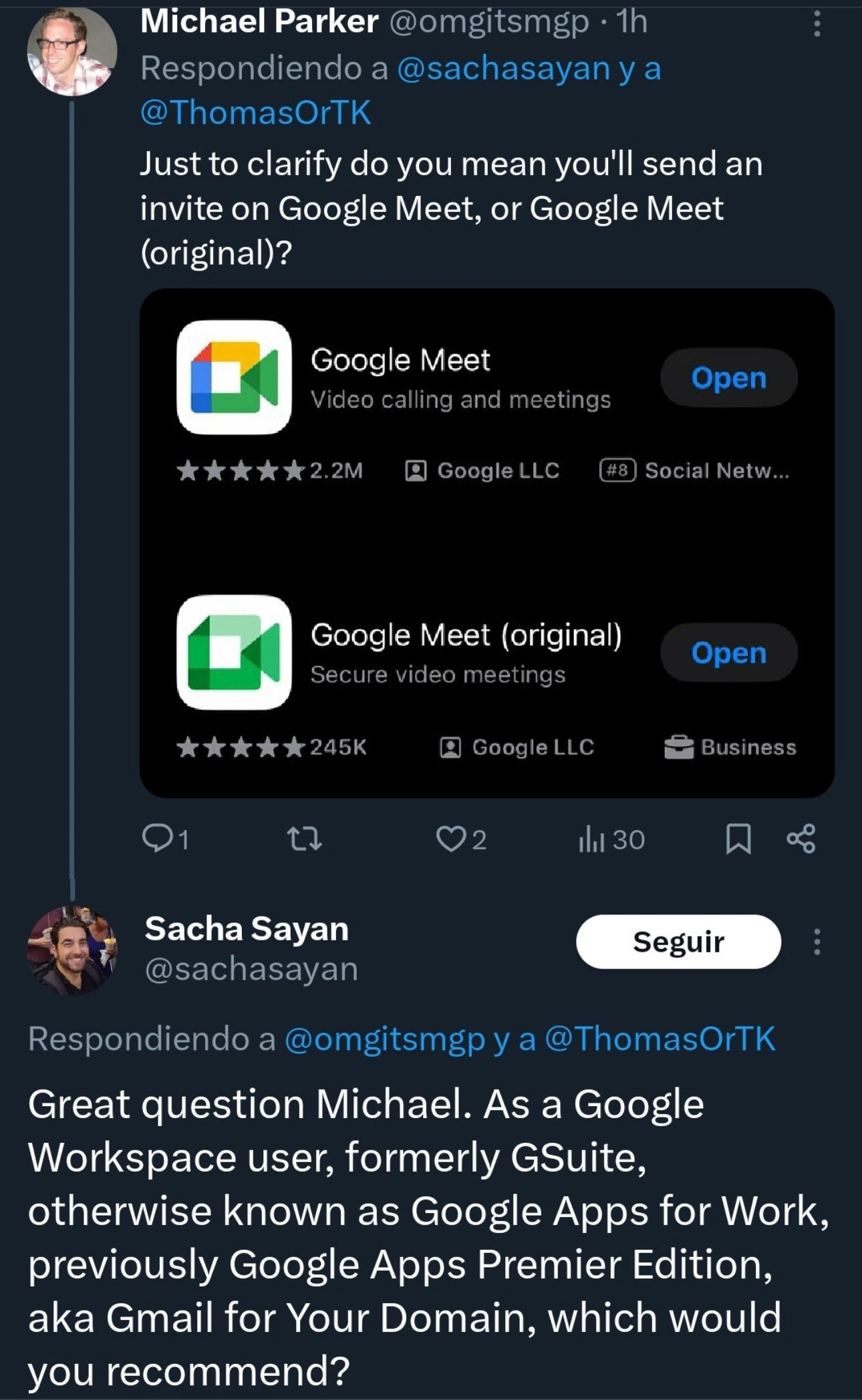
This meme is a screenshot of a Twitter conversation poking fun at Google’s confusing product names. In the first tweet, Michael asks: “Just to clarify do you mean you’ll send an invite on Google Meet, or Google Meet (original)?” He’s joking that he needs clarification because there appear to be two different things called Google Meet. And indeed, the image shows two entries from the Google Play Store: one named Google Meet and another named Google Meet (original). It’s as if Google has two apps with nearly the same name, which is obviously confusing.

Why would there be two Google Meet apps? Here’s the context: Google had Google Meet as its video meeting service, especially for businesses using what is now called Google Workspace. Separately, Google also had another video-calling app for consumers called Google Duo. In 2022, Google decided to merge Google Duo into Google Meet to have just one video-calling platform. During that merger, for a time both the old Meet and the new merged Meet existed. The new unified app took the name “Google Meet” (with the multi-colored icon), and the older app was temporarily labeled “Google Meet (original)” (with the green icon) until it got phased out. So “Google Meet (original)” was basically the earlier version of Google’s meeting app (originally known as Hangouts Meet), and “Google Meet” (no qualifier) became the updated app that included Duo’s features. This is why Michael jokingly asks which one the invite will be on – it’s a playful way to point out how absurd it is to have to specify “original” for a meeting app.

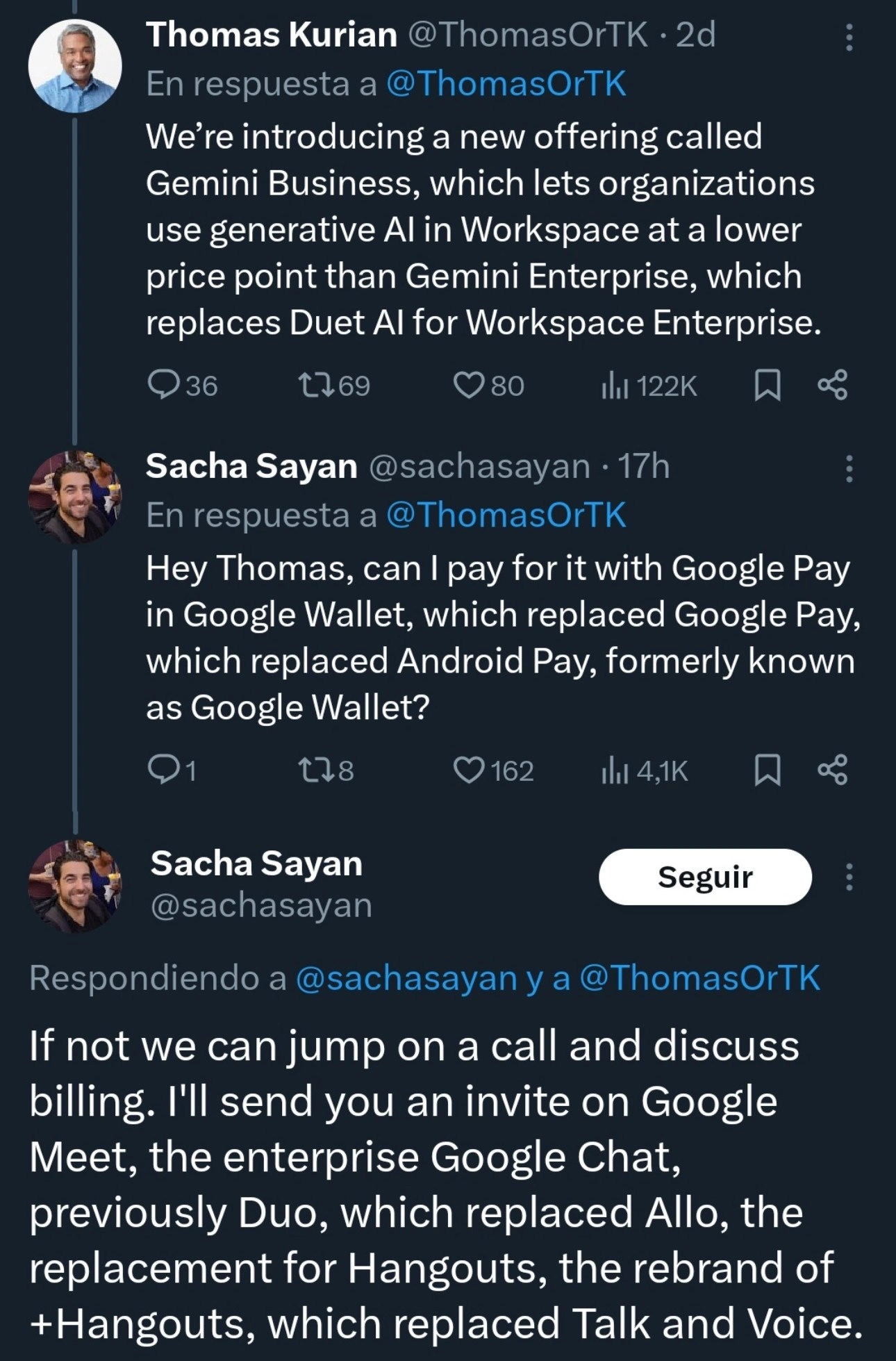
In the second tweet, Sacha replies with a sarcastic list of names: Google Workspace user, formerly GSuite, otherwise known as Google Apps for Work, previously Google Apps Premier Edition, aka Gmail for Your Domain. He’s listing all the different names that Google’s business application suite has had over the years. To break that down:

  • Gmail for Your Domain – Google’s early name (around 2006) for providing custom domain email and apps to businesses.
  • Google Apps (Premier Edition) – An updated name for the business-grade version of those apps.
  • Google Apps for Work – A later rename to make it sound more business-focused.
  • G Suite – In 2016, Google rebranded the service as G Suite, which many people recognized and used until recently.
  • Google Workspace – The current name (changed in late 2020) for the same overall product suite, which includes Gmail, Calendar, Drive, Docs, and Meet.

Sacha basically rattled off this history to humorously ask: “Which would you recommend?” He’s implying that if Michael is going to be specific about Google Meet vs Google Meet (original), then Sacha will be overly specific about which edition of Google’s services he’s using. It’s a form of tech sarcasm: pointing out the ridiculous number of name changes.

This kind of constant product rebranding is well-known in the industry, especially with Google. For someone new to this, it might help to understand that Google often changes the names of its products or combines them, which can lead to confusion. For example, Google Hangouts was a chat and video call product many people used. Google eventually split that into two services called Hangouts Meet (for video meetings) and Hangouts Chat (for text chat). Later, they dropped “Hangouts” from those names, so they became just Google Meet and Google Chat. Meanwhile, the consumer video app Google Duo was doing something similar to Meet. In a move to simplify (ironically, it felt like it made things more complex!), Google merged Duo into Meet. During that transition, if you looked in the app store or your phone, you’d see two Meet apps, hence the “original” tag on one.

For developers and IT support folks, these name changes can be a headache. Think about writing documentation or tutorials: one month you might write “Use Google Meet to start a video meeting,” and a few months later, Google changes what “Google Meet” refers to or renames the whole suite from G Suite to Workspace. Suddenly your documentation is outdated. If you’re integrating with Google’s APIs, you might see older names in code or endpoints (for instance, some API endpoints still include “apps” or “gsuite” in the URL, even though the marketing name changed to Workspace). This mismatch can be confusing until you realize they’re the same thing under different names. Tags like api_docs_outdated_again capture that feeling when you discover the guide you followed is referring to an old name. Similarly, communication_tool_overlap refers to how Google had multiple communication tools at once (Chat vs Hangouts vs Duo vs Meet) that overlapped in purpose.

In short, the meme is funny to developers because it exaggerates a real problem: Google’s habit of frequently renaming or launching overlapping products leads to moments where even tech-savvy people aren’t sure what to call a service. It’s poking fun at Google’s naming conventions (or lack thereof) and empathizing with the Developer Experience (DX) pain when product names don’t stay consistent. Even if you’re a junior dev or new to Google’s ecosystem, you can appreciate the confusion: imagine trying to figure out if “Google Meet (Original)” is something different from “Google Meet” – it sounds silly because it is! This meme is basically saying, “See how crazy this is? You’re not alone if you find it confusing.”

Level 3: A Tale of Two Meets

The meme highlights a scenario so absurdly meta that only Google’s notorious rebrand cycles could produce it: two different apps, both called Google Meet, appearing side by side on the Play Store. In the screenshot, one entry is Google Meet – Video calling and meetings (with a multi-colored camera icon) and right below it is Google Meet (original) – Secure video meetings (with a green camera icon). This parenthetical “(original)” is both hilarious and telling – it’s like labeling your second kid “Junior (original)” because you gave them the same name as the first. It’s product naming recursion at its finest, a self-referential loop where Google had to name a product after itself just to differentiate the timeline. Seasoned engineers immediately recognize the comedy: this is the epitome of that old truth in software, “There are only two hard things in computer science: cache invalidation, naming things, and off-by-one errors.” Guess which one we’re suffering from here?

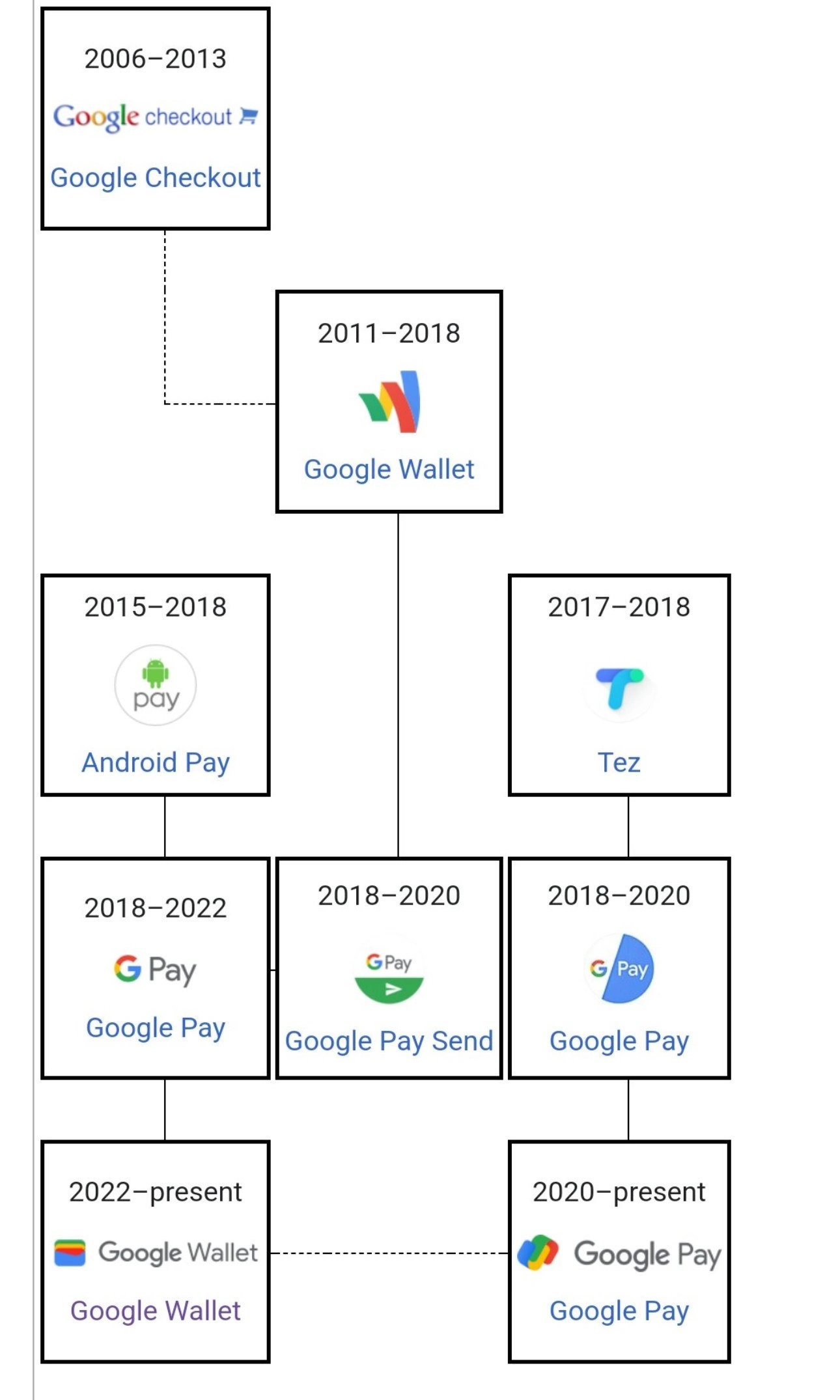
From a senior developer’s perspective, this tweet threads together years of industry irony and collective frustration. Why is it funny? Because it’s too real. Google has a long history of launching, rebranding, and overlapping its communication tools in ways that baffle even the most diligent techies. We remember the saga: Google Talk begat Hangouts, which split into Hangouts Meet (for video calls) and Hangouts Chat (for text), which then morphed into Google Meet and Google Chat. Meanwhile on the consumer side, Google launched Allo (chat app) and Duo (video calling), only to later merge Duo into Google Meet. The result was a brief, head-spinning period where two apps called Google Meet coexisted – hence the Play Store showing an “original” Meet alongside its clone. This is a textbook product_rebranding_hell scenario, where a company’s attempt to unify products creates a recursive naming nightmare.

The Twitter exchange perfectly lampoons this. Michael Parker asks, tongue-in-cheek, “Just to clarify do you mean you’ll send an invite on Google Meet, or Google Meet (original)?” It’s an absurd question that no one should ever have to ask – yet here we are. Sacha Sayan’s reply cranks the irony up to 11 by listing the Google Workspace, formerly G Suite, otherwise known as Google Apps for Work, previously Google Apps Premier Edition, aka Gmail for Your Domain. This exhaustive alias list is a wink to all the veterans who lived through each rename. It’s basically a timeline of Google’s enterprise suite branding: each time Google decided the old name wasn’t trendy or clear enough, they slapped a new name on the same package of services. For those of us writing API docs or maintaining integration code during these transitions, it’s a relatable pain. We’ve seen enterprise_software_brand_drift like this before – one day your environment variable is GSUITE_DOMAIN, the next day your boss asks why your script isn’t using WORKSPACE_DOMAIN instead.

Underneath the humor is a shared trauma of chasing moving targets. Imagine being an IT admin or developer in the middle of updating user guides when Google announces a rename: all your screenshots and text saying “GSuite” become outdated overnight by Google Workspace. It’s no wonder Sacha’s tweet drips with sarcasm – we’ve been jerked through naming_nightmares so often that we cope by making fun of it. This meme resonates because it captures misaligned expectations between Google’s marketing decisions and real-world Developer Experience (DX). Marketing presumably thought consolidating Duo and Meet under one brand would simplify things; instead it led to an identity_crisis_in_products where even Google’s own app listings had to distinguish which Meet was which. The communication_tool_overlap became so bad that end-users and support engineers were asking “Wait, which Meet are we using today?”

For veteran devs, there’s also a bittersweet chuckle at how history repeats itself. We’ve seen similar confusion with other tools (remember how Skype for Business was once Lync, and before that Office Communicator?). But Google in particular seems to iterate on its product names like versions of an API. It’s almost an anthropological study: in the archaeology of Google, you can dig through layers of branding sediment. In one layer you find Google Apps for Your Domain (circa 2006), above that Google Apps Premier Edition (2007), then Google Apps for Work, then the G Suite strata (2016-2020), and finally the modern Google Workspace layer (2020 onward). The google_meet_original_confusion on display is just another fossil in this strata, a marker of the brief period when Google’s video meeting service literally didn’t know what to call itself. We laugh because it’s absurd, but also because we feel that absurdity after years of updating code comments and telling colleagues “Yes, Google Chat is basically the new Hangouts… no, not the old Hangouts, the new one… oh never mind.” In short, the humor lands for senior devs since we’ve lived through this naming-conventions soap opera, and sometimes laughing is better than crying when you’re supporting bewildered end-users yet again.

Description

This is the second part of a satirical Twitter thread. Michael Parker's tweet asks whether an invitation will be for "Google Meet" or "Google Meet (original)?", showing a screenshot with two identically-named apps in an app store. Sacha Sayan's reply escalates the joke by listing the convoluted naming history of Google's office suite: "Google Workspace, formerly GSuite, otherwise known as Google Apps for Work, previously Google Apps Premier Edition, aka Gmail for Your Domain". The meme humorously criticizes Google's notorious and confusing product branding strategy, where products are frequently renamed, merged, or duplicated, causing user frustration. It's a relatable pain point for anyone who has tried to keep up with Google's ever-changing product landscape
Comments

7
Anonymous ★ Top Pick Google's product strategy is just A/B testing brand names in production, with their entire user base as the control group
  1. Anonymous ★ Top Pick

    Google's product strategy is just A/B testing brand names in production, with their entire user base as the control group

  2. Anonymous

    Nothing like scheduling a call in Meet-v9-LTS-original-classic to remind us that ‘backward compatibility’ at Google is just marketing’s way of versioning namespaces

  3. Anonymous

    Google's naming strategy is what happens when you let the same team that deprecated 200 products also handle brand continuity - now we need a service mesh just to figure out which Meet to meet on

  4. Anonymous

    This perfectly captures the enterprise software experience: when your company's video conferencing solution requires a PhD in Google product archaeology to determine which deprecated rebrand of a sunset feature that was merged with a discontinued service you're actually supposed to install. Bonus points if your IT department's documentation still references Hangouts

  5. Anonymous

    Only Google ships a naming collision to prod and labels the deprecated path "original"; now MDM asks which Meet to provision, calendars hit merge conflicts, and we’ve invented SemVer for branding

  6. Anonymous

    Google's 'original' Meet: the enterprise fork no Kubernetes cluster can orchestrate away

  7. Anonymous

    Google achieved eventual consistency in branding - Duo became Meet and Meet became “Meet (original)”; now my calendar needs a service mesh to route the join link

Use J and K for navigation