Skip to content
DevMeme
5390 of 7435
A Brief History of Google's Branding Labyrinth
Google Post #5907, on Feb 26, 2024 in TG

A Brief History of Google's Branding Labyrinth

Why is this Google meme funny?

Level 1: Google Name Game

Imagine you have a favorite toy, and every year the toy’s company changes its name and look for no good reason. One year it’s called Super Robot, next year they rename the exact same toy to Mega Droid, and the year after that they go back and call it Super Robot again. You’d be pretty confused, right? “Did I get a new toy, or is it the same one with a new sticker?” That’s what Google has been doing with some of its apps, and it’s why this is funny.

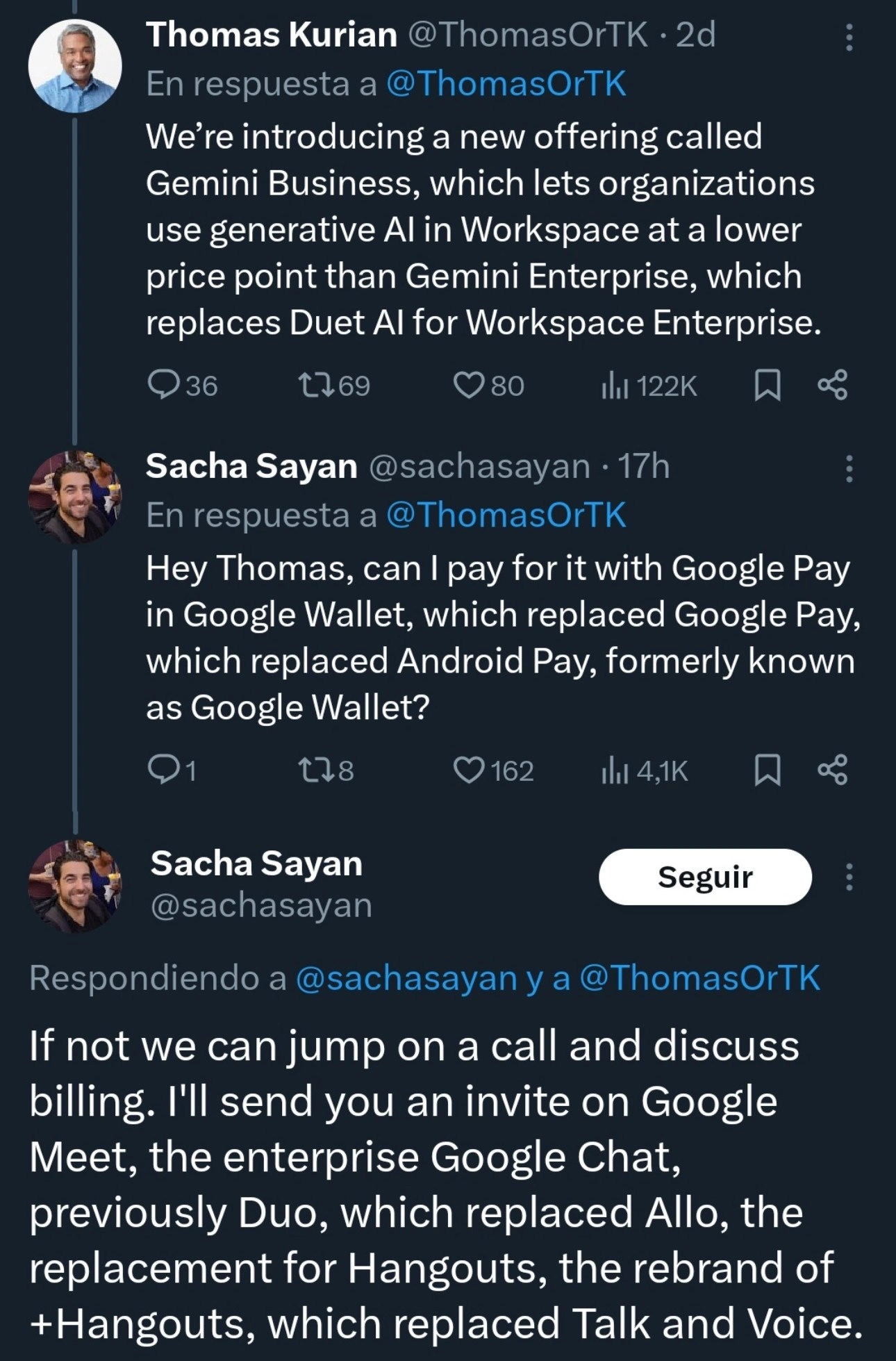
In the meme, a Google big boss said, “We have a new product called Gemini Business,” which actually is just a new name for something they already had (an AI helper in Google’s work apps). A cheeky person replied basically saying: “Cool, can I pay for it with Google Pay in Google Wallet (which is silly because Google Pay became Google Wallet, after being called Android Pay, which started as Google Wallet in the first place)?” He’s joking that Google changed the name of their pay app so many times that it’s like chasing your own tail. Then he jokes about setting up a meeting using Google’s chat apps: he rattles off a bunch of names – Google Meet, Google Chat, Duo, Allo, Hangouts, Talk, Voice – as if one turned into the next, over and over. It’s like saying, “I’ll message you on App A… I mean App B… oh, now it’s App C… actually we’re back to App A!” It sounds absurd, and that’s why we laugh.

The core humor is about confusion. Everyone can relate to being confused when names keep changing. It’s like if your teacher kept renaming the days of the week – one day Monday is “Fun-day,” then it’s “Code-day,” then back to “Monday.” You’d laugh because it’s so hard to keep track. Developers (the people who make and use these Google apps in their projects) feel the same way when Google keeps switching names. It’s a playful way of saying Google can’t sit still; they keep rebranding (renaming things) and it makes our heads spin. So this meme is funny because it points out, in a silly over-the-top way, how Google’s constant name changes for its products feel like a never-ending game of “What’s it called now?”. It’s humor that even if you don’t know all the tech words, you get the idea: they keep changing stuff that maybe didn’t need changing, and we’re all just trying to keep up – and that’s pretty silly.

Level 2: Product Musical Chairs

Let’s break down the buzzwords and product names in this meme, and why developers find them so relatable. Google is famously bad (or enthusiastic, depending on perspective) at sticking with one name or even one product in a given niche. This meme highlights two areas where the naming shuffle has been extreme: digital payments and communication apps.

First, the Google Pay / Google Wallet saga:

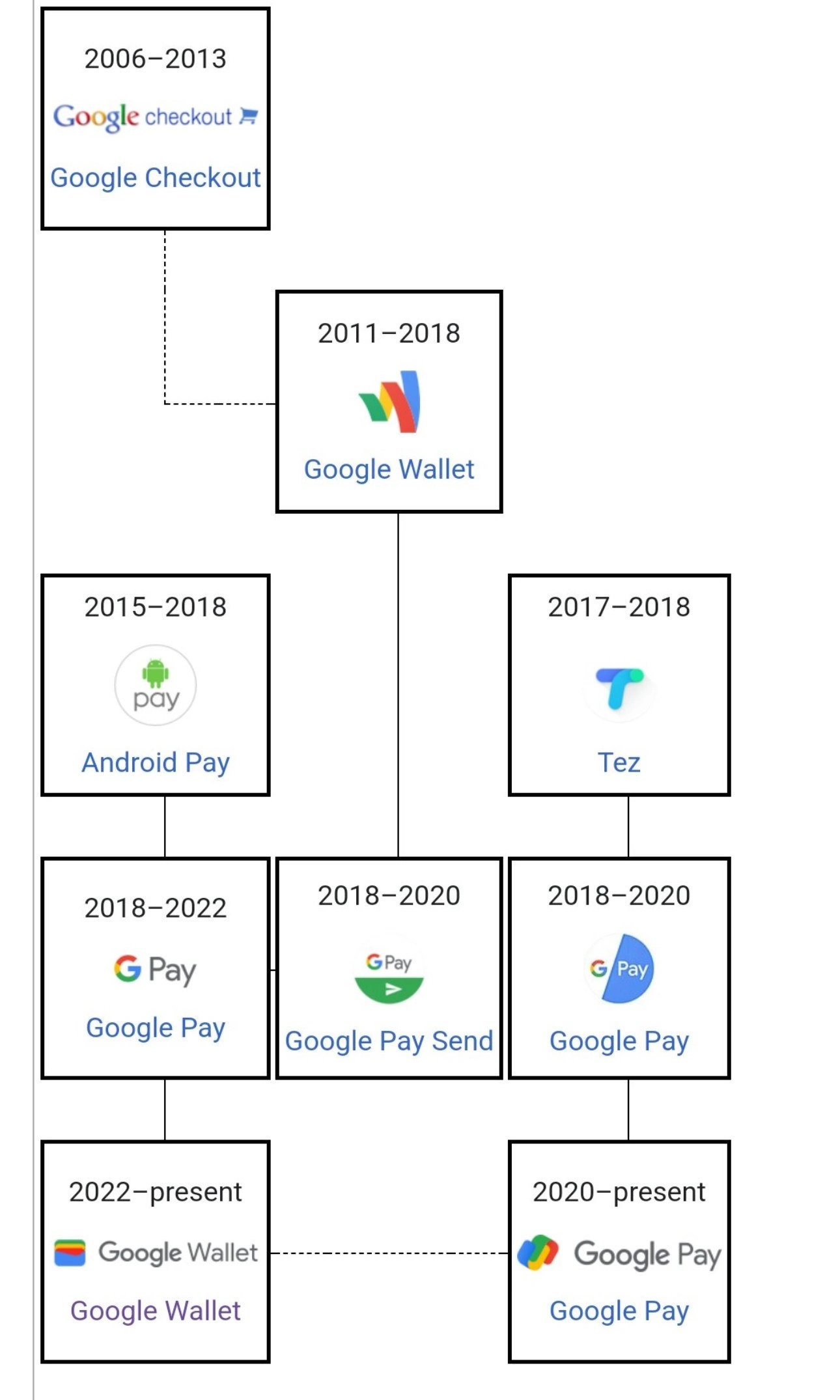
  • Google Wallet originally launched in the early 2010s as an app for mobile payments and peer-to-peer money transfers (think of it like an early version of Apple Pay or Venmo).
  • A few years later, Google introduced Android Pay (2015) as a way to unify its tap-to-pay solution on Android devices. Essentially, Android Pay was doing similar things as Google Wallet, but under the Android brand to emphasize phone payments.
  • Then around 2018, Google decided to simplify (or so they thought) by merging these services and calling the whole thing Google Pay. Google Pay was meant to be the one-stop brand for all payments — whether in-store NFC payments, in-app payments, or sending money to friends.
  • But in typical Google fashion, the story didn’t end there. By 2022, they brought Google Wallet back from the dead as a separate app for managing credit cards, tickets, and such, while Google Pay became more of an underlying service (and its app functionality varied by region). So the brand name “Google Wallet” made a comeback, meaning we’ve come full circle.

Now, the tweet’s author jokingly asks: “Can I pay for it with Google Pay in Google Wallet, which replaced Google Pay, which replaced Android Pay, formerly known as Google Wallet?” He’s stringing together the historical sequence of name changes in one sentence. If you didn’t know this history, it sounds like nonsense – but it’s exactly what happened. It’s like saying, “Can I use Product A inside Product B, which used to be Product A?” Confusing? Yes, that’s the point! Developers who have been around a few years chuckle because they remember having to update their code or mental model each time these services changed names or merged. This kind of musical chairs with names is a headache when you’re, say, implementing an online store’s payment system – suddenly the SDK docs you have are for Android Pay but everything now says Google Pay. You wonder, “Is this the same thing? Do I need to upgrade something?” It’s a perfect illustration of the joke that naming things is one of the hardest problems in computer science (right up there with cache invalidation and off-by-one errors).

Next, the Google communication apps spaghetti: The follow-up tweet references a bunch of chat and video apps:

  • Google Talk – This was Google’s original chat service, launched in 2005. It was a simple text chat (and voice) feature, integrated into Gmail. Many of us knew it as “Gchat”.
  • Google+ Hangouts – Around 2013, Google introduced Hangouts, initially as a feature of Google+ (Google’s now-defunct social network). Hangouts was meant to unify Google Talk and the Google+ Messenger into one service for both text messaging and video calls. People just called it Hangouts. It essentially replaced Google Talk (and another thing called Google+ Messenger) completely by around 2015.
  • Hangouts (Classic) – Hangouts became the default chat in Gmail and a mobile app. It started integrating features from Google Voice (a 2009 service for phone calls and SMS management). So Hangouts was doing a lot: IM, video, even phone calls.
  • Allo and Duo – In 2016, Google oddly launched two new apps: Google Allo (a messaging app with Google Assistant features) and Google Duo (a simple video calling app). These were meant for consumers as part of a new strategy (they were not branded as Hangouts). Allo was an attempt to make a smart chat app to compete with WhatsApp or Messenger, and Duo to compete with FaceTime.
  • Hangouts Chat and Meet – Meanwhile, for businesses using what was then G Suite (now Google Workspace), Google in 2017 announced it would split Hangouts into two enterprise-focused products: Hangouts Chat (for team text communication, similar to Slack) and Hangouts Meet (for video meetings, like Zoom). So “Hangouts” as a brand was being pulled in different directions (consumer vs enterprise).
  • Google Chat and Google Meet – Fast forward to around 2020: Google decided to retire the Hangouts brand completely. Hangouts Chat was rebranded to Google Chat, and Hangouts Meet was rebranded to Google Meet. They also eventually phased out the consumer Hangouts app entirely in favor of these new apps. Google Duo, the consumer video app, astonishingly survived all this and actually got merged into Google Meet in 2022 (the Duo app basically became the Google Meet app for consumers). As for Google Allo, it was shut down in 2018 after just about two years of life.

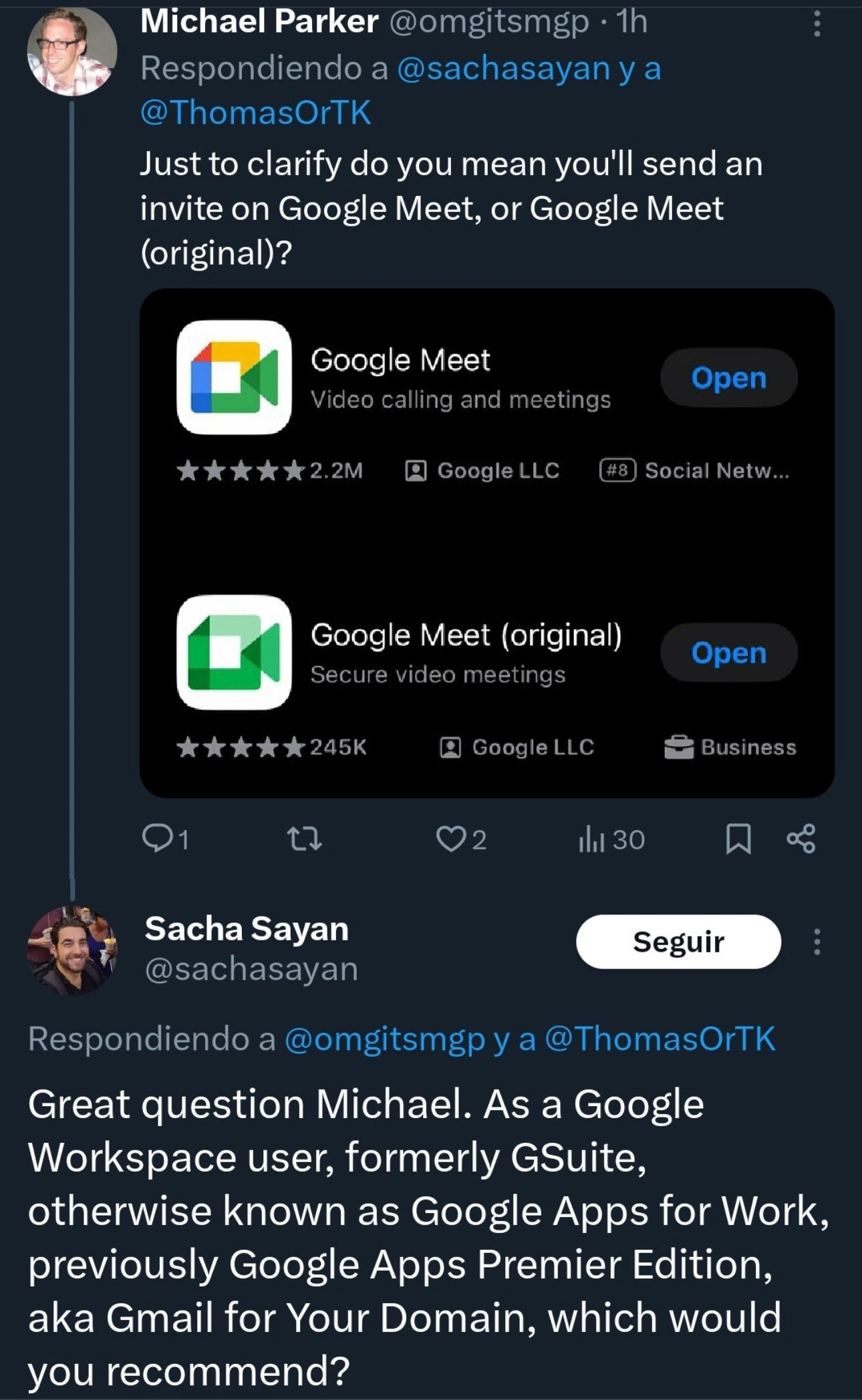
Now, look at Sacha’s comically long sentence: “Google Meet, the enterprise Google Chat, previously Duo, which replaced Allo, the replacement for Hangouts, the rebrand of +Hangouts, which replaced Talk and Voice.” This is a tongue-in-cheek summary of the above history, albeit with some playful exaggeration and mixing of consumer and enterprise lineages. Breaking it down:

  • Google Meet is referred to as “the enterprise Google Chat” (not exactly true in product terms, but he’s humorously mixing them up as if everything is just one big rebrand chain).
  • He then says Meet was previously Duo (indeed the current Google Meet app on phones evolved from the Duo app’s codebase/interface, so there’s a kernel of truth).
  • Duo replaced Allo (not literally as a product replacement, but both launched together and Allo died, leaving Duo standing – so in a comedic sense, you could say Duo outlived/replaced Allo’s role as Google’s consumer chat effort).
  • Allo was the replacement for Hangouts (Allo was positioned by Google at launch as the “next big messaging app,” implicitly hoping to succeed Hangouts for consumers).
  • Hangouts was the rebrand of +Hangouts (Hangouts did originally carry the Google+ brand, often written as Google+ Hangouts in early days, so he’s pointing out it was tied to Google+).
  • Hangouts replaced Talk and Voice (Hangouts did effectively replace Google Talk for messaging, and Google Voice’s texting/calling was later integrated into Hangouts for a while – Google Voice itself still exists separately for phone numbers, but the joke bundles it in).

The end result: a absurdly long chain of “X replaced Y, which replaced Z…” that feels almost endless. This comedic device highlights how Google’s product naming has looped and tangled over time. For a newcomer, it’s dizzying – for veterans, it’s an accurate headache we remember living through! We’ve had to migrate from one app to another, sometimes losing features or friends in the process, often asking “Which Google chat app are we using this year?” It’s TechIndustryHumor that underscores a real usability and developer experience issue: consistency. Or lack thereof.

Beyond the specific products, notice the tone: the reply is teasing a Google executive in a friendly-yet-savage way. It implies, “Sure, introduce yet another named product. By the way, how’s that different from the last one you just renamed?” This reflects a common skepticism in the developer community whenever Google announces another new service or name. The tags like google_product_renaming_infinite_loop and naming_whiplash_exception (sounds like a fake error a frustrated coder might throw) capture this sentiment. We joke that you might throw a NamingWhiplashException in code if an API changes names too often, or call the phenomenon “musical chairs” because the names keep swapping and you never know which one’s current – reminiscent of players circling chairs in a game, and suddenly the music stops (the name changes) and everyone scrambles.

On the AI front, Gemini is Google’s codename for a next-generation generative AI model (a competitor to OpenAI’s models). By naming their Workspace AI features “Gemini Enterprise” and “Gemini Business,” Google is leveraging that buzz. Duet AI (the prior name) was just introduced in mid-2023, and already by early 2024 it’s being rebranded. To devs, this feels like hype-driven churn: it’s still essentially AI features in Google Docs/Gmail (helping you write text, generate images, etc.), but now packaged under a new shiny moniker with different pricing tiers (enterprise_ai_pricing_tiers is even in the tags). This speaks to the IndustryTrends_Hype aspect: big tech loves renaming things to signal a new era or to upsell. “Enterprise” vs “Business” usually just indicates how big the customer is – Enterprise often means huge corporations with deeper pockets (and need for more security/control), while Business might target smaller companies or those with tighter budgets. So Gemini Business presumably offers fewer features or lower performance at a lower price than Gemini Enterprise. Under the hood, both are likely powered by the same core AI models. The humor isn’t in the technology itself, but in how it’s marketed and named.

In summary, this meme cleverly strings together real examples of Google’s naming chaos to create a feeling of absurdity. Developers get a cathartic laugh because we deal with these changes in our work – updating apps, re-learning branding guidelines, explaining to less tech-savvy colleagues or users that “Google Chat is basically Hangouts, but for companies, and no, it’s not Allo… yes, I know it’s confusing.” It’s relatable because most of us have felt left dizzy by at least one Google product pivot. The relatableDevExperience here is the exasperated, humorous sigh when yet another internal email or blog post announces, “We’re renaming X to Y (and shutting down Z).” You almost want to respond with, “Can I still use A in B which replaced A which replaced C…?” – exactly as this meme does. It’s a lighthearted way to say: We notice the chaos, Google, and we’re joking about it so we don’t just cry.

Level 3: Ouroboros of Branding

At the highest level, this meme pokes fun at Google’s seemingly endless cycle of renaming and replacing its own products – an infinite rebranding recursion that feels like a tech Ouroboros (the snake eating its tail). Seasoned developers recognize this pattern as classic Google. The tweet from Google Cloud’s CEO Thomas Kurian introduces Gemini Business, a new generative AI offering in Google Workspace. It’s described as a cheaper tier than Gemini Enterprise, which itself replaced Duet AI for Workspace Enterprise. In one breath, the announcement references three successive names for what is essentially the same feature set evolving over time. This kind of IndustrySatire lands because it’s too real – we’ve all seen a product get rebranded right after we finally memorized its name.

The reply by Sacha Sayan gleefully triggers the “renaming recursion” joke. He asks if he can pay using Google Pay in Google Wallet, which replaced Google Pay, which replaced Android Pay, formerly known as Google Wallet. It’s a perfect loop – Google Wallet is both the start and end of that chain. This highlights a real phenomenon: Google’s fintech branding has done a full 360°. For battle-scarred devs, this humor hits home because we’ve endured the naming whiplash firsthand. Integrate with Android Pay? Oh wait, now it’s Google Pay. Blink twice, now there’s Google Wallet again. The meme exaggerates it to absurdity, but only slightly. The Communication chaos continues in the second part of Sacha’s reply: he proposes a billing call via Google Meet, the enterprise Google Chat, previously Duo, which replaced Allo, the replacement for Hangouts, the rebrand of +Hangouts, which replaced Talk and Voice. This reads like a genealogy of Google messaging apps, compressing 15+ years of product launches, rebrandings, and cancelations into one breathless sentence. It’s funny because it’s true – Google’s messaging strategy often felt like a tech hype cycle on fast-forward, with each new VP or project team naming things anew, confident this will be the final answer.

Why do devs find this so hilarious (and a bit painful)? It satirizes IndustryTrends_Hype and the TechHypeCycle in product strategy. Big tech companies constantly rebrand or launch overlapping services to chase the latest trend or differentiate tiers. Here we see Google sliding “Gemini” (its shiny new AI model branding) into Workspace to ride the generative AI hype, effectively renaming last year’s “Duet AI” offering. For experienced engineers, this triggers an eye-roll and a chuckle: we’ve survived waves of marketing-driven name changes before. We know the code under the hood often changes far less than the logo and name do. Yet, every rename comes with relatable dev experience pain: update the documentation (again), explain to confused users that Hangouts Meet is now just Google Meet, ensure our integration doesn’t break because of new API endpoints or auth URLs. It’s the naming things problem on an enterprise scale. In software, we joke that the two hardest problems are cache invalidation and naming things – and Google’s approach to the latter is apparently to try every possible name.

On a deeper level, this meme underscores how organizational churn leads to technical and human cost. Google’s habit of launching and sunsetting products (memorialized by the community in sites like “Killed by Google”) has trained devs to be cynical. We hesitate to fully invest in a new Google API or platform because tomorrow it might be rebranded or axed. This is industry satire because it’s critiquing that Silicon Valley “move fast and break things (and rename them)” mindset. The “infinite recursion” phrasing is apt: in programming, an improperly written recursive function calls itself forever until it crashes:

function googleProductRename(name) {
    console.log("Launching " + name);
    // Recursively rename to stay on trend
    let newName = name.replace(/(.+)/, getNextMarketingTerm);
    return googleProductRename(newName);  // uh-oh, no base case - infinite loop!
}
googleProductRename("Google Wallet");
// Output: Launching Google Wallet -> Launching Android Pay -> Launching Google Pay -> Launching Google Wallet -> ... (repeat forever)

Without a “base case” (a stable product name that sticks), you get an infinite loop. The meme wryly suggests Google is stuck in this loop. It’s funny in a dark way because it feels like a self-inflicted bug in Google’s organizational code. Everyone in tech knows NamingThings is hard, but Google turned it into a game of musical chairs that we’re all stuck playing. And like any veteran on-call at 3 AM dealing with yet another deprecation notice, we cope with humor and a bit of sarcasm: “Here we go again, Google changing names more often than my code commits on a Friday.” In summary, Level 3 readers appreciate the meme as a witty commentary on Google’s product naming carousel, the absurd complexity it adds for developers, and the cyclical nature of tech hype and rebranding. It’s a laugh of recognition – we’ve all grumbled about this in stand-ups and coffee breaks, and seeing it laid out in a single Twitter thread is both hilarious and cathartic.

Description

This image is a screenshot of a Twitter thread that satirizes Google's notoriously confusing product strategy and constant rebranding. The first tweet, from Thomas Kurian, announces a new AI offering called 'Gemini Business'. A user named Sacha Sayan replies with a sarcastic question, asking if he can pay for it using 'Google Pay in Google Wallet, which replaced Google Pay, which replaced Android Pay, formerly known as Google Wallet?'. In a follow-up reply, Sayan doubles down on the joke, offering to discuss billing over 'Google Meet, the enterprise Google Chat, previously Duo, which replaced Allo, the replacement for Hangouts, the rebrand of +Hangouts, which replaced Talk and Voice.' The humor stems from the accurate and dizzying recitation of the convoluted histories of Google's payment and communication apps. For experienced developers, this is a deeply relatable frustration, as it highlights the 'product churn' and lack of long-term vision that often leads to deprecated services, forced migrations, and a fragmented developer experience when working with Google's ecosystem
Comments

7
Anonymous ★ Top Pick Google's product strategy is based on Schrödinger's app: it's simultaneously launching, deprecated, and being rebranded until you check the docs, at which point it's been replaced by a new service you have to migrate to yesterday
  1. Anonymous ★ Top Pick

    Google's product strategy is based on Schrödinger's app: it's simultaneously launching, deprecated, and being rebranded until you check the docs, at which point it's been replaced by a new service you have to migrate to yesterday

  2. Anonymous

    Google’s product map is starting to look like an eventually-consistent database - give it enough time and the names might converge… or get garbage-collected

  3. Anonymous

    The only thing more complex than our microservices dependency graph is explaining to the CFO why we need to migrate from Duet AI to Gemini Business before it becomes Bard Enterprise and circles back to being called Google AI Studio Classic

  4. Anonymous

    This thread perfectly captures Google's product strategy: a recursive function with no base case, where each product replacement is defined in terms of its predecessor, eventually stack-overflowing into a naming convention that would make even the most convoluted legacy codebase look well-documented. At this rate, senior engineers spend more time tracking Google's product genealogy than managing their own microservices dependency graphs - and that's saying something when you're running Kubernetes on top of Kubernetes because the first layer got deprecated

  5. Anonymous

    Google's rebrands outpace feature velocity - docs obsolete before merge, integrations chase ghosts like deprecated APIs

  6. Anonymous

    Google branding is a CNAME chain with no A record: finance buys “Gemini Business” via Wallet→Pay→Wallet while kickoff happens in Meet→Chat→Duo→Allo→Hangouts→Talk - eventually consistent branding, zero canonical schema

  7. Anonymous

    Google’s naming scheme is basically a distributed system - renames propagate asynchronously, and procurement retries with exponential backoff until Wallet and Pay eventually converge

Use J and K for navigation