The Security Expert's Selective Outrage
Why is this Security meme funny?
Level 1: Candy from Strangers
Imagine a kid who always says, “I will never take candy from a stranger, it’s not safe!” That’s a smart rule, right? But one day, a friendly magician (who some people don’t fully trust) comes to the neighborhood and offers the most amazing, delicious candy – for free. The kid sees all the other kids enjoying it and how shiny and yummy it looks. In that moment, the kid gets so excited that they completely forget their rule. They run over with a huge grin and grab the candy, happily eating it.
We find this funny because the kid was so sure about not trusting strangers, and then immediately did the opposite when tempted with something really good. It’s a simple story that mirrors the meme: the developer said they’d never use software from the scary government agency (like not taking candy from strangers), but as soon as that agency offered a really cool free tool (like the super tasty candy), the developer couldn’t resist and grabbed it with glee. The humor comes from seeing someone switch their beliefs so quickly – it’s a little silly and very human. We laugh because we recognize that feeling in ourselves: sometimes we make a rule, but break it when we see something we really, really want.
Level 2: Open-Source Irony
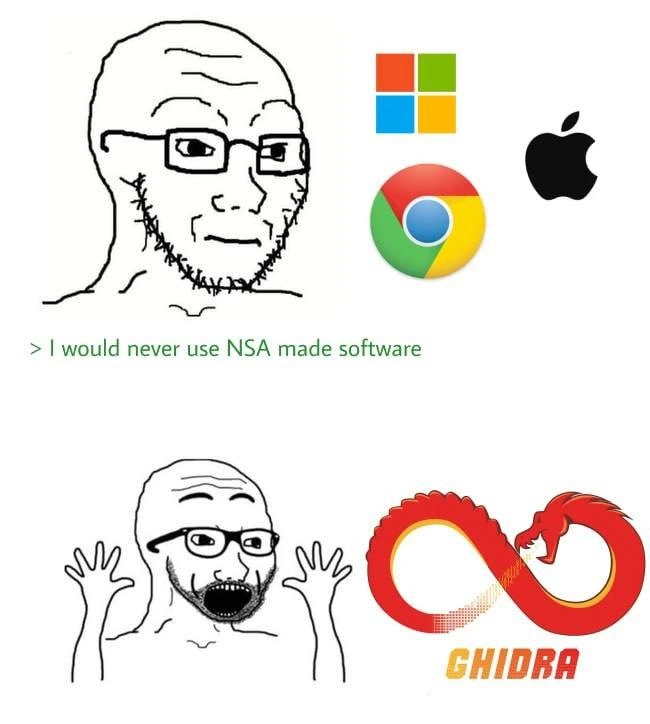
Let’s break down what’s happening in this meme in simpler terms, focusing on the key ideas (and why they’re ironic). We have a popular meme character (a drawn figure often called a Wojak) split into two scenes:
In the first scene, this character (looking stoic and self-assured) is saying, “I would never use NSA made software.” Next to him are logos of big tech companies: the Microsoft Windows logo, the Google Chrome logo, and Apple’s logo. This illustrates that he’s using mainstream tech products but claiming he won’t use anything made by the NSA. The NSA, or National Security Agency, is a U.S. government agency known for spying (intelligence gathering) and also for expertise in cryptography and hacking. So a lot of tech folks are wary of NSA software, thinking it might secretly spy on them or have backdoors (hidden methods to bypass security). Saying “I refuse NSA software” is his way of presenting himself as very privacy-conscious or suspicious of government tech.
In the second scene, the same guy is suddenly extremely happy, arms in the air, excitedly facing a big red dragon-like infinity symbol logo with the word GHIDRA. That logo is for a software tool called Ghidra, which – plot twist – was actually made by the NSA! So right after he swore he’d avoid NSA software, he’s shown gleefully using an NSA-made tool. This immediate reversal is the source of the humor. It’s like hearing someone declare they’ll never do something, and literally the next moment they’re doing exactly that.
Now, why would this happen? Why would someone who is worried about privacy end up using an NSA tool? The answer lies in what Ghidra is and the context of it being open source. Ghidra is a reverse engineering tool. Reverse engineering, in software terms, means taking a compiled program (just the machine code, where you don’t have the original source code that a human wrote) and trying to figure out how it works. Tools like Ghidra allow you to load an application or malware and analyze its internals – see the instructions it’s made of, and even decompile it (convert it back into a higher-level pseudo-code that’s easier to read). This is super useful for security researchers, for example when analyzing viruses or checking software for vulnerabilities.
Before Ghidra was available, the best reverse-engineering tool was arguably one called IDA Pro, which is expensive and closed-source. When the NSA released Ghidra for free, it was a big deal because suddenly everyone, even hobbyists and students, had access to a high-quality tool for this kind of deep software analysis. And crucially, they released Ghidra as open-source software. Open source means the source code of Ghidra is available for anyone to inspect, modify, and compile. That’s a key difference – if you’re worried “Hmm, it’s made by the NSA, maybe it has a spy function,” you (or the community at large) can actually look at Ghidra’s code to see if anything fishy is in there. Thousands of eyes in the security community indeed looked through the code when it came out. That transparency helped people gain confidence that Ghidra wasn’t secretly doing something evil. In contrast, the logos in the first panel (Windows, Chrome, Apple’s iOS/macOS) are largely closed-source – regular users and developers cannot see their source code. You have to trust those companies not to include hidden surveillance. Ironically, our meme character is fine using those closed systems while specifically distrusting NSA software. This is the irony: he’s avoiding what might be the more transparent thing (an open-source NSA tool) while using other things that might have unknown issues.
The phrase often thrown around here is “privacy vs. convenience.” We value privacy, but we also love convenient tools. Our dev initially emphasizes privacy (“no NSA code for me!”), but Ghidra is a super convenient (and powerful) tool for his work – and it’s free. The convenience and utility of Ghidra apparently win him over immediately. In real life, this pattern happens a lot. Developers or users might say, “I won’t use X company’s services because I don’t trust them with my data,” but then that company might offer something really useful (or free), and suddenly they reconsider. For example, someone might distrust cloud storage for privacy, but still use Google Drive because it’s just so handy and everyone else uses it. Here, the analogous situation is a security-conscious developer who generally tries to avoid government-made or closed-source software, but ends up using an NSA tool because it’s the best tool available and it’s open source, which offers some peace of mind.
Let’s clarify GHIDRA a bit more: it’s not a scary trojan program or anything; it’s a legitimate software toolkit used for dissecting other software. Think of it as a sophisticated microscope for programs – developed by the NSA, yes, but now freely available to everyone. When it launched (around 2019), lots of developers and cybersecurity researchers were excited. It being open-source was a big part of that excitement, because it meant the tool’s development could be transparent and even community-assisted. “NSA software” suddenly wasn’t black-box spooky; it was something you could download the source for and even contribute to (in theory, though the NSA maintains it). Open source adoption means people actively started using and integrating this open tool into their work.
The meme highlights a bit of developer_hypocrisy in a tongue-in-cheek way. Hypocrisy here means saying one thing and doing another. The character’s stance flips when his personal benefit is involved. Many junior developers learn early on that you often have to balance idealism with realism. Sure, you might prefer to only use perfectly secure, 100% trustworthy software, but in practice you’ll use software that gets the job done, and you’ll apply other safeguards (like reading reviews, checking community trust, or, in the case of open source, maybe scanning the code or trusting that others have done so). The security awareness this dev professes (“no NSA software”) is actually good – being thoughtful about what you run is a part of good security hygiene. However, the meme jabs at the fact that security tools themselves sometimes come from historically untrusted sources. It’s quite possible the dev’s inner monologue went like: “NSA software could be spying on me. But everyone is raving about this Ghidra thing… and I do need to analyze this malware… plus I can see the code… okay fine!”
In summary, the second panel’s joy is about the dev discovering that Ghidra is a fantastic tool and deciding that, despite his earlier reservations, it’s worth using. The Wojak meme format is used to exaggerate that immediate U-turn for comedic effect. By placing the two statements in stark visual contrast, it makes the situation funny and obvious. It’s showing the classic human quirk: we might talk tough about principles, but present us with something exceptionally useful (or tempting) and those principles can bend quickly. In the world of tech, that often plays out as open-source tools or convenient platforms overriding our initial skepticism. The community finds this meme funny because it’s a candid self-own: we all know how it feels to be that guy, at least once, choosing a practical tool over abstract worries, and then sheepishly laughing about our about-face.
Level 3: Doublethink Decompiler
This level peels back the industry context and shared insider smirk behind the meme. On the surface, we have a classic case of developer hypocrisy: the Wojak character emphatically declares “I would never use NSA-made software,” yet in the next breath he’s ecstatically installing GHIDRA, an NSA-made software tool. It’s a humorous portrayal of the cognitive dissonance (Orwell might call it doublethink) that tech folks often exhibit when lofty principles collide with practical needs. Why is this so relatable to seasoned devs and security professionals? Because we’ve all seen it (and probably done it).
Consider the logos next to the smug Wojak in the top panel: Microsoft, Google Chrome, Apple. These represent ultra-popular products – Windows, Chrome, macOS/iPhone – that many developers use daily without a second thought. Yet each of these big tech companies has, in one way or another, been entangled with government surveillance or privacy controversies. The NSA’s PRISM program (revealed by Snowden) involved data from Microsoft and Google; Apple touts privacy but still ships proprietary code on closed hardware. A truly paranoid tinfoil-hat dev would side-eye those as well. So the Wojak proudly shunning “NSA software” might already be standing on shaky ground if he’s using closed-source operating systems or a telemetry-happy browser. It’s the classic privacy vs. convenience conundrum: we talk a big game about privacy, but convenience often wins. The meme shines a spotlight on that irony using GHIDRA as the punchline.
Now GHIDRA – oh boy, when GHIDRA hit the scene, it was like a rockstar moment in the security tooling world. This is a powerful reverse engineering suite that the NSA developed for internal use and surprise-released to the public in 2019. Security engineers and hackers had been paying hefty sums for tools like IDA Pro or muddling through with less capable free tools. Suddenly, Big Brother drops a free, open-source alternative. Cue the collective jaw-drop. Sure, people joked “I’m not installing that, it’s from the NSA!” – but guess what happened in reality? Within hours of release, thousands of eager devs were downloading it from the official NSA GitHub repository (yes, the NSA has a GitHub – imagine explaining that to your past self). In forums and Twitter, the refrain was half-jokingly, “I don’t trust the NSA… but GHIDRA is too good to ignore.”
Why is it “too good”? Because GHIDRA solved real problems: it rivaled commercial tools, supporting multiple processor architectures, an intuitive GUI, a powerful decompiler that turns obscure assembly code back into (almost) readable C-like pseudocode, and collaboration features for teams analyzing malware. For anyone in infosec or curious about how software works under the hood, GHIDRA is like a candy store. It’s the kind of tool you usually dream about or pay big money for, now free – courtesy of, hilariously, the very spy agency folks claim not to trust. The temptation was irresistible. We see that in the meme’s bottom panel: the same character who was smugly rejecting NSA software is now overjoyed, arms raised, practically saying “Shut up and take my download!” to the GHIDRA dragon logo. The visual contrast itself is meme gold: from skeptical boomer-face Wojak to enthusiastic happy Wojak in one panel – a perfect depiction of that instant flip in stance.
The senior developers and security geeks chuckle at this because it rings so true. How many times have we heard colleagues or internet pundits declare some technology or vendor completely off-limits on ethical or security grounds, only to catch them using it “just this once because it’s useful”? It’s like the database admin who rants about open-source purity but then happily uses a proprietary tool when it solves the problem faster, or the programmer who swears off Google products for privacy but can’t resist using Chrome because, well, it’s convenient. In security circles, there’s even a tongue-in-cheek term for this pattern: “convenient security”, meaning people choose the secure path until it becomes too inconvenient or until the insecure option has a killer feature.
Specifically with NSA and tools, the infosec community has a love-hate history. The NSA is both the bogeyman of surveillance and a wellspring of top-tier security research. They sponsor crypto algorithms, then get side-eyed about possible backdoors. They warn about zero-day exploits, while simultaneously collecting them. So an NSA tool being embraced by the community is peak irony. GHIDRA’s open-source release was a watershed: suddenly the community and No Such Agency (NSA’s wry nickname) had a weird Venn overlap – a government-developed open source tool that hackers trust and use! There were plenty of jokes: “Using GHIDRA is like eating brownies a stranger gave you – but hey, they’re delicious and everyone else is eating them too.” Experienced devs recall similar ironies: for instance, the NSA’s involvement in creating encryption standards (like SHA-2, which everyone uses for secure hashing) or how they once snuck an algorithm with a suspected backdoor (the Dual_EC_DRBG random number generator) into standards. We’re aware that sometimes the NSA’s “gifts” to the community come with strings attached – so the meme’s guy initially voices that distrust. But the punchline is that the tool’s obvious value overwhelms those concerns.
The heart of the humor is that rapid open source adoption of GHIDRA against initial instincts. The phrase “Swears Off NSA Tools, Immediately Downloads GHIDRA Anyway” could practically be a commit message in some developer’s life story. It’s funny because it’s true: rationally, downloading a large complex binary analysis tool from a spy agency might sound crazy if you read it out loud. But in practice, developers convinced themselves (rightfully, as it turns out) that since GHIDRA is open-source and everyone was inspecting it, it’s safe – or at least that the benefits outweighed the risks. Some even compiled it from source to be extra sure. This is a form of rationalized trust: “I normally wouldn’t trust them, but I can see the code, and I really need this functionality.” It’s also a bit of herd validation – “everyone in the security community is using it, so it must be fine, right?” That mindset is captured perfectly by the meme’s before-and-after contrast.
To a seasoned developer, there’s also an undercurrent of “we can’t escape the NSA anyway” cynicism. The top panel’s company logos hint: you might avoid a tool blatantly stamped “NSA”, but you’re likely already using products that the NSA can exploit or data-mine through. For example, using a closed-source OS or browser means you’re inherently trusting those vendors (who themselves might be compelled by governments). The meme character’s stance is thus a bit naïve – which is why it’s so satisfying and comical to see him drop it when something tasty (GHIDRA) comes along. As a community, we share a knowing laugh because we remember being that idealistic person until reality (or job demands) made us more pragmatic.
Let’s be honest, if you’re pulling an all-nighter trying to dissect a ransomware sample that’s tearing through your company, and GHIDRA can save you hours of work, you’re going to use it. Principles at 8pm, practicality at 3am. That world-weariness is the essence of the Cynical Veteran chuckle: we’ve seen even the staunchest privacy purists eventually trade their purity for a functional debugger. And here, the trade is almost cartoonishly swift – making it prime meme material.
In code, the meme’s logic might look like this:
# Hypocrisy filter pseudocode
def should_use(tool):
if tool.origin == "NSA" and tool.name != "GHIDRA":
return False
return True
print(should_use({"name": "SomeNSATool", "origin": "NSA"})) # Outputs: False (avoiding generic NSA tool)
print(should_use({"name": "GHIDRA", "origin": "NSA"})) # Outputs: True (special exception for GHIDRA!)
The snippet above jokingly illustrates that unwritten exception: “No NSA software… except GHIDRA, that one’s fine.” It’s a programmers’ way of capturing the meme’s gag. We laugh because it’s poking fun at our own inconsistent rules. In truth, the community’s acceptance of GHIDRA came with eyes wide open. The NSA’s reputation didn’t magically become angelic overnight, but the tool was openly published, technically excellent, and met a real need. Professionals weighed the trade-offs and said, “Alright, let’s do it.” This willingness to adopt a once-suspect source’s offering – that’s the open source irony boiling over.
So level 3 unveils the shared understanding: the meme is funny since it lampoons a familiar scenario where distrust runs into desperation or desire. It underscores how developers operate in the real world, where ideals might bow to necessity. And it winks at the infosec crowd with specifics: an NSA dragon-logoed tool that everyone loves to use, despite side-eyeing the letters N-S-A. In short, it’s a satire of privacy_vs_convenience in practice and a nod to the “do as I say, not as I do” moments we’ve all experienced.
Level 4: Trusting Trust Paradox
At the deepest level, this meme pokes at a classic trust in software dilemma that borders on the philosophical. In computer security theory, there's a well-known concept from Ken Thompson’s 1984 lecture “Reflections on Trusting Trust” – the idea that you can’t just trust code because it’s available; even a compiler or toolchain can harbor hidden malice. Here, our suddenly skeptical developer proclaims they’d never run code from the NSA (National Security Agency) – presumably because of fear of backdoors or surveillance baked in. It’s the ultimate paranoid stance: “If Big Brother wrote it, who knows what it’s really doing?” From an academic perspective, this hints at the challenge of verifying software integrity. Even if source code is open, one must trust the compiler that built it, the libraries it uses, and so on – a recursive chain of trust that can feel like an ouroboros (a snake eating its tail, much like GHIDRA’s logo).
Yet, open-source software offers a powerful counter to the trust paradox: transparency and community scrutiny. GHIDRA being open-source means its code is laid bare for experts worldwide to review. And indeed, when this NSA-developed reverse engineering suite was released, legions of security researchers eagerly pored over its Java code, hunting for any sign of a national security mole nefarious functionality. It was a practical experiment in “trust but verify”: if the NSA had hidden a spy function in GHIDRA, surely this army of skeptical code-slingers would uncover it. The result? No obvious backdoors were found, and trust in the tool grew. This highlights a somewhat theoretical but fundamental point: open source verifiability. Unlike closed-source corporate software (e.g. Windows or iOS), open code allows independent verification of its behavior. In formal terms, GHIDRA’s source acts as a publicly auditable artifact. The NSA effectively said, “Here’s our tool – prove us wrong if we snuck in something evil.” And so far, the community consensus is that GHIDRA is clean (or at least no more suspect than any large complex tool).
Under the hood, GHIDRA itself embodies advanced computer science concepts. It performs binary disassembly and decompilation, which is essentially compiler theory in reverse. A compiler turns readable code into machine instructions; a decompiler like GHIDRA tries to reconstruct high-level logic from machine code. This involves building an abstract syntax tree (AST) or similar intermediate representation from raw bytes, analyzing control flow graphs and data references – heavy stuff that touches on theoretical limits of automation (perfect decompilation is, in general, undecidable in the worst case, bordering on the halting problem territory). GHIDRA’s architecture uses a language called SLEIGH to define CPU instruction semantics so it can support many architectures – a very meta design that separates machine specifics from the decompiler logic. This design is rooted in formal methods: it’s akin to defining a mini-language for each chip and having GHIDRA interpret it, demonstrating principles of language theory and abstract interpretation in practice. For veteran reverse engineers, GHIDRA’s release was like getting an graduate-level compilers textbook implemented as a free tool.
So at Level 4, the humor emerges from these deep underpinnings: the paradox of trust (we distrust “spy agency software” on principle, yet rely on formal transparency and review to trust an NSA tool), and the brilliant computer-science-heavy engineering of GHIDRA that makes it trustworthy. The NSA leveraged the open-source model to allay fears – relying on the fact that transparency can substitute for reputation. It’s an elegant, somewhat ironic solution: using communal code scrutiny (a mathematically unlimited resource, in theory) to combat the limits of trust. In other words, the NSA solved a privacy vs. convenience stalemate by saying “we’ll give you convenience and the means to verify privacy.” And developers, even the skeptical ones, found that proposition technically irresistible.
Description
A two-panel Wojak meme format contrasting a developer's software choices. In the top panel, a calm, bearded Wojak character with glasses is shown next to the logos of Microsoft, Apple, and Google Chrome. A caption below reads, '> I would never use NSA made software', expressing a principled stance against corporate software potentially compromised by the National Security Agency. In the bottom panel, the same character transforms into an excited 'Soyjack' with an open mouth and enthusiastic pose, looking at the logo for Ghidra, a software reverse engineering tool. The joke lies in the hypocrisy: Ghidra is a powerful, popular, and open-source tool that was developed and released by the NSA itself. The meme humorously points out the selective pragmatism within the security and developer communities, where the utility of a great tool can override concerns about its origin
Comments
23Comment deleted
My threat model is simple: I avoid any software that might have an NSA backdoor, unless that backdoor comes with a free, best-in-class decompiler
“Zero-trust until the NSA slaps an Apache-2 license on GHIDRA - then every security engineer hits ‘brew install ghidra’, because a license header totally counts as a security audit, right?”
After 20 years of avoiding NSA backdoors in commercial software, we collectively lost our minds when they open-sourced a world-class reverse engineering suite - proving that the only thing stronger than our privacy paranoia is our love for free enterprise-grade tooling that would otherwise cost five figures
The beautiful irony: developers who refuse NSA-developed tools while running closed-source operating systems that phone home daily with telemetry. At least with Ghidra, you can audit exactly what the NSA wrote - unlike that proprietary blob you're using to read this. Sometimes the devil you can inspect is better than the angel you can't
Everyone’s threat model bans NSA binaries; procurement approves the free, auditable decompiler with SLEIGH and headless mode - zero trust until the price tag hits $0
Irony level: expert - using NSA tools to hunt backdoors in everyone else's telemetry
My threat model says “never run NSA software” - except GHIDRA under Apache 2.0; apparently the only government app we trust is the one that lets us stop trusting everyone else’s binaries
Fr I know Ghidra has at least 20 different hidden expoits to backdoof your SoC/UEFI Comment deleted
Just saying or there is actual proof? Comment deleted
No proof thats what I heard. Msg below states otherwise. Probably more accurate than what I said Comment deleted
how, where? so never use decompilers on main, thats silly Comment deleted
Lmao Comment deleted
it true tho, always use protection💋 also kvm my beloved 🫶 Comment deleted
💀💀💀 Comment deleted
What’s chidra? Comment deleted
It's Ghidra. A reverse-engineering and decompiler tool developed by NSA Comment deleted
Ghidra leaked NSA decompiler/reverse_engineering tool that they used to find vulnerabilities in software so they could later use those to get access to whatever they needed/wanted where they weren’t able to force software/service owners to backdoor or monitor. For example Software/Service owned by Asia, Europe, or dark web… Comment deleted
Is it leaked though? Comment deleted
It's open-source now, was it maybe closed historically? Comment deleted
Never was. It was mentioned in the first part of Vault7 leak, but even it's name never was a state secret. NSA took effort to declassify the code to publish it 2 years later. Comment deleted
Wdym leaked? They literally open sourced it Comment deleted
F Comment deleted
nsa developed selinux btw Comment deleted