A Network Engineer's High-Fiber Diet
Why is this Networking meme funny?
Level 1: Cables Aren’t Food
Imagine a doctor tells a man, “You need to eat more fiber to be healthy.” The doctor is talking about fiber in food – like fruits, vegetables, or cereal – things that help your tummy. But the man in the joke is a computer network guy, and when he hears “fiber,” he thinks of the fiber-optic cables that he works with. Those are the thin, yellow wires that help computers talk to each other using light. In the picture, the man is pretending to eat a bunch of those cables, like they’re a plate of spaghetti! It looks super silly because of course cables aren’t food. They might look like yellow spaghetti, but you’re definitely not supposed to put them in your mouth. The humor is really simple: it’s a mix-up. The word “fiber” meant one thing to the doctor (food fiber for your body), but the man jokingly acted on the other meaning of “fiber” (the cables). It’s funny in the same way it would be if someone said “eat more chips” meaning potato chips, and an IT person started eating computer microchips. You know they got it wrong, and that’s why it makes us laugh. The picture is basically a big, goofy reminder: not everything that sounds the same means the same thing – and please don’t literally eat your high-speed internet cables, no matter what the doctor says!
Level 2: Not That Kind of Fiber
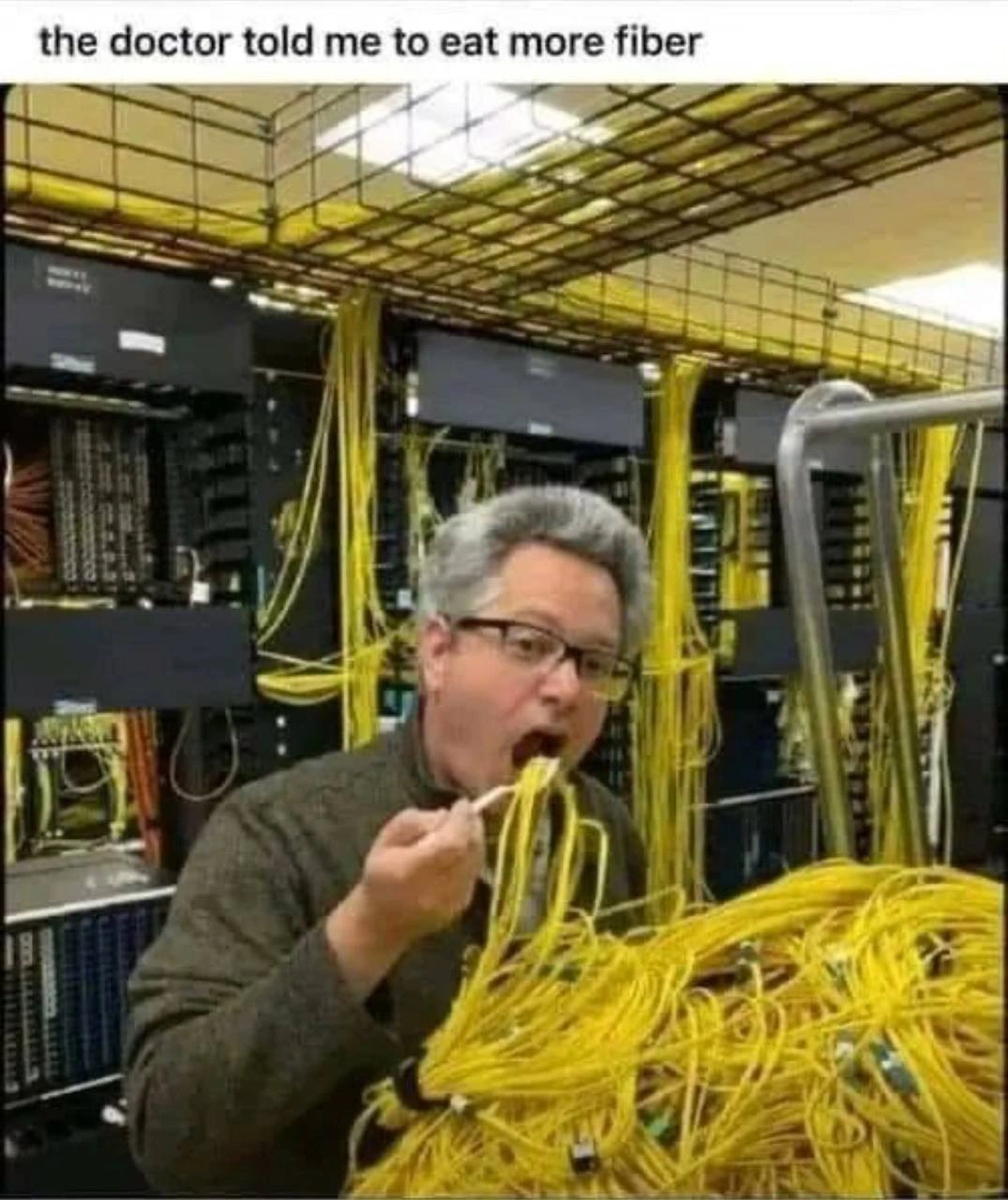
Let’s break down the joke in simpler terms. The meme shows a man in a server room holding a bunch of yellow fiber-optic cables as if they were spaghetti, ready to eat them. At the top, it says, “the doctor told me to eat more fiber.” This is a play on the word fiber, which has more than one meaning. Normally, when a doctor says “eat more fiber,” they’re talking about dietary fiber – the kind of fiber found in fruits, vegetables, and whole grains that helps your digestion. Maybe you’ve heard that advice to eat more apples or bran cereal to stay healthy. That’s one meaning of fiber (let’s call it food fiber).
But in the tech world – especially in Networking and Infrastructure – fiber usually refers to fiber-optic cables. These are the thin, yellow wires you see in the picture. They’re not electrical wires; instead of carrying electricity, they carry data as light. Fiber-optic cables are a big deal in computer networks because they can send information really fast over long distances. Think of them like the highways for all the internet data: super fast lanes with light instead of cars. The yellow cables in the image are examples of these. They often connect important equipment in a DataCenter or server room, linking up servers, switches, and routers so that data can zoom around. Network admins (the folks who take care of these systems) handle fiber cables all the time. They know fiber cables as the things you plug in to get a high-speed network connection, not something you eat for breakfast.
So the humor comes from a mix-up: the doctor’s advice was about one kind of fiber (food), but the SystemsAdministrator in the joke pretends it was about the other kind of fiber (network cables). It’s basically a pun – a funny use of a word that has two meanings. To someone deeply involved in tech, the word fiber might immediately bring to mind these cables (we also call it “optical fiber” or just “fiber” for short). The meme imagines a scenario where a literal-minded IT guy hears “eat more fiber” and thinks, “Sure, I’ll eat more fiber…optic cables!” It’s a silly literal interpretation. SysAdminHumor often features this kind of literalness, because IT folks sometimes joke that they take instructions exactly as given. It’s like if someone said “make sure to back up your files” and a rookie admin started literally walking backwards while holding files – obviously a misunderstanding for comic effect.
Now, why spaghetti? Well, look at those cables – they’re long, thin, and yellow. When you have a lot of cables jumbled together in a network rack, people often call it spaghetti wiring because it looks like a pile of tangled noodles. CableManagement is the practice of organizing and labeling cables neatly so that they don’t actually turn into a big spaghetti mess. In the picture, the cables are hanging orderly, but they’re still visually similar to a heap of pasta. The man is twirling them around a fork just like you would twirl spaghetti. By doing that, he’s doubling down on the joke: not only is he “eating fiber,” he’s treating the cables exactly like a pasta dinner. (He even has an imaginary forkful of cable spaghetti!) This is a classic cable_spaghetti_joke that anyone who’s seen the inside of a server closet can relate to. Even if you’re new to networking, imagine opening a closet and seeing tons of yellow strands everywhere – it truly looks like someone dumped a pot of noodles over the equipment. This image takes that idea literally.
Let’s also note the environment: a network_closet_scene or server room is where all the networking gear lives. Those black boxes and panels in the background are likely switches (which direct network traffic) or patch panels (which are like hubs where cables can be connected and organized). The yellow fiber cords connect different pieces of equipment to each other. A SystemsAdministrator or network engineer would spend a lot of time in rooms like this, plugging and unplugging cables, making sure everything is connected properly. They have to be careful not to mix up cables, and they often use color codes (yellow, orange, etc.) to distinguish types of connections. It’s a pretty serious, even tedious part of the job. So seeing someone play with the cables as if they’re food is immediately funny because it’s so out-of-place. It’s like a chef using noodles to wire a computer – the roles are reversed in a goofy way.
In simpler technical terms: fiber-optic cables = how internet data travels as light; dietary fiber = what your body needs from foods like veggies and grains. The meme mashes these two ideas together. If you’re a junior dev or just getting into IT, you might not deal with fiber cables yet (maybe you’re more used to Wi-Fi or standard Ethernet cables). But in big networks, fiber is extremely common. It’s literally the backbone of the internet – big companies and ISPs run huge bundles of fiber under the ground and ocean to connect the world. And yes, those bundles are sometimes jokingly referred to as fiber (without clarifying), which sets up puns like this. For example, an IT coworker might quip “I got my fiber intake today” after running new cables in the server room. It’s nerdy humor, playing on that double meaning. This meme just takes it one step further by picturing an admin trying to ingest the network fiber as if that meets the doctor’s orders. The contrast between what the doctor meant and what the admin is doing is the core of the joke. And anyone can understand it once you know the two meanings of “fiber.” It’s basically saying: Oops, wrong fiber!
Level 3: The Fiber Diet Plan
For seasoned IT folks, this meme hits on multiple inside jokes at once. First, there’s the obvious wordplay: doctor says eat more fiber → the network admin reaches for fiber-optic cables. It’s poking fun at the literal-minded nature often ascribed to engineers and sysadmins. In many tech circles, there’s a running joke that if you tell an engineer something ambiguously, they might follow your words to the letter. (Think of the classic joke: “My wife told me to pick up bread and, if they have eggs, get a dozen. I came home with 12 loaves of bread.” 🤓) Here, the doctor’s advice was about dietary fiber for health, but our trusty sysadmin’s brain autocompleted “fiber” with the kind that lives in network racks. It’s SysAdminHumor in a nutshell: taking something commonplace and reinterpreting it through the lens of tech. Anyone who’s managed a Networking closet or done SystemsAdministration can chuckle at the image of a colleague slurping down some OC-192 fiber like it’s linguine.
The visual gag is amplified by the setting. We’re clearly in a network_closet_scene or data center wiring room: 19-inch racks filled with switches or servers, and dozens of yellow patch cords neatly (or not so neatly) draped around. Those FiberOpticCable bundles overhead are installed in cable trays, part of good CableManagement practice to separate and route cables cleanly. Yet even with meticulous management, when you have hundreds of patch cords, you inevitably get what looks like a bowl of yellow spaghetti. In fact, messy cabling in server rooms is often derisively called cable spaghetti. (If you’ve ever seen a poorly managed rack, it’s a tangle where you can hardly trace one cable end to end – nightmare fuel for on-call engineers.) Here the cables are fairly organized, but the sheer quantity and their noodle-like appearance is enough to complete the metaphor. The admin in the photo is twirling a few strands on a fork as if it’s pasta night at the Italian restaurant – a perfect cable_spaghetti_joke. This resonates with anyone who’s spent late nights in a server room: after hours of troubleshooting, those cables might start looking like dinner.
There’s also an underlying nod to how crucial fiber cables are in NetworkInfrastructureDesign versus how mundane dietary fiber advice is. Network folks hold fiber-optic links in almost reverent regard – these cables carry mission-critical data, connect servers at lightning speed, and form the backbone of corporate networks and the internet at large. Seeing someone pretend to chomp on them is hilariously sacrilegious. It’s like a chef jokingly chewing on a raw ethernet cable because someone said “add more salt (LAN)” – mixing domains where such an act is absurd. The seasoned engineer knows just how delicate and expensive some of these cables and transceivers are. (Accidentally bending a fiber patch cord too tightly or dust on a fiber connector can bring down a link – those are battles scars every network admin can attest to.) So the image of a gray-haired veteran admin casually about to ingest a fistful of fiber is wonderfully ridiculous. It’s a NetworkHumor reminder that even the most advanced tech can be the butt of a joke. We’re laughing because we’ve all dealt with advice or requirements that sounded straightforward but got “implemented” in wildly wrong ways when misinterpreted. Here, the fiber_optic_pun exaggerates that literalism to comic effect.
Moreover, this meme winks at the often blurry line between work and life for IT professionals. A sysadmin spends all day with hardware and cables, so much so that terms like “fiber” automatically make them think of LC connectors and 10-gig links before breakfast cereal or Metamucil. It’s a gentle jab at how our tech obsessions color our worldview. (If you’ve ever caught yourself saying “I need to compile my grocery list” or “debug why the toaster isn’t responding,” you know the feeling.) The doctor’s advice was about personal health, but the admin’s response stayed firmly in the realm of IT. Networking pros might even joke, “Our network is pretty healthy – it’s got plenty of fiber!” In reality, no doctor is prescribing OM4 fiber optic jumpers as a source of fiber, but the memetic twist is imagining one did and the patient dutifully obeyed with nerdy flair.
And let’s not overlook the simple joy of the pun itself. Tech humor often lives in puns and double meanings (It’s not DNS, there’s no way it’s DNS… It was DNS.). Here “fiber” is the pivot. The meme creator likely heard a common health recommendation and immediately thought of racks of cables – a very sysadmin thing to do. The caption “the doctor told me to eat more fiber” set against that image is enough to crack up anyone who’s ever pulled fiber through a conduit or crimped RJ45 connectors and then heard non-tech friends confuse those terms. It’s the classic comedic formula of mismatch: expectation vs reality. You expect an image of oatmeal or broccoli (high in dietary fiber) but get a guy gorging on network infrastructure. For the seasoned crowd, there’s also a hint of gallows humor: after all the stress of keeping systems running, maybe eating the cables feels like the only way to deal with them sometimes (just kidding – don’t try this at home, folks).
In sum, at the senior-engineer level, this meme is celebrating that shared, slightly nerdy understanding: that sometimes our professional lives make us interpret the world a bit differently. It’s the kind of joke you’d forward to the network team on a stressful day for a quick laugh. Infrastructure and Hardware usually aren’t the punchline of jokes that non-tech people get, but within our circle, the idea of a high-fiber network diet is chef’s kiss comedy. After all, who wouldn’t want a network that’s both robust and part of a balanced breakfast? 🍝😅 (Just maybe keep the marinara sauce away from the patch panel.)
Level 4: Light Meal at Layer 1
At the deepest technical level, this meme is a playful collision of network infrastructure and literal interpretation. In networking terms, fiber-optic cables operate at Layer 1 of the OSI model – the physical layer. That’s the foundation where data travels as pulses of light through ultra-thin glass fibers. Each of those yellow strands the admin is twirling like spaghetti is actually a high-speed data pipeline. Inside a fiber-optic cable, a laser or LED sends information encoded as rapid flashes of light. Thanks to the physics of total internal reflection (light bouncing within the glass core), bits can zip through these strands at near the speed of light. To a network engineer, these bright yellow cables are the lifeblood of modern connectivity, capable of carrying gigabits of data per second across a data center or even between cities. They’re designed for bandwidth, not bandwidth in the nutritional sense, but the kind measured in Gbps and nanometers of wavelength.
From a hardware perspective, the joke taps into the Networking domain at a granular level. Those cables likely use single-mode fiber (often jacketed in yellow) common in enterprise DataCenter backbones. Single-mode fiber has an extremely thin core (~9 microns) that carries light directly (one mode), allowing NetworkInfrastructureDesign to span long distances with minimal loss. Multi-mode fiber (typically orange or aqua cables) has a wider core and multiple light paths, used for shorter links. Whether single or multi-mode, fiber offers enormous capacity. For context, a single fiber pair can handle 100 Gbps Ethernet or more, especially with modern WDM (Wavelength Division Multiplexing) techniques sending multiple color lasers down one strand. It’s a far cry from the old copper wires – fiber is immune to electromagnetic interference, and you can’t “hear” data on it like an old phone line; it’s literally photons in a glass highway. The man in the image is figuratively “consuming” this cutting-edge hardware. It’s as if he’s ingesting the internet’s physical layer itself – a fiber_optic_pun on having a high-fiber diet that even a router might appreciate.
By joking about eating fiber, the meme bridges a gap between two worlds: nutritional science and network engineering. In the medical world, fiber means dietary fiber – plant-based carbohydrates (like bran or veggies) that humans need for digestive health. In the tech world, fiber means glass threads carrying data. The humor emerges from a senior SystemsAdministration perspective where terms have dual meanings across domains. It’s a form of semantic collision: one word, two contexts. To someone deep in Hardware and Infrastructure, fiber might first conjure images of patch panels and transceiver modules rather than whole-grain cereal. The doctor’s advice to “eat more fiber” gets parsed like an ambiguous instruction in code, and the sysadmin’s literal-minded execution leads to a ridiculous outcome. (It’s a classic case of context not making it from one layer to another – in this case, from the health domain to the IT domain.) This is a physical_layer_humor gem: the admin attempts to comply with doctor’s orders by consuming high-speed networking gear! Of course, actually biting into a fiber-optic cable would be a terrible idea – those FiberOpticCable cores are made of glass (plus some plastic cladding), not something you’d want for lunch. But the absurdity is the point. It highlights, in a tongue-in-cheek way, just how essential these cables are: they’re the fiber that keeps the internet regular (so to speak), even if they won’t exactly help your digestive tract.
Description
A humorous image with the caption, "the doctor told me to eat more fiber." The photo depicts a middle-aged man with glasses in a server room, surrounded by racks of network equipment. He is using a fork to pretend to eat a large bundle of bright yellow fiber optic cables as if they were spaghetti. The background shows complex cable management with wires running along overhead trays. The joke is a classic pun, playing on the double meaning of "fiber": the dietary kind recommended by doctors and the fiber optic cables essential for modern networking and data transmission. It's a quintessential piece of IT humor, beloved by network administrators and data center technicians
Comments
9Comment deleted
I tried the high-fiber diet, but the latency was terrible and I'm pretty sure the packet loss is affecting my digestive system
When the doc said “more fiber,” our network guy optimized his ingestion pipeline - turns out the human GI bus is still half-duplex and the LC-to-esophagus drivers are stuck in eternal beta
After 20 years of untangling production network cables at 3am, you realize the real fiber you need isn't for your digestive system - it's the 100Gbps backbone that management still won't approve budget for while wondering why the 'internet is slow'
When your doctor recommends more fiber in your diet but you've spent 20 years in data centers, the confusion is understandable. At least fiber optic has better bandwidth than bran - though the latency on digestion might be problematic. This is what happens when you've debugged so many fiber channel issues that your brain autocompletes 'fiber' to 'optic' before 'dietary.' The real question: is this single-mode or multi-mode fiber, and does it meet the minimum bend radius specifications for human consumption?
High‑fiber diet for network engineers: 0 calories, 100 Gbps throughput - right up until someone ignores the bend radius and the change window becomes an incident bridge
Doctor said eat more fiber - we’re OS2 single‑mode end‑to‑end; the only thing clogged is the change‑advisory board
Doctor: 'Eat more fiber.' Neteng: 'Singlemode or multimode? And what's the bend radius on that fork?'
I have a feeling this is 4th repost Comment deleted
That's the Spaghetti Monster. He knows everything about you, he transfers your money, he shows you memes with kittens. The world exists thanks to him Comment deleted