Skip to content
DevMeme
5434 of 7435
Google Assistant's Literal-Minded Take on Time
Google Post #5957, on Apr 11, 2024 in TG

Google Assistant's Literal-Minded Take on Time

Why is this Google meme funny?

Level 1: Trick Question

Imagine you ask a simple question to a friend, but your friend decides to be playful. You say, “Hey, how many seconds are in a year?” You’re expecting your friend to think a bit and maybe give you a big number (because there are a lot of seconds in a whole year!). Instead, your friend grins and answers, “Twelve.” You look puzzled – twelve?! Then they explain with a laugh: “Yeah, twelve… January 2nd, February 2nd, March 2nd, and so on.”

What’s going on here? Your friend is joking with the word “second.” You meant seconds as in the ticking seconds on a clock. But your friend pretended to think you meant the second day of each month. It’s a silly trick question kind of joke — the kind that makes you groan and chuckle at the same time.

In the meme, Google Assistant (the voice/chat helper on many phones) is behaving just like that mischievous friend. Someone asked it a straightforward question, and it replied with a punny answer, listing the 2nd day of every month. It’s as if the computer is telling a dad joke. The humor comes from the surprise: the expectation was a serious answer (a huge number of seconds), but the assistant delivered a playful twist by interpreting the question in a funny way.

So, basically, the computer knew the real question but decided to give a joke answer. It’s funny because we don’t usually expect a machine to crack a joke or understand word tricks. When it does, it gives us a little “gotcha!” moment. Just like a friend teasing you with a clever play on words, the Google Assistant’s answer shows it can play along and make us laugh. It’s a reminder that sometimes even our smart gadgets have a sense of humor programmed into them, catching us off guard with an answer we didn’t see coming!

Level 2: Assistant Dad Joke

Let’s break down what’s happening in this meme in simple terms. A person asked Google Assistant a question: “How many seconds are there in one year?” This sounds like a straightforward question – probably they wanted to know the total number of seconds that pass in a year. If you do the math or ask a normal calculator, the answer should be quite large. In fact, there are 60 seconds in a minute, 60 minutes in an hour, 24 hours in a day, and about 365 days in a year. If you multiply all that, you get 31,536,000 seconds in one year (in a typical non-leap year). That’s the number most people would expect.

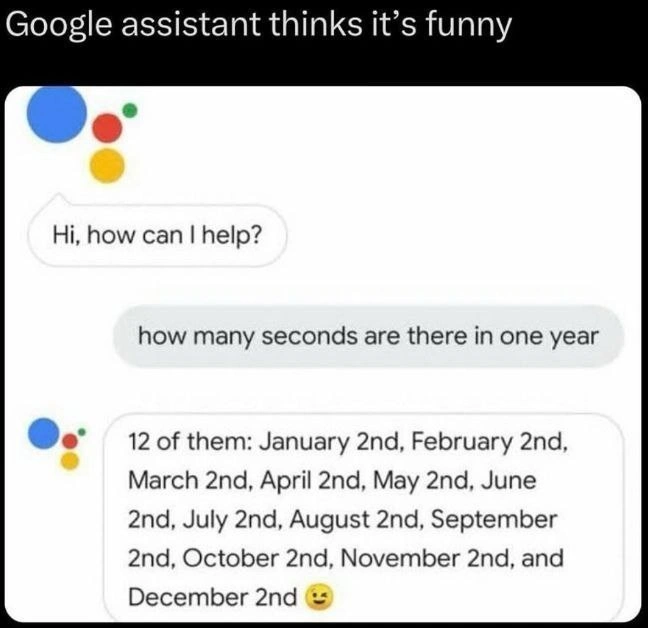
However, Google’s AI assistant didn’t reply with 31,536,000. Instead, it responded with a punny answer. The conversation in the meme goes like this:

User: “how many seconds are there in one year”
Google Assistant: “12 of them: January 2nd, February 2nd, March 2nd, ... November 2nd, and December 2nd 😉”

Notice anything off? The assistant said “12 of them,” and then listed January 2nd, February 2nd, ... December 2nd. It’s treating “seconds” as if the question was asking about the “2nd day of each month” rather than “seconds of time.” In other words, the assistant answered a different question: “How many Second-of-the-month dates are in one year?” And for that question, the answer is indeed 12 (since each of the 12 months has a 2nd day). It’s a classic pun or wordplay joke.

Here’s why it’s funny: The word “second” has more than one meaning in English. It’s a homonym (a word that can mean two things).

  • second (time unit): One meaning is a unit of time — the one we use in hours, minutes, seconds. By this meaning, the question was asking for a big number of seconds in a year (~31 million).
  • second (ordinal): Another meaning is an ordinal number, like first, second, third. By this meaning, “the second of January” means January 2nd (the date). If you interpret “seconds in a year” as “2nds in a year” (the second days in each month of the year), there are 12 such days (one in each month).

The Google Assistant deliberately chose the joke interpretation of “seconds.” It responded as if the user meant “How many second-days are in a year?” and listed all those 2nd of the month dates. The inclusion of the winking emoji 😉 was a big hint that it was being cheeky on purpose. Essentially, the assistant made a dad joke – the kind of corny wordplay joke a dad might make. In tech circles we call this an assistant dad joke because it’s the AI acting like that joke-cracking parent or friend.

For clarity, if the assistant had taken “seconds” in the normal sense (seconds of time), it would have answered with a large number (31,536,000). But it played with the words instead. This kind of response is often a programmed Easter egg (a hidden joke or feature) in the assistant’s software. The developers at Google likely added this fun response intentionally because this question is a well-known riddle. Chatbot designers sometimes do that to give the assistant some personality or to surprise and delight users. It’s an example of AIHumor, where the AI’s answer is meant to make you laugh.

However, this joke also shows a bit of an AI limitation and the challenge of NaturalLanguageProcessing. A computer doesn’t truly “understand” language the way humans do; it follows rules and patterns. The phrase “how many seconds in a year” triggers two possible interpretations as we saw. Deciding which meaning of a word is intended is hard for a machine – that’s the language ambiguity problem. In many cases, the AI will use context or probability (most people asking about seconds/year want the number). But here, the system was probably explicitly told: if you see this exact question, do the joke. It didn’t try to figure out context or ask back “Did you mean time seconds or something else?” – it just went for the pun. That’s hilarious when you’re in on the joke, but if you truly needed the information, it could be a bit confusing or unhelpful.

For a junior developer or someone learning about AI, there are a couple of takeaways here:

  • NLP and Context: Understanding human language is tricky because of cases like this. One word can have multiple meanings, and a phrase can be interpreted in different ways. A lot of programming in NLP is about handling these ambiguities. For example, figuring out that in the sentence “I’m going to the bank,” whether bank means a financial institution or the side of a river, depends on context. Here, context was minimal, so the AI had to pick a meaning for “seconds.” It picked the joke context, likely because it was explicitly programmed to recognize this famous riddle.
  • AI Personalities: AI assistants like Google Assistant or Siri aren’t just Q&A machines; they’re given personalities. That means developers often script some funny or non-standard answers to common funny questions. It makes the assistant feel more human. This “12 seconds in a year” answer is a great example of that. It’s the kind of answer that makes people smirk and realize the assistant can have a sense of humor.
  • Design Choices: There’s a design decision here: Should the assistant always give the factual answer, or sometimes be witty? Google decided that for this query, being witty was okay. If someone really needs the exact number of seconds, they might rephrase or the assistant might handle a differently phrased question with the actual number. Part of being a developer for such systems is considering user expectations. Most users don’t mind a joke occasionally, especially for a riddle-like question, but you have to be careful not to annoy users who want serious information.

In summary, the meme highlights a playful pun_on_seconds made by Google Assistant. The assistant heard a question, spotted an opportunity for a punny response, and delivered a classic “gotcha!” answer. It’s funny to us because it shows the assistant acting less like a sterile computer and more like a cheeky friend. For developers, it’s also a neat illustration of the NaturalLanguageProcessing challenge: machines take things literally, except when we explicitly teach them to recognize a joke. And in this case, the machine was essentially taught a joke and it executed it flawlessly — perhaps to the user’s surprise!

Level 3: Pun Over Precision

From a senior developer’s perspective, this meme is a perfect example of an AI behaving in a way that’s both endearing and mildly exasperating. Google Assistant, a complex AIAssistant built to be helpful, ends up trolling the user with a dad joke. The user asked a simple question expecting a straightforward numeric answer, but the assistant chose pun over precision. Instead of dutifully fetching the number of seconds in a year (we all know it’s around 31 million), the assistant gave an unexpected AI response steeped in wordplay. In essence, the software prioritized being witty over being correct to the user’s intent.

Why is this so funny (and familiar) to developers? Because we’ve all witnessed or built systems that do exactly what they’re told — sometimes to a fault. Here, the assistant technically answered the question “How many seconds in a year?” by enumerating all the “second” days in a year (12 months = 12 second-days). It’s technically a correct answer to a different interpretation of the words. This is humor that engineers affectionately call a literal interpretation or a spec misunderstanding – the kind of mischievous answer a overly literal junior dev or a clever co-worker might give to highlight an ambiguous requirement. It resonates with anyone who’s seen a program follow instructions to the letter while missing the spirit, a common software trope. The twist is, in this case the system likely isn’t accidentally misunderstanding – it’s deliberately coded to jest. It’s both a language_ambiguity showcase and an easter egg planted by the developers.

Tech companies often inject these little assistant_dad_joke moments to make their AI seem more personable. Siri, Alexa, and Google Assistant are infamous for cheeky retorts and hidden jokes. (Ask Siri about zero divided by zero sometime for a snarky reply.) This particular riddle — “How many seconds are in a year?” — is a classic that you might hear from a goofy math teacher or a parent with a penchant for puns. The devs behind Google Assistant knew this, and seemingly gave the assistant a pre-programmed personality in this instance. It’s humor-by-design: no fancy machine learning needed, just a hard-coded answer for a recognized joke prompt. In pseudo-code, it might look like:

const query = "how many seconds are there in one year";
if (/seconds.*year/i.test(query)) {
  // Developer Easter egg: respond with a pun instead of the literal answer
  console.log("12 of them: January 2nd, February 2nd, ... December 2nd 😉");
} else {
  // ... proceed with normal factual answer logic
}

(Above: a tongue-in-cheek illustration of how the joke could be hard-wired. In reality, the actual implementation would be more complex, but conceptually it’s checking for the trigger phrase and then bypassing the usual calculation.)

For seasoned engineers, the presence of a case like this in a production system is both amusing and telling. It reminds us that a lot of “intelligence” in AI products is actually clever scripting. Despite all the advanced Machine Learning under the hood of something like Google Assistant, a simple regex or lookup table might be responsible for this particular gag. It’s a bit of old-school rule-based AI humor nestled inside the modern AI. We chuckle because we imagine the dev team slipping this in and high-fiving — it’s the kind of thing you do to give your software a human touch, or maybe just to make your coworkers groan.

However, the joke also exposes a practical challenge: user intent versus system behavior. If a developer genuinely asked this question in the middle of work, they probably wanted 31536000 as an integer, not a list of dates. The witty response, while funny once, could be annoying if you’re in a hurry. This echoes a common tension in software development: should software be playful or strictly utilitarian? In this instance, the pendulum swung to playful. It’s a reminder that AI limitations aren’t always computational — sometimes they’re intentional design choices that favor charm over completeness.

In the dev community, moments like this become shared lore. We’ve all experienced something similar, like a tool that responds with an Easter egg when you use a certain flag or a system that outputs a joke in its logs. It’s endearing because it humanizes the technology (“look, it made a dad joke!”), but it’s also a bit of a facepalm because, well, it didn’t answer the question as asked. The meme’s punchline, Google Assistant listing all the “2nds” with a cheeky emoji, is a scenario every engineer can appreciate: the machine “did what I said, not what I meant,” and had a laugh at my expense.

Ultimately, this senior-level chuckle is about recognizing the interplay of language and code. It’s both a subtle nod to how far AI has come — that it can mimic humor — and a wink at how far AI still has to go in truly understanding us. We laugh, then we double-check the real answer ourselves (maybe by rephrasing the question or, heaven forbid, doing the math). And as we do, we might just admire the colleague who slipped in this joke and made an otherwise mundane Q&A moment into a memorable bit of AI humor in our day.

Level 4: Semantic Sleight-of-Hand

At a deep linguistic level, this meme spotlights a case of lexical ambiguity in a conversational AI. The user’s query “how many seconds are there in one year” is syntactically straightforward but semantically ambiguous because of the word “seconds.” In English, second is a polysemous term (a word with multiple meanings). Here it can denote two entirely different concepts: (1) a unit of time (the familiar 1/60 of a minute), or (2) the ordinal second (as in 2nd place, or the second day of a month). Determining which sense is intended is the classic Word Sense Disambiguation (WSD) problem in Natural Language Processing (NLP). Normally, context guides disambiguation — in a question about a year, “seconds” would almost always refer to time units.

However, Google Assistant’s answer flipped the script by choosing the alternate sense of “second.” Instead of performing a straightforward calculation (there are 60 * 60 * 24 * 365 = 31,536,000 seconds in a common year) via its usual knowledge base or units conversion algorithms, the assistant returned a list of 12 dates (“January 2nd, February 2nd, ..., December 2nd”). This incongruous answer indicates the AI engaged in semantic wordplay. In effect, the system resolved the ambiguity in an unexpected way: interpreting “seconds in a year” as “second days in a year” – hence there are 12 (one for each month). The wink emoji 😉 accompanying the answer underscores that this was an intentional pun, not a genuine misunderstanding. It’s a subtle signal that the AI knowingly gave a joke response rather than the literal fact.

From an AI design perspective, this kind of response is usually a pre-defined easter egg rather than a spontaneous act of creativity. Modern AI assistants like Google’s often have a library of quirky answers for common riddle-style questions. The query “How many seconds are in a year?” is a known pun_on_seconds riddle, so the assistant likely recognized a pattern or exact trigger and delivered the canned joke. In a typical NLP pipeline, the system first classifies the user’s intent. For a question phrased this way, a standard QA system might identify an intent like “ask for a quantity” and map “seconds” to the time unit, then do a quick calculation or database lookup. The presence of this joke answer implies an override in that pipeline: a deliberate check for this specific phrase that short-circuits the usual numeric computation and instead outputs the witty interpretation.

Why engineer such a response? Incorporating AIHumor is partly about user engagement — it gives the assistant a bit of personality. Yet, it treads a fine line because humor is highly context-dependent. NaturalLanguageProcessing research has shown that genuine computational humor (where a system truly “gets” a joke and can invent one) is extraordinarily challenging. What’s more feasible is detecting known jokes or ambiguities and responding with pre-written quips. That’s likely what happened here. The assistant doesn’t truly misunderstand the question like a human might; under the hood it “knows” the factual answer, but a developer has decided that, for this particular query, a playful response is more fun. It’s a clever trick: the AI behaves as if it momentarily prioritizes pun over precision, exploiting the dual meaning of a word to surprise the user.

This humorous response also highlights an AI limitation in understanding pragmatics – the aspect of language dealing with intent and context. A human asked this question in earnest would almost certainly be seeking the numerical answer (nobody actually needs a list of all the 2nd days of each month unless joking). An AI with deeper common-sense reasoning would detect that giving the joke might not fulfill the user’s actual information need. But current AI doesn’t truly possess common-sense; it relies on patterns and developer-defined behavior. In absence of a clear directive, it can latch onto linguistic quirks. In this case, the directive was likely explicitly coded: treat this query as a joke. It’s a fun demonstration of how Natural Language Understanding systems can be both surprisingly clever and inherently programmed. The humor emerges not from the AI “realizing” the pun, but from a designed response that leverages a language quirk that developers and users are expected to find amusing. Essentially, the AI performed a little semantic sleight-of-hand – responding to the literal words of the question in an unexpected way – showcasing both the creativity and the constraints of modern NLP-driven assistants.

Description

A screenshot of a conversation with Google Assistant, captioned "Google assistant thinks it's funny." The user asks, "how many seconds are there in one year." The assistant, represented by its colorful four-dot logo, gives a clever, literal answer: "12 of them: January 2nd, February 2nd, March 2nd, April 2nd, May 2nd, June 2nd, July 2nd, August 2nd, September 2nd, October 2nd, November 2nd, and December 2nd 😉". The humor comes from the assistant interpreting "seconds" as the ordinal number "2nd" rather than the unit of time. This is a classic example of a pun or a 'dad joke' deliberately programmed into AI assistants as an Easter egg, showcasing the playful side of natural language processing and delighting users who discover it

Comments

15
Anonymous ★ Top Pick This is a classic off-by-one error in contextual understanding. The NLP model clearly defaulted to the ordinal interpretation instead of the temporal unit, proving that even Google's AI can't escape a good pun
  1. Anonymous ★ Top Pick

    This is a classic off-by-one error in contextual understanding. The NLP model clearly defaulted to the ordinal interpretation instead of the temporal unit, proving that even Google's AI can't escape a good pun

  2. Anonymous

    When the NLU pipeline skips disambiguation, “seconds” gets implicitly cast to DadJokeEnum - and 31,536,000 collapses into twelve magic constants, one for every 2nd

  3. Anonymous

    After 20 years of building NLP systems that can parse complex queries, handle ambiguous context, and maintain conversation state across multiple turns, we've finally achieved the pinnacle of AI: teaching machines to deliberately misinterpret questions for comedic effect. Next sprint: implementing eye-roll detection for proper dad joke timing

  4. Anonymous

    When your NLP model's context window is so narrow it can't distinguish between temporal units and ordinal numbers, but at least it ships with a sense of humor and a winking emoji to acknowledge its own semantic parsing failure. Classic case of 'technically correct is the best kind of correct' - the model clearly prioritized literal string matching over intent classification, probably because someone optimized for precision over recall in the training data

  5. Anonymous

    Google Assistant says a year has 12 seconds; honestly the safest response - anything else drags you into UTC vs TAI, leap seconds vs leap-smear, DST, and a postmortem on why the 23:59:60 cron ran twice

  6. Anonymous

    Intent classifier: 0.51 time_unit, 0.49 ordinal_date; product flipped humor_mode=true and shipped a 31,536,000 -> 12 regression

  7. Anonymous

    LLM nails regex for '2nd' but skips the 31M arithmetic - RAG could've saved it, but puns ship faster

  8. @callofvoid0 2y

    doesn't bother himself to think more

  9. @v_simakov 2y

    Overthinking

  10. @aldaris 2y

    What about "Jan twenty second" and so on?

    1. @SamsonovAnton 2y

      Being 22nd is not the same as being 2nd. 👌

  11. @GLXBX 2y

    But it is

  12. @Diotost 2y

    It is too lazy to deal with leap years. And leap seconds too.

  13. @girumel 2y

    Come on, it's the user's input, not the assistant's reply

  14. @SanyaDez 2y

    It's funny until using goggle assistant in the smart home 😁

Use J and K for navigation