Skip to content
DevMeme
827 of 7435
A Tribute to Linus Torvalds on his 50th Birthday
OpenSource Post #936, on Dec 28, 2019 in TG

A Tribute to Linus Torvalds on his 50th Birthday

Why is this OpenSource meme funny?

Level 1: Tech Hero’s Birthday

Imagine one of your heroes – say the person who invented your favorite game or the coolest toy you have – is having a big birthday. Everyone who loves that game or toy is really thankful for what this person created because it brings them so much joy every day. So they all shout out happy birthday to him in a fun way. That’s what’s happening here, but in the world of computers.

Linus is a bit like a superhero in the computer world who made something incredible called Linux that so many people and companies use (even if you don’t see it, it’s working behind the scenes in phones and the internet). Now he’s turned 50 years old – which is like reaching grandpa age in tech years! People find it funny and awesome at the same time. They joke that the stuff he wrote at the very beginning is so old now, it could get a senior citizen discount. 🎂 But they’re also serious in thanking him: “Happy cake day” basically means “Happy Birthday, we appreciate you!”

So, this meme is like throwing a birthday party for a famous builder who built a huge playground (Linux) that everyone plays in. It’s saying: “Wow, you’ve been around a long time (50 years!) and your creation has been around so long too. Thank you, and enjoy your special day!” It’s both a joke about getting older and a big thank you to someone who did something great that lots of people care about.

Level 2: The Man Behind Linux

This meme is about Linus Torvalds, the man who created the Linux kernel, reaching a milestone age (50 years old). To appreciate the joke, you need to know a bit about who Linus is and what the Linux kernel means to tech folks. Linus Torvalds is basically the original developer of Linux, which he started as a personal project in 1991 while he was a student in Finland. The “kernel” is the core part of an operating system – think of it like the engine of a car. It’s the program that talks directly to the computer’s hardware and makes everything else (your apps and software) run. Linux today is everywhere: it runs on servers that power websites, on many gadgets, and even inside Android phones. So Linus is a pretty big deal in programming circles because his creation has hugely influenced computing and OpenSourceContribution around the world.

Now, open source means the code for Linux is publicly available for anyone to read, use, or improve. This was one of Linus’s key decisions. Instead of keeping his code secret, he shared it, and thousands of developers globally have contributed to it over the years. This open collaboration is a huge part of OpenSourceCulture – people build software together, often just for the joy of contributing or to solve common problems. Linux is one of the shining examples of that culture: it’s free, community-developed, and incredibly robust because so many eyes have looked at the code (there’s even a saying, Linus’s Law, jokingly named after Torvalds: “Given enough eyeballs, all bugs are shallow,” meaning software tends to get better when lots of people can improve it).

The meme’s text mentions a “kernel’s original README”. In software projects, a README is a text file (often literally named README.txt or README.md) that introduces the project, explains what it is, and sometimes how to build or use it. It’s often the first thing people read when they encounter new code. So, the “kernel’s original README” would be the very first documentation Linus wrote for Linux. That file is almost 28+ years old by 2019. It’s not actually 50 years old (Linux wasn’t around in 1969!), but the meme exaggerates for comic effect. It imagines that README file as a person who just turned 50 and can now join AARP.

What’s AARP? It stands for the American Association of Retired Persons, which is a group you can join when you’re 50 or older to get various perks (like discounts on travel and restaurants). Basically, saying someone “qualified for AARP” is a jokey way to say “they’re officially getting old.” In the tech world, seeing a technology or a piece of documentation last so long is unusual – software and programming languages can come and go in a few years. But Linux (and Linus) have been around since the early 90s and are still going strong. So we’re joking that the Linux kernel project is like an old-timer in the software world, entering its senior years.

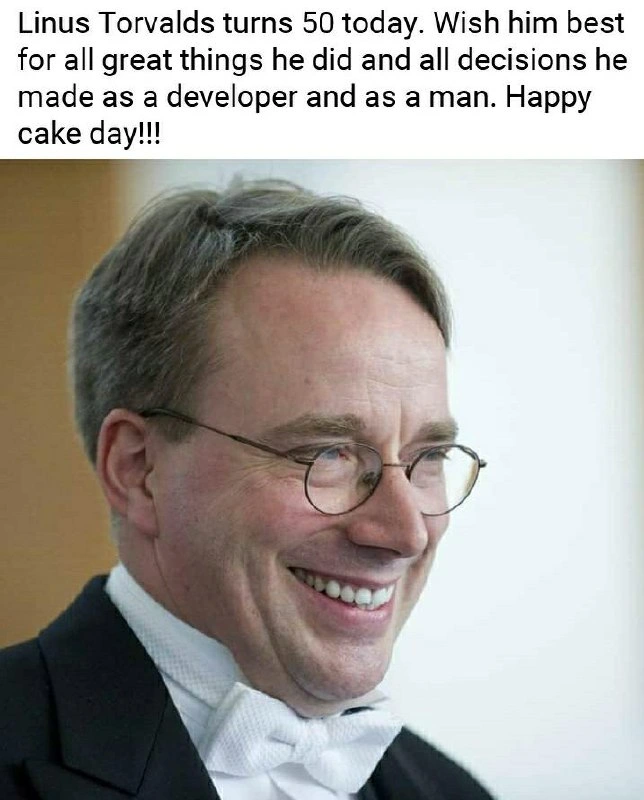
The top caption of the meme reads: “Linus Torvalds turns 50 today. Wish him best for all great things he did and all decisions he made as a developer and as a man. Happy cake day!!!” This is written like a celebratory announcement. A few things to break down here for someone new to this:

  • Linus turning 50 is factual (his 50th birthday was in December 2019). It’s a milestone birthday, and hitting “the big 5-0” is often when you get jokes about being old. But in the tech community, it’s also a moment of respect, because it means someone has had a long career.
  • “All the great things he did and decisions he made as a developer” refers to his achievements in tech – creating Linux, managing it, also creating Git (the tool nearly every developer uses for version control). “Decisions he made as a man” broadens it humorously to say we even applaud the non-technical decisions, maybe poking light fun at the fact that Linus is known to have a strong personality and has made some controversial calls (like how to license Linux, or how he interacted on mailing lists). It’s a very formal and grand way of praising him, almost like a lifetime achievement speech. That formal tone is part of the joke, because software developers usually aren’t praised like that in memes.
  • “Happy cake day!!!” is an internet slang way to say “Happy Birthday!” or “Happy anniversary!” On some online communities (like Reddit), your “cake day” is the anniversary of when you joined, often indicated by a little cake icon next to your name. So people wish each other happy cake day. In this meme, it’s just a fun way to say happy birthday to Linus, keeping it light-hearted. They even use three exclamation marks to show excitement 🎉.

The image itself is interesting: it’s a photo of Linus Torvalds dressed in a fancy black tuxedo with a white bow tie, looking happy. This isn’t how programmers are usually depicted (we’re more used to seeing them in T-shirts with nerdy jokes on them). The choice of a formal portrait makes it look like Linus is being honored at a gala or some formal event (which he has been – he’s received tech awards). The contrast between that dignified image and the meme text (“Happy cake day!!!”) creates a comedic effect. It’s like writing a serious congratulatory message for a world leader, then ending it with a casual internet meme phrase. For seasoned tech folks, that contrast is funny because Linus has always been a bit of a rebel and very informal, so dressing him up in ceremony is playful.

To a newer developer (or someone just learning about this stuff), the meme is basically doing two things:

  1. Celebrating Linus Torvalds – acknowledging the huge impact he’s had. Linux is everywhere, and without Linus’s work, computing would look very different today. It’s like saying “happy birthday to a legend in our field.”
  2. Making an age joke – highlighting that 50 is considered “old” (at least for internet culture jokes) and that it’s surprising/awesome that something from the early ’90s (Linux and its documentation) is still relevant today.

It might help to know that many technologies don’t last that long. For example, if you started programming in the 2000s, you’ve seen languages, tools, or fads rise and fall within a decade. The fact that Linux, started in 1991, is not only still around but actually more important than ever, is remarkable. It implies the project had strong fundamentals and continuous community support. When the meme mentions “long-running stewardship of a major open-source OS kernel,” it’s referring to how Linus has led the development of the Linux kernel from the start and still does. That’s a long-term maintainership record that’s hard to find elsewhere. Many open-source projects get passed to new maintainers or fade out; Linux did the opposite – it thrived and grew under the same leadership.

Finally, let’s decode the humor in simpler terms: It’s funny to imagine a file (the README) or a software project acting like a human who is getting old. Personifying tech (“giving it human traits”) often comes up in developer jokes. Here we’re pretending the Linux project is like a person turning 50 – time for reading glasses and retirement letters. But of course, neither Linus nor Linux is retiring anytime soon. If anything, they’re both still going strong. So it’s a warm, lighthearted joke: celebrating the birthday of the “dad” of Linux and marveling at how far his creation has come, all in one go.

Level 3: Open-Source Elder Statesman

Fast-forward to Linus turning 50, and this meme plays on the idea that in the fast-paced world of tech, reaching AARP age is hilariously old-school. Think about it: the Linux project has been under his stewardship for nearly thirty years — an eternity in software time. The title, “That moment when the kernel’s original README qualifies for AARP,” is a tongue-in-cheek way to say “Whoa, this project (and its founder) have been around forever!” For context, AARP is an American organization that people can join once they hit 50, often symbolizing they’re officially “older adults” (complete with senior discounts and corny membership cards). By joking that the kernel’s README could join AARP, the meme exaggerates the kernel’s age, treating a software artifact as if it were a person eligible for retirement perks. It’s a playful nod to just how long-term long_term_maintainership can be in open source – Linus wrote that README as a young man, and decades later, both he and the file are still kicking.

Senior developers find this hilarious and endearing because they remember the “good old days” when Linux was a scrappy underdog OS. Many of them grew up professionally alongside Linux. Seeing Linus in a formal portrait with a tuxedo and reading a grandiose birthday tribute feels ironically ceremonial – as if a rebel hacker has been declared a distinguished elder in the tech world. The meme’s top text gushes in almost over-the-top praise: “Wish him best for all great things he did and all decisions he made as a developer and as a man.” This flowery tribute sounds like something you’d say at a lifetime achievement award ceremony. It stands in comical contrast to Linus’s actual personality and the rough-and-tumble OpenSourceCulture he fostered. Remember, this is the same Linus Torvalds known for fiery mailing list rants and a no-BS attitude. He once flipped the bird on camera at a conference (directed at NVIDIA over driver support) and has emailed some rather colorful feedback to contributors. Seasoned engineers reading that formal praise smirk because they know Linus would probably roll his eyes at such sentimental fanfare. The tech humor here lies in that contrast: the kernel_maintainer who has historically been blunt and abrasive at times being toasted like a refined statesman on his “cake day.”

(Side note: “cake day” is internet slang (popular on Reddit) for someone’s anniversary or birthday, hence the meme’s closing line “Happy cake day!!!”) 🎂

The “decades of version control churn” mentioned in the description hints at real saga that veterans recall. In the early days, Linus managed contributions via email patches and a tool called BitKeeper. When that went south (license disputes), he famously wrote his own version control system, Git, in 2005. That decision revolutionized how developers collaborate – Git is now the standard for most projects. So when the meme says “all decisions he made as a developer and as a man,” it’s implicitly referencing things like: choosing GPL licensing, insisting on high code quality (he’s rejected many subpar patches with unvarnished criticism), creating Git to keep the project independent, and even taking a self-imposed hiatus in 2018 to work on his behavior after community feedback. Each of these decisions has shaped not just the Linux kernel, but OpenSourceContribution culture at large. For example, his choice of the GPL license ensured that countless companies contributing to Linux (IBM, Google, Red Hat, etc.) had to share their improvements, fueling a virtuous cycle of contribution. His decision to write Git gave every open source developer a powerful tool to collaborate. Even his controversial moments (like a famously blunt quote: Talking is cheap. Show me the code.”) have become part of software engineering folklore.

This meme is essentially a senior engineer’s nostalgia trip. It celebrates the fact that SoftwareHistory isn’t just about code; it’s about people like Linus who lead projects over decades. There’s a shared understanding that maintaining an OperatingSystem kernel for so long is a monumental feat of coordination, passion, and yes, stubbornness. The Linux kernel has seen roughly 30 years of continuous development – over a million commits from thousands of contributors. Yet Linus has remained the benevolent dictator (with an occasionally not-so-benevolent tone 😅) at the top, merging changes and guiding the project’s direction. It’s the ultimate example of long-term open source leadership. So when we see him hitting 50, we can’t help but make jokes: “The code’s so old, it can apply for senior citizen benefits!” But behind the joke is real admiration. Senior devs are tipping their hats to a “greybeard” (industry slang for an experienced elder) who’s literally changed the world. They find it funny that we’re even in a place to make this joke. After all, how many technologies from the early ’90s are not only still around, but forming the backbone of modern cloud computing, smartphones, and gadgets?

To put it in perspective, here are a few milestones that highlight the tech history spanning Linus’s career:

  • 1991: 21-year-old Linus announces Linux, a free Unix-like kernel, on a newsgroup: “just a hobby, won’t be big and professional…” Boy, was that an understatement.
  • Mid-1990s: Linux grows via contributions from volunteers worldwide. It starts out as a student project and becomes a serious competitor to commercial Unix.
  • 1998-1999: The term OpenSource takes off, Netscape open-sources its browser, and Linux gets mainstream attention (even corporations like IBM start embracing it). Linus becomes something of a folk hero in tech.
  • 2005: The BitKeeper incident leads Linus to create Git in about two weeks. This not only saves Linux development from chaos but also gifts the world the most popular version control system ever.
  • 2008: Android launches, using the Linux kernel. Suddenly Linux is running on millions of phones (even if users don’t realize it).
  • 2010s: Linux is basically running the internet (nearly all servers), most gadgets, the top supercomputers, you name it. Linus is still merging code, releasing a new kernel version roughly every 9-10 weeks.
  • 2019: Linus turns 50. The community celebrates the longevity of both the man and the project – with memes, of course. 🎉

When you’ve been around this long, you acquire a kind of legendary status. The meme’s formal tone – almost like toasting a head-of-state – pokes fun at that. Linus went from a rebellious coder in a T-shirt to an “elder statesman” in a tux (literally: the image might be from when he received an honorary doctorate or tech prize). It’s a playful reminder that OpenSourceCulture now has its Hall of Fame figures. And as any great Hall of Famer, Linus is being humorously showered with accolades. The next subtle joke: calling it his “cake day” keeps it from getting too serious. It’s as if the community is saying, “We respect you immensely, but we’ll still joke around with you.”

In summary, level 3 of this joke dissects why experienced devs smirk: it’s celebrating a long-lived open source project and its sometimes cantankerous leader as if they were royalty. That mix of sincerity (acknowledging great contributions) and silliness (AARP membership and cake references) resonates with anyone who’s watched the Linux saga unfold. The meme is both a tribute and a roast, in the classic developer humor style.

Level 4: The Kernel Architecture Wars

The humor in this meme hides deep operating system lore. Back in the early 90s, a famous debate raged between computer scientists about kernel design – specifically monolithic vs microkernel architecture. Linux (the kernel Linus created) is a monolithic kernel, meaning most OS functionality runs in a single address space in the core. Academics like Andrew Tanenbaum (creator of MINIX, a teaching OS) argued that monolithic kernels were antiquated and that microkernels (which run modular components as separate processes) were the future. Tanenbaum even declared “Linux is obsolete”, critiquing Linus’s design for being too tied to one hardware architecture (the Intel 386) and not as theoretically elegant as a microkernel. This was the Kernel Architecture War of its day – a classic theory vs. practice showdown in OperatingSystems design history.

Linus, a 21-year-old student at the time, responded with pragmatic confidence. He famously defended his choices, pointing out that performance and practicality mattered more for real users than academic purity. In a monolithic design, a system call (the way programs request services from the OS) can execute faster as a simple function call within one big program, rather than message-passing between separate microkernel services. On the downside, a bug in any part of a monolithic kernel can crash the whole system, but Linus was willing to live with that trade-off for speed. Over the years, Linux proved highly adaptable: it gained loadable kernel modules (allowing pieces of the kernel to be added or removed at runtime like microkernel servers) and was ported far beyond the 386. Ironically, what started as an architecture criticized for lack of portability ended up running on everything from wristwatches to mainframes. The hardware portability battles mentioned in the meme’s description allude to exactly this – the engineering grind of making one codebase work on countless CPUs and devices. It required redesigning parts of the kernel to abstract differences in endianness, CPU instructions, memory management units, and I/O systems. These efforts were monumental, but they paid off: Linux became one of the most portable and ubiquitous kernels ever, vindicating a lot of Linus’s early decisions.

Another fundamental decision was licensing the kernel under the GPL (GNU General Public License). This “copyleft” license ensured that anyone could use and modify Linux freely, provided they share their changes under the same license. Academically, this created a distributed experiment in software evolution: thousands of developers could contribute (the “bazaar” model) instead of one vendor controlling the code (the traditional “cathedral” model). The result was a rapid iterative improvement cycle that few proprietary kernels could match. Over decades, Linux incorporated advanced OS research ideas (from efficient O(1) process schedulers to modern filesystem designs) at a pace that felt unimaginable in the early ’90s. In a sense, the kernel’s original design and community-driven process gave it an architectural immortality – it could continuously adapt without needing a ground-up rewrite. That’s why in 2019 we’re joking about the original README being old enough for retirement benefits: the core of Linux has persisted and evolved so long that it feels ancient in tech years. It’s as if a piece of software achieved what few do – living to a ripe old age while staying absolutely critical to modern infrastructure. The meme’s advanced joke is that the linux_kernel has achieved a status akin to a patriarch of computing, embodying design principles and longevity that are textbook-worthy. Senior engineers with a background in OS theory chuckle because they know these historical battles and design choices form the bedrock of why Linux remains dominant. Linus Torvalds may be turning 50, but the OpenSource creation he set in motion carries decades of academic and engineering lessons — a living timeline of TechHistory encoded in C.

Description

An appreciation post celebrating the 50th birthday of Linus Torvalds. The image features a pleasant, smiling photograph of Linus Torvalds, formally dressed in a tuxedo with a white bow tie. Above the image, white text on a plain background reads: 'Linus Torvalds turns 50 today. Wish him best for all great things he did and all decisions he made as a developer and as a man. Happy cake day!!!'. The post, dated December 28, 2019, honors the creator of the Linux kernel and the Git version control system, two technologies that are foundational to modern software development. It's a moment of respect and celebration from the developer community for one of its most influential figures

Comments

7
Anonymous ★ Top Pick Here's to the man who gave the world two great projects: one that runs most of the internet, and another we use to argue about how we broke it. Happy 50th, Linus
  1. Anonymous ★ Top Pick

    Here's to the man who gave the world two great projects: one that runs most of the internet, and another we use to argue about how we broke it. Happy 50th, Linus

  2. Anonymous

    Maintaining a single repo that boots everything from smartwatches to mainframes for three decades - proof that in some teams, production really IS the dev environment

  3. Anonymous

    Linus gave us Git so we could blame each other for production issues, and Linux so we'd have something stable to run our unstable code on - truly a visionary who understood developers would need both version control and damage control

  4. Anonymous

    Linus at 50: Still the only person who can push to master in production, reject your pull request with a legendary flame email, AND have the entire tech industry thank him for it. Here's to the man who proved that 'just a hobby, won't be big and professional like gnu' could become the foundation of cloud infrastructure, Android phones, and every server that's ever served you a cat video. May his kernel panics be few and his merge conflicts always trivial

  5. Anonymous

    Happy cake day - please squash your commits before slicing; Linus invented Git so the kernel could revert the rest of our decisions

  6. Anonymous

    Thanking a kernel maintainer for “all decisions” is brave - especially shipping a DVCS where checkout meant switch branch, edit the index, and discard files; tag this birthday v50.0.0-rc1 and hope nobody force-pushes history

  7. Anonymous

    Linus at 50: Stable as an LTS kernel, fork-proof as Git, and still flaming bad patches hotter than prod alerts

Use J and K for navigation