Skip to content
DevMeme
1237 of 7435
The Forbidden C++ Manual
Languages Post #1381, on Apr 24, 2020 in TG

The Forbidden C++ Manual

Why is this Languages meme funny?

Level 1: The Scary Cookbook

This is like a TV expert saying they found a dangerous secret book, then the camera zooms in and it is just a difficult cookbook. The funny part is the huge serious buildup followed by something programmers recognize as ordinary learning material, even if C++ can definitely feel scary on its own.

Level 2: A Programming Book In Disguise

C++ is a programming language used for systems software, games, performance-sensitive applications, embedded systems, and many older codebases. It gives programmers a lot of control over memory and hardware-level details, which makes it powerful but also difficult to learn safely.

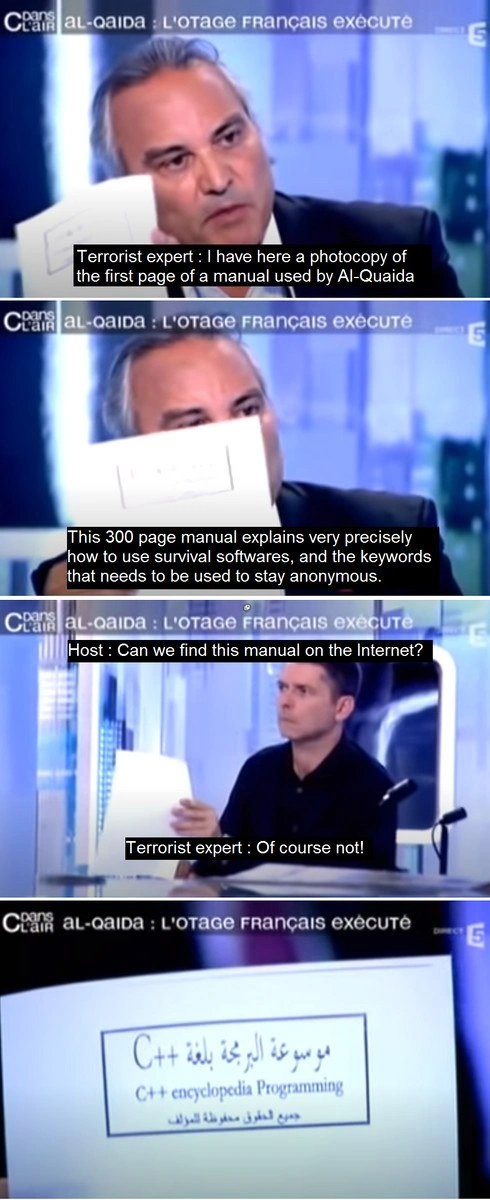
The image shows a TV discussion where a document is described as a serious manual connected to anonymity and software. The final close-up shows text that looks like C++ encyclopedia Programming, with Arabic text around it. That mismatch is why developers laugh: the dramatic setup makes the document sound mysterious, but the visible English title looks like normal programming education material.

Technical documentation can look strange or intimidating to outsiders. A page full of syntax, operators, compiler flags, or memory diagrams may appear secretive if someone does not know the context. But documentation is usually the opposite of secret: it exists to teach people how a tool works.

The meme fits security humor because media coverage sometimes treats ordinary technical artifacts as suspicious. Developers are used to seeing terminals, code, or manuals portrayed as inherently dangerous. The reality is more boring and more precise: technology can be used well or badly, but a programming book is not automatically evidence of anything beyond someone trying to learn programming, which is punishment enough if the chapter is about templates.

Level 3: Undefined Behavior Theater

The four-panel TV screenshot builds suspense around a supposedly secret manual. The subtitles say a Terrorist expert has a photocopy of a manual, that it explains survival softwares, and that it cannot be found on the Internet. Then the final panel reveals a document cover reading:

C++ encyclopedia Programming

That reveal is the whole joke. The show frames the paper as forbidden operational knowledge, but the visible artifact looks like an awkwardly translated C++ programming book. For developers, that is funny because C++ documentation is already intimidating enough without a television panel treating it like contraband.

The deeper satire is technology misunderstanding in public discourse. Nontechnical media segments often turn ordinary computing terms into ominous props: "keywords," "software," "anonymity," "manual," "Internet." Those words can be meaningful in a real security context, but when presented without technical grounding they become fog machines. The audience is invited to feel that something cyber and dangerous is happening, while the camera appears to be showing a programming-language reference.

C++ is a perfect accidental punchline because it has a reputation for complexity. It is powerful, old, performance-oriented, and full of sharp edges: manual memory management, undefined behavior, template metaprogramming, pointer arithmetic, object lifetimes, build systems, ABI concerns, and compiler-specific behavior. A 300-page C++ manual is not a surprising artifact of clandestine tradecraft; it is what happens when someone tries to explain the language politely and runs out of mercy.

The meme also needles security theater. Real operational security involves threat models, endpoint compromise, metadata leakage, network behavior, identity separation, and disciplined procedures. The screenshot's translated subtitles reduce that to "survival software" and "keywords" to stay anonymous. That sounds like someone heard three terms from a briefing and stored them in the same mental drawer as movie hacking.

The final panel's plain programming-book energy punctures the seriousness. It suggests the expert may be brandishing educational material as if the existence of C++ itself proves some elaborate plot. Developers have seen this kind of category error before: a shell script becomes "malware," a terminal becomes "hacking," a config file becomes "the dark web," and a compiler manual becomes international intrigue. Somewhere, a build warning is asking for asylum.

Description

A four-panel French television screenshot from "C dans l'air" shows a segment header reading "al-qaida : L'OTAGE FRANCAIS execute" with a France 5 logo. English subtitles say, "Terrorist expert : I have here a photocopy of the first page of a manual used by Al-Quaida," then "This 300 page manual explains very precisely how to use survival softwares, and the keywords that needs to be used to stay anonymous," followed by the host asking, "Can we find this manual on the Internet?" and the expert answering, "Of course not!" The final panel zooms in on a document cover whose visible title reads like "C++ encyclopedia Programming" with Arabic text above and below, making the supposed secret manual look like an ordinary or awkwardly translated C++ programming book. The technical humor comes from the mismatch between sensational security commentary and a programming-language manual that many developers would already consider intimidating enough.

Comments

1
Anonymous ★ Top Pick To be fair, a 300-page C++ manual can radicalize anyone against undefined behavior.
  1. Anonymous ★ Top Pick

    To be fair, a 300-page C++ manual can radicalize anyone against undefined behavior.

Use J and K for navigation