Expectations vs. Reality of the Command Line
Why is this CLI meme funny?
Level 1: Just a Toy Train
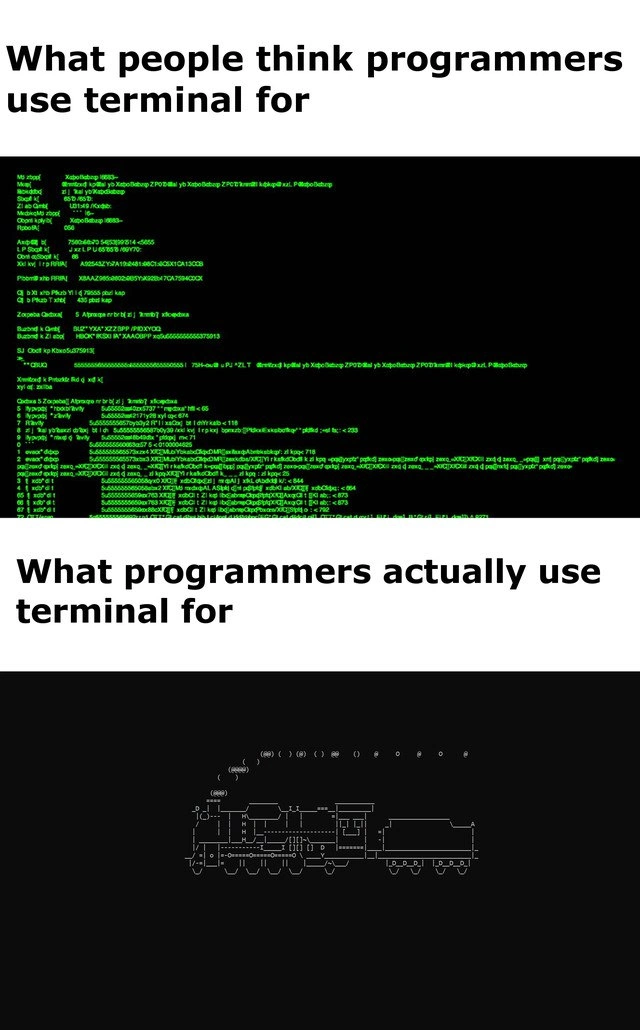
People often imagine that programmers are doing something mysterious and magical whenever they see a black computer screen with lots of green text. It’s like thinking a chef is always flambéing fancy dishes with big flames. But in reality, programmers aren’t casting spells or hacking into secret vaults all day – sometimes they’re just having a bit of fun. This meme shows that instead of doing “super serious hacking” on that scary-looking screen, the programmer was actually just making a little toy train go across the computer screen for laughs. Imagine expecting a wizard to summon a dragon, but he just pulls out a cute little choo-choo train trick. It’s funny because it reminds us that behind the high-tech appearance, programmers like to play and joke around, too.
Level 2: ls vs sl
Let’s break down what’s happening in this meme for those newer to the command line. A terminal (or CLI, Command Line Interface) is that black window where programmers type text commands to control the computer. It’s a bit like chatting with your computer by writing instructions instead of clicking buttons. In the first panel of the meme, the screen is filled with bright green text on black. This style comes from older computers and terminals (historically, many monitors only displayed green or amber text). It’s often used in movies to show “hacking” because it looks complex and geeky. In reality, a lot of that matrix_green_text you see in films is nonsense or just the output of some commands scrolling by. Actual programmers do use green text sometimes (you can customize your terminal colors), but the terminal_hack_screen stereotype is mostly for show. In day-to-day work, the terminal is used for many normal tasks: listing files, running programs, checking logs, etc. There’s nothing magical about the green text – it’s just a color choice! You could have yellow, white, or any color text in your terminal. The key point: outsiders see a screen like that and think “Wow, that person must be hacking the Pentagon,” but often it’s something mundane or even playful.
Now, the second panel reveals what’s actually going on: the programmer is running the sl command to display a steam_locomotive in ASCII art. Here’s the inside joke: on most Unix/Linux systems, ls is one of the most common commands – it simply lists the files and folders in the current directory (it stands for “list”). It’s probably the first command you learn in the CLI. But if you accidentally swap the letters and type sl instead, normally you’d just get an error (“command not found”). Some mischievous soul created the sl program as a good-natured prank. Instead of an error, if you have sl installed, typing sl will launch an animation of a steam train made out of text characters. Yes, an ASCII art locomotive chugging across your terminal! ASCII art means pictures drawn with the standard text characters (letters, numbers, symbols) arranged on the screen – kind of like pixel art, but using text. For example, the wheels might be made of O letters, the chimney of a Y, and so on. It’s all displayed in a monospaced font (where each character is the same width) so that the text aligns neatly to form an image. The result is a charming little train that “choo-choos” from left to right in your terminal window, with steam puffs shown as ((( o ))) or oOoOo floating above the engine. It doesn’t do anything useful for your work – it’s purely for amusement.
So the meme’s bottom caption, “What programmers actually use terminal for,” jokingly suggests that after all the serious coding tasks, programmers use their terminal for silly fun like this. It’s highlighting a piece of TerminalLife and culture: developers often indulge in small CLITools Easter eggs to lighten the mood. The top caption, “What people think programmers use terminal for,” refers to the common assumption that a terminal’s purpose is super-secret coding or hacking. The bottom shows that sometimes the purpose is just entertainment. This resonates with many in the community because it’s a form of DeveloperHumor – mixing technical know-how with playful surprises. If you’re a new developer, encountering these Easter eggs is actually a delightful part of learning the ropes. It teaches you that technology isn’t all serious; there’s a lot of room for creativity and jokes. In fact, discovering sl or similar commands (like cowsay, which makes an ASCII cow say things, or the classic fortune for random quotes) is often how beginners learn about the rich, fun-loving hacker culture. The expectation_vs_reality format here drives home that the Developer Experience isn’t always as intense as it appears from the outside – sometimes we’re just typing funny commands to see a train go by, especially when we need a break. It’s a wholesome reminder that programmers are human and like to play occasional pranks on themselves (or colleagues). So, in summary: ls (list files) is a serious, everyday command, while sl (steam locomotive) is a cheeky little trick that turns a typo into a moment of joy on the terminal.
# Example to illustrate the joke:
$ ls
Desktop Documents Downloads Music Pictures Videos
$ sl
# Oops, typed 'sl' instead of 'ls'... 🚂 puff puff!
# (Your terminal screen is now delightfully occupied by a steaming ASCII train)
Level 3: Hacking vs Hijinks
The meme brilliantly contrasts the mythical aura of the CLI with the mundane reality of developer life. In the top panel, we see a wall of glowing matrix-green text on a black screen – the classic Hollywood "hacker screen." This plays into the popular image that programmers live in a terminal running elite cryptic commands to infiltrate mainframes. Outsiders often equate any black terminal with high-stakes hacking, imagining developers furiously typing gibberish and code at breakneck speed (think The Matrix or Mr. Robot vibes). But the bottom panel hilariously subverts this expectation. Instead of some serious exploit or sudo rm -rf carnage, the terminal is running the whimsical sl command, which makes an ASCII art steam locomotive chug across the screen. This stark expectation_vs_reality setup is developer humor gold: it highlights how much of a programmer’s Command Line Interface (CLI) usage is everyday and sometimes downright silly, rather than cinematic hacking.
For seasoned developers, this joke hits home because it’s a shared experience and a bit of an inside joke. We’ve all had non-technical friends or family walk by, see a terminal full of scrolling text, and assume we’re performing some dark wizardry. In reality, we might just be tailing log files or running a build script – or, as this meme jokes, goofing off with an Easter egg program. The terminal_hack_screen trope (green text and rapid output) is a kind of tech folklore perpetuated by movies. Real-world programmers do use terminal consoles constantly – for building code, managing servers, using git, running tests – but it’s usually not as dramatic as neon green hex dumps flying by. In fact, developer culture often mocks that Hollywood portrayal by embracing playful command-line tools and pranks. The sl command shown here is a perfect example of TerminalHumor: it’s a joke program that displays a steam locomotive, included on many Unix-like systems purely to amuse. Many developers intentionally install sl not for productivity, but for a laugh when someone mistypes ls (the command to list directory contents). It’s a lighthearted nod to the fact that working in a terminal all day doesn’t have to be all serious – we sprinkle in fun to keep our sanity.
This meme also reflects the reality of DeveloperExperience (DX): the command line is powerful, but developers love to personalize it with quirky tools that make the grind more enjoyable. There’s an entire subculture of CLI toys and Easter eggs (cowsay, anyone? or running fortune for a random joke) that turn the plain text interface into a canvas for creativity and humor. Senior engineers chuckle at this because they remember the first time they discovered these little gems or pranked a teammate by setting up sl on their machine. It’s a rite of passage in tech culture – realizing that behind the intimidating black screen, there’s room for whimsy. Expectation vs reality memes like this thrive in tech circles because they ring so true: yes, we could be using the terminal to tweak kernel parameters or SSH into a server farm, but sometimes we’re just letting an ASCII train choo-choo across our monitor while we wait for our code to compile. In short, the meme humorously demystifies the CommandLineInterface: rather than being a constant hacker battlefield, the terminal is often just a normal workplace – one where developers seek out a bit of fun between serious tasks. It’s a gentle reminder that even the most expert-looking console can hide a bored programmer and a beloved ASCII art joke.
Description
A two-panel meme contrasting perceptions of programmer terminal usage. The top panel, captioned 'What people think programmers use terminal for', displays a terminal with glowing green, indecipherable text on a black background, mimicking a dramatic Hollywood hacking scene. The bottom panel, captioned 'What programmers actually use terminal for', shows a simple black terminal window displaying a large ASCII art steam locomotive. The humor lies in the subversion of expectations. While the terminal is a powerful tool, the meme points to a classic inside joke among developers: the 'sl' (steam locomotive) command, which is often accidentally run when one mistypes the common 'ls' command to list files. This meme resonates with developers who understand the mundane reality of their daily toolset, which also includes playful easter eggs and moments of levity
Comments
7Comment deleted
The fastest way to tell a junior from a senior is to see who's surprised by the train. The junior thinks they broke something; the senior just sighs and waits for their `ls` output
True CLI ritual: run `sl`; if the train reaches the buffer edge before the monolith finishes compiling, congratulations - you’ve just identified the next microservice candidate
The 'sl' command has better uptime than our production Kubernetes cluster, and unlike our microservices, it actually arrives at its destination
The 'sl' command: proof that Unix developers in the 1990s understood that the best way to teach proper typing habits wasn't through error messages, but through the shame of watching an unstoppable ASCII locomotive chug across your terminal while your entire team watches you wait for it to finish. It's the original 'you had one job' moment, now immortalized in package managers worldwide - because nothing says 'production-ready tooling' like deliberately installing a command that mocks your typos with a 30-second animation you can't Ctrl+C out of
People imagine terminals are for hacking; we mostly argue with kubectl and YAML, then fat‑finger ls and launch sl - the only train that’s reliably on time during an incident
Matrix agents chase bullets; we chase buffer overflows in perfectly kerned ASCII locomotives during on-call lulls
Stakeholders picture me crafting shellcode; in reality my ~/.zshrc aliases run git, kubectl, and sl to keep morale up during 30-minute CI waits