Skip to content
DevMeme
1236 of 7435
The Fountain of Youth is Compiling Your Last Build
MentalHealth Post #1380, on Apr 24, 2020 in TG

The Fountain of Youth is Compiling Your Last Build

Why is this MentalHealth meme funny?

Level 1: Too Much Homework

Imagine you have a big, really hard homework assignment that keeps you up all night. You’re hunched over your desk solving problems for hours and hours. By the time you finish, you feel super tired. You might have baggy eyes, messy hair, and look like you haven’t slept – basically, you look older and worn out, kind of like an old person who’s very tired. Now imagine after that, you stop doing hard homework for a while. You get to play outside, sleep well every night, and just relax. After a week of this easy life, you look in the mirror and you look bright, happy, and full of energy – almost like you became younger again because you’re not tired anymore!

This meme is making a joke just like that. In the first picture, the man (Elon) was doing something super hard and stressful (writing computer programs nonstop, which is like really tough homework or puzzles). It made him look kind of old and exhausted even though he was young. In the second picture, years later, he isn’t doing that hard programming work every day anymore – and he looks fresher and younger. The funny idea is: when you stop doing the super hard, stressful stuff, you look and feel better. It’s a silly way to say that working too hard can make you look tired and older, and taking a break or having a less stressful job can help you look healthier. We find it funny because we know in real life stress can make people look tired, so the joke pretends it can even mess with your age. It’s like saying, “See what happens if you do too much work? You turn into an old person!” – and when you quit, “Poof! You’re young again!”

Level 2: Bugs, Burnout & Hair Loss

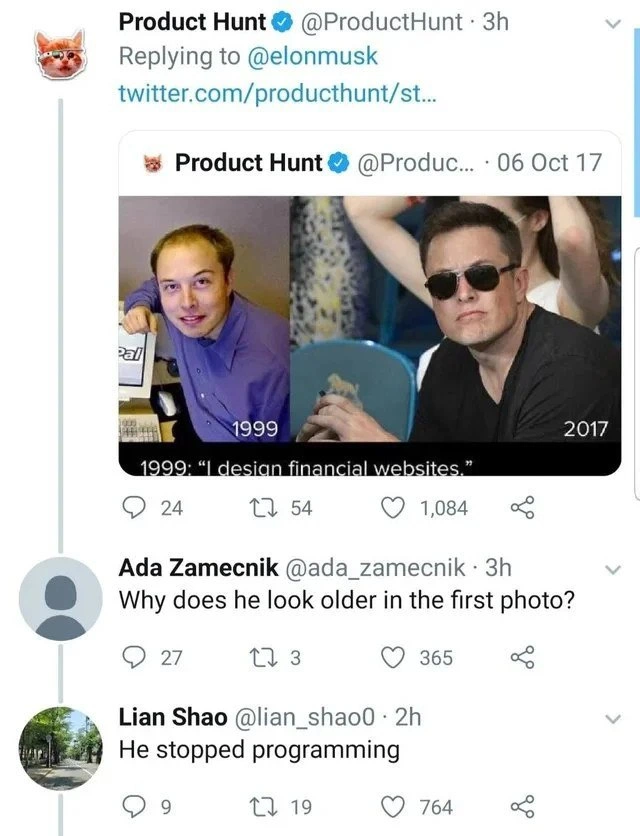
This meme jokes that programming can make you look older – literally aged by code – and that quitting programming might make you look younger. It shows two photos of Elon Musk side by side: one from 1999 and one from 2017. In 1999, he says, “I design financial websites,” which is basically a way of saying he was a programmer (Elon was building what became PayPal back then). In that old photo he looks a bit worn out: he had thinning hair, a tired smile, and the kind of pale complexion you get from coding indoors 24/7. In the 2017 photo, Elon is much older in real age, but he actually looks healthier and younger – he’s got a full head of hair, he’s wearing cool sunglasses, and he looks more relaxed.

On Twitter, someone innocently asked, “Why does he look older in the first photo?” Another person quipped in reply: “He stopped programming.” This witty answer implies programming aged him, and once he stopped programming, he somehow got his youth back. It’s an exaggeration for comedic effect, playing on the stereotype that coding is a super stressful job that can age a person prematurely. The humor hits home for developers because it feels relatable: many of us have had days (or entire projects) that left us feeling decades older.

Let’s break down some terms and ideas:

  • Burnout: Burnout is a state of extreme mental, emotional, and physical exhaustion caused by prolonged stress. In the tech world, DeveloperBurnout is unfortunately common. It happens when programmers work too long or too hard without enough rest – for example, pulling all-nighters to meet a deadline, or constantly being on-call for emergencies. A burned-out developer feels drained, loses motivation, and often looks tired or unhealthy. In the meme, the 1999 photo of Elon Musk represents someone who might be on the edge of burnout: imagine him coding day and night at his startup, living on caffeine and fast food. He looks older than his actual age because of that stress. This is a nod to MentalHealthInTech issues – the industry is becoming more aware that overworking developers can lead to anxiety, depression, or burnout. The meme makes light of it by joking about appearance, but the underlying idea is real: too much stress isn’t good for you.

  • Developer Lifestyle & Frustration: The lifestyle of a hardcore programmer (especially during a product launch or crunch time) isn’t exactly healthy. Picture long hours sitting at a desk, eyes glued to the screen, often late into the night. You might survive on coffee or energy drinks, skip exercise, and rarely see sunlight. This kind of lifestyle can cause developer frustration – when every day feels like fighting fires (bugs in code, crashes in production) and never getting enough sleep. Over time, that frustration and lack of self-care can show up physically: maybe you get dark circles under your eyes, or your skin breaks out, or you just look exhausted. In Elon’s 1999 case, he even had noticeable hair loss as a young man – a lot of people joke that programming (and the stress of running a startup) cost him his hair. By contrast, in 2017 he’s not writing code every day; he’s the CEO of SpaceX and Tesla. As a CEO, he has different responsibilities – lots of meetings, strategy, public speaking – stressful, yes, but not the repetitive grind of coding for 12 hours straight. And funnily enough, by 2017 he had gotten hair restoration (so he literally has more hair, making him look younger). The meme doesn’t mention the hair transplant; it keeps it simple: he quit coding, poof, youth restored!

  • “Programming ages you” Joke: There’s a common joke among developers that each tough project or every gnarly bug adds a year to your life (in appearance if not in reality). If you’ve ever seen a before-and-after comparison of a U.S. President at the start and end of their term, you notice they age faster – many people attribute this to stress. The same idea is applied humorously to programmers. Big project with tight deadlines? You might come out the other side with a few extra gray hairs. It’s not scientifically exact, but it’s a relatable exaggeration. We often share these jokes as a lighthearted way to cope with the stress. This meme is a perfect example of TechHumor: it takes a relatable situation (feeling and looking beat after coding marathons) and exaggerates it (quitting coding turns back time) to make us laugh. It also touches on the concept of DeveloperExperience (DX) in an indirect way – a good DX at a company might mean better tools, reasonable hours, and a focus on work-life balance so that developers don’t burn out and feel awful. Unfortunately, not every workplace has great DX, especially in high-pressure environments, so the joke lands because many have lived the bad side of it.

  • Career Path – Quitting Programming: The meme also hints at something in tech careers: as some developers advance in their careers, they move away from day-to-day coding. They might become team leads, engineering managers, or even executives like CTOs or CEOs. Part of the reason can be personal preference or ambition, but sometimes it’s also about escaping the grind of constant coding. By joking “he stopped programming,” the meme plays on the idea that once you escape the code, life might get easier on you (and on your face!). In real life, management has its own stresses (arguably Elon Musk as a CEO has massive stress, possibly more than coding ever gave him). But it’s a different kind of stress, and you’re not typically pulling overnight debugger sessions as a CEO. Many developers can relate to at least daydreaming, “Maybe if I switch to a less intense role, I won’t feel so tired all the time.” The Career_HR aspect here is that tech companies are recognizing burnout as a problem – good managers will try to rotate on-call duties, enforce vacation time, or provide mental health resources because losing a burnt-out developer helps no one.

In summary, this meme takes a fun snapshot of developer life reality and turns it into a quick joke: coding can be so taxing that it seemingly made Elon Musk look older in his 20s, and quitting coding was like a youth serum. It’s funny because it’s an exaggeration of the truth. Developers see Elon’s transformation and laugh, thinking, “Ha, maybe I’d look and feel that much better if I wasn’t neck-deep in code all day.” It’s a humorous reminder of the importance of work-life balance and taking care of your health, told in true developer meme fashion.

Level 3: Years in the Code Mines

At first glance, this meme is a tongue-in-cheek nod to the aging effects of programming. It features a side-by-side of Elon Musk in 1999 versus 2017, with a witty Twitter exchange beneath:

Ada Zamecnik: Why does he look older in the first photo?
Lian Shao: He stopped programming.

For seasoned developers, the humor lands close to home. The implication is that programming ages you prematurely – a wry exaggeration many veteran coders relate to. In the left photo (1999), a young Elon is pale, balding, and sporting the weary smile of someone who’s been wrestling with production code and late-'90s web tech. The right photo (2017) shows him years later, yet looking healthier and oddly more youthful (with a full head of hair and cool sunglasses). The punchline? By 2017 he wasn’t coding anymore. He’d gone from writing financial website code in a CRT-lit cubicle to leading companies from the boardroom. The meme suggests that stepping away from hands-on development was his secret to a youthful glow-up. 😏

Experienced devs chuckle because the struggle is real: marathon coding sessions, on-call pager duty at 3 AM, endless debugging – they all leave their mark. After enough years in the code mines, you collect trophies wrinkles and gray hairs as fast as Git commits. It’s practically an industry in-joke that developer burnout and stress can make a 25-year-old look 35. Every all-nighter chasing a heisenbug (a bug that vanishes when you try to debug it) feels like it subtracts a year from your lifespan. We laugh, but only to keep from crying – it’s RelatableDeveloperExperience at its finest. This meme taps into that collective memory of pounding caffeine during a deadline crunch and later noticing the mirror betraying an older face. The MentalHealthInTech message under the humor is that coding under constant pressure can exact a real toll on well-being.

From an insider’s perspective, there’s nuance here about career trajectory and the DeveloperLifestyle. In 1999, Elon Musk was knee-deep in start-up coding culture (back then he was building X.com, which became PayPal). That meant long hours in front of a beige CRT monitor (which itself could double as a stress-inducing space heater). The 90s dot-com era glorified pushing yourself to the limit – 14-hour days, seven days a week. Work-life balance was practically nonexistent; the DeveloperExperience was all about shipping features before the bubble burst. It’s no wonder the young Elon in that photo has a receding hairline and a fatigued look. Fast-forward to 2017: Elon’s not pair-programming or fighting CSS bugs anymore. Instead, he’s allocating tasks to engineering teams and focusing on big-picture ideas (rockets and electric cars). Sure, being a CEO is its own brand of stress, but it’s a different kind of stress. He’s not staring down a segmentation fault at 4 AM or dealing with npm install breaking his build. His daily grind no longer involves the frustration of finicky code, and the meme jokingly credits that change for his apparent age reversal.

Let’s talk burnout_and_appearance in tech. We’ve all seen a colleague emerge from a death-march project looking like they aged a decade in a month. Chronic stress can manifest physically: dark circles under eyes, sallow skin, hair loss – the whole package. It’s an exaggeration that quitting programming is a fountain of youth, but the core joke rings true because intensive coding often goes hand-in-hand with unhealthy habits. Late-night coding binges fueled by pizza and energy drinks aren’t exactly spa treatments for your body. Staring at code for hours with shoulders hunched and eyes strained is the opposite of self-care. The cumulative effect of tight deadlines, endless debugging cycles, and the mental load of constantly learning new frameworks can make even a young developer feel ancient. Each critical production bug feels like it might be shaving off a few more hairs or adding a new wrinkle. In pseudo-code, it might look something like:

# Each critical bug that keeps you up at night adds to your apparent age
for bug in critical_bugs:
    developer.hair_count -= 1     # a hair falls out for each emergency
    developer.wrinkles += 1       # a new stress wrinkle appears

This snippet (half-joke, half-nightmare) captures the meme’s sentiment: every critical bug or 3 AM emergency has a cost. Seasoned devs often joke that after a gnarly on-call rotation, they’ve “earned a few gray hairs.” The DeveloperHumor in Lian’s reply (“He stopped programming”) is self-deprecating acknowledgment of this lifestyle – as if the simple act of not coding anymore will reverse years of DeveloperFrustration. We know it’s not that simple in reality (executives have stress too, just ask Elon’s 2017 self about launching rockets or meeting Tesla production targets), but it’s funny to imagine that trading VS Code for PowerPoint might come with the perk of de-aging.

On a more systemic level, this joke touches on real Career_HR conversations in tech. Many developers eventually face a crossroads: continue coding and risk eventual burnout, or move into less code-intensive roles (management, consulting, product) seeking saner hours and maybe sanity. The meme uses Elon as an extreme example of the “quit programming = regain life” narrative. In truth, the industry has started paying attention to things like MentalHealth and burnout prevention. Progressive teams promote sane hours, remote work flexibility, and mental health days to avoid grinding their developers to dust. But the RelatableDeveloperExperience behind the meme is that historically, and even today, plenty of companies still run on heroic programming sprints that leave people drained. The joke wouldn’t be funny if it didn’t have a kernel of truth. Seasoned coders smirk because they remember those 1999-style crunches (and maybe have the hairline to prove it), and they know a few ex-developers who look a lot happier (and healthier) since they left the code behind. Ultimately, this meme pokes fun at our industry’s work-hard, age-hard culture. It’s a reminder (in the guise of humor) that maybe we should all take a breather and not commit our health to the repo. After all, as any battle-scarred veteran will tell you: no feature is worth your sanity or your hair.

Description

A screenshot of a Twitter thread discussing Elon Musk's appearance. The initial tweet from Product Hunt shows a two-panel image comparing Elon Musk in 1999, balding and with the caption 'I design financial websites,' to a more suave-looking Musk with a full head of hair in 2017. A user named Ada Zamecnik replies, 'Why does he look older in the first photo?'. The punchline is delivered by user Lian Shao, who replies, 'He stopped programming.' The meme's humor is rooted in the widely shared experience of developer burnout and the intense stress associated with hands-on coding. It suggests that the pressures of programming can physically age a person, and that escaping the daily grind for a more managerial or executive role is the equivalent of a rejuvenation treatment. This is a cynical but relatable joke for senior engineers who have witnessed or experienced the toll of the profession


Comments

7
Anonymous ★ Top Pick The transition from engineer to manager is just a very slow, multi-year PR where you merge 'sanity' and 'free time' back into the main branch of your life
  1. Anonymous ★ Top Pick

    The transition from engineer to manager is just a very slow, multi-year PR where you merge 'sanity' and 'free time' back into the main branch of your life

  2. Anonymous

    Apparently the real anti-aging serum is `git commit -m "delegated to platform team"` - once your name falls off the blame history, the wrinkles get garbage-collected

  3. Anonymous

    The real reason Musk looks younger after 18 years? He finally migrated from debugging PayPal's legacy Perl codebase to just tweeting about Dogecoin - turns out shareholder meetings age you less than hunting down race conditions in payment processing systems

  4. Anonymous

    The progression from 'I design financial websites' to tech mogul perfectly captures the developer's dilemma: you either die coding, or live long enough to see yourself become a manager. The real joke here is that stopping programming apparently has anti-aging properties - perhaps we should add 'reduced exposure to merge conflicts' to the list of longevity factors alongside diet and exercise

  5. Anonymous

    Elon's ultimate refactor: swap keyboard for boardroom - hairline preserved, no more 3AM deploys

  6. Anonymous

    The real anti‑aging treatment is leaving the 3 a.m. pager rotation - stop SSHing into prod to resuscitate a Perl/Oracle monolith and your SLA with entropy improves

  7. Anonymous

    Stop programming and the GC finally collects your 3am allocations - instant anti-aging

Use J and K for navigation