Tiny library version difference steals four hours of build debugging
Why is this Dependencies meme funny?
Level 1: Tiny Difference, Big Problem
Imagine you and your friend each have a nearly identical coloring book picture to finish. Both of you use the same set of crayons and follow the same steps. In the end, the pictures are supposed to look exactly the same, but somehow they don’t – something is off in one of them. You spend hours together trying to figure out why the two pictures aren’t matching. Finally, you discover the reason: one tiny crayon mark or a single detail was different – maybe an extra stripe on a shirt that one of you colored without noticing. It was so small that your eyes skipped over it, but that little difference made the whole picture come out differently. You both feel frustrated because it took so long to find such a minor mistake. In the end, it’s a bit funny (in a silly way) that such a tiny difference caused such a big problem. That’s exactly what happened to the developers in the meme: one small detail (a teeny version number change) was different between them, and it messed up their results until they finally spotted it. The humor comes from the surprise that something so seemingly insignificant could hide in plain sight and cause a lot of trouble – it’s like losing a bunch of time looking for a needle that was right there in front of you the whole time!
Level 2: Spot the Difference
For a newer developer, let’s break down what happened here. Two engineers were trying to figure out why their code builds weren’t giving the same results. They eventually discovered the root cause was a version mismatch in a dependency called html5lib. A dependency is just an outside library or package that your project uses (in this case, html5lib is a Python library for parsing HTML). They both had html5lib installed, but one had a slightly different version than the other. How different? The version numbers were 0.9999999 vs 0.999999999. At first glance those look almost identical – just a long string of 9’s. Not exactly semantic versioning as we know it! Semantic versioning (often abbreviated SemVer) is the standard way of giving versions to software: you use three numbers separated by dots, like 1.2.3, where each part (Major.Minor.Patch) signifies how big the changes were. In SemVer, a difference in version is usually easy to spot, e.g. 1.2.3 vs 1.3.0 or even 0.9.0 vs 0.10.0. But here, html5lib’s version wasn’t in three parts – it was one long decimal-ish number that just got an extra 9 tacked on for a new release. That’s highly unusual and not very user-friendly.
Now, these developers found it “nearly impossible to spot” the difference on a pip list readout. pip is the package manager for Python. When you run pip list or pip freeze, it shows you all installed packages and their versions. If both of them listed their packages, the lines for html5lib would have looked almost the same. Imagine scanning through dozens of packages, and the only difference is:
# Developer A's pip freeze output
html5lib==0.9999999
# Developer B's pip freeze output
html5lib==0.999999999
See how easy it is to miss the extra 99 in the second line? It’s like those “spot the difference” puzzles – not obvious until you look very carefully. Because of this subtle difference, Developer B’s html5lib was a newer release than Developer A’s. Different library versions can lead to different behavior or output, even if your own code hasn’t changed. That’s exactly what happened: each build pulled in a slightly different html5lib, and that caused the outputs to diverge. This kind of issue is part of what developers jokingly call “dependency hell” – when managing library dependencies becomes a nightmare of conflicts or mysteries. It’s also related to the classic “works on my machine” problem, where code runs in one environment but breaks in another due to environmental differences like library versions. In this case it almost worked on both machines, but the results weren’t identical, which is even sneakier.
So why all the fuss about version numbers? Because clear versioning (and matching versions) is crucial for build reproducibility. We want our software builds to be deterministic – given the same code and same dependency versions, you should get the same result every time, whether on your laptop or on a CI server. If one person has html5lib 0.9999999 and another has 0.999999999, they effectively aren’t building the same project, even though it seemed so at first. The link the developer shared (semver.org) goes to the Semantic Versioning guidelines which encourage using version numbers like Major.Minor.Patch that increment in logical, easy-to-see ways. html5lib’s maintainers apparently weren’t using SemVer properly. They were still on a 0.x version (meaning the library wasn’t considered “1.0” stable yet), and instead of incrementing a normal minor or patch number, they just extended the decimal figure. Maybe they did that to indicate “we’re almost at 1.0, but not quite,” but it ended up being confusing for users.
For a junior dev, the lessons here are: always ensure your team is using the same dependency versions and prefer libraries that follow sane versioning practices. If you ever encounter a weird version like 0.999999999, your antennae should go up! Typically, teams solve this by pinning exact versions in a requirements.txt file or using a lockfile. For example, they might specify html5lib==0.9999999 in the requirements file. That way, everyone and every environment uses that exact version unless deliberately updated. If a new version comes out, you update the requirement explicitly rather than accidentally. In modern DevOps and CI/CD build systems, pipelines often do a fresh install of dependencies from such a lockfile to avoid “It works on my machine” discrepancies. In short, consistent environments = fewer headaches.
Finally, why is this meme funny (especially to developers)? Because we’ve all been in this exact situation, tearing our hair out over something that turned out to be almost invisible. There’s a certain relatable pain in spending hours debugging and then finding out it wasn’t a complex bug in your code at all – it was something silly like a one-digit version difference. It’s a mix of relief and annoyance: relief that you found it, annoyance that it was that all along. The developer who wrote the comment was clearly frustrated (“steamed” as he said) and even pre-emptively guessed the maintainers’ response (“html5lib isn’t ready for production so this versioning is appropriate”). That hint of sarcasm and the link to the SemVer spec got a lot of 👍 and 😂 reactions from other programmers, basically saying “We feel your pain.” For a newcomer, it’s a peek into why package management and version control are taken so seriously: because a tiny oversight can waste a ton of time. And once you experience it, you’ll likely double-check versions first the next time something weird happens!
Level 3: The Nine that Broke the Build
At the senior engineer level, this meme hits like a war story from the dependency front lines. Two developers spent half a day chasing a phantom bug in their build process, only to discover the culprit was a microscopic difference in a library version. One machine had html5lib 0.9999999 installed, the other had html5lib 0.999999999. Yes, count those 9’s: one version has two extra nines at the tail. That one extra digit was enough to make their build outputs diverge. It's the kind of maddening, nearly invisible discrepancy that gives seasoned devs flashbacks of "works on my machine" incidents and dependency hell nightmares.
The humor here is darkly relatable: how absurd that a difference so small could steal four hours of debugging. It’s funny in that “I’m laughing because otherwise I’d cry” way. Every experienced dev has lost time to a silly environmental inconsistency or misbehaving package. In this case, the version numbers were almost indistinguishable at a glance – a perfect trap. The meme’s author describes it was “nearly impossible to spot on the pip list readout” >.< – which is the textual equivalent of a frustrated facepalm. Two extra nines buried in a long decimal version string can hide like a needle in a haystack, especially when you’re not expecting any difference. This is a classic build reproducibility issue: same code, different environments, inconsistent results. It’s a bane of continuous integration when one agent has a slightly newer dependency than another. Seasoned devs know that if two supposedly identical builds behave differently, some environment detail – often a dependency version – is the usual suspect.
This meme shines a light on the importance of Semantic Versioning (SemVer) and proper package management discipline. The commenter even cheekily dropped a link to the SemVer spec, essentially saying: “See? This is why we have versioning rules!”. In a semantically versioned world, releases have clear Major.Minor.Patch numbers (like 1.4.2 or 0.10.1), so differences stand out. But here we have a non-semantic versioning scheme – the library maintainers kept the version under 1.0.0 by incrementing an endless decimal: 0.9999999 → 0.999999999. Maybe they thought “hey, it’s not production-ready, let’s just add more 9s instead of bumping to 1.0.” From a veteran’s perspective, that’s almost comically cruel. It’s version numbering that borders on obfuscation. One more nine, one more nightmare. Why would anyone do that? Possibly to signal “99.99999% complete but not 1.0”, but in practice it just creates confusion. The SemVer spec explicitly exists to prevent this kind of pain — with properly incremented major/minor numbers, you’d immediately notice if one of you had 0.9.0 vs 0.10.0, for example. Here, by contrast, the difference was literally a couple of characters wide, visually easy to miss.
In real-world teams, we guard against this by pinning exact dependency versions and using lockfiles (like a requirements.txt or Pipenv/Poetry lock in Python). That way, everyone is supposed to run with the exact same library versions, eliminating the “but it works on my machine” discrepancy. If one dev had installed html5lib at a different time and got a slightly newer release, a properly configured build system or CI pipeline should catch that by rebuilding from a clean slate. But if versions aren’t locked down, subtle mismatches slip through. This is also a mini case study in why even pre-1.0 libraries should use sensible version numbering. Sure, SemVer says “0.x is for initial development and can break anytime,” but it doesn’t recommend turning the patch number into Pi with endless digits. 😅 The exasperation in the bug report (“I’m steamed about losing so much development time”) is something any senior dev understands deeply. It’s developer frustration at its finest: the anger of knowing a huge chunk of time was wasted by something so trivial and avoidable. And the reactions (208 👍, 85 😆, etc.) show the developer community’s mix of empathy and gallows humor – so many of us have been burned by a “tiny version difference” causing big problems. This meme cleverly encapsulates the shared pain of debugging a nearly invisible issue, and it sarcastically pokes maintainers to do better with versioning. The senior takeaway: always double-check those dependency versions – the devil is in the details (sometimes in the form of a couple extra 9’s).
Description
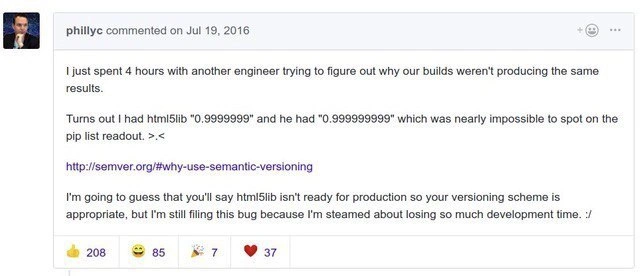
Screenshot of a GitHub-style comment box by user “phillyc” dated July 19 2016. The comment text reads: “I just spent 4 hours with another engineer trying to figure out why our builds weren’t producing the same results. Turns out I had html5lib ‘0.9999999’ and he had ‘0.999999999’ which was nearly impossible to spot on the pip list readout. >.< http://semver.org/#why-use-semantic-versioning I’m going to guess that you’ll say html5lib isn’t ready for production so your versioning scheme is appropriate, but I’m still filing this bug because I’m steamed about losing so much development time. ;/” Below the text are reaction icons with counts: thumbs-up 208, laugh 85, hooray 7, heart 37. Visually it’s a standard issue-tracker comment with the author avatar on the left and grey toolbar on top. Technically, the meme highlights how non-semantic version numbers like 0.9999999 vs 0.999999999 make dependency differences almost invisible, causing reproducibility bugs and wasted debugging hours, underscoring the importance of proper semantic versioning and package management discipline

Comments
11Comment deleted
The gap between 0.9999999 and 0.999999999 is exactly four senior-engineer hours - turns out SemVer isn’t optional, it’s a budgeting tool
After 20 years in tech, you learn that the hardest bugs to find are the ones where the difference between '0.9999999' and '0.99999999' determines whether your CI/CD pipeline thinks you're deploying a patch or accidentally rolling back to the stone age - and your monitoring dashboard uses a font where all nines look identical
Four hours debugging identical builds only to discover the difference between 0.9999999 and 0.99999999 - a perfect demonstration that in software engineering, the devil isn't just in the details, it's in the ninth decimal place. This is why senior engineers develop trust issues with floating-point version numbers and an unhealthy obsession with `pip freeze` output. The real tragedy? Explaining to your PM why you spent half a workday hunting a single digit that semver.org explicitly warned you about
If your dependency ships 0.999999999 as a version, you’re not tracking releases - you’re debugging floating point; pin hashes or accept nondeterministic builds as a feature
Semver: where one extra 9 turns reproducible builds into a 4-hour game of 'spot the integer impostor'
Our builds diverged because one box had html5lib 0.9999999 and the other 0.999999999 - turns out we’re doing versioning in IEEE 754 instead of SemVer, where rounding is a breaking change
Loooooooooool Comment deleted
So it's not even a joke Comment deleted
Damn…. Comment deleted
what the fuck Comment deleted
These kind of crappy version systems are so damn frustrating. Mildly funny, until you need to deal with them Comment deleted