Meme reminds us there’s still a server hiding in “serverless” marketing
Why is this Cloud meme funny?
Level 1: Hidden Helper
Imagine you go to a fancy new restaurant where there are no waiters in sight. You just tap your order on a screen, and after a bit, your food appears as if by magic. It feels like the restaurant has no servers (no waitstaff) at all. But in reality, back in the kitchen, a chef is working hard to cook your meal. The chef is the hidden helper making the magic happen. This meme is joking about something similar in the computer world. When people say a service is “serverless,” it sounds like there are no computers (servers) involved. But that’s as silly as thinking no one cooked your food! There is always a real computer somewhere doing the work, even if you don’t see it. In simple terms, the meme reminds us that even when they advertise a tech service as having no server for you to deal with, a server is still there behind the curtain – just like that hidden chef in the kitchen. It’s funny because it points out the hidden truth: no matter how “magical” something seems, there’s always someone or something real working in the background to make it happen.
Level 2: Servers in Disguise
Now let’s peel back the jargon for a junior dev or someone newer to the cloud. Serverless is a popular term in cloud computing (the world of running software on remote computers over the internet). “Serverless” doesn’t literally mean “no servers at all” – it means you don’t have to manage the server yourself. Instead, a cloud provider (like Amazon’s AWS, Microsoft’s Azure, or Google Cloud) runs your code on their servers for you. It’s like a pay-as-you-go arrangement: you write a small program or function, upload it, and the cloud service runs it whenever it’s needed, automatically scaling it and taking care of all the low-level stuff like provisioning machines, updating OS patches, etc. This is often called Functions as a Service (FaaS). A classic example is AWS Lambda. With AWS Lambda, if you write a function to handle, say, an image upload event, you don’t launch a server and set up a whole application – you just give that single function to AWS. When a new image arrives, AWS will invoke your function in a sandboxed environment on one of their machines. When the function isn’t running, you’re not charged and you don’t even know what machine it was on. Magic, right?
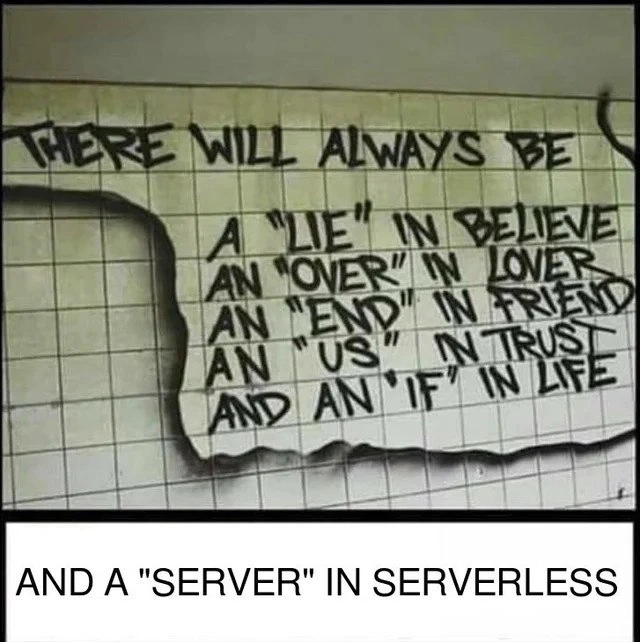
The meme jokes about the word itself: “serverless” still contains the word “server.” That’s a cheeky way to point out the hidden reality. In the image, the top section is stylized graffiti text listing hidden words inside bigger words, with a somewhat pessimistic tone (e.g., there’s “over” in lover, “end” in friend). It’s implying that even in positive terms, something less positive can hide. The meme maker added the bottom line “AND A ‘SERVER’ IN SERVERLESS” in clean bold text as the punchline. Visually, it’s a humorous contrast: the top looks like deep, brooding wall art, and the bottom looks like a straightforward caption revealing the tech joke. The idea is that cloud providers’ marketing sometimes makes it sound like servers have vanished (“No servers to worry about!”), but in truth, those servers are simply out of your sight – running behind the scenes in a data center.
For a junior backend developer, this is a lighthearted reminder: if you deploy your code using a serverless service, you won’t directly interact with any server – you won’t pick an operating system, open firewall ports, or ssh into a machine. That’s all handled by the cloud. However, your code still executes on a real machine – it’s just managed for you by AWS or whichever provider. So the humor here is a bit of a pun and a reality check: serverless = servers, but managed by somebody else. Think of it as “servers in disguise.” The server is hidden like a ninja, but it’s absolutely there, doing the work whenever your function gets triggered.
This resonates as CloudHumor and BackendHumor because newcomers might actually wonder, “How does my code run with no server?” The answer is it can’t – it’s just that the server is abstracted away (meaning you don’t deal with it directly). People in DevOps (development operations) or SRE roles, who traditionally set up and maintain servers, often joke about this. They say things like, “There’s no cloud, it’s just someone else’s computer,” meaning your tasks are running on computers owned by a cloud company. In other words, you moved the work to another machine you don’t own. The meme’s punchline “a ‘server’ in serverless” is basically a clever way of saying that. It’s pointing out the serverless_paradox: the term suggests no server, but actually includes a server (both as a word and in reality).
Let’s clarify some terms from the tags and context for completeness:
Serverless Architecture: A way to build applications where the developer mainly writes small pieces of code (functions) and uses managed services, instead of running whole servers. It can scale automatically and you pay only for the execution time you use. Example: using AWS Lambda and Amazon API Gateway to create a web API without managing any EC2 servers yourself.
DevOps/SRE: DevOps engineers and Site Reliability Engineers focus on infrastructure, deployment, and keeping services running smoothly. In a traditional setup, they’d configure servers, networks, monitoring, etc. In a serverless setup, they still do a lot (CI/CD pipelines, setting up cloud resources, monitoring performance), but they might not maintain the OS of a server. They find this meme funny because they deal with the real computers behind “serverless” services whenever things scale or go wrong.
CloudNative: This term refers to software designed to run in cloud environments, taking advantage of things like elasticity (scaling up/down), managed services, and automation. Serverless is considered cloud-native since it generally runs only on cloud platforms. By 2021, serverless had become a common part of cloud-native app design, but engineers had also accumulated a healthy skepticism for the buzzword.
AWS Lambda: A specific service by Amazon Web Services that lets you run code without provisioning servers. It’s an example often used when explaining serverless. If someone cracks a joke about “there’s a server in my AWS Lambda”, they’re pointing out that Lambda is running your function on an AWS-managed server instance (often in a container or microVM).
The meme’s comedic twist also relies on the words_inside_words gimmick. The top graffiti text is something you might have seen shared online: it shows hidden words like lie, end, us, which change the meaning of the larger words they’re in. It’s sort of saying “don’t be fooled by the bigger picture, there’s something smaller inside that might contradict it.” By appending “a ‘server’ in serverless,” the meme applies that exact pattern to tech jargon. It humorously warns: don’t be fooled by the term “serverless” – a server is still in there somewhere! This is a classic case of marketing_vs_reality in tech. Cloud providers market “serverless” as if infrastructure has vanished, but any experienced developer (even many new ones now) will tell you it just means the infrastructure is managed for you. So the meme is both a pun (with the word server literally inside the word serverless) and a gentle lesson. If you’re a junior developer chuckling at this, you’re essentially being welcomed into the insiders’ club of understanding that every high-level convenience in computing rests on layers of actual technology underneath. And knowing that, you’ll be better prepared to troubleshoot or design systems with the real world in mind. After all, even if you never touch a server in a serverless app, you might still need to consider things like function timeouts or memory usage – clues that the server is there, working behind the scenes and setting some ground rules.
Level 3: All Abstractions Leak
At the highest technical level, this meme exposes the ServerlessArchitecture marketing paradox. Seasoned cloud engineers grin (or groan) because they know “serverless” is just an abstraction – one that leaks reality at the edges. In practice, serverless means “I don’t run the server, my cloud vendor does” – but those servers are still very real, racked up in a data center, humming away. The top graffiti-style text listing hidden words (a "lie" in believe, an "us" in trust, etc.) sets a cynical tone: it’s highlighting hidden truths inside comforting words. The punchline “and a ‘server’ in serverless” lands like a bitter truth bomb for anyone who’s deployed code to the cloud. CloudNative architects and DevOps veterans see the humor: after all the hype, serverless computing hasn’t magically defied physics – there’s always a computer crunching numbers somewhere (usually in someone else’s rack).
This joke resonates especially with backend developers and SREs (Site Reliability Engineers) who have experienced the “serverless” sales pitch versus the operational reality. Sure, you can deploy a function on AWSLambda and forget about provisioning VMs or containers – until your function hits a cold start delay at 3 AM and reminds you there’s a container spinning up behind the curtain. Abstraction always leaks. You don’t manage the server, but you feel its presence in other ways: the dreaded cold start latency (when an idle function is invoked and underlying infrastructure has to wake up), or the 15-minute execution cap and memory limits that remind you a real OS and scheduler enforce boundaries. Those limits aren’t arbitrary – they exist because your code is running in a sandbox on a real server with finite resources. It’s like the cloud is saying, “I’ll handle the server, but you play by my rules.” The experienced engineers chuckle because they’ve been bitten by those hidden rules before.
Even the term “serverless” itself contains the word “server” – literally and figuratively. It’s a textbook example of cloud marketing_vs_reality. Providers pitch “No infrastructure to manage!”, but in reality the infrastructure is still there, just managed by someone else’s ops team. Veteran DevOps folks have a tongue-in-cheek mantra: “There is no cloud… it’s just someone else’s computer.” The meme’s caption “AND A ‘SERVER’ IN SERVERLESS” is basically that mantra rehashed as graffiti poetry. It’s CloudHumor with a dark twist, playing on the serverless_paradox: you’ve removed servers from your responsibilities, not from existence. The seasoned perspective acknowledges that DevOpsHumor often hides a real warning: if you completely believe the glossy promise (there’s a “lie” in believe, remember? 😏), you’ll be in for a surprise when an AWS region outage or a misconfigured function brings your app down. In other words, trust the cloud – but verify, and always have a backup plan.
To a senior engineer, the contrast between the gritty graffiti wall and the clean caption is more than stylistic – it represents the divide between hype and reality. The gritty top half lists harsh truths lurking inside positive words, much like an architect’s hard-learned lessons hiding inside cloud whitepapers. The clean bottom strip bluntly delivers the dev punchline: even in cutting-edge cloud tech, you can’t escape the fundamentals. This rings true in backend circles: whether you’re deploying on bare metal, VMs, Kubernetes, or Lambda, somebody is racking servers and configuring networks underneath. It might not be you, but it’s happening. The meme succinctly captures that collective industry wisdom with a dash of cynicism. We laugh, a bit ruefully, because we’ve all chased shiny new abstractions thinking we’re free of the past – only to find the old problems pop up in new forms.
In fact, many of us have seen this pattern before. Old-timers might compare modern serverless to the mainframe era’s time-sharing or to CGI scripts on early web servers – you submit code and an unseen server executes it for you. The technology has evolved (lightweight containers or micro-VMs fire up your function in milliseconds now), but the principle is the same. No matter how fancy the platform – be it AWS Lambda, Azure Functions, or Google Cloud Run – the code runs on actual hardware somewhere, and it can glitch, run out of memory, or hit I/O bottlenecks just like any server. The cloud provider’s automation can restart it or spin up more instances in a flash, which is awesome, but to a seasoned dev that just means a fleet of hidden servers is working overtime. We chuckle because the meme exposes this sleight of hand: serverless is essentially outsourcing the grunt work to a cloud vendor’s ops team and machinery.
Let’s break down the irony in a quick comparison:
| Buzzword | What it Suggests | The Reality |
|---|---|---|
| Serverless | “No servers to worry about” | Your code runs on hidden servers (you just don’t SSH into them) |
| Cloud | “It’s just out there, like magic” | Actually a bunch of data centers full of powered-on machines |
| NoOps | “No operations team needed” | Ops work is automated or handled by the vendor’s SREs (issues can still wake someone at 3 AM) |
| FaaS (Functions-as-a-Service) | “Just deploy code in functions” | The provider packages your code into containers/VMs that run on real CPUs and RAM underneath |
This table hits the crux of the joke: each lofty concept comes back down to earth. BackendHumor often pokes fun at this kind of thing – the gap between the dreamy promise and the gritty implementation details we eventually confront. The meme’s creator essentially slapped an IT truth onto a piece of poetic graffiti, implying “don’t be too romantic about these terms, they hide hard realities.” A senior developer reading “AND A ‘SERVER’ IN SERVERLESS” might smirk and think: Yep, been there, debugged that. We’ve witnessed supposedly hands-off systems fall over or hit limits because, surprise, they rely on actual hardware and code that can fail. In the end, the meme reminds us that in computing there’s no free lunch: you can move the servers out of sight, but you can’t make them vanish. Or more playfully – you can’t spell serverless without server.
Description
The image is divided into two stacked sections. The top section shows a jagged, torn-paper rectangle taped to a tiled wall, with black graffiti-style lettering that reads: “THERE WILL ALWAYS BE A "LIE" IN BELIEVE AN "OVER" IN LOVER AN "END" IN FRIEND AN "US" IN TRUST AND AN "IF" IN LIFE.” The lower section is a clean white strip containing bold text: “AND A "SERVER" IN SERVERLESS.” Visually, the contrast between grimy wall art and crisp caption reinforces the punch-line. Technically, the joke pokes fun at cloud vendors’ “serverless” branding by pointing out that compute nodes still exist - you just don’t manage them directly - echoing common backend, DevOps, and cloud-architecture cynicism
Comments
51Comment deleted
Serverless: because nothing says “modern architecture” like grepping CloudWatch logs at 3 a.m. for a container you don’t control on a server you’re still paying for
Just like how 'NoSQL' databases still use SQL, 'serverless' still has servers - they're just someone else's problem now, along with the cold start latency, vendor lock-in, and that one Lambda function from 2019 that's costing $3000/month because nobody remembers what it does but everyone's afraid to delete it
Serverless is like saying 'I don't have a car, I just use Uber' - technically true from your perspective, but someone's still maintaining a fleet of vehicles somewhere. The real joke is that we've gone from racking physical servers, to provisioning VMs, to orchestrating containers, to writing Lambda functions... and somehow convinced ourselves we've eliminated servers entirely. Meanwhile, AWS is building data centers the size of small cities to run your 128MB function that executes twice a day
Serverless: where the 'less' is marketing, and the 'server' is the fine print in your multi-region bill
Serverless means no servers you manage - until the VPC, three IAM roles, a NAT gateway bill larger than the app, and a 3am cold start remind you whose metal it really is
Serverless: the servers didn’t disappear - they rebranded as cold starts and now live in your p99 latency and the CFO’s FinOps dashboard
- laughter in slaughter - fun in funeral Comment deleted
😂 Comment deleted
And java in javascript Comment deleted
and C in C# Comment deleted
C in javascript also Comment deleted
implement minecraft in minecraft Comment deleted
there's a C in minecraft as well Comment deleted
C in C# Comment deleted
beat you to it Comment deleted
yep Comment deleted
What's in Linux? Comment deleted
UX Comment deleted
Linux Is Not UX Comment deleted
holy f*ck it deserves "always has been" template Comment deleted
That's what recursive acronym LINUX stands for: (L)inux (I)s (N)ot (U)ni(X) Comment deleted
S(he) be(lie)ve(d) Comment deleted
(W)ine (i)s a(n) (e)mulator btw Comment deleted
(d)olphin (o)mits (l)esser (p)atches, (h)indering (i)nner (n)uance Comment deleted
(O)SS (s)tays (s)ilent Comment deleted
then it's just Lin Comment deleted
asm in asmr Comment deleted
ass in assembler Comment deleted
ALSA in Balsam okay I'm getting lazy now lol Comment deleted
C is also acronym for (C) Comment deleted
Yea, and S in IoT means Secutiry Comment deleted
I think Secutiry is improtnat tho Comment deleted
Vendors of IoT devices don't Comment deleted
"win" in "windows" Comment deleted
in in windows Comment deleted
I remembered a joke from the mid-2000s: - What is 'Microsoft Works'? - An oxymoron! Comment deleted
And a meow in meowcat Comment deleted
I and me in anime Comment deleted
damn Comment deleted
mime in mimetype Comment deleted
Please not the mimes Comment deleted
"ea" in "aheago" Comment deleted
*ahegao https://en.wikipedia.org/wiki/Ahegao Comment deleted
bravo, you found my deliberate spelling mistake. Well, I wasn't sure how to spell it, but I wanted to make the joke work either way. Comment deleted
Don’t know why *us in the trust* is in the list. The others is kind of opposite to each other. Comment deleted
thats because it's not us but US Comment deleted
Thanks bro Comment deleted
Wire in wireless Comment deleted
C in CSS Comment deleted
ss in css Comment deleted
42 in 420 Comment deleted