xkcd Dependency, 2026 Edition: Nebraska Maintainer Goes GenAI
Why is this Dependencies meme funny?
Level 1: The Wobbly Tower
Imagine a gigantic tower of blocks where the whole thing — every app, every website, everything — balances on one tiny block near the bottom. For years, one quiet person carefully kept that little block from crumbling, for free, and nobody ever thanked them. Now a vending-machine company gave that person unlimited free snacks, and in exchange they've handed the job of holding up the tower to a robot that talks very confidently but doesn't actually understand blocks. Everyone living in the tower just keeps going about their day. The funny-scary part is that nothing has fallen over yet — and "yet" is doing all the work in that sentence.
Level 2: Why One Little Block Matters
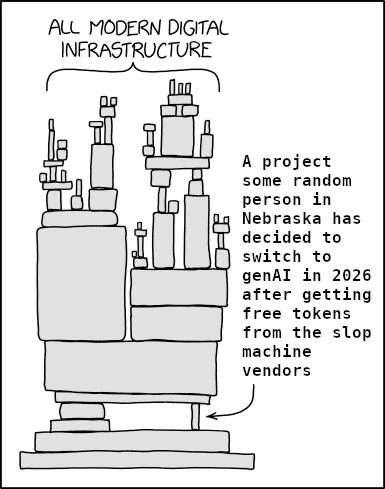
The drawing is a dependency graph rendered as Jenga. In modern development, almost nothing is written from scratch — your app pulls in open-source libraries, those libraries pull in other libraries, and ten levels down there's some tiny utility package that everything transitively relies on. That's the skinny peg near the bottom of the tower, the one the arrow points to. If it breaks, gets compromised, or just publishes a bad version, the breakage propagates upward through everything stacked on it. (Look up the left-pad incident: an 11-line string-padding function was unpublished from npm in 2016 and broke builds across half the internet.)
"GenAI" here means using a large language model to write and maintain the code. "Free tokens" are the API credits vendors hand out — tokens being the unit you're billed in when calling a model. The joke's mechanism: the maintainer isn't choosing AI because it's better; they're choosing it because it's free right now, the same way you end up with a gym membership you never wanted. For a junior dev, the lesson is concrete: npm install (or pip install, or cargo add) is a trust decision. Every line in your lock file was written by someone — and increasingly, by something — and you inherit their bugs, their security posture, and now their hallucinations.
Level 3: The Peg Gets a Copilot
To appreciate this panel, you need the original artifact it remixes: xkcd #2347, "Dependency," the single most-cited comic in every supply-chain security talk since 2020. The original showed the same teetering tower of blocks labeled "ALL MODERN DIGITAL INFRASTRUCTURE" balanced on one thin peg captioned "a project some random person in Nebraska has been thanklessly maintaining since 2003." It became shorthand for a real phenomenon with real names attached: core-js (maintained by one person, who at one point asked for donations from prison), OpenSSL pre-Heartbleed (two part-time devs underpinning most of TLS), log4j (volunteers, until December 2021 made them famous), and the xz backdoor of 2024 (a lone burned-out maintainer socially engineered into handing the keys to an attacker). The industry's entire dependency graph rests on unpaid hobbyists — this was the canonical illustration of it.
This 2026 edition keeps the drawing and swaps the caption:
A project some random person in Nebraska has decided to switch to genAI in 2026 after getting free tokens from the slop machine vendors
The mutation is surgical. The original risk model was abandonment: one human, no bus factor, no funding. The new risk model is delegation: the human is still nominally there, but maintenance is now performed by an LLM, adopted not because it was evaluated but because the free tokens made the marginal cost zero. That's the sharpest barb here — "slop machine vendors" frames AI-coding subsidies the way one frames casino comps or cigarette samples: a loss-leader to create dependence. Every vendor in 2025–2026 ran exactly this play, showering open-source maintainers with credits, because an ecosystem maintained through your model is an ecosystem that can't leave.
The security implications compound rather than replace the old ones. A solo maintainer was a single point of failure; a solo maintainer rubber-stamping AI-generated patches is a single point of failure with a much higher commit velocity and much lower review depth. Supply-chain risk used to mean "what if this person quits or gets compromised." Now add: hallucinated dependency names (slopsquatting — attackers register packages LLMs commonly invent), plausible-but-wrong patches that pass CI because the tests were also generated, and code provenance nobody can attest to. The xz attack required years of patient social engineering to get malicious code merged. AI-mediated maintenance offers the same outcome as a default workflow: code nobody fully read, merged by someone who trusts the machine more than they trust strangers.
Description
A parody of xkcd #2347 'Dependency' in Randall Munroe's hand-drawn style: a precarious tower of stacked gray blocks labeled 'ALL MODERN DIGITAL INFRASTRUCTURE' with a curly brace at the top. An arrow points to the tiny, load-bearing peg near the bottom of the stack, with caption text reading: 'A project some random person in Nebraska has decided to switch to genAI in 2026 after getting free tokens from the slop machine vendors'. The original comic's punchline - all infrastructure resting on a thanklessly maintained hobby project - is updated for the AI era: that same critical dependency is now being vibe-maintained by an LLM because the vendor handed out free tokens, swapping the single-maintainer risk for AI-slop supply-chain risk
Comments
7Comment deleted
The Nebraska maintainer was a single point of failure; the LLM replacement is a single point of failure with infinite confidence and no commit history it can explain
requesting context 😬 Comment deleted
https://github.com/chardet/chardet/releases/tag/7.0.0 chardet was rewritten with ai, and there's drama about it, because the current maintainer changed the license to a less restrictive one Comment deleted
https://github.com/chardet/chardet/issues/327 Comment deleted
it does seem like they wiped the repo before doing this rewrite: https://github.com/chardet/chardet/commit/7e25bf40bb4ae6884892c094080e011290494947 Comment deleted
Plot twist: the new licence agreement was vibe-coded by AI, too. Comment deleted
Coming up next, Internet blackout because of chardet Comment deleted