Developers enthusiastically pass off testing before rushing back to shiny new features
Why is this Testing meme funny?
Level 1: Playing Before Chores
Imagine you have a child who absolutely loves playing with new toys. One day, they get a brand-new LEGO set (that’s like a developer getting a cool new feature to build). Now, before playing, they should probably tidy up their room or do their homework (this is like doing testing – it’s the less fun, but necessary task to make sure everything is in order). At first, the child says, “Okay, I’ll clean up a little” and pretends to start cleaning. But within a minute, they toss the cleaning rag aside and grab the new LEGO set to start playing immediately. They’re hugging that shiny toy box and completely forgetting about the chores.
This meme is just like that scenario! The developer is the child, testing is the boring chore, and implementing new features is the exciting new toy. It’s funny because we understand the feeling: the child (or developer) is so eager to enjoy the fun stuff that they push away the responsible stuff with barely a thought. We laugh because we know the chores (testing) are important – if you skip them, you might end up with a mess (or a broken software later) – but it’s so tempting to just do the fun part first. In simple terms, the meme shows the goofy moment when a developer says “Sure, I did the tests” (like a kid saying “Sure, I cleaned my room”) and then rushes off to do what they really want: play with new features. It’s a playful reminder that doing the boring work is important, even if we’d rather skip straight to the fun.
Level 2: Chasing Shiny Features
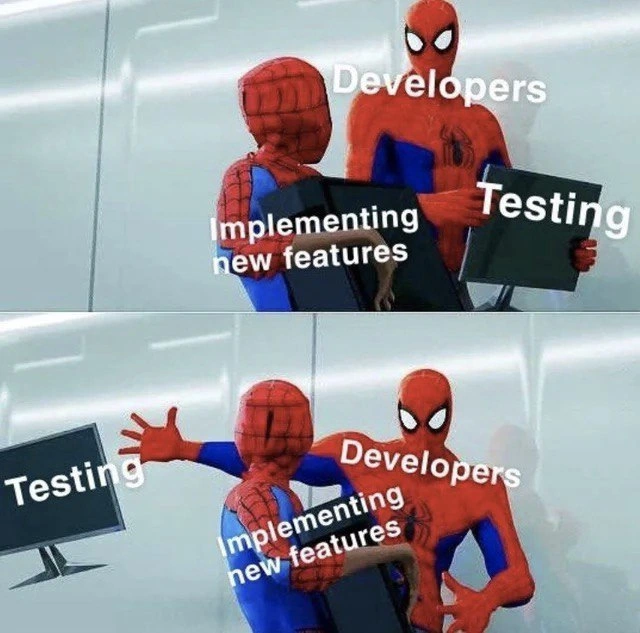
At its core, this meme is about a developer’s tendency to favor implementing new features over doing thorough testing. Let’s break down the scene in simpler terms. We have two Spider-Man characters in the hallway: the taller one represents Developers (i.e., the programmers), and the shorter one represents the activity of Implementing new features (basically, building the cool new stuff in the software). The monitor labeled “Testing” stands for all the testing work that should be done – like writing unit tests, performing code reviews, or doing QA checks to make sure everything works correctly.
In the first panel, the developer Spider-Man is momentarily handing the “Testing” monitor to the other Spider-Man. This is like a developer saying, “Alright, let’s do some testing on this new feature I built.” It’s that brief moment where they acknowledge, “I should test my code.” But in the second panel, the developer suddenly shoves the “Testing” monitor away and instead hugs the “Implementing new features” character. This represents the developer essentially pushing aside testing tasks and eagerly jumping back into coding new features. It’s as if they’re saying, “Actually, never mind testing right now – I want to keep coding more features!” The visual joke is that testing literally gets thrown to the side while the developer enthusiastically clings to writing new code.
Why is this funny to people in software development? Because it’s relatable. Many developers (especially when excited or under pressure) have done something similar in real life – maybe not literally tossing a monitor, but skipping or rushing through tests to get on with a new feature. For example, imagine you just implemented a cool new functionality in your app. Proper process says you should now write some unit tests (small programs to check that each part of your code works as expected) and maybe do some integration testing (making sure the new code plays well with the rest of the system). But writing tests can feel tedious compared to the fun of coding the feature itself. Perhaps you run the app once or twice manually to see if it “seems to work” and then immediately start on the next feature. That’s basically what this meme is showing: giving testing a quick glance, then speeding back to feature development.
Let’s clarify a few terms featured here:
- Testing in this context means all the quality checks like running the program to find bugs, writing automated tests, or having a QA engineer try to break the new code. It’s a crucial part of software development because it ensures the product is stable and does what it’s supposed to do.
- Implementing new features means adding new capabilities or improvements to the software – this is the creative, exciting part where developers get to build something new that users will see or use. It’s often the part of development that gets the spotlight and praise.
- SDLC (Software Development Life Cycle) is the overall process of developing software, which includes stages like planning, coding, testing, and deployment. In a healthy SDLC, testing is an important stage that comes before you release updates to users.
Now, the joke is highlighting a tension in the SDLC: developers sometimes treat testing as a mere afterthought because they (or their bosses) are in a hurry to deliver the next feature. It’s like having a checklist where “Write new feature code” is checked enthusiastically, but “Test the new code thoroughly” gets a rushed check or even skipped. This can lead to DeveloperPainPoints later – for instance, if you don’t test properly, a bug might slip through and cause an error in the live product (yikes!). Then you have to stop adding new features and rush back to fix that bug, which is often more painful than if you had tested and caught it earlier.
New developers often learn about this the hard way. Maybe the first time you wrote a feature, you only did minimal testing (“It worked on my machine, so I assumed it was fine!”) and then a bug report came in from QA or a user. It’s a very RelatableDevExperience: the excitement of shiny new features can cloud our discipline to test. This meme basically says, “developers love new features so much that they’ll push testing away to get to the next feature faster.” It’s poking fun at that habit. The tags like TestingHumor and CodeQuality are there because the humor comes from recognizing that skipping tests is bad for code quality, yet it still happens a lot.
In real-world terms, think of a developer who’s just finished coding a new login feature for an app. Instead of writing a few tests to verify it handles correct and incorrect passwords properly, they immediately start working on the next big feature (say, a fancy profile page), telling themselves they’ll “write the tests later.” That “later” can become a huge testing backlog – a pile of testing tasks that keeps getting postponed. This backlog might never get done if the team is always in a rush. The meme’s scene exaggerates this by having the developer push testing away physically, but it’s not far off from what sometimes happens in fast-paced software teams.
So, the second panel where the developer is hugging “Implementing new features” shows where the developer’s heart truly is at that moment: building cool new stuff. The poor “Testing” monitor left flying to the side represents all the unsung but important work that gets neglected. It’s funny in the meme, but it also carries a little lesson: if you ignore testing for too long, problems will eventually catch up with you. In summary, the meme is a lighthearted reminder that while new features are exciting, we shouldn’t forget about testing – otherwise, we’re just delaying issues until later.
Level 3: Feature Hug, Test Shrug
This meme humorously captures a classic quality vs velocity showdown in software development. In the first panel, the taller Spider-Man (labeled Developers) pretends to hand off a monitor labeled Testing to the shorter Spider-Man (labeled Implementing new features). By the second panel, the developer Spider-Man literally tosses Testing aside and bear-hugs Implementing new features. It’s an exaggerated take on a common reality: developers giving a perfunctory nod to testing before diving head-first back into new feature work.
Why is this so funny (and painful) to experienced devs? Because we’ve all seen it happen. Under pressure from ambitious roadmaps and excited stakeholders, feature development often gets top priority in the SDLC (Software Development Life Cycle), while testing and code quality take a back seat. This leads to the feature-over-testing mindset being satirized here. Everyone preaches that you shouldn’t skip writing unit tests or neglect QA, yet when a shiny new feature beckons, even the well-intentioned team might shove testing “off to the side” just like that monitor in the meme. The taller Spider-Man’s enthusiasm for hugging “Implementing new features” reflects how product managers and developers celebrate new capabilities, whereas the sidelined monitor symbolizes how QA efforts are often defenestrated (thrown out the window) when deadlines loom or inspiration strikes.
From a senior perspective, this points to the perennial quality vs speed tradeoff. Developers know skipping tests is a risky bargain – it’s essentially taking on technical debt. Every time testing is passed off or postponed, there’s interest accruing in the form of later bugs, unstable releases, and those dreaded late-night production incidents. It’s all fun and games until a bug crashes the app in production at 2 AM. The humor here comes with a knowing groan: today’s “hug the new feature, ignore the tests” thrill often becomes tomorrow’s firefighting session when an untested edge case blows up. The meme nails that cognitive dissonance – devs enthusiastically passing off testing as if saying, “Yeah, yeah, tests, sure… we’ll get to that,” when really they’re already racing back to coding the next feature.
This pattern is so relatable because it happens across the industry. Perhaps a sprint ends and there’s no time for the promised unit tests – so devs merge the feature with a // TODO: add tests comment left behind (we've all seen something like this):
# New feature code (simplified example)
def add_new_feature(data):
result = do_something_cool(data)
return result
# Developer promises to test later
def test_add_new_feature():
assert True # TODO: implement actual tests after release
In continuous integration pipelines, you might even see builds where tests are temporarily disabled or set to always pass, just to deploy faster. It’s both funny and scary: “No tests failed!” – of course, if we didn’t write any real tests! This aligns with the meme’s second panel: by shoving testing out of the way, the developers ensure nothing stops them from hugging that new feature into production.
Historically, seasoned devs recall eras of separate QA teams and waterfall models where testing happened at the end. In modern agile teams, testing is supposed to “shift left” (done early and often by developers themselves), but the meme jokes that old habits die hard. Even in 2021’s fast-moving dev world, the allure of shipping features sometimes wins out over the discipline of testing. The RelatableDevExperience here is the shared guilt and anxiety: we love the rush of new code, but we know skipping tests is a gamble. The first panel’s polite handoff of “Testing” is pure lip service – it’s the developer thinking “We should test… right?” – followed by the second panel’s embrace of features, essentially saying “Eh, testing can wait. Let’s build more cool stuff now!”
In short, the meme is a comical mirror to our industry’s feature-first mentality. It highlights how developers, whether due to management pressure or personal excitement, often prioritize implementing new features over rigorous testing. We laugh (maybe a bit nervously) because it’s true – we’ve been that Spider-Man, assuring everyone testing is handled, only to shove it aside and sprint towards the next release. And just like Spider-Man’s spidey-sense, experienced devs have an inner voice tingling, warning “🚨Write those tests, or this will come back to bite!” – yet the pull of progress can be overpowering. The meme exaggerates it perfectly, letting us chuckle while remembering that balancing code quality with speed is an ongoing challenge.
Description
Two-panel Spider-Man meme set in a sterile, white hallway. Panel 1: a taller Spider-Man labelled “Developers” hands a widescreen monitor labelled “Testing” to a shorter Spider-Man whose torso text reads “Implementing new features.” Panel 2: the taller Spider-Man shoves the monitor (still labelled “Testing”) off to the left, arms outstretched, while hugging the shorter Spider-Man still labelled “Implementing new features.” The juxtaposition humorously illustrates how engineers briefly acknowledge quality assurance before prioritising feature work, highlighting common tensions between rapid delivery and comprehensive testing in the SDLC
Comments
6Comment deleted
“Our coverage target is still 80% - we just measure it with post-incident RCAs instead of JUnit.”
After 20 years in the industry, I've learned that 'we'll add tests in the next sprint' is just developer speak for 'these features will become someone else's debugging nightmare in production' - but hey, at least the velocity metrics looked great this quarter!
The irony here cuts deep: we all know comprehensive testing prevents the 3 AM production incidents that destroy velocity far more than writing tests ever could, yet somehow 'testing' always ends up being the one getting thrown out the window when sprint commitments loom. It's the engineering equivalent of knowing you should floss but convincing yourself that extra two minutes is better spent on literally anything else - until the technical debt collector comes calling with a P0 incident and a rollback strategy that doesn't exist
Management: “Shift-left testing.” Developers: slide testing off the Kanban - velocity up, DORA green, PagerDuty red
We optimized the pipeline by removing the slowest stage - now "Testing" runs in production under the alias "customer feedback"
TDD? Nah, this is the real pattern: Test-Deflecting Developers, where blame achieves perfect branch coverage