Skip to content
DevMeme
7290 of 7435
The GNU C Library Account Replies 'F*** You' to Go's No-libc Flex
Languages Post #7990, on May 11, 2026 in TG

The GNU C Library Account Replies 'F*** You' to Go's No-libc Flex

Why is this Languages meme funny?

Level 1: The Bridge Nobody Thanks

Imagine a town where everyone crosses the same old bridge to get anywhere, and a bridge keeper has spent forty years keeping it safe. One day a new kid shows up with a jetpack and announces, "Best part of my jetpack: I never have to use that bridge!" And the bridge — in this cartoon, the bridge itself has a social media account — replies with two very rude words. It's funny because we've all felt like the bridge: you do reliable, invisible work for years, and instead of a thank-you, someone celebrates not needing you as their proudest achievement. The shortest reply says everything the longest one would.

Level 2: What's Actually Being Skipped

  • libc / glibc — the GNU C Library, the standard toolbox almost every Linux program uses to talk to the OS: opening files, allocating memory, looking up hostnames. Programs normally link to it dynamically, meaning they need a compatible copy on whatever machine they run on.
  • System call (syscall) — the raw doorway into the kernel. Libc wraps these in friendly functions; Go on Linux knocks on the kernel's door directly.
  • Static linking — baking everything a program needs into one self-contained executable. Result: copy one file to any Linux server and it runs. No installer, no dependency list, no version mismatch.
  • The version mismatch problem — build a normal program on a new Linux, run it on an old one, and you get version GLIBC_2.34 not found. Go's approach makes this entire error category vanish — which is why the original poster calls it Go's best feature.
  • Quote-post dunking — replying to someone's take by republishing it with your commentary on top. Here, the "someone" is a library pretending to have feelings.

First-week-with-Go experience: you scp the binary to a bare server, it just runs, and you briefly understand why people get evangelical about this.

Level 3: Single Binary, Singular Reply

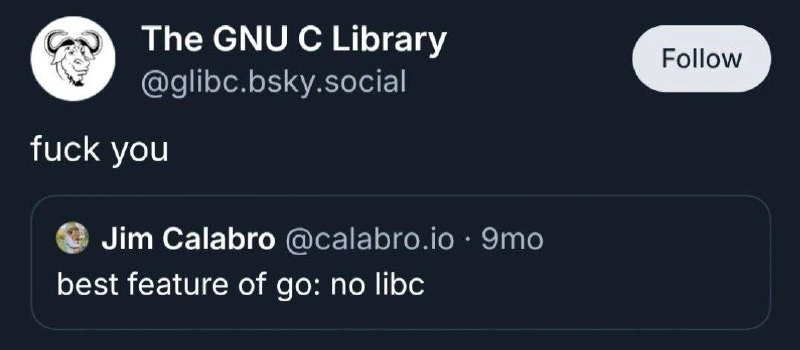
The screenshot itself is the joke's delivery system: a Bluesky parody account, "The GNU C Library" (@glibc.bsky.social) complete with the GNU gnu-head avatar and a Follow button, quote-posting Jim Calabro's nine-month-old "best feature of go: no libc" with a reply of exactly two words:

fuck you

The comedy is the personification — forty years of foundational infrastructure, the library that virtually every process on every Linux box links against, reduced to a wounded poster firing back with the brevity of a segfault. No rebuttal about NSS, no essay about locale support. Just the raw, unbuffered emotion of a dependency that has been deemed optional.

Senior engineers laugh because the underlying grievance is a real architectural war story. The single static Go binary solved an entire genre of operational pain: the GLIBC_2.32 not found error when a binary built on a new distro lands on an old one; the container images that needed a whole Debian userland just to satisfy the loader; the Dockerfiles that now simply say FROM scratch and copy in one file. Glibc's versioned-symbol scheme — designed with care to allow forward compatibility — became, in the container era, the thing everyone routed around rather than understood. And there's the institutional sting: Go came out of Google with explicit lineage from Plan 9, a research culture that always regarded Unix's C plumbing as something to be rewritten, not revered. The parody account's profanity is funny precisely because glibc's maintainers have spent decades doing thankless, exacting compatibility work, only to watch a generation of developers celebrate its absence as a feature. Infrastructure's reward for working perfectly is being resented for existing.

Level 4: The Syscall Boundary Is the Only Stable ABI

The technical claim being celebrated — "best feature of go: no libc" — rests on a genuinely deep property of Linux: it is nearly the only mainstream kernel that guarantees a stable userspace syscall ABI. Linus Torvalds' famous "we do not break userspace" covenant means a program can bypass every userspace library and invoke SYS_write, SYS_futex, or SYS_clone directly via the syscall instruction, and that contract will hold across kernel versions for decades. Go's runtime exploits exactly this: on Linux, with CGO_ENABLED=0, the compiler emits its own syscall stubs, its own threading built on raw clone(2) and futex(2), and its own DNS resolver — no libc.so.6 anywhere in ldd's output, because there is no dynamic loader involved at all.

This is not portable physics, it's Linux-specific politics. On macOS, OpenBSD, Solaris, and Windows the syscall layer is explicitly unstable; the system C library (or ntdll) is the only sanctioned entry point, and Go was repeatedly bitten for going around it — macOS updates broke Go binaries until the toolchain switched to calling libSystem like everyone else, and OpenBSD enforces the rule outright (syscalls must originate from approved regions). Glibc, meanwhile, isn't just memcpy and printf: it owns the Name Service Switch (nsswitch.conf), locale machinery, the dynamic loader, and pthread semantics — the integration tissue of a GNU/Linux system. Skipping it means reimplementing DNS resolution semantics (Go's pure-Go resolver subtly differs from glibc's, an evergreen source of "works in Alpine, fails in prod" tickets) and forfeiting NSS plugins entirely. The flex and the insult are both earned.

Description

A dark-mode Bluesky screenshot. A parody account named 'The GNU C Library' (@glibc.bsky.social) with the GNU gnu-head logo and a Follow button quote-posts Jim Calabro (@calabro.io, 9 months ago) who wrote 'best feature of go: no libc'. The glibc account's entire reply is 'fuck you'. The humor hinges on Go's statically-linked runtime making direct syscalls and bypassing the C standard library on Linux, a design choice frequently praised for deployment simplicity (single binary, no glibc version mismatches in containers) - here personified as a mortal insult to glibc itself

Comments

20
Anonymous ★ Top Pick Go skipped glibc and got a single static binary; glibc skipped diplomacy and got straight to the point - both are admirably free of dynamic dependencies
  1. Anonymous ★ Top Pick

    Go skipped glibc and got a single static binary; glibc skipped diplomacy and got straight to the point - both are admirably free of dynamic dependencies

  2. @TheFloofyFloof 2mo

    true tho

  3. Max 2mo

    lol what is going on?!? why are they so emotional? xD

  4. 𝅺 2mo

    dynamic linking was a mistake. every program should have compiled-in musl.

    1. @sylfn 2mo

      2/10 ragebait

      1. 𝅺 2mo

        okay lol

    2. @TheFloofyFloof 2mo

      but think of the 5kb of ram savings by dynamically linking

      1. @SamsonovAnton 2mo

        1) Compile helloworld.c with -lstatic and witness how many times wrong you are. 2) Have you seen RAM prices recently?!

    3. @ZmEYkA_3310 2mo

      The humble hardlinking gtk so a 3mb app becomes 3gb 🤝🤝

      1. 𝅺 2mo

        gtk sucks, i think we can agree on that. it's insane for a toolkit to weigh so much. look at https://en.wikipedia.org/wiki/Tk_(software) for an example of what all gui toolkits should aspire to be.

        1. @feedable 2mo

          3/10 ragebait

        2. @purplesyringa 2mo

          3/10 ragebait, you're getting better!

          1. 𝅺 2mo

            thanks!

          2. @acidbong 2mo

            oh, that's rating, i thought you were counting them, like "no more than 10 per post"

        3. @ZmEYkA_3310 2mo

          C tier bait

  5. @dollarbr 2mo

    The cold hard truth is: if you’re still debating musl vs glibc, you’ve already lost the architectural war. Truly transcendent code should be OS-agnostic. If your logic depends on a C library implementation, your software was legacy before the first commit. Real engineers code for eternity, not for a specific linker.

    1. @TheFloofyFloof 2mo

      Why does desktop software need to be OS-agonistic?

      1. @dollarbr 2mo

        If you’re still thinking in terms of 'desktop software,' you’re already 10 years behind. The hardware is just a temporary vessel; your logic should exist in a pure, abstract state. Why limit your genius to an OS when you should be targeting the universal machine? Limiting yourself to a specific environment is just admitting your code isn’t robust enough to survive the vacuum of pure logic.

        1. @lem0nsh 1mo

          we should all just develop for Uxn

  6. @Daonifur 2mo

    Personally prefer tinyc anyway

Use J and K for navigation