The Sophistication Ladder of Conditional Statements
Why is this Languages meme funny?
Level 1: Same Thing, Different Name
Imagine you have a favorite sweet treat. In America you call it “candy,” but your friend from England calls it “sweets.” You both mean the same yummy chocolates and gummies, just using different words. Now picture a very proper friend who insists on calling them “confections” – that’s a super fancy way to talk about candy. It might sound funny or confusing at first, but you’d eventually smile and realize they’re still talking about candy, too. In the end, no matter what word each person uses, they all want to share the same treat. That’s exactly what’s happening in this meme: different programming languages have their own word for the same idea. It’s a little silly that each one sounds a bit different, but once you know the translations, you understand everyone means the same thing – just like candy, sweets, and “confections” are all the same sugary goodness.
Level 2: One Conditional, Many Dialects
Let’s break down what’s going on for someone who’s maybe new to coding. In any programming language, an if-else structure is how the computer makes a decision: “if condition A is true, do something; otherwise (else) do something different.” Sometimes you want to check more than one condition – that’s where an else-if clause comes in. It basically means “if the first check didn’t happen, then if this next condition is true, do that.” No matter the language, that concept is the same.
However, each programming language has its own syntax (specific spelling and format rules) for writing that else-if part. The meme is showing four ways to say the exact same thing:
- In Perl (and similarly in Ruby), you write an else-if as
elsif(all one word, no “e” after the “els”). That’s just how those languages spell it. - In Python (and shell scripting languages like Bash), you’d write
elif– basically “else” without the “se”. It’s concise, fitting Python’s clean style. - In C-style languages (C, C++, Java, JavaScript, C#, etc.), you typically just put the words
else ifseparated by a space (and usually surround the code block with curly braces). There’s no special single word; you literally write anifimmediately after anelse. - The word “otherwise” isn’t a standard keyword in any major programming language. It’s more like plain English. Sometimes when writing pseudocode (fake code used for explaining algorithms), people use words like “otherwise” to mean “else”. The meme includes it as a very formal, jokingly polite alternative to else-if, not something you’d see in real code.
For example, here’s how you might see a multi-branch conditional in a couple of languages:
# In Python, using if/elif/else
if temperature >= 100:
print("Boiling!")
elif temperature <= 0:
print("Freezing!")
else:
print("Just liquid water.")
// In C (or Java/JavaScript), using else if
if (temperature >= 100) {
printf("Boiling!");
} else if (temperature <= 0) {
printf("Freezing!");
} else {
printf("Just liquid water.");
}
Both of those do the same thing logically: they check if temperature is above 100, below 0, or otherwise it must be in-between. The only difference is how the code is written. If you’re coding in Python and you try to type else if like in C, the interpreter will complain (because Python doesn’t recognize an else directly followed by a new if – Python expects the combined elif). Likewise, if you’re used to Python’s elif and accidentally put that into a Java program, you’ll get a syntax error, since Java only understands the two-word else if style.
For a newcomer, this can be a bit puzzling at first: Why do different languages use different words for the same idea? The answer mostly comes down to design choices and history. Perl chose elsif to keep it a single token (and fun fact: it was probably inspired by older languages like Ada that also used elsif). Python went with elif to keep the syntax tidy and avoid extra nesting (and it took a cue from the way Bash shell scripts use elif). Languages in the C family didn’t introduce a new keyword at all – they just rely on the basic grammar that lets an if statement follow an else. There are even more odd variants out there (Visual Basic uses ElseIf as one word, some textbooks’ pseudocode use “ELSE-IF” or “otherwise”), but the meme covers the most common ones that developers run into.
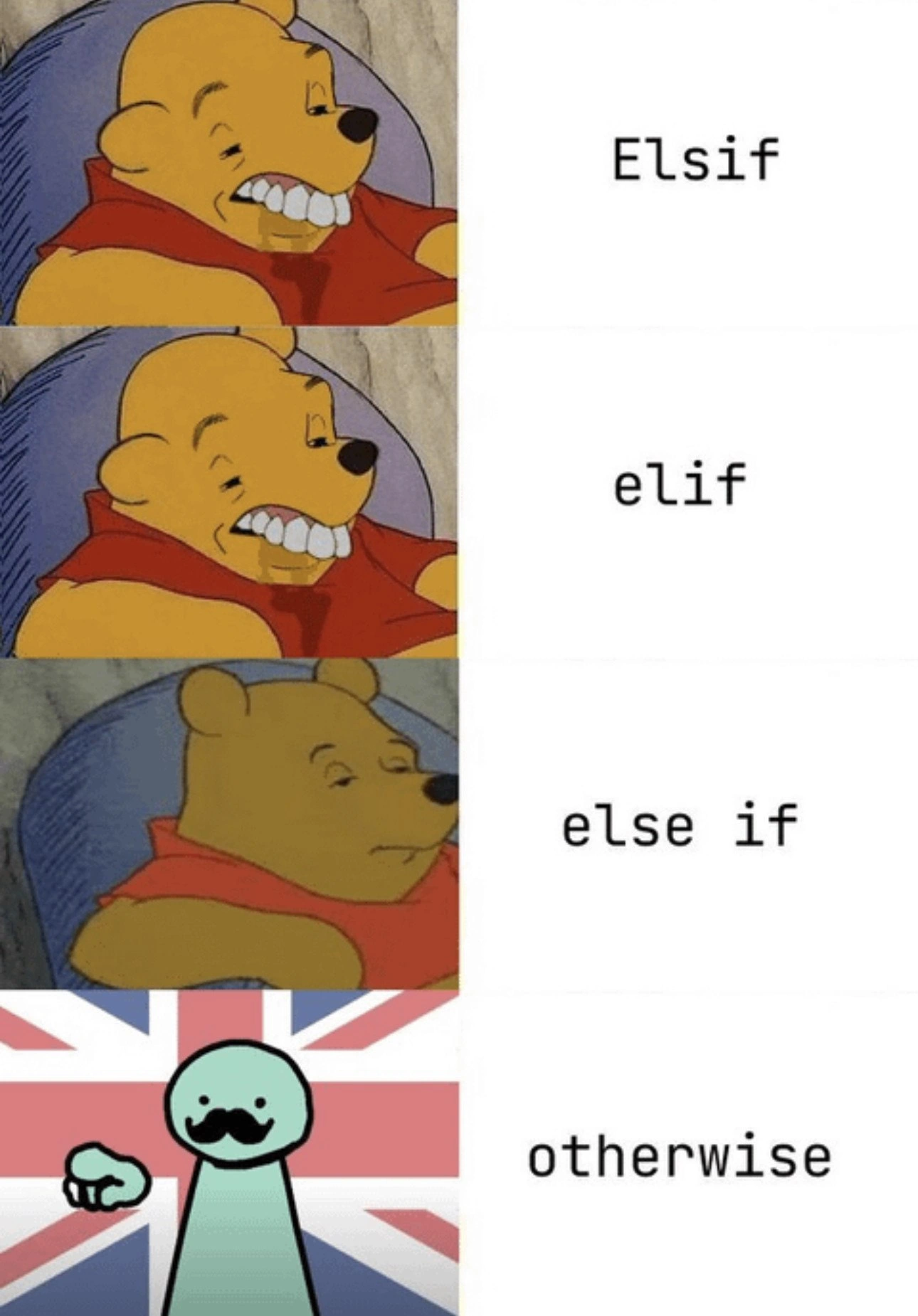
Now, the meme itself uses Winnie-the-Pooh’s reactions as a legend for these syntax differences. On the left side of each panel, Pooh’s face changes while on the right side we see a keyword:
- For
elsifandelif, Pooh has that uncomfortable, teeth-gritting smile. It’s as if he’s saying, “Hmm, that’s one way to put it… kinda weird but okay.” This reflects how a coder might feel seeing a less familiar form of else-if from another language – a bit of “hang on, that looks odd” before remembering which language it comes from. - For
else if, Pooh looks calm and indifferent. That makes sense becauseelse ifis very common and plain – not much to react to. It’s the everyday way to express the idea, so Pooh’s not excited or upset by it. - In the last panel, Pooh is replaced by that fancy stick-figure with a mustache, pointing grandly in front of a British flag, labeled “otherwise.” This dramatic transformation is the meme’s way of saying “we’re being extra fancy now.” Otherwise is like a posh, high-society way to say else-if, something you’d never actually use in real code but might jokingly use to sound sophisticated. It’s as if the code is suddenly speaking with a British accent, which is why it’s funny.
If you’re a junior developer, the key point here is: all these different words (elsif, elif, else if, and even “otherwise”) are just different flavors of the same idea. They all mean, “okay, if the previous condition didn’t happen, let’s check this next condition instead.” The meme is making us laugh by showing how programmers sometimes get tripped up by these little differences or even playfully argue about them. You might hear debates like, “Should we write pseudocode using Python’s nice elif, or stick to a more universal else if, or just use plain English ‘otherwise’ so everyone knows it’s pseudocode?” It sounds funny, but it happens because each of us gets used to the style of whatever language we started with.
So, don’t worry if you see these various spellings in different code – it’s just like hearing the same phrase in different languages or dialects. Once you know that elif and elsif and else if are all cousins, you’ll translate them in your head automatically. Think of it like understanding that “lift” and “elevator” are the same thing in British vs. American English. In programming, whether someone writes it as elif or else if, they’re ultimately doing the same if/else logic. Different codebases might have their own little style, but in the end, it’s all the same decision-making process under the hood.
Level 3: Conditional Code Switching
At a glance, this meme humorously highlights how a simple conditional logic can expose which programming “dialect” you’re using. It’s a snapshot of LanguageComparison in action, spotlighting those little LanguageQuirks in syntax that every programmer eventually encounters. Seasoned devs chuckle at this scenario because they’ve lived through the SyntaxHumor of hopping between languages and tripping over these tiny differences. We all recognize it: reading code and immediately spotting an elsif vs elif vs else if – it’s like finding a linguistic fossil in your codebase that instantly reveals the language’s lineage.
Each panel in the meme is essentially code archaeology:
- Perl (and its descendant, Ruby) use
elsif. Winnie-the-Pooh’s strained half-smile in the first panel suggests, “Alright, I remember this oddball spelling…” For many of us, seeingelsifis a throwback to older scripting days – a bit archaic, almost like spelling “color” as “colour.” It works, but it definitely flags, “Hey, this code has a Perl accent.” - Python (and Bash) use
elif. In the second panel, Pooh still wears that awkward grin, as if encounteringeliffeels slightly more familiar but still distinct. Python folks findelifperfectly normal (short and sweet!), but a C/C++ veteran might blink twice thinking, “Did you drop an s there, friend?” - C/C++/Java/JavaScript and other C-family languages spell it out as
else if(two separate words). By the third panel, Pooh’s expression has gone neutral, almost relieved. This is the vanilla syntax many of us learn first; nothing surprising here. It’s straightforward and reads like plain English – Pooh is neither impressed nor upset becauseelse ifis as standard as it gets. - Finally, the meme cranks the silliness to eleven with “otherwise” in a posh context. The last frame swaps Pooh for a moustachioed teal stick-figure on a Union Jack background, literally putting on a British accent for the posh pseudocode version of else-if. In proper Queen’s English, “otherwise” means the same as “else” – but no mainstream programming language actually uses
otherwiseas a keyword. This is tongue-in-cheek: the meme pretends there’s an über-formal dialect where devs say “If X, otherwise Y” with a cup of tea in hand. It’s an absurd, Monty Python-esque escalation, and that absurdity is what makes us laugh.
The humor cuts deep for experienced devs because these little conditional variations are so relatable. Working on multiple projects, you inevitably become a polyglot and suffer a bit of mental gear-shifting. One day you’re writing Python and type elif by reflex; the next day in Java you accidentally write elif and the compiler faceplants with a syntax error. Or you go from C to Python and find yourself typing out else if and wondering why it’s not working. It’s the tiniest language quirk, yet it trips you up when you least expect it. Every senior developer has had that moment of realization: “Wait, how do I spell else-if in this language again?” followed by a self-deprecating chuckle. It’s a rite of passage in multi-language fluency, a quick context switch that feels a bit like switching accents mid-conversation.
Beyond personal slip-ups, there’s a cultural LanguageWars undercurrent here too – albeit a playful one. Each programming community subtly prides itself on its chosen syntax. Perl programmers might jokingly defend elsif (“It’s logical! Why waste an extra letter?”), Pythonistas love the clean brevity of elif, while C-family devs shrug, “Just write else if, what’s the big deal?” These preferences can spark friendly debates (the kind of DeveloperHumor only programmers find funny) even though everyone knows it’s trivial. It’s a bit like regional accents: none is “wrong,” but they mark where you come from, and fellow devs will gently tease each other about them.
Now, about that “readability vs portability” nit-pick mentioned in the description: this refers to the little tussles that happen when writing pseudocode or documentation. Imagine you’re describing an algorithm in a document for a mixed audience. Do you use a specific language’s style (say, Python’s elif) because it looks clean to you? Or do you write “else if” or “otherwise” in plain English so it’s not tied to any one language? There’s no universal rule here, so teams often bike-shed over it. One reviewer might say, “Using elif in pseudocode could confuse folks who aren’t Python-savvy; let’s stick to else if for clarity.” Another might respond, “But else if isn’t a single keyword in some languages; maybe use a neutral term like ‘otherwise’ for the pseudo-code.” It’s a minor nit-pick, but it shows how aware we are of these differences. The meme playfully ranks these options like they’re flavors of high tea, with “otherwise” looking like the fanciest option of all (great for readability laughs, but ironically the least portable into real code since you’d have to translate it).
This meme is a piece of classic CodingHumor because it exaggerates a tiny truth that developers encounter all the time. It lands so well precisely because it’s RelatableHumor – any programmer who’s had to switch between languages sees those different else-if spellings and thinks, “Haha, yep, I’ve been there!”. We can’t help but smirk and acknowledge the many “dialects” of code we’ve seen. In the end, it humorously reminds us that even a simple if/else decision can look a dozen different ways, depending on which language (or pseudocode gentleman) is holding the pen.
Description
This is a four-panel, vertical meme format, similar to the 'Expanding Brain' or 'Tuxedo Winnie the Pooh' memes, which ranks different ways of writing an 'else if' conditional statement. The first two panels feature a crudely drawn, tense-looking Winnie the Pooh, representing lower sophistication. Next to these are the words 'Elsif' and 'elif' respectively. The third panel shows a standard, calm-looking Winnie the Pooh next to the more common 'else if'. The final panel breaks the pattern entirely, displaying a simple, light-blue cartoon character with a mustache clenching its fist in front of a Union Jack flag. Next to this is the word 'otherwise'. The humor is derived from the escalation of programming language syntax from common variants ('elif' in Python, 'elsif' in Ruby) to the standard C-family 'else if', and finally to the absurdly formal and British-themed 'otherwise', which is not a standard keyword in most languages but perfectly captures a sense of over-the-top, quirky formality

Comments
35Comment deleted
Some developers use 'elif' for conciseness. Others prefer 'else if' for clarity. I, however, use 'otherwise', and my IDE is configured to only compile after it has queued up a formal complaint to the compiler's manager
The real portability layer isn’t POSIX - it’s a regex that translates every codebase’s preferred spelling of ‘else-if’ before the diff reviewer has an aneurysm
After 20 years of writing conditionals, you realize the real branching nightmare isn't elsif vs elif - it's explaining to the junior why your 'elegant' pattern matching solution with guards and monadic transformations takes 3x longer to debug than a simple switch statement
After 20 years in the industry, you realize the real sophistication isn't in choosing 'otherwise' over 'elsif' - it's in avoiding nested conditionals altogether by refactoring into a strategy pattern, only to have a junior dev rewrite it back to if-else chains because 'it's more readable.'
If the team is debating elif vs else if, the senior fix is a dispatch table or pattern matching - otherwise you’ve just built a 200‑line ladder
Polyglot repos prove the hardest cross-platform issue isn’t containers - it’s remembering whether the branch keyword is elif (Python), elseif (PHP), elsif (Ruby/Perl), else if (C/JS), or, if you’re in Spark, the aristocratic ‘otherwise’
15+ YoE truth: They all desugar to jumps, but 'otherwise' pairs best with a spot of tea during the perf regression
if ! Comment deleted
haskell moment Comment deleted
unless Comment deleted
is there a new lang called pringles? Comment deleted
elif is stupid. but ending an if block with fi is beyond moronic Comment deleted
bash : Comment deleted
Well, Bourne really liked Algol. But in Algol that stuff actually kinda works and is consistent. Comment deleted
please use English in this chat Comment deleted
ifn't Comment deleted
more like unless Comment deleted
Duded you just reversed the whole lookup Comment deleted
if(){} or(){} Comment deleted
this thing got more attention than I expected let's inplement it somewhere Comment deleted
💀💀😂😂😂 Comment deleted
nested when 🤬 Comment deleted
Elseways 🤴 Comment deleted
nextguess Comment deleted
oddchance Comment deleted
Apparently Comment deleted
Perchance 🇬🇧 Comment deleted
But otherwise=else🤔 Comment deleted
Doesn’t need to be Comment deleted
Semantically it is tho. And in no way otherwise=else if. if a==1 ... otherwise a==2 ... just doesn't work. Comment deleted
elfish Comment deleted
we also need block in any case Comment deleted
But still Comment deleted
in another case Comment deleted
ow Comment deleted