Computer science: neither computers nor science, yet here we are anyway
Why is this CS Fundamentals meme funny?
Level 1: Not What It Sounds Like
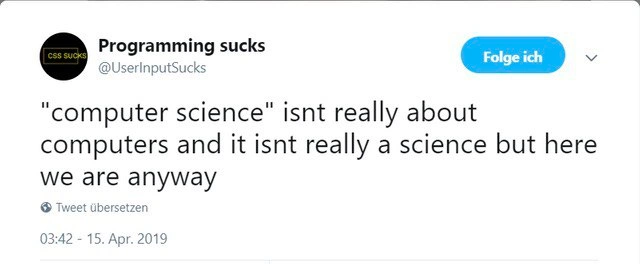
This meme is funny because it shows how names can be misleading, and we laugh at the confusion. Think about it in simple terms: a jellyfish isn’t actually a fish (it’s a squishy sea creature), and a peanut isn’t really a nut (it’s a bean!). Those names don’t perfectly describe the thing, right? In the same way, “computer science” sounds like it would be all about computers and doing science experiments, but it’s not exactly that. It’s more about using your brain to solve puzzles and tell computers what to do. Imagine signing up for a “Computer Science” class expecting to take apart computers or mix chemicals like in science class, and then finding out you’re actually learning how to solve math puzzles and make your own games or apps. You might say, “Huh, that name is weird… but okay, let’s do this!” The tweet in the picture jokes about this by basically saying: “Computer science isn’t about computers or real science… but here we are anyway!” The feeling behind it is a playful shrug – like when you call a starfish a fish even though it’s not one, and everyone just goes with it. It’s silly, but we accept it. So the meme makes us smile because we realize, yeah, the name “computer science” is kinda funny and wrong, but oh well! We still use it and know what it means. It’s a little joke that even grown-up programmers and students chuckle at, because it reminds us how weird and wonderful our world of technology can be.
Level 2: Not Fixing Printers
For newcomers or junior devs, it helps to break down what computer science really means versus what it sounds like. At its core, computer science is the study of how we can use algorithms (step-by-step procedures) and data structures (ways to organize information) to solve problems. Notice there’s no requirement of a physical computer in that definition! In a typical CS Fundamentals course, you’ll spend more time with pen-and-paper math puzzles or writing code on a whiteboard than you will tinkering with actual computer hardware. The term might make grandma think you can fix her laptop or reboot the Wi-Fi router (we’ve all gotten those calls), but a lot of CS is quite theoretical. It’s about things like complexity theory (figuring out how efficient an algorithm is) or discrete mathematics (logic, combinatorics, graph theory) – definitely not assembling motherboards or swapping out hard drives. And what about the “science” part? In everyday language, science brings to mind experiments with test tubes or discovering new species. Computer science doesn’t usually follow the classic scientific method of hypothesize -> experiment -> observe natural phenomena. Instead, it’s more like creating logical designs and proving things about them. In fact, many parts of CS feel closer to doing math homework or solving a puzzle than doing a chemistry lab. We design an algorithm and then we might prove it works (or find out why it fails) using reasoning or controlled tests. It’s a rigorous discipline, yes, but more of a problem-solving craft than an observational science. This contrast is exactly what the meme jokingly highlights.
To make it crystal clear, here’s how the name vs. reality breaks down:
| Name suggests | Actually about |
|---|---|
| Computers (hardware, devices) | Computation – logic and algorithms in software |
| Science (lab experiments, natural laws) | Theory & Math – proofs, problem analysis, abstract models |
| Being a tech fix-it wizard | Being a developer who writes code and solves problems creatively |
In developer culture, there’s a running joke that there are only two truly hard problems in computer science: cache invalidation and naming things (some versions add “off-by-one errors” as a third, just to prove the point by miscounting!). This tweet plays right into that naming is hard humor, pointing out that even the entire discipline’s name might be a misnomer. It’s tagged as ComputerScienceHumor for good reason. In online DevCommunities like Twitter, Reddit, or Stack Overflow, you’ll often see memes and discussions about how confusing our terminology can be. The tag computer_science_semantics is all about these kinds of semantic giggles: times when the literal meaning of our tech terms doesn’t match what they actually mean. And trust us, developers have an endless supply of these linguistic quirks to laugh about.
So if you’re a junior dev or a student just figuring this out: no, studying computer science won’t teach you to build a PC from scratch like a PC repair class. It won’t magically turn you into the IT person who can fix every printer jam (though you might pick up those skills as a side effect). Instead, you’ll learn how to think computationally – to break problems into parts, use logic to solve them, and write programs to make computers do cool things. And despite the name, that’s okay! The meme’s author says “here we are anyway” because everyone in the field has kind of agreed to live with the funky name. It’s like an inside joke we all share in the DeveloperCulture: we know our degree name sounds a bit off, but we carry on coding, laughing at tweets like these during coffee breaks. After all, if we tried to rename everything in tech that turned out to be misleading, we’d spend more time renaming than coding. (Looking at you, JavaScript – which has almost nothing to do with Java!) In short, this tweet is a nod to anyone who’s realized that computer science ≠ building computers and science ≠ exactly the scientific method, and it gives us a chuckle and a sigh of relief that we’re not alone in that realization.
Level 3: Telescopes Not Required
Computer Science has always had a bit of an identity crisis. A classic quip (often attributed to Edsger W. Dijkstra) puts it succinctly: “Computer science is no more about computers than astronomy is about telescopes.” This meme leans on that exact insight. The tweet humorously points out that “computer science” isn’t really about physical computers, and it isn’t a traditional science either – yet we still call it that. It’s a wink to every seasoned developer who’s had to explain their field and seen eyes widen in confusion. Why is this funny? Because it’s too true. The discipline deals mostly with abstract algorithms, data structures, and mathy theory – far more than screwing in PC parts or mixing chemicals in a lab. In academic terms, computer science is more of a formal science or an applied mathematics field. We prove theorems about algorithms and solve logical puzzles; we don’t typically don lab coats or peer into microscopes. And while we do use computers as tools, the field is fundamentally about computation and information, not about the silicon chips themselves. The tweet’s resigned punchline “but here we are anyway” captures that shared shrug of developer culture: the name stuck, for better or worse. Historically, the term “computer” originally referred to people (yes, humans!) who computed things, and early pioneers had to name the new academic field something catchy – hence computer science. Were there better names? Possibly “Informatics” (used in Europe) or “Computing Science”, but naming things is famously hard (more on that soon). So here we are, decades later, still grinning at the irony. Within developer communities, jokes like this are a rite of passage. It’s a form of TechHumor that unites experienced devs across programming languages and backgrounds – a gentle roast of our own profession’s quirks. We’ve all been there, chuckling at the semantic mishaps and thinking, “Who named this, anyway?” The meme itself, presented as a tweet from a tongue-in-cheek account (“Programming sucks”), adds an extra layer of insider snark: even the handle mocks the frustrations of coding life. Ultimately, this meme lands because it speaks a developer truth: ComputerScienceHumor often comes from exposing the gap between words and reality. In an industry where we struggle with naming things every day (hello, innumerable FooService classes and badly named variables), the very title of our field is the original sin of misleading names. And yet, despite the misnomer, we soldier on – building software, advancing algorithms, and, of course, making jokes about it along the way. Here we are anyway, indeed.
Description
The image is a white-background screenshot of a tweet captured in the standard Twitter UI. In the upper left is a circular avatar reading “css sucks” on a black background, next to the bold handle text “Programming sucks” and the username “@UserInputSucks”. To the right is a blue “Folge ich” (German for “Follow”) button. The tweet text, in black sans-serif font, reads: “"computer science" isnt really about computers and it isnt really a science but here we are anyway”. Below that are the gray sub-details “Tweet übersetzen” and the timestamp “03:42 - 15. Apr. 2019”. The layout follows classic Twitter styling with light gray separators and ample white space. Technically, the post pokes fun at the disciplinary naming of computer science, a perennial joke among seasoned engineers who know the field deals more with abstractions, algorithms, and theory than with physical machines or laboratory science, highlighting the linguistic quirks developers love to debate
Comments
7Comment deleted
Computer science: 90 % is persuading a fleet of distributed calculators to agree on yesterday’s truth, and the other 10 % is explaining to finance why that’s called “eventual consistency,” not “budget overrun.”
After 20 years, you realize computer science is just applied philosophy with a compiler that occasionally agrees with your existential arguments
Misnamed twice and still shipped - computer science was the industry's first production release
This echoes Dijkstra's famous quote that 'computer science is no more about computers than astronomy is about telescopes' - yet we still require CS graduates to debug printer drivers and explain why Karen's Excel macro doesn't work. The field is really applied discrete mathematics with occasional hardware interruptions, but 'Algorithmic Problem Solving and Complexity Theory' doesn't fit as nicely on a diploma
CS: Where we prove programs halt on paper, then ship distributed systems that never do
We call it “computer science” because “formal logic sporadically interrupted by leaky abstractions and human factors” didn’t fit on the diploma
Computer Science isn’t about computers or science; it’s mostly CAP, Conway, and calendar math - proving you can’t have consistency, availability, or a reliable release date at the same time