Programmers boast creativity until you see their EventBus naming spree
Why is this CodeQuality meme funny?
Level 1: One Name for Everything
Imagine your friend says, "I'm super creative, just like an artist or a writer!" Sounds impressive, right? But then you look at the stories they write and notice something odd: every character in every story has the same name. The hero is named John, the sidekick is named John, even the villain is named John. In one story, the dog is named John too! That would be pretty silly and confusing. You’d probably think, "Hmm, maybe this friend isn’t as creative as they say."
That's exactly the joke this picture is making, but with computer code. Programmers are saying, "We are creative people!" – but then the code they write uses the same word over and over for everything. In the picture, the code has the word "Event" repeated a bunch of times, kind of like naming every character John. It’s as if a chef bragged about inventing amazing new recipes, but then every dish has the same basic ingredient and name, like plain bread called by five different plain names.
Why is this funny? Because it’s a contradiction – saying one thing and doing another. The programmers call themselves creative, but the way they named things in the code doesn’t show much creativity at all. Even someone who doesn’t program can get the humor: it’s like a kid claiming to be a great inventor but every toy they make is just a slightly different stack of the same blocks. We expect creativity to mean variety and originality. Naming everything "Event...Event...Event" (just like naming every pet "Pet") is the opposite of that.
So the meme is poking fun at programmers. It’s saying: "You talk a big game about being inventive, but look – you literally named everything almost the same thing!" It makes us laugh because it’s true sometimes – coming up with good names is hard, and even smart people can end up doing something that looks pretty goofy. In simple terms, the meme is a funny reminder that actions speak louder than words: if you’re truly creative, it should show in your work (whether it’s art or code). And if you name everything the same, well… maybe you're not that creative after all, and that’s why it’s humorous.
Level 2: The Name Game
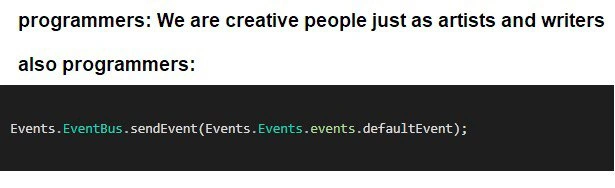
So, what's actually happening in this meme? Let's decode it at a more basic level. The meme contrasts what programmers say versus what they do. In the top caption, developers proudly claim to be as creative as artists or writers. But in the next moment (the "also programmers:" part), it shows a line of code that completely undermines that claim. The code is Events.EventBus.sendEvent(Events.Events.events.defaultEvent);, which is basically a very roundabout way to send a default event using an EventBus system.
First, let's explain an EventBus. An event bus is a design pattern used in software where you have a central hub (the "bus") that things can subscribe to or publish events on. Think of it like a messenger system: one part of the program shouts, "Hey, an event happened!" and the EventBus delivers that message to any part of the program that's listening. It's supposed to help different parts of a program communicate without directly knowing about each other. In many frameworks, you'd see something like eventBus.send(event) or eventBus.post(event) to broadcast an event. So far so good – nothing inherently wrong with using an event bus.
Now, the funny part is how everything is named in this particular snippet. We have a lot of the word "Event" everywhere. Naming conventions in programming are guidelines on how to name things like classes, methods, and variables. Good naming conventions usually make code easier to read by giving each element a clear, specific name. For example, if you have a class for managing users, you might call it UserManager. You wouldn't call it just Manager because that’s too vague. Here, though, the naming has gone off the rails. We see Events.EventBus.sendEvent(Events.Events.events.defaultEvent) – it's almost comical: the word "Event" or "Events" appears repeatedly.
Let's break that down piece by piece in simpler terms:
Events(the first one) could be a namespace or package name, or maybe a class name grouping event-related stuff. In some programming languages like Java or C#, you might have a namespace calledEventsthat contains all your event-handling classes.EventBuslooks like the name of a class or object inside that namespace. An EventBus object is responsible for sending out events to whoever is listening.sendEventis the method being called on the EventBus. That method takes an event as a parameter and sends it out. So far we haveEvents.EventBus.sendEvent(...)meaning "use the event bus to send an event." That part isn't too strange.
Inside the parentheses is where it gets wild: Events.Events.events.defaultEvent. This suggests that to send the event, they are accessing some event object defined elsewhere: perhaps a default event stored in a weird place. Possibly the programmer set up a class or object called Events (yes, another one), which has a field or property named events (a collection or container of event objects), and from that they retrieve defaultEvent. So it reads like: "Take the defaultEvent from the events list in the Events container, which is in the Events namespace, and send it via the EventBus located in the Events namespace." Whew! 😅 If that sounds confusing, that's exactly the point. It’s very confusing to see so many similar names chained together.
This is a textbook example of verbose identifiers and poor naming. A verbose identifier is a name for something in code that is unnecessarily long or repetitive. Sometimes beginners think longer names are always clearer, but in this case the long name is just the same word "Event" repeated, which doesn't add clarity at all. In fact, it reduces clarity because everything blends together. It's also showing method chaining or property chaining (using a lot of dots . to navigate through objects), which is common in programming. But usually, each step in a chain has a distinct name so you know you're stepping through different layers. Here it feels like going through five doors in a row all labeled "Event".
Let's connect this to code readability. Code readability is how easy it is for a person to read and understand the code. When you follow good naming conventions and write clean code, someone else (or you, a few months later) should be able to quickly grasp what the code does. In this meme's code, readability is poor: you have to stop and think, "What is Events here? And what is the second Events? Why is there an events inside Events? What's defaultEvent referring to?" It’s likely the original programmer was trying to organize things (maybe they had a central Events place for all events and an EventBus for sending them), but the result is messy. It's considered a code smell because it hints at a deeper problem. A code smell means something in the code is not outright wrong (the code might run fine), but it "smells" odd and could lead to bugs or be hard to maintain. Repeating the same word over and over is smelly because it suggests a lack of clear structure or differentiation in the code's design.
This is also a lesson in how naming things is genuinely tricky. There’s a famous humorous saying among developers: "The hardest thing in programming is naming things." Why? Because picking good names requires truly understanding what your code represents. If the concept wasn’t clear to the developer, they might fall back on generic words like "event" for everything. Maybe they were in a rush or just didn’t want to think of a better term for "defaultEvent" (perhaps it could have been named something like initialLoadEvent or whatever its actual purpose was). Similarly, naming a container Events and also having a class Events shows a lack of uniqueness – they could have called one of them something like EventRegistry or EventManager to differentiate.
For a newer developer, the humor here is that the programmers talk big about being creative, but then do something very lazy or unimaginative in their code. It's like saying "I'm an innovative chef!" and then always cooking plain rice. The meme resonates as developer humor because we often encounter code where the naming is so bad it's almost funny. It’s an ironic self-own: programmers know we should be better at naming, yet many of us have written or seen code like this, especially when we're not paying attention or are new to a codebase. The categories CodeQuality and DeveloperExperience_DX are highlighted here because using such repetitive names lowers code quality and makes the developer experience worse – working with code like this is frustrating. If you had to fix a bug in this system, you might have to open three different files all named Events something to trace what's going on, which is tedious.
In short, at this level, we understand the meme as a commentary on how naming conventions can go wrong. It’s explaining why the code snippet is absurd: the developer basically named everything in the chain with some variant of "Event", undermining the claim of being creative. The joke lands because anyone who’s started writing real code has faced the struggle of naming (and probably cringed later at some names they chose!). We laugh a bit, and maybe resolve to be more thoughtful next time we name a class anything other than repeating an existing name.
Level 3: One Name to Rule Them All
At first glance, this meme is a battle between code quality ideals and grim reality. It highlights one of the classic developer inside jokes: naming things is supposed to be a creative act, yet here we see nothing but repetitive monotony. The top text has programmers grandly claiming, "We are creative people just as artists and writers." The punchline hits when the code snippet shows the exact opposite – a ridiculously redundant call Events.EventBus.sendEvent(Events.Events.events.defaultEvent);. The word Event (or a variation of it) appears half a dozen times in one line! This is a prime example of a code smell in naming: an overly verbose, circular reference that screams lack of originality. In theory, good naming conventions encourage clarity and brevity – each class or method name should carry distinct meaning. But here everything is named Event something, which conveys almost nothing. It's the software equivalent of an author using "thingy" to name every character in a novel.
Let's break down that Frankenstein of an identifier chain:
Events.EventBus.sendEvent( Events.Events.events.defaultEvent );
Events– likely a namespace or class (perhaps a container for event-related stuff).EventBus– a class or object responsible for handling events (common in many architectures as a central message hub).sendEvent– a method call to publish an event through the bus.- Inside the parentheses, we again reference
Events(the same namespace/class), then.Events(possibly a static inner class or a singleton instance ironically also called "Events"), then an.eventsproperty (maybe a collection or registry of events), and finally.defaultEvent(the actual event object being sent).
It’s a tongue-twister of a call. Code readability is clearly suffering – any poor soul maintaining this code will need a mental parse tree to figure out which "Events" is which. Why is this funny to developers? Because we've all seen this anti-pattern in real projects. It's a perfect satire of those moments when a programmer's supposed "creativity" evaporates into boilerplate naming sludge.
There’s a well-known saying in software engineering:
"There are only two hard things in Computer Science: cache invalidation and naming things." – Phil Karlton
This meme zeroes in on that second hard thing. The naming conventions here are so bad, it's as if the developer gave up and hammered the word "Event" repeatedly like a dented nail. It’s self-referential naming run amok – almost a recursive joke where the code is mocking itself. Any experienced engineer can relate to the pain: maybe the original coder thought having everything under an Events umbrella was neat, but the result is a verbose_identifiers nightmare. The humor cuts deep because it reflects a truth: for all our talk of being "creative like artists," programmers frequently churn out bland, boilerplate names like ManagerManagerUtil or in this case an EventBus that lives under Events.Events.
From a senior developer perspective, this is a gentle roast of our industry’s penchant for tragic naming. The Developer Experience (DX) here is awful – imagine trying to debug or extend this. It's embarrassingly easy to introduce bugs when everything is called Event-something. Did you mean the Events class or the Events object? Is defaultEvent truly the default, or is it an ironically named special case? The maintainability of such code plummets when names lose specific meaning. This line of code might technically work, but it violates the Don't Repeat Yourself principle at the semantic level: the concept "Event" is repeated incessantly. It’s like the coder was so unsure of what to call things that they just defaulted to the same word in different flavors. The result is comedic and cringe-worthy all at once.
And let's not ignore the meta-irony: programmers often do fancy themselves problem-solvers with a creative flair. We build worlds out of logic, akin to artists with algorithms. Yet, confronted with the simple task of naming a class or method, we sometimes produce atrocities like this – zero imagination, zero clarity. The meme humorously calls out that contradiction. It's both a laugh and a wince of recognition. We’ve been in code reviews where someone flags FooManagerManager or DataControllerController and asks, "Really? That's the name you went with?" Here, it's Events.Events.events.defaultEvent prompting the same sarcastic smirk. Maybe the original dev thought if they repeated "Event" enough times it would magically become meaningful art. Spoiler: it didn’t. Instead, it became the kind of naming spree that gives seasoned engineers war flashbacks. In summary, this level of analysis sees the meme as a commentary on code quality: it skewers poor naming practices and highlights the gap between how programmers like to see themselves (innovative, artistic) and what the harsh deadlines and habits can lead to (dull, repetitive code). It's programmer irony at its finest, and every senior dev reading that code snippet is likely shaking their head with a chuckle, thinking, "Yep, been there, done that, got the t-shirt."
Description
The meme has a plain white background with two bold black captions stacked above a dark code block. The first caption reads, "programmers: We are creative people just as artists and writers". Directly underneath, the second caption says, "also programmers:" followed by a black, monospace code snippet that displays the exact line: "Events.EventBus.sendEvent(Events.Events.events.defaultEvent);" with syntax-highlighted class and method names. The intentionally repetitive "Events.Events.events" chain mocks boilerplate, unimaginative identifier choices and highlights how developers often undermine their own claims of artistic creativity through poor naming. Experienced engineers will recognize this as a commentary on naming conventions, code smell, and maintainability challenges in real-world codebases
Comments
7Comment deleted
After two DDD workshops, an architecture review, and a naming tiger team, we proudly shipped Events.EventBus.sendEvent(Events.Events.events.defaultEvent); apparently the only bounded context we could agree on was recursion
We spent three sprints arguing about whether it should be Events.EventBus or EventBus.Events, then compromised by using both and calling it "future-proof architecture."
There are two hard problems in computer science, and this line solved neither while invoking one six times
Ah yes, the classic 'Events.Events.events' pattern - because why use a single namespace when you can create a matryoshka doll of event objects? It's like the architect read the Gang of Four book, got really excited about the Observer pattern, then decided that one level of abstraction was for junior developers. This is what happens when your event-driven architecture becomes so meta it achieves self-awareness. The real creativity here is convincing the code reviewer that 'Events.EventBus.sendEvent(Events.Events.events.defaultEvent)' is somehow more maintainable than just 'eventBus.send(defaultEvent)'. At least when the inevitable refactoring ticket comes, you can claim you were being 'creative' with your namespace design
Nothing says we’re “creative” like DDD where the ubiquitous language is just “Event”: EventBus.sendEvent(Events.Events.events.defaultEvent) - event storming turtles all the way down
EventBus nesting: because true artistic genius means turning pub-sub into a stack trace Matryoshka doll that no junior can unravel
Event-driven until you read Events.Events.events.defaultEvent on a global EventBus - distributed goto with bonus implicit coupling