Skip to content
DevMeme
268 of 7435
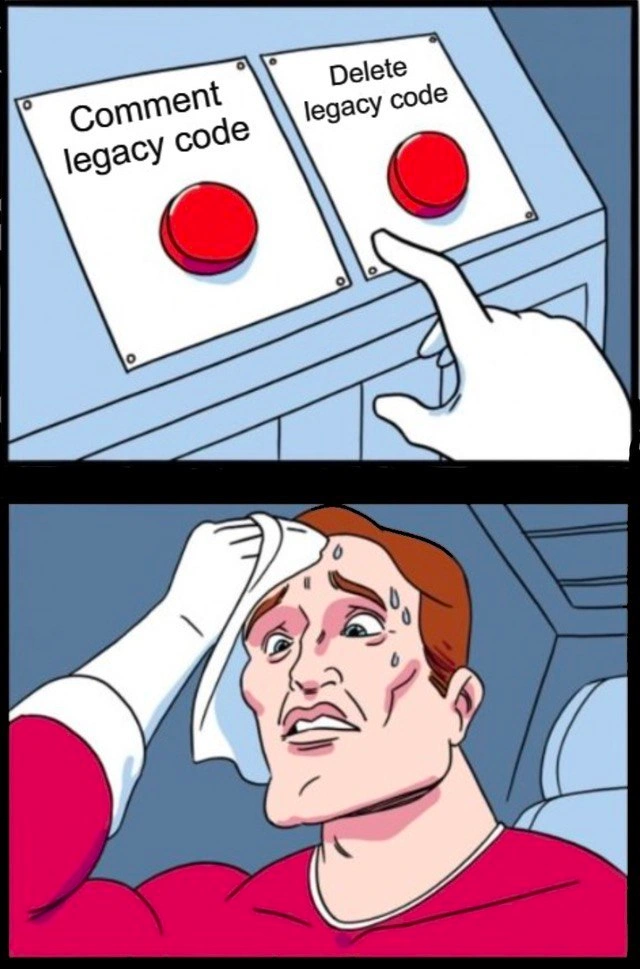
Developer sweating over the choice: comment out or delete legacy code
LegacySystems Post #324, on Apr 17, 2019 in TG

Developer sweating over the choice: comment out or delete legacy code

Why is this LegacySystems meme funny?

Level 1: Trash or Stash

Imagine you’re cleaning your room and find a mysterious old toy that you never play with anymore. You’re not sure what to do with it. You have two choices: throw it in the trash, or stash it away in the closet. If you throw it out, your room will be neater – no more clutter! But you’re a little worried: “What if I suddenly need this toy later, or I discover it was part of something important?” You start to sweat, thinking about the chance you might regret tossing it. On the other hand, if you hide it in the closet, you don’t lose it forever, and you feel safe because it’s still somewhere nearby. But now your closet is getting full of old, unused toys, making it hard to find things. This funny picture with the superhero sweating over two buttons is just like that. He’s basically freaking out over whether to throw away old stuff for a cleaner space, or hide it just in case he needs it later. It’s humorous because we’ve all felt that stress over a simple choice – and seeing a superhero sweat over it makes us laugh and say, “Hey, I know that feeling!”

Level 2: Comment Out or Clean Up

Now let’s dial it down a notch and explain what’s going on here. The meme shows a cartoon superhero faced with two choices (in the classic two_buttons_meme format). Each red button is labeled with a dreaded task: “Comment legacy code” and “Delete legacy code.” He’s sweating because he can’t decide which is the right move – and this is poking fun at a very real comment_vs_delete_dilemma in everyday programming.

First, some definitions: legacy code is a fancy term for old code that’s still in use. Typically, it’s code you inherited from someone else (who might have left the company ages ago) or from an older version of the system. It often comes with little to no documentation and probably no tests. Think of legacy code as that old, creaky part of a system that “works” but everyone is afraid to touch. It’s the opposite of shiny new code – and it tends to accumulate TechnicalDebt. Technical debt is a metaphor comparing messy or quick-and-dirty code to financial debt: it “interest” over time in the form of harder maintenance. The more TechDebt you have, the more your codebase “owes” in terms of cleanup and refactoring later. And refactoring just means cleaning up or reorganizing code without changing what it does – like tidying a messy room without throwing away any essential furniture.

So why do these buttons say comment or delete legacy code? This reflects two ways developers handle outdated or suspicious code that might no longer be needed:

  • Commenting out code means putting a code comment (// or # symbols, depending on the language) in front of code lines to prevent them from executing. The code stays in the file for humans to see, but the computer will ignore it. It’s like hiding the code in plain sight. For example, in a Python file you might do:

    # Legacy code disabled:
    # result = legacy_calculation(data)  # This line is now a comment and won't run
    result = new_improved_calculation(data)  # Using the new code instead
    

    Here, the old legacy_calculation line is commented out – it won’t run, but anyone reading the code can tell what was there before.

  • Deleting code means just outright removing those lines from the source code. You hit the delete key and poof, they’re gone from the file. In modern development, we use version control (like Git) which remembers every change, so even if you delete code, you could retrieve it later from history if needed. Deleting is a more permanent removal – the code won’t run (obviously, it’s not there!) and it’s no longer sitting in your source either. The file gets cleaner and shorter.

Now, why would a developer sweat over this choice? It seems straightforward: if the code is legacy (not used or outdated), just delete it and clean up, right? The problem is uncertainty and fear of breaking things. In a large LegacyCodebase, it’s not always clear whether a piece of code is truly unused. Maybe it’s not called anywhere obvious, but what if it’s indirectly used by some plugin, or an external script, or a weird edge-case configuration? If you delete it and you’re wrong, something in production (the live system running for users) could crash or misbehave. “Breaking production” is every developer’s nightmare – it means the live site or app has an outage or bug that affects customers. Imagine deleting a seemingly spare wire in a complex machine, only to find out it was secretly connecting the power supply!

So commenting out the code feels “safer.” You’re basically saying, “I won’t run this anymore, but I’ll keep it around just in case we need to quickly bring it back.” It’s a form of fear-driven coding insurance. The sweaty superhero in the meme is basically every engineer who has ever thought: “I think we don’t need this code… but what if I’m wrong?” Hitting the Delete button is scary because you might get blamed if something breaks. By commenting it out instead, you have a safety net: you can restore it by simply uncommenting (removing the // or #) if someone screams that a feature disappeared. It’s like putting the code in a closet rather than tossing it in the trash.

However, leaving lots of commented-out code lying around leads to clutter. It makes the codebase confusing – anyone new might wonder, “Why are there 50 lines of code commented out here? Is it legacy? Is it temporary? Should I delete it now or is it serving as documentation of what used to be?” CodeMaintenance suffers because the source files get bloated with stuff that isn’t actually doing anything. It’s generally considered bad practice to commit large chunks of commented-out code to a shared codebase (because that’s what version control is for – you can always look at history to see removed code). Many coding style guides explicitly say “don’t leave commented-out code – remove it or leave it live.”

So, the humor is in this familiar situation: RefactoringNeeded (we need to clean up), but RefactoringPain (it’s painful to risk change). The two-button meme template usually presents a character agonizing between two tough choices; here the choices are:

  • Keep the legacy code as comments (implies you’re too cautious to fully remove it).
  • Delete the legacy code entirely (you’re bold but maybe foolhardy if you haven’t verified it’s safe).

Both choices have pros and cons, which an experienced developer knows all too well. Let’s break them down in a simple table:

Option Pros (Why do it) Cons (Risks/Downsides)
Comment Out Legacy Code - Quick safety: disable functionality without losing it.
- Easy to undo if something goes wrong (just uncomment).
- Provides a reference of old code for future devs (they see what used to be).
- Clutters the code with inactive lines, hurting readability.
- Others might be confused about why it’s there.
- Technical debt remains; someone will have to clean it later (if ever).
Delete Legacy Code - Cleans up the codebase: fewer lines, less confusion.
- Reduces TechnicalDebt and maintenance burden.
- Encourages best practice (trust version control for history).
- If you guessed wrong about it being unused, something might break in production.
- Harder to restore quickly under pressure (you’d have to dig through git history to find it).
- Psychologically scary – you might second-guess yourself a lot before doing it!

As you can see, it’s a trade-off. Newer developers (and honestly even veterans) often face this comment_vs_delete_dilemma during a big cleanup. The meme exaggerates the internal conflict by showing a hero sweating profusely – like it’s the hardest decision of his life – which is funny because, in theory, code cleanup should be straightforward when you have good practices. But in reality, especially in LegacySystems, it can feel like cutting the red or blue wire on a bomb. Are you gonna defuse it (clean the code) or make it blow up (break something)?

In short, at this intermediate level, the meme is about a developer’s indecision when tidying up old code. It’s highlighting the tension between doing what’s right for long-term CodeQuality (deleting cruft) and playing it safe to avoid immediate disaster (leaving the code in comments). Anyone who’s maintained an old codebase recognizes this sweaty superhero because we’ve all been him at some point – finger on the trigger in a code editor, trying to decide if today’s the day we finally delete that 500-line legacy monstrosity, or if we’ll just put // in front of it and pray. The humor lands because it’s a true reflection of developer life: even something as simple as removing a few lines can turn into a nerve-wracking decision when you’re dealing with unknowns.

Level 3: Dead Code Dilemma

At the highest technical tier, this meme highlights the eternal struggle with legacy code and the oppressive weight of technical debt. The developer’s sweating face is practically an on-call PTSD flashback: they’ve seen one innocent deletion bring down a critical system at 3 AM. In large LegacySystems, code that looks unused might be tangled in ways you can’t see (perhaps some ancient legacy module or a config file still calls it). Removing that code is like pulling on a thread in a precariously knitted sweater – you’re never sure if the whole thing will unravel. But leaving it in (even commented out) means accepting a mess that could live forever in your codebase, haunting new developers who stumble upon it. This is the Refactoring pain the meme captures: the choice between cleaning up for future CodeQuality versus the risk of breaking something today.

Why is this humorous to experienced devs? It’s painfully relatable. We’ve all done a cautious double-take before deleting a supposedly “dead” function, hand hovering nervously over the Delete key like it’s a big red nuke button. The meme perfectly exaggerates that feeling by using the classic two-buttons dilemma template: big red buttons labeled “Comment legacy code” and “Delete legacy code”. It humorously equates a routine refactoring decision with a life-or-death crisis. The shared joke is that even simple code cleanup can feel like defusing a bomb when you’re dealing with brittle LegacyCode. The sweaty superhero (originally a meme character faced with two bad options) symbolizes a senior engineer weighing two evils:

  • Comment it out – Take the safer route and just disable the code. This way, if hell breaks loose, you can quickly uncomment and roll back (“No one will ever know I tried to kill that monster function!”). But commented blocks become ghost code, clutter that undermines CodeQuality. Future maintainers might scratch their heads: “Is this a feature flagged off, or just junk we forgot to delete?” It’s TechnicalDebt incarnate – you’re kicking the can down the road.
  • Delete it outright – Be brave and remove the code completely. This reduces bloat and TechDebt, and it’s the proper cleanup. A leaner codebase is easier to maintain and reason about. But if you misjudged and that “unused” code was actually silently critical, congrats: you just summoned a production bug. Without comprehensive tests or documentation (hallmarks of legacy systems), that risk is real. As the saying goes, “Legacy code is code without tests,” so deleting untested code is a high-wire act without a safety net.

In a perfect world, we’d write unit tests, verify no functionality breaks, and confidently nuke any truly dead code. Real-world legacy systems laugh at such ideals. Often there’s zero test coverage on that 10-year-old module nobody touched because “it’s working, don’t touch it.” The result? Fear-driven development: leaving commented-out chunks in case someone still needs them, or because no one wants to be the one who angered the code gods by permanently deleting something. It’s darkly funny because it’s true – many codebases have entire graveyards of commented code, preserved like fossils. The meme’s tags like RefactoringNeeded and CodeMaintenance hint at this ongoing battle. We recognize that sweaty hesitation: the developer is basically facing the Refactoring Riddle of our age – do I pay off a bit of tech debt and risk an outage, or do I let the debt ride and hope it doesn’t implode later?

To seasoned engineers, the humor cuts deep: both choices feel wrong. It’s a catch-22 baked into software entropy. Press the left button (comment it) and you’ve technically changed nothing – the “dead” code stays in your codebase, mocking you every time you scroll past it. Press the right button (delete it) and you might be answering a PagerDuty call at midnight because, surprise, that code was keeping some obscure workflow alive. It’s like a Schrödinger’s code paradox: it’s both useless and indispensable until you remove it and observe the consequences. No wonder the poor dev in the meme is sweating bullets!

In summary, at this deep technical level, the meme underscores a common engineering dilemma born from technical debt and uncertainty. It shines light (with a grin) on how maintaining LegacyCodebase often becomes a psychological game of chicken. The “sweating superhero” could be any senior developer with commit access, finger hovering over git rm, agonizing over whether they’re about to Refactor heroically or trigger the next incident. It’s a laugh of recognition – bitter, knowing, and universally shared across dev teams who’ve inherited a big ball of mud and lived to tell the tale.

Description

Classic two-buttons meme in comic style, split into two panels. Top panel: a gloved hand hovers between two bright red buttons mounted on a control box; left button label reads "Comment legacy code" and right button label reads "Delete legacy code" (all text shown exactly as in image). Bottom panel: same gloved superhero-like character, clad in a red suit, nervously wipes sweat from his forehead, visually conveying indecision and anxiety. The meme humorously illustrates a common engineering dilemma around handling brittle legacy code - whether to keep it around in commented form for safety or remove it entirely to reduce technical debt - highlighting refactoring pain, code maintenance trade-offs, and fear of breaking production

Comments

7
Anonymous ★ Top Pick Comment it out and become eternal owner in ‘git blame’, or delete it and find out at 2 AM that it was the undocumented rate-limiter for the payment gateway - choose your fighter
  1. Anonymous ★ Top Pick

    Comment it out and become eternal owner in ‘git blame’, or delete it and find out at 2 AM that it was the undocumented rate-limiter for the payment gateway - choose your fighter

  2. Anonymous

    The real third button is "git blame" to find out who wrote it, then realize it was you during your startup's pivot three acquisitions ago

  3. Anonymous

    Git remembers everything, yet we keep commented-out code around like a will - just in case the deceased function had dependents

  4. Anonymous

    The real senior move? Press both buttons simultaneously by wrapping the legacy code in a feature flag, adding a TODO comment with a JIRA ticket from 2015, and scheduling a 'quick 15-minute' architecture review meeting that somehow gets recurring for the next three years. Version control exists for a reason, but we all know that one time someone needed that 'temporarily' commented code from six months ago during a 3 AM production incident

  5. Anonymous

    Commenting legacy code is the enterprise feature flag; deleting it is how you schedule a 3 a.m. lesson in reflection-based dependencies only prod knew about

  6. Anonymous

    Senior move: write a characterization test, then git rm the fossil - otherwise you’re just curating a museum in your VCS

  7. Anonymous

    Commenting legacy code documents the crime scene; deleting it makes you the prime suspect in the prod outage investigation

Use J and K for navigation