Skip to content
DevMeme
3746 of 7435
The Slippery Slope of 'Proof of Concept' Code
TechDebt Post #4086, on Jan 25, 2022 in TG

The Slippery Slope of 'Proof of Concept' Code

Why is this TechDebt meme funny?

Level 1: The Quick Fix That Stuck

Imagine you quickly throw together a small treehouse out of cheap scrap wood, just to see if you can do it. It’s wobbly and ugly, with nails sticking out, but it kind of looks like a treehouse. You plan to rebuild it properly if it works. To your surprise, it doesn’t collapse – in fact, it holds up pretty well. Now your parents say, “This is great! Let’s invite the neighbors’ kids to play in it tomorrow.” Suddenly, your flimsy little treehouse is going to be used every day. You know it’s not sturdy or safe, and you meant to fix it up with better materials, but since kids are already playing in it, it’s hard to find a chance to rebuild it. You tell yourself, “Maybe in a few months when the kids are on vacation, I’ll reinforce it.” Months later, the wobbly treehouse is still there, more permanent than you ever intended, and you feel a bit silly for ever thinking it was temporary.

This is exactly what the meme is joking about: we often make a quick fix or a rough draft thinking, “I’ll improve this later,” but if it works even a little, people might start relying on it right away. The funny (and painful) part is that “later” never comes, and that quick fix becomes a long-term solution. In the meme, the person putting on clown makeup represents someone realizing they’ve been foolish – their face paint gets thicker each time they say “I’ll clean it up later” but never do. By the end, they’re a full clown, meaning our quick, messy solution is now running the show, and we feel pretty goofy for letting that happen. The lesson: be careful with quick fixes, because sometimes a temporary patch ends up sticking around forever, and you’ll have to live with its quirks for a long time.

Level 2: From PoC to Prod

Let’s unpack this meme in simpler terms. Imagine a developer creates a quick software solution as a Proof of Concept (PoC) – basically a rough draft or an experiment to show that an idea could work. PoCs are usually held together with minimal code quality; they’re not meant to be final. So the developer in the first panel says, "I don't need to write clean code," because they think nobody else will seriously use this code. Clean code means code that is well-organized, easy to read, and maintainable. Writing clean code often involves proper structure, clear naming, and avoiding messy constructs like giant functions that try to do everything (often called spaghetti code because it’s tangled and hard to follow). But our developer shrugs that off, essentially saying, "Eh, I'll just throw this together quickly." This mindset is the start of clean_code_procrastination – delaying the effort to write tidy code.

In the second panel, the developer doubles down: "This is just the proof of concept." In other words, “Since it's only a demo, I can ignore best practices.” They might not write any unit tests (small programs that automatically test parts of the code) because writing tests takes time and the developer assumes the code will be thrown away anyway. They might hard-code values (put literal values in code where flexible logic should be), skip error handling (not writing what should happen if something goes wrong), and leave comments like // TODO: refine this or // quick hack. All of these are telltale signs of a quick-and-dirty approach. The developer believes this is okay for now. Proof of concept projects are expected to be a bit messy since their main goal is to prove an idea works. For example, think of a hackathon project: you care more about showing your app can do something cool than about writing perfect code under the hood.

Now, panel three shows the classic promise: "Once I know for sure this solution will work, I will go back and clean this mess up." This is essentially saying, "I'll refactor it later." Refactoring means improving the code's structure and clarity without changing what it does. It’s like tidying up a messy room: you’re not buying new furniture; you’re just organizing what’s there. The developer fully intends to do this cleanup after proving the idea. At this stage, the code "works" for the basic scenario, but it's a messy code implementation – perhaps all jammed in one file, with poor naming, and absolutely no tests verifying it properly. The unit tests aren’t even compiling (meaning they either don't exist or are in such disrepair they can’t run). The developer thinks, "No big deal, I'll add tests and documentation right after this demo." Many junior developers have felt this way – you rush to get something working to show your boss or client, promising yourself you'll fix the ugly parts later.

Finally, panel four is the punchline of reality: "Well it works better than I anticipated and my boss wants it deployed ASAP. Maybe I'll rewrite it once it's been in prod for a few months." Here, the rough prototype actually performed well, and the boss is impressed. They say, "This is great! Let's ship it to actual customers immediately!" Deployment ASAP means putting the code into the production environment (the live system where real users use the software) as soon as possible. The developer didn’t expect this outcome – they figured they'd get time to polish it, but suddenly there's no time. The feature is too useful to delay. So the boss effectively says, “We can’t wait, let's go live with what we have.” Now the developer is in a bind: the codebase is not production-ready at all. It's like a house with unstable foundations. But because it "works" (at least in basic tests), everyone assumes it's fine to use. The developer then tells themselves, "Alright, I’ll let this go to production, but I swear I'll rewrite or refactor it in a few months when things calm down." That last line is very tongue-in-cheek, because in software, things rarely calm down. Once a feature is in production and users rely on it, taking time to rewrite it is difficult. New feature requests, bug fixes, and other priorities usually come first.

This scenario is extremely common in software teams – so common that there's a term for it: technical debt. Technical debt is a metaphor where doing things the quick-and-dirty way (like rushing out a PoC to production) is like taking on a debt. In the short term, it “buys” you time or speed, just like a loan gives you money now. But in the long term, the debt must be paid back with "interest" – meaning that messy code will cost extra time and effort later. For instance, code that has no tests and poor structure is harder to extend or debug. Developers who work on it later might introduce bugs because the code is confusing. The "interest" on technical debt can appear as slower development (everything takes longer because you have to untangle the mess first) or production issues (because the code wasn’t robust). If you never scheduled time to repay this debt by refactoring and writing tests, the cost piles up.

Why do bosses and teams fall into this trap? Often, it's release pressure and excitement. If a prototype shows promise (say it’s a new feature customers really want or a demo that wowed stakeholders), there’s huge pressure to ship it immediately to gain business value or beat competitors. Managers might say, "We’ll clean it up later, but we can’t lose this opportunity now." This leads to the infamous poc_to_prod_pipeline – a sarcastic way of saying the prototype went straight to production without the normal stages of polishing. Juniors might not realize it, but once something is in production, people tend to be very hesitant to change it significantly (because “if it ain’t broke, don’t fix it”). So that promised rewrite keeps getting postponed.

The clown imagery nails how, with each excuse, the decision becomes more absurd. By the end, the developer has effectively made a fool of themselves (hence the clown costume), because they now have to maintain a messy_code_in_prod that they wrote under haste. The clown_makeup_meme_format is a popular way to joke about someone gradually turning into a clown by their own actions – here the action is neglecting code quality. Every senior engineer who mentors juniors has probably warned, "If you say you'll refactor later, you might be painting your face like a clown without realizing it." It’s a comical warning.

In summary, for a newer developer: the meme is telling a story of why you always hear senior devs harp on writing clean code and tests early on. It's showing the slippery slope: temporary code very often becomes permanent. The senior_engineer_facepalm reaction (an experienced dev smacking their forehead) comes from having seen this pattern repeat over the years. The message is: try not to cut corners thinking you’ll fix them later, because “later” might never come, and you’ll be stuck maintaining a clownish codebase. 🤡🎪

Level 3: The Tech Debt Circus

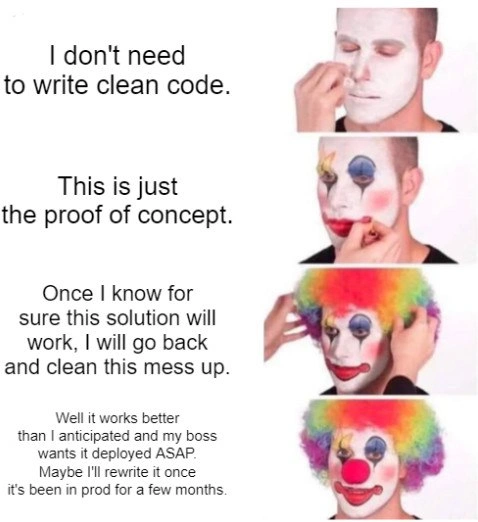
In this clownish saga of Technical Debt, we see a proof-of-concept morphing into a mission-critical system overnight – a transformation every seasoned engineer recognizes with a mix of laughter and dread. The meme’s four panels depict a developer step-by-step applying clown makeup, each step corresponding to another rationalization for sloppy code. By the final panel, our developer is fully costumed as a clown – a perfect metaphor for how foolish one looks deploying spaghetti code to production under the guise of “temporary” solutions. The humor cuts deep because it's painfully real: a throwaway prototype (meant to be discarded or rewritten) gets fast-tracked into a production environment due to management’s release pressure and surprising initial success. This is a textbook example of proof_of_concept_gone_production – the code that was supposed to be a quick demo becomes the foundation of a real system, complete with all its messy entrails.

The text in each panel reads like the stages of a tragic comedy that senior developers know by heart:

  • Panel 1: "I don't need to write clean code." – The developer starts skipping best practices, thinking the code’s short lifespan makes quality irrelevant. Perhaps they pepper the code with global variables, magic numbers, and // TODO: fix later comments, expecting no one will ever see this code in the wild. At this stage, they’re just beginning to dab on the clown makeup, indulging in a bit of clean_code_procrastination.
  • Panel 2: "This is just the proof of concept." – The justifications deepen. The code is held together with duct tape and optimism, but that’s okay (they think) because it’s “temporary.” No unit tests, no documentation – after all, why polish something that will be thrown away? The clown makeup gets thicker. The developer might write functions like doEverythingInOneFunction() or hard-code values left and right. The architecture is non-existent, perhaps a big ball of mud design, but who cares? It’s not like we’re deploying this... right?
  • Panel 3: "Once I know for sure this solution will work, I will go back and clean this mess up." – Ah, the famous last words. This is the RefactoringNeeded promise that rarely gets fulfilled. The developer genuinely believes there will be time to untangle the spaghetti code, add proper error handling, and write those missing unit testsafter the concept is proven. But any experienced engineer can practically hear the clown honk at this reasoning. In reality, once the hack “works,” forces conspire to ensure it never gets cleaned: deadlines, boss’s enthusiasm, fear of breaking the only copy of a working solution. The developer is now wearing the rainbow wig and red nose, convincing themselves they'll refactor "later" – a mythical time that exists just beyond the next sprint (and always will).
  • Panel 4: "Well it works better than I anticipated and my boss wants it deployed ASAP. Maybe I'll rewrite it once it's been in prod for a few months." – This is the punchline, delivered by a fully decked-out clown. The throwaway code exceeded expectations and now stakeholders want to deploy it immediately. The developer has no choice but to roll this half-baked solution into production, 🤡 and all. The code is far from ProductionReadyCode, yet here it goes, handling real users and real data. The promise to "rewrite it in a few months" is the final self-delusion. Every senior engineer reading this knows that once a messy solution is serving customers, rewriting it becomes exponentially harder – it's now a moving train with passengers. That “few months” will turn into a few years, if not the entire lifetime of the system. Thus, a sketchy proof of concept quietly ossifies into a permanent, brittle part of the architecture. Welcome to the TechDebt carnival, where today’s quick hack is tomorrow’s legacy system!

The humor here comes from the cognitive dissonance and shared pain: we’ve all heard these rationalizations in real meetings. It’s a satirical take on ReleasePressure overriding engineering prudence. Clean code and proper design are pushed aside for speed, and everyone pretends this is fine – until it’s not. The clown makeup meme format perfectly captures the escalating foolishness: each additional layer of face paint is another layer of self-deception. By the end, the developer (and their codebase) is virtually unrecognizable, wearing the full clown suit of accumulated TechnicalDebt. As a senior dev, it’s a facepalm moment – you witness a colleague (or perhaps your younger self) essentially deploying a prototype as a production system, and you just know that a messy_code_in_prod disaster is brewing. It’s funny because it’s true: the gap between what we intend (temporary hack) and what we deliver (actual product) can be absurdly wide in software projects. The meme resonates especially in teams who have uttered the classic line, “We’ll refactor in the next release,” only to find that “next release” never comes because the hacked solution is technically working and nobody wants to disturb it.

From an industry perspective, this scenario is a well-known anti-pattern. Shipping a proof of concept as if it were final is like launching a rocket built out of cardboard because the prototype managed to lift an inch off the ground. The technical debt incurred – all those shortcuts and omissions – acts like accrued interest on a loan: it slows down future development and can lead to costly failures at the worst times. Seasoned engineers have learned (often the hard way) that "we'll fix it later" almost always means we won’t fix it at all, especially once users rely on the system. This clown-makeup meme is a humorous cautionary tale: the more you justify neglecting good practices now, the more of a clown you may feel like when that SpaghettiCode lives in prod forever. 🤡

Description

A four-panel meme, known as 'Putting on Clown Makeup', illustrates a developer's descent into creating technical debt. Each panel on the right shows a person progressively applying more clown makeup, while the corresponding text on the left reveals their justifications. First panel: 'I don't need to write clean code.' shows the person applying white face paint. Second panel: 'This is just the proof of concept.' shows them getting colorful eye makeup and red lips. Third panel: 'Once I know for sure this solution will work, I will go back and clean this mess up.' shows them putting on a rainbow clown wig. Final panel: 'Well it works better than I anticipated and my boss wants it deployed ASAP. Maybe I'll rewrite it once it's been in prod for a few months.' shows the person with a full clown face, including a red nose. The meme satirizes the common developer rationalization process where a 'temporary' or 'proof of concept' solution, written with poor quality, ends up in production due to business pressure. Experienced engineers find this painfully relatable as it highlights how easily good intentions to refactor are abandoned, leading to long-term technical debt that rarely gets addressed
Comments

10
Anonymous ★ Top Pick The most permanent thing in software is a 'temporary' solution that worked on the first try
  1. Anonymous ★ Top Pick

    The most permanent thing in software is a 'temporary' solution that worked on the first try

  2. Anonymous

    Our architecture doc still labels this service "throwaway-poc," yet it now sits behind Kafka, three Lambdas, and the CFO’s quarterly report - because nothing scales like code you promised to delete tomorrow

  3. Anonymous

    The same POC code that was "definitely getting refactored" is now the critical path for three microservices, has its own Kubernetes namespace, and just got promoted to the company's reference architecture

  4. Anonymous

    Nothing is more permanent than a temporary solution that works - it instantly acquires users, dependencies, and a line item in next year's 'modernization initiative'

  5. Anonymous

    This meme perfectly captures the four stages of technical debt grief: denial ('I don't need clean code'), bargaining ('just a POC'), false hope ('I'll refactor later'), and acceptance ('it's been in prod for 18 months and nobody dares touch it'). The real punchline? That 'few months' rewrite is still in the backlog, right below 'migrate off jQuery' and 'update Node 12' - both added in 2019

  6. Anonymous

    The lifecycle of a spike: demo → ‘just ship it’ → mission‑critical microservice with an SLO, while the refactor ticket expires faster than its TLS cert

  7. Anonymous

    The second law of thermodynamics in action: POCs start elegant, but prod entropy turns every codebase into a clown car of tech debt

  8. Anonymous

    Every “temporary” PoC that ships to prod is a payday loan against your SLO - interest compounds nightly at 03:00

  9. @pinguin2001 4y

    Windows 11 be like:

  10. @SamsonovAnton 4y

    People who like to say "Premature optimization is the root cause of all evil" be like:

Use J and K for navigation