Skip to content
DevMeme
3745 of 7435
The SaaS Grind vs. The NFT Gold Rush
IndustryTrends Hype Post #4085, on Jan 25, 2022 in TG

The SaaS Grind vs. The NFT Gold Rush

Why is this IndustryTrends Hype meme funny?

Level 1: Working Hard vs. Lucky Break

Imagine you spent all year building an awesome LEGO city – you carefully put together every brick, made houses, roads, and cars, really doing your best job. You’re proud of how much effort you put in. Now suppose a friend of yours draws a quick funny picture of a dog on a piece of paper and, out of the blue, someone offers them a giant pile of money for that drawing. It’s like your friend won a big prize in a contest you didn’t even know was happening, just for that one little drawing. Meanwhile, you worked so hard on your project and no one is handing you a giant pile of money for it. How would that make you feel? Probably pretty confused and maybe a bit frustrated! You might even laugh and think, “Wow, what a joke… I did all this work and they got rich from a doodle.”

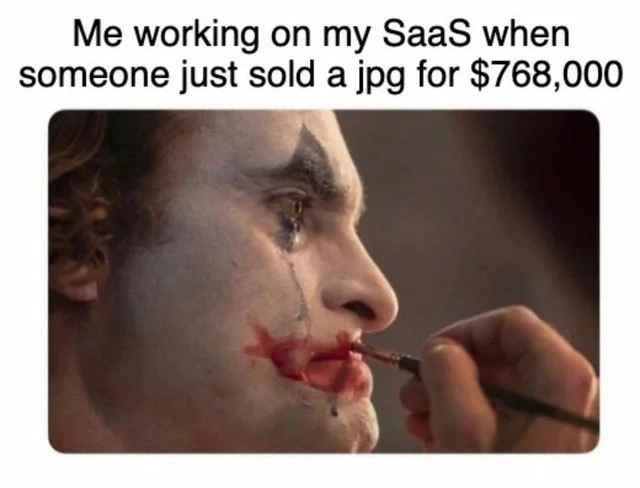
That’s exactly the feeling this meme is joking about. The person in the picture is the hard-working one (like you building the LEGO city) and they’re putting on clown makeup, which means they feel a bit foolish or like the joke’s on them. They’re saying, “I guess I’m the clown for working so hard.” Why? Because someone else just got an easy, lucky break – like winning a lottery – by selling a simple thing (a picture of a dog, in this case) for an unbelievable amount of money. It’s funny in a teasing way: it shows how life isn’t always fair. Sometimes people who work really hard see others get rewarded for something that seems silly or effortless. The clown makeup is a way to cope with that feeling – you sort of make fun of yourself for being the “silly” one who thought hard work would be the most rewarded.

So in very basic terms: one person did a lot of hard work on something real, and another person got super lucky with something that looks like a simple fun idea. The hard worker feels a bit like, “Well, I guess the joke’s on me!” It’s a mix of envy and humor. We laugh at the situation because it’s so absurd and unfair that it’s cartoonish – like something you’d see in a clown show. The meme is using that exaggeration to make us grin and say, “Yeah, that’s how it feels sometimes!”

Level 2: Hype vs. Hard Work

Let’s break down the joke in simple terms. On one side, we have SaaS, which stands for Software as a Service. This is a common model in tech where a company builds an application and offers it to users over the internet, usually charging a subscription fee. Think of things like online email services, project management tools, or any app where you pay monthly to use it. Building a SaaS product is a lot of work: you have to write a ton of code, make sure the app can handle many users at once (multi-tenant means one app/server is serving lots of different customers safely), and keep improving the service. SaaS founders and developers often talk about long nights coding, fixing bugs, dealing with customer support, and slowly growing the number of users. The phrase “blood, sweat and tears” is often used to describe this intense effort — it’s not literal blood, of course, just a metaphor for hard work and sometimes suffering to make something great.

Now, on the other side, the meme mentions someone selling a JPEG dog for $768,000. What’s that about? This is referring to a trend involving NFTs. An NFT, or Non-Fungible Token, is basically a unique digital certificate that says you own something one-of-a-kind on the internet (usually some digital art, image, or collectible). It’s built using blockchain technology – the same kind of technology behind cryptocurrencies like Bitcoin. Blockchains are like public ledgers (imagine a record book everyone can see) that keep track of who owns what. An NFT uses that system to assign ownership of a specific item that can’t be copied in terms of ownership (even if the picture itself can be copied, the NFT is like the “authentic” claim of ownership). In this case, a “JPEG dog” just means a picture of a dog (JPEG is a common image file format) that someone turned into an NFT token and sold. And yes, during the height of the BlockchainHype around NFTs (roughly 2021), real headlines showed seemingly goofy things like an NFT of a cat meme or a dog picture selling for hundreds of thousands of dollars, sometimes even millions. It sounds unbelievable, but it was an actual craze — people were treating these NFTs like rare Pokémon cards or art pieces and paying huge amounts for them.

So the meme’s caption is basically the developer saying: “Here I am, working diligently on my SaaS startup, and meanwhile someone else just made $768,000 by selling a digital picture of a dog.” It’s a classic expression of disbelief and sarcasm. The humor comes from the valuation disparity — that’s a fancy way to say there’s a huge difference in how the market values the two things. The poor developer’s project might be really useful and maybe even making some money, but it’s probably nowhere near a $768,000 payout, especially not overnight. On the flip side, the NFT sale for the dog picture seems to have made a ridiculous amount of money with comparatively little effort.

Let’s clarify a couple of terms from the tags and context for completeness:

  • ERC-721: This is the name of a standard on Ethereum (a popular blockchain) for creating NFTs. You can think of it like a template or recipe that developers use so that their NFTs work with common marketplaces. The meme jokes about a “one-liner” ERC-721 mint, implying that sometimes creating an NFT can be as simple as calling a single function or running a short script, especially with existing libraries. In reality, there’s more to it (you have to deploy a smart contract), but compared to building a full software product, it can feel like a trivial amount of coding to get an NFT out there.
  • Multi-tenant SaaS grind: “Multi-tenant” we covered – it means the software is designed to accommodate many clients in one system. The “grind” refers to the hard work and long hours (grinding away) to build and maintain that kind of complex system. This is day-to-day developer toil: writing code, fixing bugs, setting up servers, etc. It’s called a grind because progress can be slow and you have to continuously put in effort.
  • Founder existential crisis: A startup founder is someone who started their own company (like a SaaS app). An “existential crisis” is when someone seriously questions the meaning and purpose of what they’re doing. Combine those, and you have a founder suddenly questioning if their whole startup journey makes sense. In the context of the meme, the person working on the SaaS might jokingly (or semi-seriously) think, “Why am I doing all this? Did I choose the wrong path? Who’s the clown here, really?” upon seeing the NFT madness.
  • Tech Hype Cycle: This refers to a phenomenon often talked about in the tech industry (popularized by Gartner). It’s the pattern that a new technology often goes through: first there’s excitement and unrealistic expectations (hype), then a crash when reality sets in, and eventually a more stable growth once the tech matures. NFTs in 2021 were at that crazy hype peak – everyone thought they’d revolutionize art, gaming, finance, etc., and prices/speculation went through the roof. The meme is set during that peak hype time, so it’s a commentary on that trend (IndustryTrends_Hype is basically pointing to this very situation of a trendy bubble).

Now, the image itself: it shows someone carefully applying clown makeup. In meme language, making yourself into a clown means you realize you’ve been silly or you feel foolish. It’s often used when someone’s made to feel that all their serious efforts were in vain or based on a wrong assumption. Here, the developer is metaphorically putting on clown makeup on themselves, as if saying “I guess I’m the clown for working so hard on something traditional, while the real joke is the market rewarding something seemingly trivial.” It’s very much a self-deprecating kind of humor – the developer is not literally a clown, but they feel like one for a moment.

In simple terms, this meme is comparing hard work vs. sudden luck. The “SaaS blood, sweat and tears” side is the hard work: doing everything right, grinding day in and day out. The “NFT lottery valuations” side is like a sudden lucky break: a lottery ticket payoff, where someone gets a huge reward out of nowhere (from the perspective of an outsider, at least). It resonates in the tech community because a lot of people at the time were scratching their heads at how some blockchain projects or digital collectibles were skyrocketing in value, while normal businesses had to fight tooth and nail for every dollar. The meme captures that absurd feeling in one image and one caption. It’s funny in a are-you-kidding-me kind of way. Even if you’re new to tech, you can understand the irony: normally, we expect more reward for more work (like study hard, get a good grade), but here it looks inverted – someone did something that looks effortless and got a huge reward, while someone else is working super hard and feeling left behind. That’s the crux of the humor.

Level 3: Multi-Tenant vs mintToken()

For the seasoned developer or startup founder, this meme delivers a very pointed punchline. It contrasts the grind of building a SaaS with the gold-rush vibe of the NFT world. Picture a founder who has spent months – maybe years – working on a cloud application: architecting a multi-tenant system (where one codebase serves many customers securely), wrestling with payment gateways for recurring billing, ensuring compliance with regulations (GDPR, SOC 2, you name it), setting up customer support, and carefully scaling the service. This is the everyday StartupLife: lots of late nights, meticulous coding, and gradual gains. The phrase “blood, sweat and tears” in the title isn’t an exaggeration; building a reliable SaaS product requires continuous hard work and personal sacrifice. Every new customer gained is a win from literal sweat equity. If you’ve ever dealt with something like implementing single sign-on or patching a production bug at 3 AM, you know the unglamorous effort behind a stable SaaS.

Now along comes the NFT craze – a quintessential example of StartupCulture getting upstaged by what feels like a Vegas casino. The meme’s caption “someone just sold a jpg for $768,000” refers to a real pattern during the NFT boom: trivial or humorous digital collectibles (like a meme image of a dog) fetching house-sized sums of money. From the perspective of a hard-working developer, seeing that headline scroll by is both awe-inspiring and soul-crushingly absurd. The careful SaaS builder can’t help but think: “Really? I’m over here optimizing database queries and fine-tuning onboarding flows, and that guy just cashed out enough to buy a house by selling a digital trading card of a dog?” It’s the ultimate valuation disparity. The logical part of your brain knows these scenarios are outliers, likely the peak of a hype cycle, not sustainable. But the emotional part can’t help feeling like the universe just played a joke on all your practical efforts. That feeling is the founder_existential_crisis this meme hints at – when a founder literally questions, “What am I doing with my life building this company, when apparently I could draw a doodle or write a few lines of solidity code and potentially hit the jackpot?”

The side-by-side comparison could be broken down like this:

SaaS Grind (Hard Work) NFT Goldrush (Hype Windfall)
Building real features over months or years; fixing bugs, handling user support daily. Minting a token in a day (or just uploading art to an NFT marketplace).
Income grows via monthly subscriptions – maybe tens or hundreds of dollars per customer, steadily earned. Income comes as one-off windfalls – potentially hundreds of thousands from a single sale if you get lucky.
Valuation tied to revenue and user growth (slow, logical buildup). Valuation tied to hype, rarity, and FOMO (fast, often irrational spikes).
Responsible for ongoing maintenance: uptime, updates, customer retention – you must deliver continuous value. After the sale, there’s often no ongoing obligation – the value can evaporate if the hype dies, but the seller already profited.

The table really underscores why the person in the meme might feel like a clown. On the left, the SaaS path is all about grinding and steadily building value. On the right, the NFT path is like catching a lucky break in a speculative frenzy (a TechHypeCycle peak). It’s not that NFTs require zero skill – there’s creativity and tech involved in launching a successful one – but relative to a full-blown SaaS product, the effort vs. reward ratio can seem comically skewed during a hype wave. A single clever smart contract and some buzz on crypto Twitter might bring in more cash overnight than a finely-tuned SaaS will see in a year.

To make this concrete, think about the technical effort: writing a robust SaaS might involve thousands of lines of code across front-end, back-end, and infrastructure (AWS configs, databases, user authentication flows, etc.). In contrast, deploying an NFT often boils down to a few crucial lines in a smart contract. For example, an NFT contract’s core might look like:

function mintDogNFT(address to, string memory metadataURI) public {
    uint256 tokenId = totalSupply() + 1;
    _mint(to, tokenId);
    _setTokenURI(tokenId, metadataURI);
    // One simple function to register a new "JPEG dog" token on the blockchain
}

That one function (using a standard library in Solidity) can create a brand new token representing ownership of a unique dog JPEG, assign it to someone, and set the reference to the image’s metadata. And boom – you have a product (of sorts) to sell on a marketplace. It’s admittedly a very small product, with no ongoing service behind it, but the meme is pointing out how such a tiny bit of code or effort could yield an outsized payday in the NFT era. Meanwhile, your SaaS likely has a whole class for handling subscription billing retries and another for permission management – and none of those guarantee you a payday like that.

The BlockchainHype of 2021 (when this was posted) made such scenarios common cocktail-talk in tech circles. There were real stories of people making life-changing money by selling pixel art, tweets, or meme images as NFTs. For example, the original “Doge” meme image (featuring an actual Shiba Inu dog) was sold as an NFT for an eye-popping sum. These were the lottery-ticket outcomes that had every developer shaking their head. We joked on forums and Twitter that we should drop everything and start an NFT project, half-seriously. It’s the classic grass-is-greener moment: “Why am I sweating over multi_tenant_saas_grind when a bit of crypto-art could set me up for life?”

Of course, seasoned engineers also know the other side: many NFT projects flopped, and many jokey JPEGs never sold at all. Chasing hype is usually not a stable strategy. The SaaS, built with solid fundamentals, might still be around in 5 years providing steady income, whereas the hyped NFT’s value could crash 99% once the bubble pops. But knowing that doesn’t make it any less frustrating in the moment when someone hits the jackpot. So the meme’s humor is really the TechHumor of shared pain: we all understand how upside-down it feels that serious work can be overshadowed by what looks like absurd luck. We laugh because otherwise we’d cry, right? The clown makeup is the perfect metaphor – you laugh at yourself for even briefly thinking that playing by the “hard work” rules would guarantee the best outcome. It’s a dark, ironic laugh among veteran developers and founders: the universe has a funny way of rewarding things.

Thus, in this meme, StartupCulture meets Blockchain mania. It’s the responsible tortoise versus the speculative hare. And in 2021’s tech story, the hare was zipping far ahead (until it eventually ran off a cliff, but that part comes later). The meme captures that snapshot in time when every serious SaaS builder was momentarily tempted to question their life choices, feeling like the clown painting on a smile while the NFT circus rolled into town with bags of cash. It’s cathartic humor – a way for those who’ve been diligently coding and hustling to vent: “Sure, I’m only building a real business here… but apparently I should have just drawn some dogs on the blockchain. Ha. Ha. 🎪🤡” (Yes, that’s a bit of bitter clown laughter echoing in the text).

Level 4: Proof-of-Hype Economics

At the deepest level, this meme highlights a clash between fundamental value creation and speculative market dynamics. Building a SaaS (Software as a Service) product is rooted in traditional business principles: you create software that solves a real problem, charge users a recurring fee, and grow steadily. Valuations for SaaS startups are usually based on multiples of revenue or user growth – tangible metrics grounded in utility. In stark contrast, the NFT craze represents a wild deviation from these fundamentals. An NFT (Non-Fungible Token) is essentially a unique digital deed, often implemented via the Ethereum ERC-721 standard, that uses cryptographic guarantees on a blockchain to prove ownership of a one-of-a-kind digital item (like that JPEG of a dog). This technology of digital scarcity is elegant – it solved a long-standing problem of how to establish uniqueness and ownership for digital assets using decentralized consensus. In academic terms, a blockchain achieves agreement on who owns what through protocols that tolerate faults (the famous Byzantine Generals Problem solved by proof-of-work or similar). That means when someone “mints” (creates) a token for a dog image, the network collectively agrees it’s the one-and-only original token tied to that image.

However, the humor (and absurdity) here comes from how human economics overlay this tech: the NFT isn’t generating cash flow or solving a practical problem; its value comes from pure speculative demand. The price tag – a JPEG dog selling for $768,000 – is a prime example of a speculative bubble phenomenon. Economically, this is often described by the greater fool theory: people buy an overpriced asset not for its intrinsic worth, but because they expect to find an even “greater fool” later who’ll pay more. It’s the same logic that fueled historical manias like Tulipmania in the 1630s and the dot-com bubble around 2000. Here, the “asset” just happens to be a blockchain token linked to a dog picture. The IndustryTrends_Hype aspect is evident: NFTs became an irrationally hot trend, where the usual rules of valuation went out the window. Everyone was chasing the next big score in the crypto art lottery, pumping prices to surreal heights solely because they believed in the hype or didn’t want to miss out (classic FOMO, or “Fear Of Missing Out”).

From a theoretical standpoint, it’s almost a collision of two economic worlds. On one hand, the SaaS model aligns with the idea of intrinsic value – the product is worth something because it provides ongoing service to users. On the other hand, NFT valuations during the craze were almost entirely extrinsic – driven by collective belief, memetics, and the hope that someone else will pay even more. The meme’s top caption sets up this dichotomy perfectly. The developer sweating over multi-tenant billing logic is engaging in value creation the old-fashioned way (incremental, effortful, rational), while the NFT speculator is capturing value the newfangled way (sudden, effortless, hype-driven).

It’s telling that the image chosen is a person applying clown makeup. In internet parlance, “putting on clown makeup” means realizing you’ve been foolish or that you’re about to play the fool. At this level, it symbolizes a moment of existential clarity about market irrationality. The experienced engineer can’t help but feel like the fool for grinding away on a serious startup while witnessing what is essentially a crypto lottery winner. It’s as if the universe of tech economics momentarily turned upside down: the serious work is undervalued, and the speculative token gets the spotlight. We might even say, in a tongue-in-cheek way, that the invisible hand of the free market is wearing a clown glove here.

In summary, the meme on a deep level is poking fun at how blockchain hype created a temporary reality where a single clever (or absurd) use of cryptography – minting an NFT – could generate astronomical valuations overnight. It reflects the puzzling outcome of a trustless decentralized technology (which is a marvel in itself) enabling what feels like an economic circus. For those of us who study or have lived through tech bubbles, it’s a reminder that markets can remain irrational (and hilarious) longer than you can remain solvent – or in this case, longer than you can keep a straight face without clown makeup.

Description

A meme featuring a close-up shot of Joaquin Phoenix as Arthur Fleck from the movie 'Joker'. He is in the process of applying clown makeup, with a tear rolling down his cheek and smudging the paint, conveying a sense of profound sadness and exhaustion. A white text box above the image contains the caption: 'Me working on my SaaS when someone just sold a jpg for $768,000'. The image and text together create a poignant and relatable commentary on the tech industry during the NFT (Non-Fungible Token) bubble of 2021-2022. The joke highlights the stark contrast between the immense effort, dedication, and complexity involved in building a legitimate Software-as-a-Service (SaaS) product and the seemingly effortless, speculative windfalls from selling NFTs. For experienced developers, this captures the feeling of disillusionment when the market appears to reward low-effort hype more than substantive engineering work
Comments

12
Anonymous ★ Top Pick I spent a week debugging a race condition in our microservices architecture, while someone else right-clicked, saved, and minted a JPEG for a mortgage-free life. It feels like we're optimizing for the wrong metrics
  1. Anonymous ★ Top Pick

    I spent a week debugging a race condition in our microservices architecture, while someone else right-clicked, saved, and minted a JPEG for a mortgage-free life. It feels like we're optimizing for the wrong metrics

  2. Anonymous

    Apparently my five-year battle with multi-tenant billing still earns less than a one-line ERC-721 that says "woof"

  3. Anonymous

    Spent three years optimizing database queries to shave 50ms off response times while someone's monkey JPEG just outperformed my entire company's valuation because it has a rare hat

  4. Anonymous

    Months of multi-tenant architecture, billing edge cases, and SOC 2 prep - outvalued by a JPEG whose entire infrastructure is a URL that will 404 by next year

  5. Anonymous

    While you're architecting multi-tenant isolation, implementing OAuth flows, and optimizing database queries for your SaaS platform, someone just right-clicked 'Save As' on a procedurally-generated monkey picture and retired. The real joke? Your ARR projections assume rational market behavior, but you're competing in an economy where a JPEG with provable scarcity on an immutable ledger somehow has better unit economics than your carefully crafted subscription model. At least when your SaaS inevitably pivots to 'blockchain-enabled' something, you'll have the technical chops to actually build it - unlike the person who just sold that JPEG, who probably can't explain what a Merkle tree is beyond 'it's like, crypto stuff.'

  6. Anonymous

    Years refactoring my SaaS monolith for $1k MRR; one Ethereum tx flips a JPG to 768k. True proof-of-stake

  7. Anonymous

    I spent a quarter wiring multi-tenant billing, SSO, and SLOs; a rock PNG cleared my ARR in one block - apparently I shipped SaaS when the market wanted Hype‑as‑a‑Service

  8. Anonymous

    I hardened multi-tenant RBAC and EU VAT billing - turns out exits scale with subscribers.csv, not pods or SLOs

  9. Deleted Account 4y

    Me working on my SaaS when someone just sold a Google Drive link for a jpg for $768,000

    1. @TERASKULL 4y

      Me building a SaaS for a client that will be used for hardcore gay porn NFT minting.

  10. @Magilarp 4y

    Me building a SaaS (idk what that is) when someone just dumped an NFT to the next biggest fool in a line of next biggest fools

    1. @RiedleroD 4y

      software as a service

Use J and K for navigation