Skip to content
DevMeme
3976 of 7435
Pointer Safety Enlightenment Levels, From Checks to Mapping the Zero Page
Bugs Post #4325, on Apr 19, 2022 in TG

Pointer Safety Enlightenment Levels, From Checks to Mapping the Zero Page

Why is this Bugs meme funny?

Level 1: No Lock, No Lockouts

Imagine you have a door that locks behind you, and you keep forgetting your keys. The first idea is just to be really careful and always remember your keys (that’s like a coder being extra careful with pointers). The second idea: put a reminder sign on the door or check your pockets every time you go out (this is like a program doing a runtime check for null pointers – a little safety step each time). The third idea: get a fancy keypad or a fingerprint lock that won’t even require a physical key (this is like using a new language/technology that doesn’t allow the possibility of a missing key/null pointer at all). Now for the last idea: you’re so fed up with keys that you decide to remove the lock from the door altogether. 😮 Now you can never get locked out, because, well, the door never truly locks! That’s like making the forbidden address 0 into a real place – you’ll never crash from a null pointer because null isn’t null anymore. Of course, leaving your door unlocked all the time might solve your lockout problem but invites a ton of new problems (anyone could just walk in!). It’s a silly, extreme fix. The meme is funny because it’s as if each step we got smarter about solving the lost key problem, and then suddenly someone suggests a “solution” that is so out-there (and not really wise in reality) that it makes you laugh. It’s showing how desperate or creative people can get when trying to avoid problems – sometimes crossing over into the absurd.

Level 2: Look Before You Dereference

Let’s break down the joke in simpler terms. The meme is about null pointer errors, which are a very common bug in programming. A pointer is like a reference or an address that tells the program where to find something in memory. A null pointer basically means the pointer isn’t set to any valid address – it’s pointing at “nothing.” In many languages (like C/C++), NULL is often represented as 0, an address that you’re not supposed to use. If your code tries to use a null pointer (for example, tries to access whatever it points to), the program blows up with a runtime error – often a crash like a segmentation fault. Think of it like having a bogus house address; if you try to visit it, you end up in a wall or an empty field – it just doesn’t work.

So, how do developers avoid these crashes? The meme lists four “enlightenment levels” of solutions:

  • Careful Programming: This means being very careful not to make the mistake in the first place. For a programmer, that includes things like initializing pointers properly, checking for errors, and following best practices. It’s essentially saying “just don’t mess up.” For example, if you call a function that returns a pointer, you make sure to handle the case when that pointer might be NULL. This is basic defensive programming, akin to always double-checking your work manually. It works most of the time but relies entirely on the programmer’s diligence. Humans forget, so this alone often isn’t enough.

  • Runtime Checks: This is like putting safety guards in the code. Here, the program itself checks if a pointer is null while it’s running, and then handles it gracefully rather than just using it blindly. For instance, before using a pointer, you might do: if (ptr != NULL) { /* proceed */ } else { /* handle error */ }. Many languages will throw a specific error (like throwing an exception) if you attempt to use a null reference – that’s the language performing a runtime check for you. This approach catches the problem at the moment of use, which is better than crashing unexpectedly. It’s as if every time you go to open a door, you try the knob gently to see if it’s locked (null) before you barge in. It adds a bit of overhead (some extra code and checks), but makes the software more robust.

  • Compile Time Checks & Language Design: This is where the programming language helps you avoid the problem entirely. Compile time means when you build the program, before it even runs. Some languages are designed so that you cannot forget to handle null values – the compiler will yell at you if you do. For example, in Rust you would use an Option type instead of a raw pointer, and the compiler forces you to consider both the “Something” and “Nothing” cases. In languages like Kotlin or Swift, variables are by default not allowed to be null; if something can be null, you have to explicitly mark it and handle it. This is a really clever way to avoid null pointer bugs: the problem is solved at the code design level. The meme calls this “clever language design” because languages have evolved features specifically to combat the notorious null pointer errors (remember, it’s a billion-dollar mistake for a reason!). This approach is like having a door that simply won’t close unless you have the key in it – you just can’t make the mistake of locking yourself out, because the design prevents it.

  • Making 0 a Usable Memory Address: And now the crazy one. This isn’t a typical solution you’ll find in programming textbooks – it’s more of a joke or extreme thought experiment. The idea is, if null is represented as address 0, what if we just made address 0 valid? Then a null pointer wouldn’t be pointing at “nothing” anymore! In a very low-level sense, one could try to allocate actual memory at address 0 (which operating systems normally forbid). If that were done, dereferencing a null pointer would just read/write that memory and not crash. It’s like saying, “I keep falling into this hole, so I’ll fill the hole with concrete. Problem solved!” Yes, you won’t fall – but you’ve introduced other issues. In computing, doing this breaks a lot of assumptions. It could mask bugs – your program might be doing the wrong thing with a null pointer and you wouldn’t know because it didn’t crash. It also can create security risks (for example, malicious programs could exploit this in weird ways). So, while it technically avoids the immediate error, it’s considered a terrible practice in real life except in very specialized systems. The meme uses it as the final over-the-top punchline – it’s the kind of wacky idea that makes you chuckle because it’s both ingenious and absurd.

So, the joke progression is: we start with normal, sensible solutions (be careful, add checks, use better languages/tools) and end with a wild, “so crazy it just might… no, it’s still crazy” kind of solution. It’s funny to programmers because it parodies the way people sometimes propose off-the-wall hacks to avoid addressing the real problem. And it specifically resonates with anyone who’s wrestled with pointers in C/C++ or similar low-level programming issues. We’ve all seen that one bug that keeps causing segfaults until you put in a check or refactor the code – the idea of just making the segfault impossible by changing how memory works is a comedic exaggeration of our desperation. The meme format (the expanding brain with increasing “intelligence”) sets us up to expect a wise, sophisticated final answer – and then delivers a solution that’s technically clever but practically insane. That twist is the heart of the humor.

Level 3: Billion-Dollar Cure

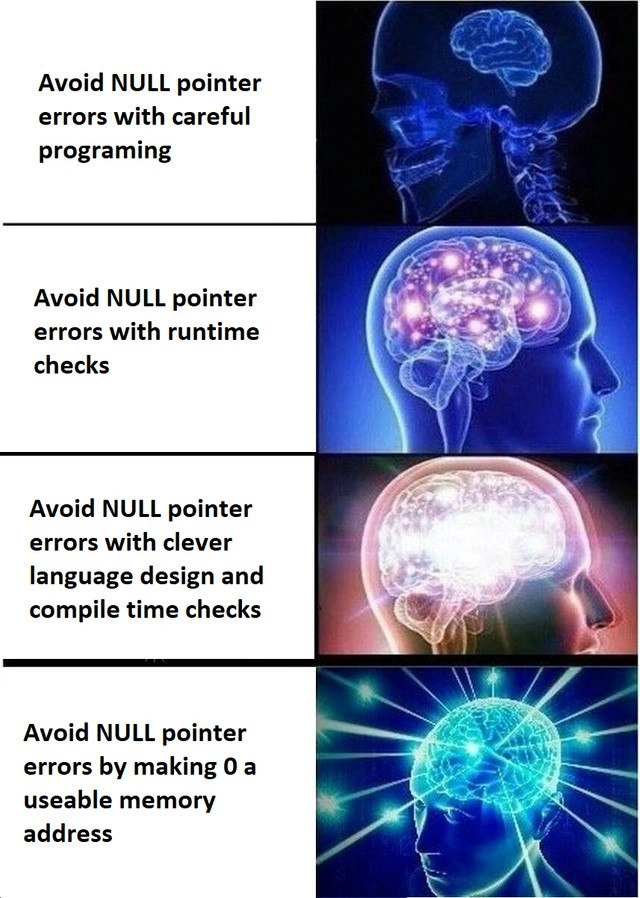
Why go to such extremes? The meme humorously escalates through real strategies developers use to handle null pointers, each tier reflecting a deeper commitment to preventing that infamous runtime error. The shared developer experience here is the universal dread of dereferencing NULL (a pointer aimed at nothing) and causing crashes. Many of us have felt that sinking feeling when a program blows up with a segfault, or the Java equivalent NullPointerException. It’s so common that Sir Tony Hoare dubbed the null reference “my billion-dollar mistake.” The meme’s four levels riff on how we try to banish this mistake:

“Avoid NULL pointer errors with careful programming.”
Use discipline and manual caution. This is the entry-level solution: just be careful, double-check your code, and defensive coding practices will save you. Seasoned C programmers know the drill – initialize your pointers, check your returns, and never trust anything. It’s akin to telling a junior dev: “just don’t make mistakes.” 🙃 It sounds simple, but in practice humans are fallible, especially with manual memory management. Forget one check and boom – segmentation fault. This level reflects an approach where code quality relies on individual diligence and code reviews. It works… until it doesn’t.

“Avoid NULL pointer errors with runtime checks.”
Trust, but verify every time. Here we start adding runtime checks in the code to catch nulls before they do harm. A classic C snippet might be:

if (ptr == NULL) { 
    return ERROR; // handle the null case
}
doSomething(*ptr); // safe to use ptr now

This is a step up in code safety: the program actively checks pointers at run-time to prevent misuse. Languages like C and C++ don’t do this for you automatically, but good coding standards (or static analysis tools) encourage adding these checks. Higher-level languages often throw exceptions if you call a method on a null object – that’s also a runtime check, just baked into the language. The meme’s brain glows a bit brighter here, because we’re using logic and guard rails in code. The downside? It’s slightly more work and can clutter the code. Plus, you only catch the problem when it’s about to happen, at runtime, which might be late – possibly in production. Still, compared to blind faith, this is a sane middle ground many teams adopt to reduce bugs.

“Avoid NULL pointer errors with clever language design and compile time checks.”
Eliminate the possibility of nulls by design. Now the brain is almost fully lit. This refers to modern language design and compile-time checks that outright prevent or greatly reduce the chance of null pointer dereferences. For example, Rust doesn’t even have a null value for normal references – you’d use an Option<T> type, which forces you to handle the “null or not null” question before the code ever runs. The compiler checks that you’ve covered the None case, so a Rust program won’t compile if you forget to handle a potentially null value. Similarly, languages like Kotlin, Swift, and C# have the idea of non-nullable types. If a variable is not explicitly declared as nullable, the compiler guarantees it can’t be null – you literally can’t assign null to it. The few languages that do allow NULL by default (like Java) have introduced Optional/Maybe types or annotations like @NotNull to help at compile time. This level is all about type systems and language rules acting as a safety net before the code even runs. It’s like getting a thorough inspection that won’t let the code through until all potential null-dereferences are sealed off. This approach is considered a best practice in modern software engineering – it tackles the problem at the root (in code structure) rather than at runtime. The meme treats this as the penultimate enlightenment because it’s a genuinely powerful solution; it’s the industry’s collective “aha!” to fix Tony Hoare’s billion-dollar mistake. Write languages or use features that make null errors impossible or at least extremely obvious to the developer. Fewer surprises in production, happier life for everyone.

Finally, the punchline:

“Avoid NULL pointer errors by making 0 a usable memory address.”
Redefine reality to bypass the problem. The brain in the image is now cosmic, hinting this is a “galaxy-brain” idea – it sounds ultra-enlightened but is actually tongue-in-cheek. This is a nod to some low-level programming lore. Instead of writing better code or using safer languages, you twist the environment so that a null pointer is no longer null! In C/C++, NULL is defined as address 0. Normally, accessing that triggers a crash, because the OS treats address 0 as off-limits. But if you map the zero page to real memory, a NULL pointer now points to a valid memory block. The program won’t crash; it might even think NULL just points to a struct of all zeroes. You’ve technically “avoided a null pointer error” because you removed the error condition itself. This is hilarious to experienced devs because it’s such an absurd workaround. It’s like fixing a leaky boat not by patching the holes, but by declaring water to be non-lethal and sailing on. 🤷‍♂️ It might keep the boat afloat a bit longer, but you’ve introduced a host of new problems (and you’re definitely ignoring why the leak happened!). In real life, almost nobody does this in production code — aside from some niche embedded systems or historical experiments — because it violates every principle of code quality and memory safety. But the sheer audacity of “solving” a bug by altering the fundamental rules (making the null address valid) is what makes the joke land. It satirizes that one guy in a meeting who proposes a crazy hack instead of doing things “the right way,” taking the idea of a clever workaround to an extreme. Seasoned developers laugh (and maybe cringe) because we’ve all seen scenarios where someone tries to fix a bug with a hack that’s technically genius but practically terrifying. This meme just pushes that to literal cosmic proportions.

Overall, the meme uses the Expanding Brain format to poke fun at our eternal battle with null pointers. Each panel escalates: from basic personal diligence, to programmatic checks, to language-level guarantees, and then to a god-tier hack that flips the table. It’s funny because it riffs on real solutions then ends with a ridiculously wrong-but-funny “solution.” The humor hits especially for C/C++ folks and systems programmers who deal with pointer arithmetic, segfaults, and the quirks of memory addresses. They’ll smirk at the first three approaches (familiar best practices) and then burst out at the last one because it’s a facetious twist – a reminder that sometimes our “bright ideas” can go way off the deep end. It’s a shared tongue-in-cheek acknowledgment of both how far we’ve come in making software safer and how, in the trenches, we occasionally entertain crazy ideas to patch up legacy code. After all, when you’ve been up at 3 AM debugging yet another NULL crash, the thought “what if I just made NULL valid?” might sound like fleeting genius. The meme captures that delirious thought and gives it the galaxy brain crown for comedic effect.

Level 4: Zero-Page Nirvana

At the deepest systems level, that last panel’s idea – “Avoid NULL pointer errors by making 0 a usable memory address” – is a memory management head-scratcher that only a true low-level guru might attempt. In modern operating systems, the virtual memory address 0x0 (the zero page) is deliberately left unmapped. Why? Because if a program tries to access address 0 (i.e., dereferences a NULL pointer), the CPU raises a fault (on x86/x64, a segmentation fault) and the OS stops the program. This safety net turns a potentially wild memory undefined behavior into a clean crash, making bugs easier to catch. But the galaxy-brain suggestion here is to remap the zero page – essentially trick the system into thinking address 0 is valid memory.

Doing this involves kernel-level wizardry: using something like the Unix mmap system call with the MAP_FIXED flag to place a page at address 0. For example, a privileged process on Linux might do:

// Dangerous hack: map a page at address 0x0
#include <sys/mman.h>
#include <fcntl.h>
int fd = open("/dev/zero", O_RDONLY);
void* p = mmap((void*)0x0, 4096, PROT_READ | PROT_WRITE, 
               MAP_PRIVATE | MAP_FIXED, fd, 0);

This code maps a 4KB page of zeros at 0x0. If successful, any NULL pointer (which is literally 0) now points to this harmless memory instead of causing a fault. In effect, dereferencing null would just read/write from that page. No crash! 🚀

Of course, this “solution” is like solving the headache by guillotining the pain sensors. You’ve eliminated the symptom (no more immediate crash on null access), but at what cost? By sacrificing the segfault alert, you risk silent data corruption or bizarre behavior as the program now merrily writes to address 0. In fact, operating systems usually prevent mapping low memory addresses in user space as a security measure. (Hackers once exploited kernel NULL pointer dereference bugs by mapping 0 and placing malicious code there – if the kernel accidentally jumped to null, it would execute the attacker’s payload). So mapping address 0 is generally blocked (e.g., Linux’s mmap_min_addr setting) precisely because it’s so dangerous.

In theoretical terms, this touches on the fundamentals of memory safety. Memory-safe languages and OS designs strive to ensure every pointer reference maps to valid, intended data. Here, instead of ensuring pointers are valid, we’re brute-forcing the memory environment itself to make an invalid pointer appear valid. It’s a complete inversion of typical safety practices – a systems hack that trades away reliability for the illusion of safety. It’s both brilliant in a mad-scientist way and absolutely bonkers. The meme’s final cosmic brain is poking fun at how an apparently “enlightened” low-level programmer might propose solving the problem by literally redefining reality (memory layout) to avoid errors, rather than dealing with pointers properly. This is null-pointer nirvana achieved by warping the system – a solution that technically avoids the dreaded crash, but by venturing into the realm of Undefined Behavior Zen where mere mortals fear to tread.

Description

Four-panel “expanding brain” meme split vertically: left column is white with black text, right column shows a side-view brain that glows more intensely each row. Row 1 text: "Avoid NULL pointer errors with careful programing" beside a dim blue X-ray brain. Row 2: "Avoid NULL pointer errors with runtime checks" next to a brighter violet, electrically sparking brain. Row 3: "Avoid NULL pointer errors with clever language design and compile time checks" beside an even brighter pink-white brain enveloped in light. Row 4: "Avoid NULL pointer errors by making 0 a useable memory address" alongside a cosmic, radiant green-blue brain exploding with energy. The gag escalates from ordinary defensive coding and runtime guards through type-system guarantees to an absurd systems-programming hack - remapping address 0 - highlighting null-pointer pitfalls, memory safety trade-offs, and undefined behavior familiar to C/C++ and low-level developers

Comments

7
Anonymous ★ Top Pick When the directive is “zero null-pointer crashes by Friday,” the junior adds guard clauses, the senior proposes Option<T>, and the staff engineer quietly mmap’s page 0 and calls it a root-cause resolution
  1. Anonymous ★ Top Pick

    When the directive is “zero null-pointer crashes by Friday,” the junior adds guard clauses, the senior proposes Option<T>, and the staff engineer quietly mmap’s page 0 and calls it a root-cause resolution

  2. Anonymous

    After 20 years of explaining why address 0x0 is sacred, I'm ready to negotiate a peace treaty with the kernel team if we can just map one tiny struct there for backwards compatibility with that legacy system nobody wants to rewrite

  3. Anonymous

    Mapping page zero doesn't fix null dereferences - it just promotes them from segfaults to silent data corruption, which is technically a zero-crash architecture

  4. Anonymous

    The real galaxy brain move is realizing that if you map valid data at address 0x0, you've just turned every NULL check in your codebase into a potential security vulnerability. It's the programming equivalent of solving your house's door lock problem by removing all the doors - technically no more lock failures, but you've created a somewhat larger architectural concern

  5. Anonymous

    Sure, you can “fix” null derefs by mmap’ing page zero - right up until ASLR, W^X, and your security team file a P0 with your name on it

  6. Anonymous

    When Rust's borrow checker feels restrictive, true architects just map NULL writable - zero-cost abstractions, 70s style

  7. Anonymous

    mmap page zero to a DefaultObject: the enterprise pattern that converts null pointer crashes into silent corruption and gets celebrated as “availability.”

Use J and K for navigation