First programming rule: if it works, ignore the obvious leaks
Why is this TechDebt meme funny?
Level 1: If It’s Not Sinking…
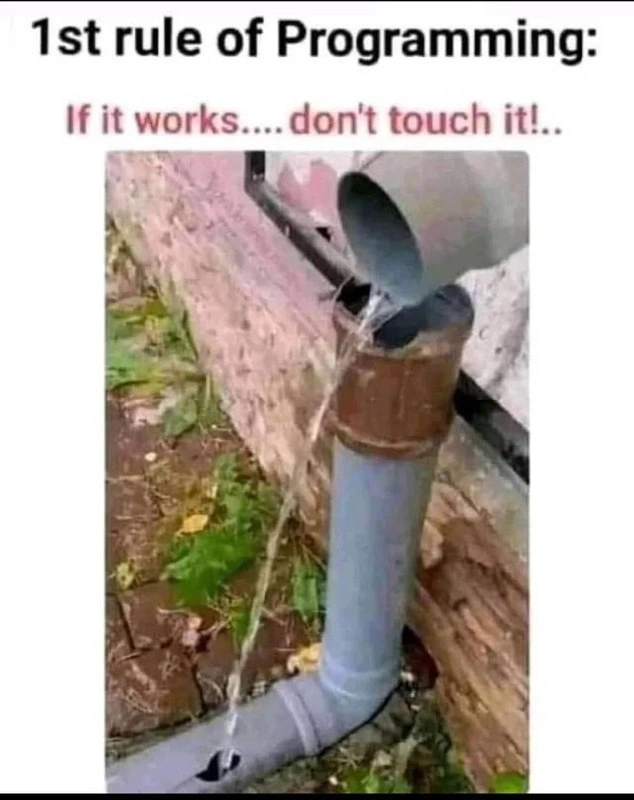
Imagine you have a small boat with a tiny hole in the bottom. A little water is coming in, but the boat is still floating just fine. What do you do? You should probably patch the hole, right? But let’s say you don’t have a patch kit and you’re scared that if you move things around too much, you might make the hole bigger. So instead, you just keep riding in the boat, occasionally scooping out a bit of water, pretending everything is okay. It sounds silly, but that’s exactly the joke here. The meme is saying that sometimes people treat programs (or any problem) like that boat: “If it’s working well enough, don’t mess with it!” We find it funny because the pipe in the picture is obviously broken — water is leaking everywhere — yet whoever set it up just left it that way. It’s like they said, “Well, the water is still coming through, so don’t touch it!” We laugh because we know ignoring a leak is not how you’re supposed to fix things, but we also kinda understand the feeling of not wanting to disturb something that’s barely working. The emotional core is the relief of not having to fix a tricky problem mixed with the anxiety that one day it might break badly. In everyday life, it’s like using an old toy or device that has cracks: as long as it still works, you shrug and say, “Meh, it’s fine.” It’s a lighthearted poke at this very human habit of avoiding trouble until we absolutely have to deal with it.
Level 2: Duct Tape Solutions
The meme is comparing programming to plumbing in a funny way. Think of the grey pipe in the picture as a piece of code. Water is supposed to travel through the pipe (like data or a function’s output flowing through a program). But here the water is spilling out of a big gap, clearly not going where it’s meant to — that’s the “obvious leak.” In programming terms, a “leak” could be something like a bug or a memory leak (where a program is using up memory and not giving it back). Normally, you’d want to fix a leak, right? But the caption says, “1st rule of Programming: if it works... don’t touch it!” This is a popular tongue-in-cheek saying among developers: “If it ain’t broke, don’t fix it.” It reflects a kind of fear_of_refactoring – refactoring means cleaning up or improving the code without changing what it does. Why would anyone be afraid to improve code? Because, especially in a LegacyCode (an old or fragile codebase that’s been around a long time), even a small change can unexpectedly break something else. Imagine a very old program that somehow still runs; the people who wrote it may have left, and there are hardly any tests (automatic checks) to ensure everything still works after changes. Developers call such systems legacy systems. In those, a quick fix or hacky workaround might have been added to solve an urgent problem — like adding an elbow joint pipe that doesn’t quite fit but directs most of the water. It’s not a clean solution, but it’s a production_quick_fix: it kept the program (or pipe) working in the moment. Over time, more and more of these duct tape solutions accumulate, which is what we call technical debt. Technical debt is like taking a shortcut in code: it makes things okay for now but creates “interest” (extra work or risk) later.
So, in simpler terms, the meme is poking fun at a common developer mindset: “This code is a mess and clearly has issues (like the leaking pipe), but since our program still runs and users aren’t screaming, we’d rather not mess with it.” It highlights a coding humor and pain point about maintenance: fixing the underlying problem (replacing the whole pipe properly or rewriting a chunk of code) can be time-consuming and might cause new bugs. Just as someone might procrastinate fixing a leaky pipe by saying “well, the water is still kind of going where it should,” a programmer might say “the app still works, mostly, so leave that old module alone.” Every junior developer learns about the ideal of clean, well-structured code (high CodeQuality), but then on their first team project they might encounter a giant, clunky function that everyone is scared to modify because it’s critical and nobody fully understands it. That’s the scenario here. The pink text “If it works... don’t touch it!!” isn’t serious advice for good coding; it’s a sarcastic summary of how people actually behave when dealing with fragile systems. The picture of the leaking_pipe_meme is a perfect plumbing_as_code_metaphor: code infrastructure can “leak” or have cracks, and sometimes instead of rebuilding it properly, developers will just watch the water flow around the problem. It’s both funny and a little sad — funny because it’s a goofy pipe situation, sad because it’s relatable when you’ve seen messy real-life code that everyone is afraid to fix.
Level 3: The Jenga Codebase
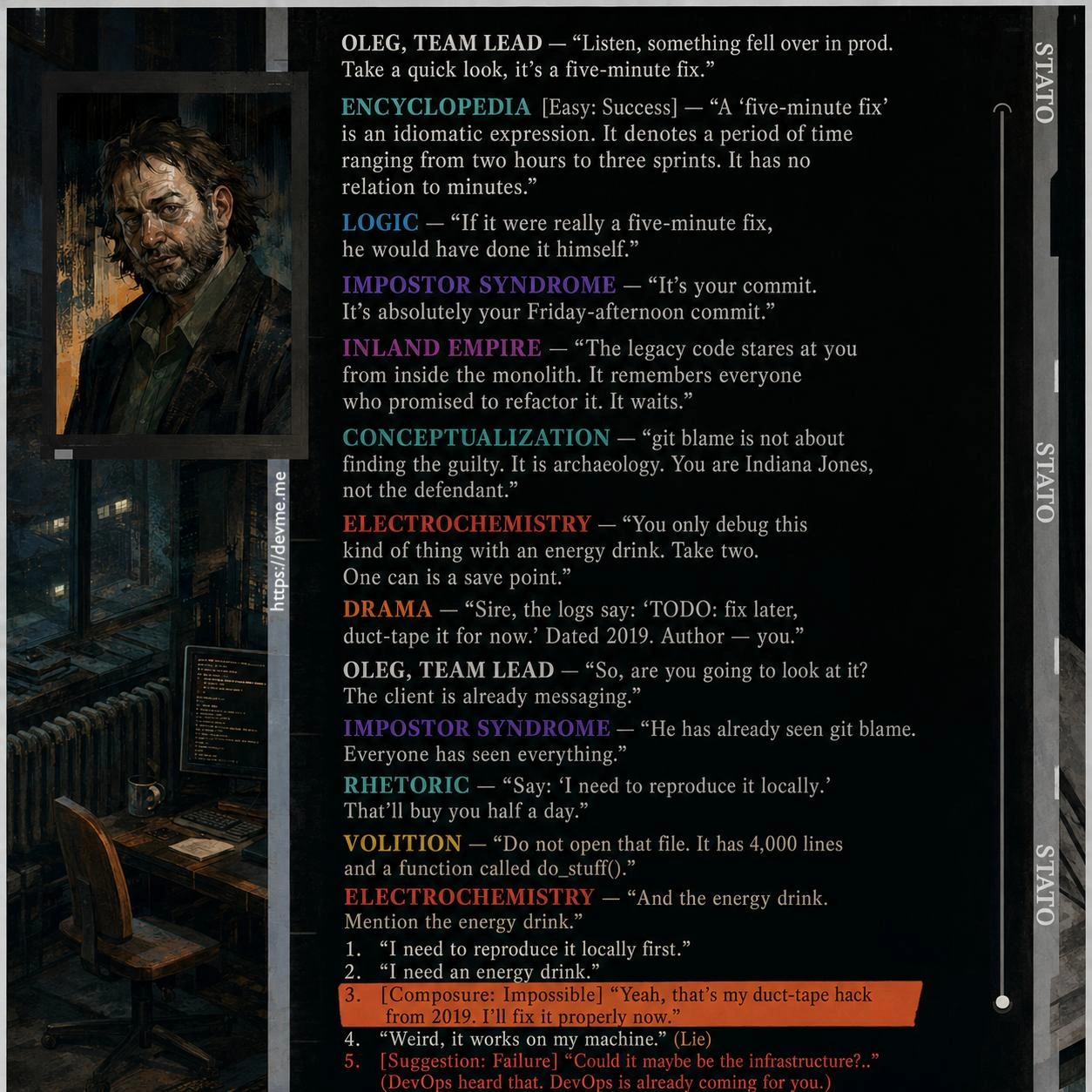
Ever worked on a project where the code feels like a tall Jenga tower? One wrong move and crash! – the production falls over. This meme nails that feeling. The image of water gushing out of a misaligned pipe joint is basically a photograph of legacy code in the wild. It’s held together by duct tape (or by fragile logic) and everyone on the team knows it’s faulty, but hey, it mostly works. The bold caption “If it works... don’t touch it!!” is the battle-scarred cry of developers who have been burned by seemingly innocent changes. It’s a mix of cynicism and survival instinct. We laugh because it’s a shared reality: altering one line in a brittle system can spawn Heisenbugs (those bugs that vanish when you try to debug them) or unleash a cascade of new issues. The leaking pipe metaphor screams TechnicalDebt – an accumulation of “temporary” quick fixes and hacky_workarounds that have become permanent. Each drip of water is like a minor bug or performance hit: individually manageable, but collectively they signal a system at its limits. Yet, the team’s mantra is “Leave it be.” Why? Because the last time someone tried a refactoring marathon on that module, it triggered an outage and a 3 AM incident call. It’s a classic maintenance pain point: no one has time (or courage) to fix the root cause under pressure of deadlines, so they apply another patch or just route around the problem. Over months and years, these patches fossilize into a LegacySystem, where original design coherence is long gone. The humor has a dark edge: it points to a culture where “shipping new features” is valued over CodeQuality, so obvious leaks are tolerated as long as the mess doesn’t flood production. We’ve all seen code comments like:
// TODO: This is a hack. It leaks, but it works.
// We'll fix it in the next major refactor (maybe).
They never got fixed, of course. Instead, that workaround becomes mission-critical. It’s funny and tragic—DeveloperHumor born from MaintenancePain. Everyone nods knowingly because we’ve inherited functions named oldPaymentFlow_FINAL_v2() that no one dares to delete. The meme’s absurd plumbing scenario encapsulates this perfectly: it’s ridiculous that the pipe’s owner doesn’t fix the leak, just like it’s ridiculous we sometimes build entire subsystems around a flawed piece of code rather than repairing it. In the daily grind, RefactoringNeeded tasks get postponed, new features pile on, and the leak keeps leaking. The code doesn’t crash, so overengineering kicks in: we write a new script to mop the floor (monitor and restart the service if it fails) instead of sealing the hole (fixing the bug). Seasoned devs chuckle (or groan) because the “if it ain’t broke, don’t fix it” rule has a grain of truth in their world. It’s a form of risk management in a shared pain environment: better the devil you know (a controlled leak) than the devil you don’t (a risky fix potentially breaking something else). This meme exaggerates it to an absurd physical image, which makes it hilarious and a bit too real at the same time.
Level 4: Thermodynamics of Tech Debt
In software engineering, there’s an unwritten second law of thermodynamics for code: left unchecked, complexity and chaos only increase. This meme lampoons that law by showing a literal leak ignored over time. In theoretical terms, each quick fix and kludge adds a bit of entropy to the codebase. The water pouring out of the misaligned pipe is like a memory leak or inefficient algorithm that everyone knows is there, yet the system still (barely) functions. Why disturb it? In fact, Lehman's Laws of Software Evolution predict that as a program evolves, its complexity rises unless we actively refactor it. Ignoring “obvious leaks” is how you end up with a big ball of mud architecture: a system so entangled that any change can cause unforeseen consequences. Ward Cunningham’s concept of technical debt comes to mind – every hack or “if it works, don’t touch” approach is a debt that accrues interest in the form of harder maintenance later. The humor here hides a deep truth: maintaining software integrity is akin to balancing thermodynamic forces. Without periodic refactoring (the equivalent of releasing heat or organizing the system), a codebase slides toward disorder. It’s a bit like the broken window theory in software quality – leave one broken piece (or a leaking pipe) unfixed, and soon the whole codebase’s discipline erodes. Formal methodologies and automated tests aim to fight this entropy, providing a safety net so that fixing leaks doesn’t break the entire system. But absent those, engineers rationally fear that touching a stable-yet-leaky module might introduce instability. In academic terms, we could say there's high regression risk due to tight coupling and unknown dependencies (cue Hyrum’s Law: every observable quirk in your code will be relied on by somebody). This deep-dive perspective shows that the meme isn’t just dark humor – it reflects fundamental software thermodynamics: systems naturally degrade, and not touching a working thing is a short-term strategy to postpone facing that unforgiving reality.
Description
Meme shows bold black headline text reading "1st rule of Programming:" followed by pink text "If it works.... don't touch it!!". Beneath the caption is a photo of a drainage pipe: water pours out of an elbowed grey pipe, entirely missing the intended joint and spilling through a hole before reaching the ground - yet no one has fixed the clearly broken setup. The visual gag equates the kludgy plumbing to legacy code that functions just enough to stay in production. Technically, it satirizes fear of refactoring, accumulation of technical debt, and the cultural tendency to leave brittle but "working" code untouched to avoid new bugs

Comments
7Comment deleted
Our entire payment “pipeline” is basically this: a 2005 cron’d Perl script dribbling cash through five symlinked directories - nobody patches the leak because it still clears $100M a night and the last refactor ticket turned into a war story at QBR
That's the payment processing module from 2003 that somehow handles 40% of our revenue - the original developer left no documentation, but we know it involves a cron job, three different date formats, and what we suspect is a hardcoded tax rate for a country that no longer exists
That gap between the pipes isn't a bug - it's an undocumented integration layer, and it has 100% uptime as long as nobody runs the test suite called 'wind'
This is the architectural equivalent of that 10,000-line God class with no tests that's been in production for 8 years - everyone's terrified to refactor it because the original developer left in 2016, there's no documentation, and somehow it handles 40% of your revenue. Sure, the cyclomatic complexity is off the charts and it violates every SOLID principle, but the last three engineers who tried to 'modernize' it caused outages. So now it just sits there in your codebase like this plumbing setup: objectively terrible, structurally questionable, held together by duct tape and prayers, but shipping features and making money. The real first rule? Sometimes the best code is the code you don't touch
Legacy rule: it “works” because the leak is a mission‑critical side channel - Ops calls it backpressure, Security calls it exfiltration, Finance calls it billable; runbook step one: don’t touch
Leaky Abstraction as a Service: upstream bypasses the interface via a side-channel; it passes in prod, so the risk register doubles as our test suite
This pipe nails the CAP theorem for legacy systems: it trades consistency for availability, leaking gracefully under load