Then vs Now: AI Tools Replaced the Million Dollar App Idea Guy
Why is this AI ML meme funny?
Level 1: Sleeping in Peace
Imagine you’re trying to sleep, but a friend keeps throwing toys at you wanting you to build a super complex LEGO castle for them for free. 😴🧱 Back then, the poor programmer was like a kid under the blanket getting hit by all those “please help me, I have a great idea but I won’t do any work” arrows. It wasn’t very fair or fun – the programmer just wanted some rest! Now fast forward to today: we have a helpful robot friend (that’s the low-code tool and AI) who jumps in front of the sleeping programmer to catch all those flying idea-arrows. The robot soldier bravely takes the hits so the programmer can keep snoozing a bit longer. It’s funny because the roles changed – instead of the human coder immediately waking up to “build my idea, please!”, the eager idea-people are busy with the new DIY robot tools first. The programmer is like a kid who finally gets to sleep through the night because their new automatic toy is handling the pesky troublemakers. We laugh because we see the programmer peacefully sleeping while the shiny new helper gadget is full of arrows – it shows in a simple way how new tech tools are protecting people from old headaches (even if that poor gadget is getting a bit beat up doing so!). In the end, it’s a playful cartoon about how life has gotten just a tiny bit easier for coders, thanks to those brave little builder tools catching the chaos upfront.
Level 2: No-Code to the Rescue
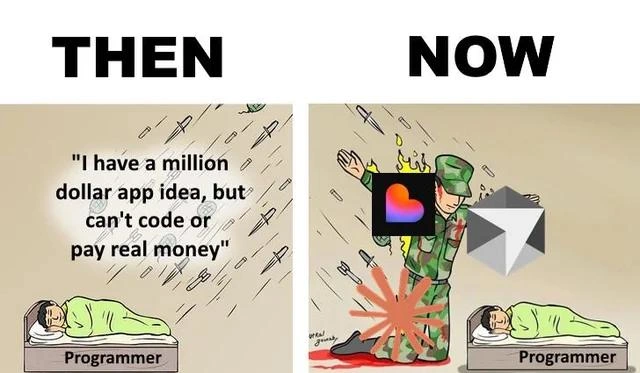
This meme uses a then_vs_now_meme_format to show how life has changed for developers over time. In the left panel ("THEN"), we see a Programmer sleeping in bed, but arrows are raining down on them. Those arrows symbolize all the unrealistic_app_ideas and demands people throw at developers. The quote "I have a million dollar app idea, but can't code or pay real money" is a classic scenario in StartupHumor: someone has a big idea for an app or business but lacks the ability to build it (and isn’t offering any budget either). For a junior developer, this situation might sound familiar – like when a friend or acquaintance finds out you can code and immediately says, “Hey, I have this great idea for an app. You build it, and we’ll split the profits!” It’s a major DeveloperPainPoints moment, because it shows how some people think an idea alone is enough, and the actual coding is just a trivial detail. The arrows hitting the sleeping programmer illustrate how, back then, the developer directly felt every one of these incoming requests (and headaches). The poor coder is under fire (even in their sleep!) from client_requests_deflection that didn’t exist yet – meaning there was nothing to shield them.
Now, look at the right panel ("NOW"). The programmer is still sleeping in the same bed, but now there’s a soldier kneeling over them, blocking the arrows. This soldier has two big logos on his chest. Those logos stand for modern low_code_platforms and no_code_tools and also a generative_ai_shield (generative AI builder) – basically the new tech tools that non-developers are using to create apps without writing code themselves. To clarify these terms: no-code tools are software platforms that let you build applications through a visual interface and pre-made components instead of typing out code. Think of things like website builders where you drag and drop elements, or app makers where you can create basic apps by filling out forms and logic, often referred to as Automation platforms. Low-code is similar, but might require writing a little bit of code or scripts; these are often aimed at “power users” or tech-savvy business folks. And generative AI (like ChatGPT or code assistant AI) is an artificial intelligence that can generate code or content based on prompts. For example, someone might tell an AI, “Write me an app that does X,” and the AI will try to produce code or a solution.
In the meme, these tools are depicted as the brave soldier shielding the programmer. Instead of the arrows hitting the programmer directly, now the arrows hit the soldier – meaning all those “I have a great idea, build it for me!” requests are now often aimed at these tools first. The wannabe entrepreneurs today will try using a no-code app builder or ask an AI to create their idea, before they run to an actual developer. This is a big change in the DeveloperExperience_DX. It’s like these modern tools are absorbing the initial impact of idea-spam. The soldier is even bleeding, which humorously shows that these requests can be brutal or too much even for the fancy tools. (No-code platforms can struggle to build a complex “million-dollar” app, and AI can write poor or buggy code if the idea is too ambitious or vague – that’s the AIHypeVsReality aspect.)
For a junior developer, the right panel might also feel relatable in a different way: you might have experimented with these tools yourself or seen non-tech colleagues use them. Perhaps someone in your startup tried building a quick prototype with a no-code tool like Bubble, or used a generative AI like GitHub Copilot to auto-complete code. These tools often promise to make development so easy that “anyone can do it.” The meme makes a funny point: now when someone has a wild startup idea, they might say “I’ll just use an app builder or AI to make it!” This deflects the immediate pressure away from you, the developer. The phrase "low-code friendly fire" from the title is a play on words – friendly fire means getting hurt by your own side accidentally. The joke implies that while these new tools are on the developer’s side (they’re “friendly”), they sometimes cause their own problems (maybe building something messy that a dev later has to fix – a bit of unintended harm, or “friendly fire”). But in this scene, at least the developer gets to sleep through the initial onslaught of arrows.
So, the “Now” panel is basically saying: today’s trend of Automation and do-it-yourself app building has become a shield for programmers. Non-coders will try to use these hyped tools first to bring their idea to life. The developer isn’t the first target anymore, which is a bit of a relief and a comedic contrast to earlier times. Of course, when those tools can’t quite deliver the fully working “million-dollar app” (which is often the case), the project might still end up on a real developer’s desk – but by then, at least the initial crazy rush or the most naive expectations have been filtered (or the person now appreciates that it’s not as easy as it seemed). This then_vs_now comparison, using the shielding_soldier_trope with arrows, humorously captures an IndustryTrends_Hype shift in the startup world and tech culture.
Level 3: AI Meat Shield
In the past, every startup dreamer with unrealistic_app_ideas treated the nearest coder like a free on-demand CTO. The left panel’s quote – "I have a million dollar app idea, but can't code or pay real money" – is practically a rite of passage in StartupHumor. Senior engineers smirk because we’ve all gotten that late-night message from a college buddy or that LinkedIn rando promising "equity and exposure" instead of a paycheck. Back THEN, the hapless Programmer (sleep-deprived and under a thin green blanket of denial) was directly impaled by this idea-spam arrow_storm_visual. Each arrow is a wild request or a half-baked feature from someone who thinks coding is magic you do for free on weekends. It’s a classic DeveloperPainPoints scenario: the DeveloperExperience_DX of being an involuntary co-founder for every million-dollar idea guy who doesn’t grasp that software development is actual work (and no, buying you a coffee and “exposure” doesn’t count as real compensation).
NOW, in the right panel, the joke is that modern hype-tech has swooped in as a bleeding shielding_soldier_trope. Those two logos on the soldier’s chest – one a multicolor swirl and the other a grey faceted triangle – represent popular low_code_platforms and generative_ai_shield tools. Essentially, today’s Automation hype (no-code builders, AI code assistants, etc.) has volunteered as the new meat shield for idea shrapnel. This soldier stands above the sleeping dev, heroically intercepting the “I’ve got the next Uber, but you’ll have to build it” arrows. It’s an absurdly satisfying reversal. The seasoned engineer in 2025 is like, “Sure, pal, go ask your fancy AI and drag-and-drop tool to build the next Facebook. I’ll be here catching some Z’s.” The IndustryTrends_Hype cycle means non-coders actually believe these tools will turn their napkin-sketched app into a unicorn overnight. So they bombard the no_code_tools and AI first, deflecting_client_requests away from real developers.
But notice the soldier is bleeding onto the floor – a darkly funny detail any cynic will appreciate. 🩸 This implies that while low-code platforms and AI take the initial hit, they’re also getting wrecked (or at least severely strained) by these demands. In real life, that translates to glitchy auto-generated apps, spaghetti configurations, or half-working prototypes that buckle under real-world complexity. The AIHypeVsReality vibe here is strong: these tools promise the world (and do provide an Automation assist), but often they collapse under the weight of truly unrealistic_app_ideas. The Programmer stays blissfully asleep initially, spared from the ideation crossfire, but the humor hides a knowing grimace: when the no-code “hero” inevitably falls (or produces a Frankenstein app), guess who gets the panicked 3 AM call to fix it? Yep – the same developer who was sleeping peacefully. The meme perfectly captures this too real shift in DeveloperExperience_DX. It’s DeveloperHumor with a side of war-weary sarcasm: one hype (ToolingOverload of no-code/AI) is being used to fend off another hype (the perpetual “million-dollar idea” barrage).
In short, the senior perspective here chuckles at the evolving battlefield. Then vs Now meme format highlights that we’ve basically deployed new tools_to_the_rescue as front-line fodder for the idea barrage. It’s an AIHumor twist on the old story: programming veterans have seen “solution-of-the-month” promises come and go. Whether it was 4GL tools in the 90s, WYSIWYG site builders in the 2000s, or today’s GPT-powered code gen, the cycle repeats. This meme nails the shared, darkly triumphant feeling: “At least now something else catches those arrows first!” – even if we know the battle isn’t truly over.
Description
Two-panel 'THEN vs NOW' comparison meme. Left panel ('THEN'): A programmer sleeps peacefully while a person in military camouflage (representing non-technical people with ideas) stands guard deflecting knives, with a speech bubble: '"I have a million dollar app idea, but can't code or pay real money"'. The programmer sleeps unbothered because these people couldn't actually build anything. Right panel ('NOW'): The same military figure now wields AI tools (shown as app icons including what appears to be a heart/dating app icon and a geometric AI icon) that are exploding/attacking the sleeping programmer. The meme suggests that AI coding tools have now empowered non-technical people to actually build software, threatening professional programmers' job security
Comments
15Comment deleted
2020: 'I have an app idea but can't code' was a punchline. 2025: same person ships to production with Cursor before you finish your morning standup
In the past, you needed a business plan to shield you from bad ideas. Now, you just need a Vercel hobby plan and a GitHub Sponsors profile to prove you're too busy shipping to listen
At last, the drag-and-drop brigade absorbs the "million-dollar idea" barrage - wake me only when their JSON-export hits a distributed-lock edge case
Remember when 'I have a million dollar app idea' meant a developer would have to politely explain why equity isn't payment? Now they just get bombarded with 'Why do we need you when we have Figma-to-code?' emails from founders who think drag-and-drop can handle their real-time distributed system requirements
The real plot twist isn't that non-technical founders can now ship code with AI - it's that they're about to discover the other 90% of software engineering: debugging production incidents at 3 AM, managing technical debt, scaling beyond the first 100 users, and explaining to investors why 'the AI wrote it' isn't a valid architecture decision. Welcome to the trenches, idea guy - the programmer's still lying down because they know what's coming next
Thank low-code for filtering the inbox until their MVP needs auth, billing, offline sync, GDPR, SSO, rate limits, and a 99.9% SLA - then we get the rewrite ticket
We used to ghost “million‑dollar idea” emails; now the idea ships itself via a no‑code+LLM stack, leaves 2,000 lines of brittle YAML, and asks me to productionize it by EOD
No-code MVPs: Ship fast, scale never - call a real dev when it implodes at 10k users
And then someone asks you to fix the app they just created Comment deleted
"Can you fix my vibe slop?" Comment deleted
Can you pay me 1000 € per hour? Comment deleted
only 1000? you're doing it for cheap Comment deleted
there is more enticement in trying to understand code and redo it into what it fails to try to execute than in translating incoherent babble into code, so this is still better also, people would be more eager to pay for such job because they have more attachment to something in creation of which they participated Comment deleted
you know? That is a very good point :D Comment deleted
I didn't say I fix the AI slop, I will just rewrite the app from scratch :D And take extra time :D Comment deleted