Skip to content
DevMeme
6539 of 7435
Australia Asks If GitHub Is a Social Network Endangering Children
DevCommunities Post #7167, on Sep 26, 2025 in TG

Australia Asks If GitHub Is a Social Network Endangering Children

Why is this DevCommunities meme funny?

Level 1: Library vs Nightclub

Imagine a library where kids and adults quietly read books and do homework together. It’s calm, educational, and people are there to learn. Now imagine someone who doesn’t really know what goes on in the library starts worrying that it’s actually like a wild nightclub where kids might get into trouble. This person is so concerned that they suggest banning kids from the library, thinking it’s a dangerous place! Sounds pretty silly, right? In this story, GitHub is like that library for coding – a place where people (including some teens) write code, learn, and help each other with programming projects. But some officials in Australia mistakenly thought GitHub might be like a social media party site that could harm children. Developers find this funny (and a bit frustrating) because it’s such a big mix-up. The “dangerous social network” image just doesn’t fit GitHub at all. It’s as if someone confused a school study group with a rowdy party. That misunderstanding is the whole joke: a safe, nerdy coding website got mistaken for a risky teen hangout, which makes us shake our heads and laugh at how far off the mark that idea is.

Level 2: For Code, Not Selfies

At this level, let's break down what’s going on in simpler terms. The headline is essentially asking if GitHub is a social network that could be harmful to children, and whether Australia should treat it like other kid-restricted sites. To understand the joke, you need to know what GitHub actually is, and how it’s very different from a typical social media platform.

GitHub is an online service that developers use to store code and work on programming projects together. It’s built on Git, which is a version control system. Version control is a way to keep track of changes in code over time, so multiple people can collaborate without messing up each other’s work. Think of GitHub as a huge, organized repository (like a project folder) where each software project has its own space. Developers can upload their code, edit it, and use GitHub’s tools to manage those changes. For example:

  • They create something called a pull request to propose changes to the code. (It’s like saying, “Hey, I’ve got a fix or new feature, can someone review and add it?”)
  • They set up CI pipelines (Continuous Integration) which automatically run tests and build the software whenever new code is added, to make sure nothing is broken.
  • They do code reviews, where other developers comment on the code changes, suggest improvements, or catch bugs before the code gets merged in.

All of that is pretty much the daily workflow for software teams. GitHub is incredibly important for developers – it’s where huge open-source projects (like programming languages, frameworks, even the Linux kernel) live and grow through community collaboration. It’s also used by companies to build products. So, it’s not designed as a hangout for kids; it’s a workplace and community for coders. Yes, GitHub does have some social aspects (you can "follow" your favorite developers or give a star ⭐ to a project you like, similar to a like/upvote), but these features exist to help people discover useful code and keep up with what others are building. It's all centered around software development. There’s no status feed of personal life updates, no photo albums, no dance challenges – just updates about code and project issues. In short, GitHub = code platform, not a conventional social network.

On the other hand, a social network (like Facebook, Instagram, TikTok, etc.) is a site or app where the general public (including lots of teenagers) share personal content and socialize. The main content on those platforms is usually pictures, videos, status messages, and chat. People go to social networks to be entertained, to communicate with friends, or to follow trends. Because they’re so public and social, these platforms come with risks for kids: talking to strangers, encountering inappropriate content or cyberbullying, spending too much time scrolling – those are the kinds of dangers legislators worry about with under-16 users. That’s why you hear about laws or rules (like the one in Australia) considering bans or parental consent for young teens on such sites. They’re trying to improve online safety by keeping kids away from potential harm.

Now, here’s why that headline is funny: Australia’s cyber-safety regulator essentially sent a letter to Microsoft (the company that owns GitHub) asking, “Hey, is your platform dangerous for kids and should we include it in this under-16 ban?” For developers, this sounds ridiculous because using GitHub is more like using a work tool or an educational resource than hanging out on a social platform. It would be like treating a programming class or a technical forum as if it were the same as a teen chat room. The regulators probably saw that GitHub has user accounts, public posts (in the form of code repositories and comments), and maybe that some users could be under 16, and so they lumped it into the “social network” category without understanding its purpose. The sub-headline even calls GitHub “Microsoft’s code locker,” which shows the writer is trying to describe GitHub in simple terms – essentially a vault for code. Developers don’t usually call it a “code locker” (we just say repository or platform), but hey, at least that phrasing recognizes it’s about storing code. The funny disconnect is imagining some official thinking, “Kids can fork repos and send pull requests – oh no, that sounds like socializing, must be dangerous!” 😅

To put it plainly: GitHub is where you collaborate on code, not where you chat with friends about random stuff. If a 15-year-old is on GitHub, they’re likely writing code, learning programming, or contributing to a software project. That’s generally a constructive activity, arguably even educational. It’s not the kind of place where we typically worry about the classic social media problems like predators or explicit content. Of course, like any site, GitHub has rules and could host some content not meant for kids (for example, code for hacking tools or a project with inappropriate language in the comments). But it’s overwhelmingly a professional and educational environment, not a social hotspot. Most teenagers who aren’t interested in coding wouldn’t even find GitHub appealing – there are no “likes” for your new outfit or funny dog videos there. And for those teens who are into coding, GitHub is a fantastic resource to improve their skills and collaborate with others. Ironically, banning them from it might do more harm (by stunting their learning) than letting them participate under some guidance.

So the meme is highlighting how the regulators’ question misses the mark. It’s a bit like when non-tech people completely misunderstand a common developer tool. If you’re a junior dev or just starting out, imagine someone in your family who doesn’t know about programming hearing you talk about “pushing to GitHub” – they might ask, “Is that like posting on Facebook?” And you’d laugh and explain it’s totally different. That’s essentially what’s happening on a larger scale here. The tech community is laughing because to us the difference is obvious: GitHub is a tool/community for coders, whereas social networks are for general socializing. The confusion by the authorities is both amusing and concerning, and that’s why this meme was made – to playfully call out that mix-up.

Level 3: Policy vs Pull Requests

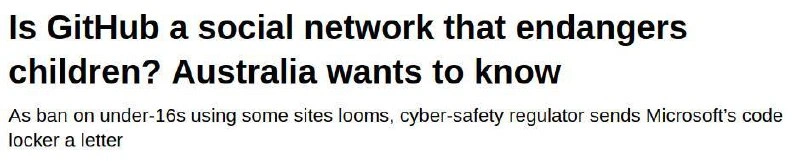
"Is GitHub a social network that endangers children? Australia wants to know."

The headline alone made every seasoned developer do a double-take. The idea of equating GitHub with a teenage social hangout is both absurd and darkly funny to those of us in the trenches of software development. GitHub is universally known among coders as a version control platform – essentially a collaboration hub for coding projects, where we manage pull requests, run CI pipelines, and conduct code reviews. It's the backbone for open-source projects and software teams, not a place for kids to swap selfies or gossip about school. So, seeing a cyber-safety regulator lump this code repository platform in with TikTok or Instagram exposes a hilarious disconnect.

Why is this so humorous? It's a classic case of MisunderstandingTechnology and skewed PublicPerception. Policymakers, perhaps unfamiliar with developer tools, are treating a code-hosting service as if it were Snapchat for coding. They’re considering an under-16 ban on certain “social” sites and somehow Microsoft’s code locker (GitHub) made their list. To a senior developer, this is irony at its peak – like watching someone try to child-proof a production server because they think it's an arcade game. We trade pull requests and bug fixes on GitHub, not friend requests or cat videos. The platform’s content is literally source code and technical discussions. The “danger” in our world usually means a nasty null pointer exception, not an online predator. The regulators imagining GitHub as a den of child endangerment is so off-base that you can't help but chuckle.

From an industry perspective, this meme pokes fun at the perennial gap between fast-moving DevCommunities and slow-moving policy. It’s highlighting an TechIndustryIrony: the folks writing laws often have a shaky grasp of the technologies they're trying to regulate. Historically, we've seen similar comedic misclassifications – like when 1990s export laws treated encryption code as a weapon, or when politicians suggested “the internet is a series of tubes.” Here we are in 2025, and a regulatory misunderstanding of a developers’ platform still causes facepalms. The eSafety officials in Australia likely sent that formal letter to Microsoft asking, in effect, “Do we need to worry about kids on your GitHub social network?” You can almost picture some Microsoft engineers reading that and going, "Wait, what?". This bureaucratic mix-up is meme gold because it’s too real: devs have all experienced non-technical stakeholders profoundly not getting what our tools actually do.

Real-world scenarios make this “GitHub as social network” notion even more laughable. Picture a 15-year-old developer in Australia who loves coding. Maybe they’re tinkering with Python or contributing to an open-source game mod on GitHub. Now imagine that teen suddenly getting banned from GitHub due to a law meant to protect them from social media. It’s tragically comical: instead of shielding kids from dangerous content, the rule would be blocking one from learning to code with peers. As senior devs, many of us started young – finding camaraderie in coding forums and pushing our first commits in high school. The thought of a teen coder being told “No GitHub for you, it’s too dangerous!” is both hilariously misguided and a bit alarming. Are they worried a 14-year-old might fork a repository and accidentally learn something? The meme strikes a chord because it’s a perfect storm of good intentions meeting technological cluelessness.

Systemically, this situation underscores why bridging the knowledge gap is so important. GitHub does have followers, stars, and even a feed – superficial features that might mislead someone unfamiliar into thinking it's just “Facebook for nerds.” But those of us inside the industry know these are ancillary; the core is collaboration on code. When policymakers don’t grasp that nuance, we get scenarios like this headline: well-meaning regulations veer into the absurd. The humor has an edge of frustration: we’re laughing, yes, but we’re also shaking our heads. Why do smart people keep making the same mistakes about tech? Often, it’s incentive structures and fear of the unknown – it’s safer (politically) to be overcautious and group every user-content platform together than to take the time to understand the differences. So we end up with one-size-fits-all rules that accidentally rope in a code repository.

In true developer humor fashion, the community responds with memes. It’s our coping mechanism. We joke that maybe the only real threat on GitHub is exposing kids to toxic poorly-indented code or the horror of zero documentation. 😅 The headline is laughable, but it carries that underlying sigh: here we go again, yet another non-technical authority treating a vital dev tool like a frivolous social app. In short, this meme lands so well with us because it's a blend of comedy and cautionary tale. We’re amused by the sheer absurdity, but also reminded of the ongoing need to educate others about what our tools actually do. After all, if they can mistake a version control platform for a teen social network, what’s next – banning text editors because kids might type something? It’s a humorous reality check for the tech industry and regulators alike.

Description

Screenshot of a news article headline reading 'Is GitHub a social network that endangers children? Australia wants to know' with the subheadline: 'As ban on under-16s using some sites looms, cyber-safety regulator sends Microsoft's code locker a letter.' The article highlights the absurdity of Australia's broad social media regulation potentially classifying GitHub - a code repository and collaboration platform - as a social network subject to age restrictions. This reflects the common disconnect between tech regulators and the actual nature of technology platforms

Comments

11
Anonymous ★ Top Pick Breaking: Australia classifies 'git push --force' as cyberbullying. Merge conflicts now require parental consent for users under 16
  1. Anonymous ★ Top Pick

    Breaking: Australia classifies 'git push --force' as cyberbullying. Merge conflicts now require parental consent for users under 16

  2. Anonymous

    Australia's cyber-safety regulator is worried about GitHub. Clearly, they've never seen the psychological damage a single `git blame` can inflict on a senior engineer's ego

  3. Anonymous

    Great, now every public repo will need a PG-13 rating - better start grepping the Linux kernel for swear words before the cyber-nannies fork it

  4. Anonymous

    Next week: Australian regulators discover Stack Overflow and wonder if copy-pasting code snippets constitutes 'grooming behavior' - better start checking IDs before allowing anyone to debug a null pointer exception

  5. Anonymous

    Apparently GitHub is now a 'social network' because developers occasionally interact in pull request comments - by that logic, my compiler is a therapist because it listens to my problems and tells me exactly what's wrong. Next up: Australia investigates whether Stack Overflow constitutes a dating site since people keep asking 'Why doesn't this work?' and getting responses

  6. Anonymous

    If GitHub is a social network, our SOC2 scope now includes moderating PR comments, the SBOM becomes a friend graph, and Legal will ask for a policy exception for git clone

  7. Anonymous

    GitHub endangering kids? The real trauma is their first exposure to a force-pushed main branch

  8. Anonymous

    If GitHub is a social network, I’m bracing for the audit that reclassifies pull requests as user‑generated content and mandates content moderation for merge conflicts - please add COPPA to git init and age‑gate the monorepo

  9. @Algoinde 9mo

    we need to protect kids from becoming rust developers

    1. @hur7m3 9mo

      https://www.phoronix.com/news/Ubuntu-25.10-Coreutils-Makeself

  10. Deleted Account 9mo

    what?

Use J and K for navigation