Cat Convinces You To Stay Up Late And Ruin Tomorrow
Why is this MentalHealth meme funny?
Level 1: Past Bedtime Problems
Imagine you have a big day at school tomorrow – maybe a test or a fun event – but you decide to stay up really late playing video games or watching cartoons. You know how the next day you’d feel really tired, grumpy, and find everything hard? This meme is joking about that exact kind of situation, but for grown-up programmers.
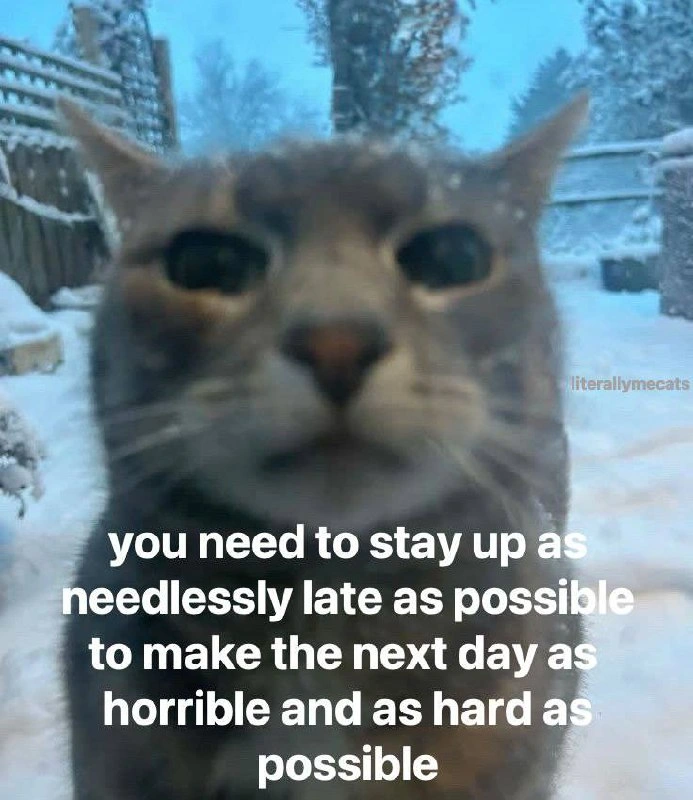
In the picture, there’s a silly cat standing outside in the snow early in the morning, looking all groggy (like it hasn’t slept). The cat is saying, “You should stay up as late as you can for no reason, so tomorrow will be super terrible for you.” 😺 Of course, that’s bad advice on purpose – it’s like when a friend sarcastically says, “Sure, eat all your Halloween candy in one go, you’ll totally not get a stomach ache!” The joke is that doing the opposite of what you should (not sleeping when you need to) will make the next day awful, and the cat is pretending that’s the goal.
Why is this funny to people who write computer programs? Because a lot of them have done this to themselves! Just like kids might sneak a flashlight under the covers to read comics at midnight and then feel awful in class, programmers sometimes stay up late at their computers when they really should go to bed. Maybe they’re trying to fix one last thing in their program or they get distracted watching tech videos, and suddenly it’s 2 AM. The next morning, they feel just as bleary and confused as that cat looks. Everything at work seems harder because their brain is sleepy. They might make lots of mistakes in their code (kind of like doing math wrong because you can’t focus).
So the cat meme is a funny way of saying: “Hey, remember how dumb we are when we don’t sleep? Let’s not do that!” It uses reverse psychology humor – telling you to do the wrong thing to remind you what the right thing is. Even a child knows if you stay up too late, the next day you’ll be dragging your feet. Grown-ups are just big kids sometimes; they know this, but they do it anyway and then joke about it. The cat giving terrible advice is like a goofy friend egging you on to misbehave, and that makes people laugh because they recognize, “Heh, I’ve totally done that, even though I knew better.”
In simple terms: get a good night’s sleep. If you don’t, you’ll end up like the sleepy cat in the snow – and nobody has a good time when they’re that tired. The meme is funny because it’s true: staying up too late for no good reason just makes the next day feel like walking through deep snow with no boots on. It’s a playful reminder that sometimes the smartest thing you can do is simply go to bed on time, whether you’re a kid at school or a coder building the next big app.
Level 2: Crunch Time Crash
Let’s break this down in simpler terms. The meme shows a cat early in the morning, looking blurry and cold. The text on the image basically says: “You should stay up really, really late for no good reason, so that tomorrow will be as awful and difficult as possible for you.” It’s obviously joking – giving terrible advice to make a point. Developers find this funny because it points out a common bad habit in our field: staying up way past bedtime to code or surf the web, and then suffering for it the next day at work.
In the world of software development (and really any tech job), sleep deprivation is a well-known enemy of productivity. There are even running gags about it, like the tag LateNightDebuggingSessions which sums up those bug-hunting marathons that stretch into the wee hours. Newer developers (and heck, many experienced ones too) sometimes pride themselves on being a night owl dev. That means they enjoy coding at night when it’s quiet. It feels productive at first – no meetings, no distractions, just you and the code. You might think, “I’ll get this feature done or fix this bug while everyone else is asleep!” But the meme is a tongue-in-cheek reminder of the cost of that choice.
Why is staying up late to code a problem? For one, as you get tired, your brain slows down. Coding isn’t like mindlessly watching TV; it’s a mentally intense task, like solving puzzles. When you’re low on sleep, you start making way more mistakes. Imagine trying to do your math homework at 2 AM after being awake for 18 hours – you’re going to mess up even simple stuff. In coding, those mistakes turn into bugs (errors in the software) or bad decisions that create what we call technical debt. Technical debt is a term for quick-and-dirty solutions that you or your team will have to clean up later, a lot like taking shortcuts that eventually require extra work. A sloppy “fix” you write at 2 AM might crash a program or slow down the whole system (production latency spike refers to an increase in response time, meaning the software or website becomes slow for users). There’s even an unofficial developer rule: “Don’t deploy (release) code after midnight”, because chances are you’ll break something and ruin everyone’s tomorrow.
Aside from messing up the code, you’re also messing up yourself. Lack of sleep hits your mental health and energy hard. The next day, you’ll likely feel like that cat looks – groggy, disoriented, and just not happy. Developers often have daily morning meetings (like a stand-up in Agile teams) where everyone talks about what they’re working on. Now imagine coming into that stand-up after an all-nighter: you can barely keep your eyes open, let alone explain what you did. And if what you did was push a risky code change at 2 AM, you might also be dealing with a production issue first thing in the morning (worst case, you broke something live for customers – eek!).
The meme is categorized under DeveloperProductivity and MentalHealth for good reason. It highlights that working more hours doesn’t always mean you’re more productive – often it’s the opposite. When you’re exhausted, your productivity and code quality plummet. It’s like thinking “I’ll drive all night to save time,” but then you’re so tired you start driving in the wrong direction. Deadlines and crunch time (when a team is rushing to finish work before a due date) are when people are most tempted to do this. You feel pressure to get stuff done, so you sacrifice sleep. In the short term, you might write a few extra lines of code, but at the cost of writing them poorly and slowing yourself down the next day (or the next week if you get sick or burned out). That’s why this behavior is called an anti-pattern – it’s a common response to a problem that actually makes things worse, not better (just like a bad coding solution we later have to refactor).
The tag self_sabotage_routine really nails it: self-sabotage means you’re undermining your own success. No one is forcing the cat (or you) to stay up needlessly late; it’s a choice, often driven by anxiety or habit. And routine implies it happens repeatedly. Many developers fall into a routine of caffeinating all day, coding late into the night (we jokingly call it coffee_driven_development), then waking up wrecked and reaching for even more coffee. It’s a vicious cycle. Over time, this can lead to developer burnout, which is that state of being emotionally and physically exhausted, and losing passion for the work you used to love. Burnout is a serious concern in tech circles these days, and avoiding chronic sleep loss is one way to help prevent it.
Let’s talk about the image choice: a cat in the snow at early morning. The cat’s expression is kind of dazed and up-close, as if it stuck its face in a camera with no concept of personal space – pretty much how you feel when you bumble into your 9 AM meeting half-awake. 😾 Cats are famously creatures that love sleeping (ever heard the term “cat nap”?). So it’s humorous that literallymecats (the credit on the image) present this cat as the one dishing out advice to avoid sleep. It’s like hearing a normally sensible friend tell you, “Yeah, go ahead, wreck yourself. Great plan.” The snowy background adds to the vibe: early morning cold, everything hazy blue – it looks like the dawn after a long, sleepless night. If you’ve ever stumbled outside or even looked out the window after pulling an all-nighter, dawn has that surreal bluish tint and you feel a bit unreal, just like the meme’s atmosphere.
For a junior dev (or anyone new to this world), the meme is basically saying: “I know it’s tempting to grind away all night on work or get lost on Twitter or Reddit, but it’s a trap. You’re only making tomorrow worse.” It’s using sarcasm (saying the opposite of what’s wise) to poke fun at our tendency to do exactly what we shouldn’t. OnCall_ProductionIssues tag hints at another aspect: sometimes, staying up late isn’t even by choice – if you’re the on-call engineer, you might get paged at 2 AM for a server crash and end up working then. But this meme specifically says “needlessly late,” meaning it’s calling out when we choose to sabotage ourselves even when it’s not an emergency. And if you’ve ever done on-call rotations, you know how rough the next day can be after a 2 AM incident. Choosing to simulate that for no reason is, well, pretty silly – and that absurdity is exactly what the meme is highlighting for humor.
In simpler terms: take care of your sleep, and your code (and your sanity) will thank you. The experienced folks chuckle at this meme because we’ve all learned that lesson the hard way. It’s a funny reminder that sometimes the hardest bug to fix is our own bad habit of not getting enough rest. As a junior dev, it might be tempting to pull all-nighters like you did in school, but in professional software development, consistency and clarity beat brute-force hours. Or as a wise project manager might say: “Work smarter, not longer.” The cat meme just delivers that wisdom with a heavy dose of irony and a cute, bleary feline face.
Level 3: 2 A.M. Code Gremlins
At this senior vantage point, the meme lands as a darkly comic anti-mantra for developers flirting with burnout. The blurry grey cat peering through a cold pre-dawn blur feels too real – it’s basically the avatar of every engineer who has ever thought “Just one more quick fix at 2 AM”. Seasoned devs recognize this scenario as feeding the gremlins in our code: those nasty bugs and performance issues that come scurrying out when we tinker past midnight.
The text’s prescription – “stay up as needlessly late as possible to make the next day as horrible and as hard as possible” – drips with sarcasm. It’s a harsh send-up of our own worst instincts. We’ve all been there: the on-call page pings or a crunch time feature deadline looms, and suddenly it’s a LateNightCoding marathon. Maybe you’re chasing a production issue, or maybe you’re doom-scrolling tech forums (the classic doomscrolling_anti_pattern) instead of sleeping. Either way, you convince yourself that pushing through the bleary-eyed hours is a good idea. Spoiler alert: it’s not.
From a systems perspective, the consequences are as predictable as a memory leak in a forgotten while(true) loop. Your brain’s cognitive throughput drops massively when you’re sleep-deprived – akin to a server running at 5% battery saving mode. Reaction times lengthen (hello, latency spike), focus thrashes like an overloaded CPU, and mistakes multiply. In code terms, you’re introducing new bugs faster than you’re fixing the old ones. That “quick fix” you proudly commit at 2:00 AM often turns into a 2am_commit horror: the one that breaks the build or triggers a 9:00 AM incident. It’s the developer equivalent of kicking off a deploy with failing tests because “it was just a small change, what could go wrong?” – famous last words in every post-mortem meeting.
Veteran engineers know this pattern as a self-sabotage routine on par with any classic anti-pattern in software design. We might jokingly call it “Sleep-Driven Development” or, more accurately, sleep-deprived development. The meme cleverly reframes it as advice from a grumpy cat: a feline Dr. Evil prescribing the very formula for developer misery. It’s funny because it inverts common sense – like a twisted best practice from Bizarro World. Everyone knows (or eventually learns) that coding while exhausted tends to create technical debt and “sleep debt” simultaneously. The sleep debt is real: in physiological terms, one all-nighter can impair your cognitive function similar to a blood-alcohol level of 0.10%. So pulling those heroic stupid late shifts means you’re effectively coding drunk the next day, minus the fun. No wonder the meme-cat promises “the next day as horrible and as hard as possible” – your code might compile, but your brain sure won’t.
The production latency spike mentioned in the title wryly captures two things at once. First, if you bungled some code into production at 2 AM, you might literally cause a performance slowdown or outage by morning (been there, seen the graphs). Second, you – the hapless dev in question – become the latency spike. Your personal throughput tanks. Ever tried to follow a stand-up meeting on 3 hours of sleep? It’s like running a database on a Raspberry Pi: everything feels sluggish and on the verge of crashing. The snowy, bleary cat photo brilliantly encapsulates that fragile morning-after state. The cat’s unfocused stare is the mirror of a sleep-deprived engineer’s 1,000-yard stare into their coffee mug, bracing for the pain of debugging the mess they made last night. And the fact that it’s a cat is chef’s kiss – cats are notorious for sleeping 15 hours a day. Even the ultimate nap expert is telling you (tongue-in-cheek) to skip sleep. That irony isn’t lost on a grizzled developer: it’s like your own exhausted brain mocking you via meme, “Sure, pull an all-nighter, what could possibly go wrong?”.
In sum, this meme resonates on an almost existential level with experienced developers. It skewers the paradox of developer productivity: the harder you push at absurd hours, the more you sabotage tomorrow’s output. It’s a cynical nod to the late-night hero mentality many of us fall for early in our careers (or when crunching on a deadline), only to discover repeatedly that you can’t fix tired. The veteran perspective here is full of weary laughter – because we’ve learned this lesson the hard way, probably more than once. As the saying goes in ops teams: “If you ignore sleep long enough, your code will put you to sleep – by taking down prod and forcing a 3 AM emergency.” This meme’s humor lies in how accurately it portrays that avoidable tragedy as if it were sage advice. It’s funny, it’s painful, and it’s 100% literally me (and literally you, and literally all of us at some point) – just like the meme’s watermark literallymecats implies. We laugh because otherwise we’d cry… but at least we’ll cry ourselves to sleep next time (we hope).
Description
Photo of a grey tabby cat in a snowy outdoor setting looking directly at the camera with an intense, hypnotic stare. The text overlay reads: 'you need to stay up as needlessly late as possible to make the next day as horrible and as hard as possible.' Watermark reads 'literallymecats'. The meme captures the irrational late-night behavior many developers experience - staying up coding, browsing, or debugging well past a reasonable bedtime, then suffering the consequences the next workday. The cat's persuasive stare represents the inner voice that convinces you 2 AM is a perfectly fine time to start a new side project
Comments
13Comment deleted
My brain at 11 PM: 'You should refactor that entire module.' My brain at 9 AM standup: 'I have literally no idea what day it is or what a computer does.'
My brain at 2 AM: 'Let's refactor this entire module.' My brain at 9 AM stand-up: 'Function... take... data... do... thing?'
It’s the "self-inflicted latency spike" pattern: ship code at 02:00, spend the 09:00 stand-up explaining why your brain - and production - are both still paging
This is what happens when you convince yourself that the bug causing the memory leak will definitely reveal itself if you just stare at the heap dump for another three hours, ignoring that your cognitive function degrades exponentially after midnight - but hey, at least tomorrow's standup update will be 'still investigating the same issue from yesterday'
This meme perfectly encapsulates the senior engineer's paradox: we've accumulated enough experience to know that staying up until 4 AM to fix 'just one more thing' will absolutely wreck tomorrow's architecture review, yet we possess the hubris to believe *this time* will be different. It's like running a distributed system without circuit breakers - you know the cascading failure is coming, you've seen it a hundred times before, but somehow you convince yourself that your mental state has better fault tolerance than it actually does. The real kicker? We'll debug production issues the next day with the same cognitive capacity as a O(n!) algorithm, wondering why everything feels exponentially harder
Architectural warning: sharding your sleep with coffee as the transaction coordinator yields eventual consistency at best - and a 9am standup deadlock
The feline anti-pattern: accrue sleep debt at O(n²) velocity to cascade failures across tomorrow's sprint capacity
Every midnight I refactor “just one more thing,” and by standup the SLO is red because the human autoscaler is stuck at one replica
I knew it! Thanks, cat! Comment deleted
aye aye captain 🫡 Comment deleted
Already do this 🤫 Comment deleted
But he is trying to be him. Let him a chance Comment deleted
True.... Comment deleted