The Escalating Madness of Code Optimization
Why is this Languages meme funny?
Level 1: Shortcuts Backfire
Imagine you’re helping to carry books across a room. First, you carry them one by one, which is simple and clear – it just takes a bit longer. Next, you get clever and carry two books at the same time. Yay! Now you’re finishing the job faster, and you feel pretty smart about that little trick. But then you try to carry a whole tower of books all at once to save even more time. 😅 What do you think happens? The stack is too wobbly, you can’t even hold it properly, and boom – books tumble everywhere, making a huge mess. This meme is funny for the same reason: it shows a person getting more and more excited about making a task shorter or “smarter,” until the final attempt is so over-the-top that it doesn’t work at all. It’s a silly reminder that trying to be too clever with a shortcut can backfire and become just plain nonsense, making everyone laugh at how far it went.
Level 2: From Addition to Addiction
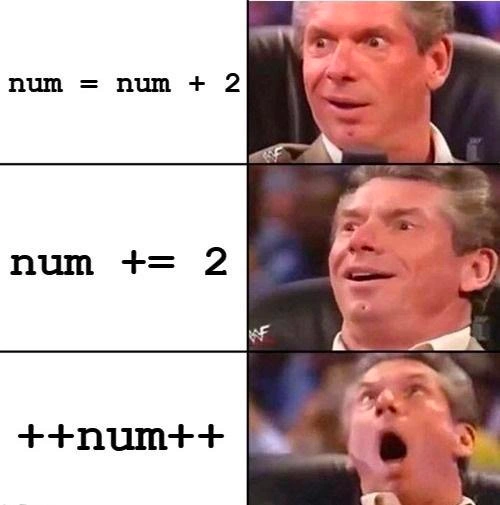
Let’s break down what’s happening in this meme step by step. The code on the left is written in a C-style syntax (think of languages like C, C++, Java, or C#). It shows three versions of adding 2 to a number stored in a variable called num. In the first panel, num = num + 2 does exactly what it reads as: take the current value of num, add 2, and store the result back into num. This is the longhand, very clear formula. We’re literally reassigning num to be its old value plus 2. No tricks – any newbie programmer can follow that. The reaction on the right is pretty mild, reflecting that this gets the job done but isn’t anything spicy.
In the second panel, we see num += 2. This is an example of a compound assignment operator. The += operator is what we call syntax sugar – a convenient shortcut provided by the language. num += 2 means “increase num by 2,” and under the hood it accomplishes the same result as the first line. It's just less typing and arguably cleaner. Many languages have these shorthand operators for arithmetic: -= to subtract, *= to multiply, /= to divide, and so on. When the meme shows the man on the right (WWE’s Vince McMahon) looking noticeably more excited at num += 2, it’s poking fun at how developers often feel a little thrill when using a tighter, more elegant syntax. We’ve basically said the same thing with fewer characters, and that efficiency can be oddly satisfying. In terms of code readability, num += 2 is generally considered perfectly fine – most programmers know this idiom by heart. In fact, if you wrote num = num + 2 in a codebase where += is the norm, a reviewer might jokingly ask if you’re feeling verbose that day. 😄 It’s a common, accepted shorthand, and it doesn’t confuse anyone. So, up to this point, the meme is showing valid, normal code and the increasing approval of using a shorter form.
Now, the third panel is where things go off the rails. ++num++ is shown as the ultimate, ecstatic step – but if you try to compile or run this in real life, you’ll hit a wall. Why? This snippet is not valid syntax in practically any mainstream programming language. It looks like someone tried to combine a prefix increment (++num) with a postfix increment (num++) all in one go. Let’s clarify those terms:
- Increment operator (
++): In languages like C and Java,++increases an integer variable’s value by 1. It can be used in two ways. Prefix increment means you write it before the variable (e.g.,++num), and this will increment the value first, then result in the new value. Postfix increment means you write it after the variable (num++), which will result in the original value ofnum, and then increment the variable as a side effect. For example, ifnumis 5, thenx = ++num;will setxto 6 andnumbecomes 6. Butx = num++;will setxto 5 whilenumstill becomes 6 afterward. This nuance is important in complex expressions, but the key point is you normally choose one or the other at a time. - In
++num++, someone has absurdly tried to do both at once on the same variable. If we attempt to read it left to right, it’s like “incrementnum(prefix) ... then incrementnum(postfix)?”. The compiler or interpreter just throws up its hands 🤷 and says “Nope, I don’t know how to parse that.” Technically, most languages will stop at++numand then be utterly confused by the extra++hanging at the end. You might get an error like “lvalue required as increment operand” or a syntax error. It’s a bit like writing a sentence that says “I I apple” – it just doesn’t conform to the grammar rules.
The humor is that no sane programmer would actually write ++num++. The meme exaggerates to make a point: being overly obsessed with shortening code can lead to illegible or outright invalid code. In real coding life, there are cases of confusing overuse of ++. For instance, something like *ptr++ = *q++ in C has a very specific meaning (it increments pointers at the same time as assignment), but to newcomers it looks like gibberish line noise. Another example: mixing multiple increments in one expression (e.g., num = num++ + ++num) is a famous recipe for undefined behavior in C/C++ – it might compile, but the program’s behavior can become unpredictable. Because of such pitfalls, most coding standards and linters will flag crazy combined operations as errors or at least bad practice. The meme’s final panel basically takes this idea to the extreme with a nonsensical ++num++.
So, to recap the progression in a more concrete way, imagine this pseudo-code running:
int num = 40;
num = num + 2; // num becomes 42 (simple addition)
num += 2; // num becomes 44 (compound assignment does the same thing)
++num; // num becomes 45 (prefix increment by 1)
num++; // num becomes 46 (postfix increment by 1)
// ++num++ --> ERROR: This line doesn't compile, it's not valid C/Java syntax
Each valid step updates num as expected. By the time we try ++num++, the compiler would complain (imagine a red error underline here 🛑). The meme’s joke is encapsulated in that final, forbidden expression. It’s labeled as if it were code, but really it’s more like a funny graffiti that looks code-like but breaks the rules. It parodies the mindset of someone who always asks, “Can I make this even shorter? Even more succinct?” Sometimes those attempts lead to ingenious new tricks... and sometimes, as here, they lead to pure gibberish.
The right side of the meme uses the famous Vince McMahon reaction images. Vince McMahon (the CEO of WWE wrestling) is shown in still frames looking increasingly excited and eventually completely blown away. Internet culture often uses these images to humorously represent escalating enthusiasm. In this context, the ordinary num = num + 2 gets a neutral look, the tighter num += 2 gets an intrigued smile, and the absurd ++num++ sends him into over-the-top euphoria. It’s a perfect illustration of the caption “Developers escalate excitement with ever shorter variable increment syntax options.” In other words, the more you compress the code (even beyond what’s reasonable), the more thrilled the depicted developer supposedly becomes. This taps into a common vein of coding humor: jokes about language quirks and syntax abuse. We laugh because there’s some truth to it – many of us have felt that nerdy excitement when discovering a cool new operator or trick. But we also laugh because the final state is ridiculous; it’s a gentle roast of that over-excitement. The meme hence sits at the intersection of SyntaxHumor and CodeReadability commentary. It educates (in a humorous way) that just because something could be written shorter doesn’t always mean the language or your fellow coders will appreciate it!
Level 3: Syntax Sugar High
At the senior level, this meme hits on a classic language quirk: our love for syntactic sugar and the adrenaline rush of ultra-concise code. The left panels show three ways to increment a number, each more compact than the last. Seasoned developers recognize how each step trades a bit of clarity for brevity. The first form, num = num + 2, is explicit and clear – no surprises. The second, num += 2, is the beloved compound assignment operator, a shorthand many languages offer to add and assign in one go. It's functionally identical to the first, just less to type (and one fewer chance to mistype the variable name 😅). By the third panel, we see ++num++, which cranks the brevity dial past 11 into the realm of illegality. This line is intentionally invalid code in C, Java, and most C-style languages – a fact that makes the joke outrageously clear to experienced eyes. It's as if the developer was so high on cutting syntax characters that they overdosed on plus signs. The humor lands because we've all met that coder chasing a "clever" one-liner, pushing language rules to the breaking point. They get that sugar high from reducing 5 characters to 2, even when it means confusing everyone else or, in this case, writing nonsense that won’t compile.
On a deeper level, this meme playfully mocks the code golf mentality – those times in our career we tried to make code as short as possible just for the thrill of it. Perhaps you recall an overeager colleague (or your past self) who couldn’t resist doing multiple operations in a single expression, because hey, fewer lines means more wizardry, right? There's an industry-wide in-joke here: software languages add features like += or ++ to make common operations succinct, but some devs treat these features like a challenge to create the densest code imaginable. The result? Code that's harder to read, harder to maintain, and sometimes, like ++num++, not even valid. Seasoned developers have been bitten by this. For example, writing i+++++j in C++ looks like some next-level trick, but it's actually parsed in a completely unexpected way (as i++ ++ + j, which is nonsense). Many of us have spent late-night debugging sessions untangling such syntax abuse in production code, muttering "just because you can shorten it, doesn’t mean you should." This meme packs that sentiment into a visual gag: each shorter syntax brings more giddy excitement, until we leap off the logic cliff entirely.
The Vince McMahon reaction images on the right perfectly amplify the joke for those in the know. McMahon’s progressively ecstatic expressions mirror a dev’s escalating thrill: “Standard addition? Neat.” (calm face) “Compound assignment? Oh, that’s nice!” (pleased grin) “Double-plus madness? TAKE MY MONEY!” (eyes bulging in euphoric awe). It’s a tongue-in-cheek critique of how we sometimes fetishize language quirks and terse idioms. In real-world teams, senior engineers often preach readability and maintainability. Yet even they can’t deny the guilty pleasure of a well-placed ++ or a slick one-liner. This meme exposes that internal conflict: the Languages aspect shows off the nifty operators our programming tools give us, while the CodeQuality angle reminds us that going overboard can lead to WTFs in code review. The final panel’s invalid ++num++ is the punchline that drives home the senior perspective: chasing ever shorter syntax for its own sake is a dead-end. If your code literally looks like line noise or breaks the compiler, you might have gone too far in the name of cleverness. In summary, experienced devs laugh at this meme because it’s a caricature of a truth we live with: we love elegant shortcuts, but we’ve learned (often the hard way) that readability > clever obfuscation. The meme gives us permission to chuckle at our own tendency to get a little too excited about those tasty syntax sugars.
Description
This image uses the three-panel Vince McMahon reaction meme to satirize different ways of writing code to increment a number by two. Each panel on the left shows a line of code, while the corresponding panel on the right shows Vince McMahon's increasingly ecstatic reaction. The first panel shows the standard, verbose syntax: `num = num + 2`, met with a look of mild interest. The second panel displays the more concise compound assignment operator: `num += 2`, which earns a more excited and pleased reaction. The final panel, the punchline, presents the nonsensical and syntactically invalid code `++num++`, which is met with McMahon's ultimate, mind-blown expression. The humor lies in the progression towards what appears to be an even more compact and 'clever' syntax, which is in fact completely incorrect in most programming languages. The pre- and post-increment operators (`++`) are for incrementing by one and cannot be combined in this way. This meme pokes fun at the developer obsession with syntactic sugar and finding the most obscure way to write simple operations, to the point of absurdity
Comments
7Comment deleted
The difference between a Senior and a Principal Engineer: The Senior writes `num += 2`, while the Principal writes `++num++` in the commit message as a joke, but then has to spend an hour in the PR comments explaining to a junior why it doesn't actually work
If someone slips in a ‘++num++’, sure we save two characters - right up until production pays compound interest on the undefined-behavior debt
After 20 years in the industry, I've seen developers go from 'readable is better than clever' to 'let me chain 17 operators in one line' - but at least we all agree that ++num++ is where even the most aggressive code golfer admits defeat to the parser
The real joke here is that '++num++' is undefined behavior in C/C++ due to modifying the same variable twice between sequence points - a classic interview gotcha that separates those who've actually debugged compiler-specific nightmares from those who just memorize syntax. Senior engineers know this triggers the 'nasal demons' clause of the standard, where the compiler is literally allowed to do anything, including launching missiles or formatting your drive. It's the programming equivalent of dividing by zero while standing on one leg during a full moon
“++num++” doesn’t add two; it upgrades your PR from a nit to a 40‑minute lecture on lvalues vs prvalues while the build fails
num = num + 2 is readable; num += 2 is idiomatic; ++num++ is a compile error bundled with a surprise lecture on lvalues and sequence points
++num++: the increment so ambitious, it crashes the parser before runtime